This article explains how the leading sleep tech uniquely regulates your sleeping temperature as your pregnancy progresses.
Pregnancy disrupts your sleep. Your basal body temperature rises by 0.3 to 0.5°C in the first trimester. Your blood volume increases by around 45% by late pregnancy. Your resting heart rate climbs 15 to 20 beats a minute. Your heart rate variability drops. Around a third of pregnant women get hot flashes.
The bed you slept well in before pregnancy was set up for a different body. Your temporary new body now runs hotter, harder, and more variably every night, for nine months.
Why pregnancy disrupts sleep, and why ordinary cooling fails
To fall into deep regenerative sleep, your core temperature must drop by about 1°C. Your body does that by releasing heat through your skin. Pregnancy works against the drop on every count: more heat, more blood to circulate, less efficient cooling. About 78% of pregnant women say their sleep is disturbed.
The usual fixes do not work. Air conditioning cools the room evenly, so it cools your partner, too. Fans dry the air and add noise. Cooling sheets work for ten minutes, then warm up. Opening a window does nothing about the heat coming off your skin. Heat leaves your body through the surface in contact with it, and that surface is your bed.
How Eight Sleep’s Pregnancy Mode works
The Pod is a cover that fits over your existing mattress. Water flows through it at a temperature you set, or one the system sets for you. Each side of the bed runs independently. Built-in sensors read your heart rate, heart rate variability, breathing rate, and movement. No wristband, no chest strap, nothing worn on the body.
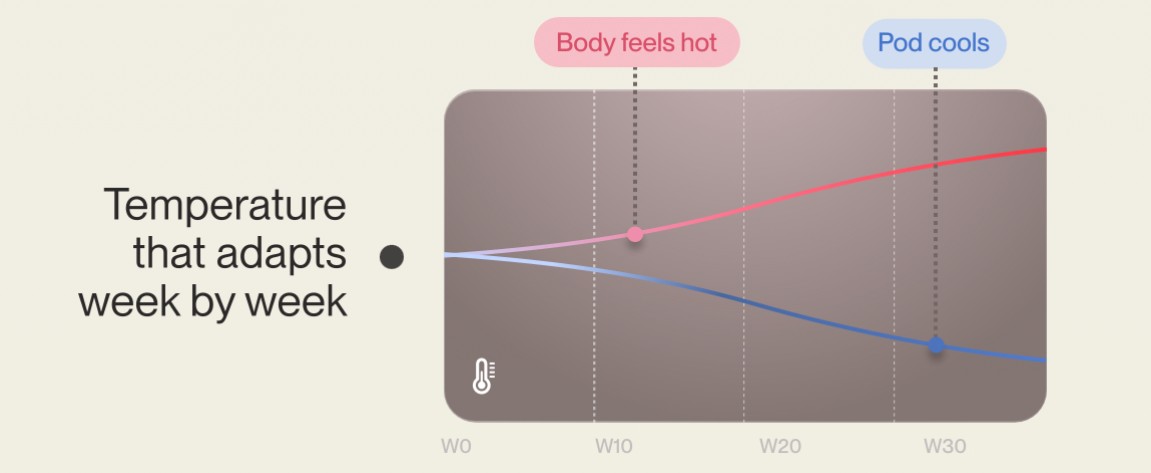
Pregnancy Mode adapts to a changing you in three ways.
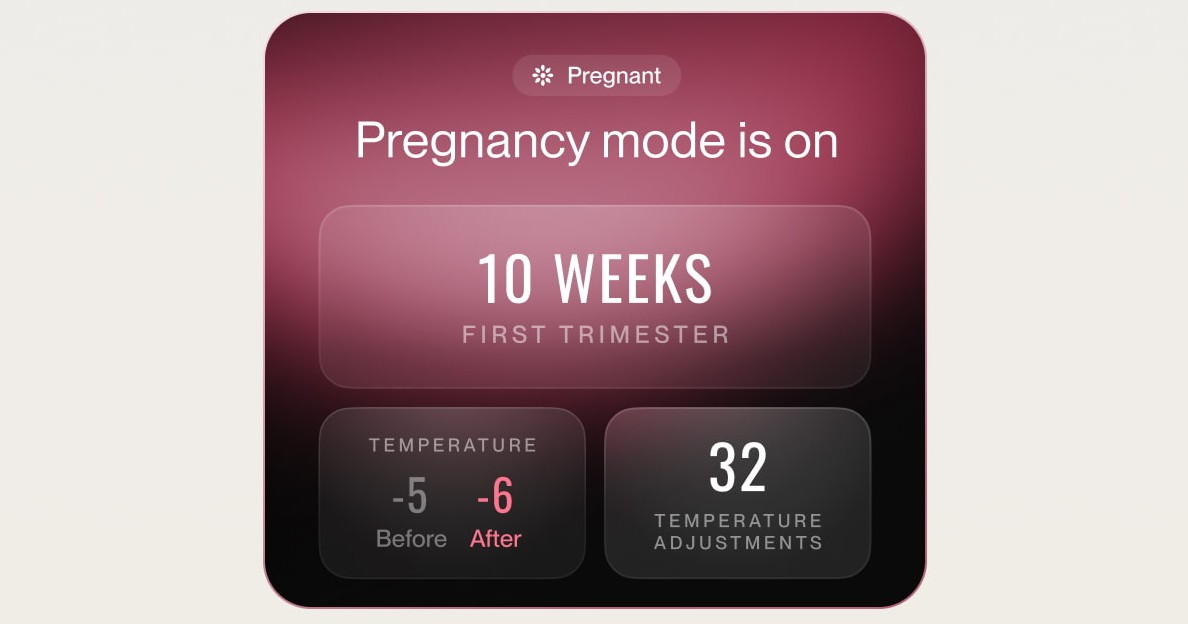
- You enter your due date in the app. The Pod knows which week of pregnancy you are in and adjusts cooling according to a schedule that runs from the first trimester through 24 weeks after birth.
- It cools ahead of the change, not after it. Standard Autopilot reacts to your sleep data. Pregnancy Mode runs a schedule built from 45,000 nights of pregnancy sleep data, and pre-empts the rise in body temperature the next week will bring.
- It reads your numbers in the context of pregnancy. A drop in HRV at week 28 is not the same as a drop at week 8. The app shows you what is normal for your stage and how you compare to your own pre-pregnancy baseline.
Designed to address menopausal temperature changes or the effects of excessive exercise, Hot Flash (hot flush) mode also works in pregnancy mode when needed. Eight Sleep’s own data show that pregnant women set the Pod to around 3°F cooler than baseline by the third trimester, returning to baseline around 8 weeks after birth.
Better sleep, with knock-on effects
Better sleep during pregnancy is associated, in peer-reviewed research, with five things that matter to mother and baby: lower risk of gestational diabetes, lower risk of preeclampsia and pregnancy hypertension, lower risk of perinatal depression and anxiety, shorter labour and fewer caesareans, and stronger postpartum recovery.
Eight Sleep is not a medical device and does not prevent any of these conditions. I cannot make assertions about improved temperature management and pregnancy outcomes. The Pod improves your sleep. Your sleep is linked to the outcomes above. The benefit comes through better sleep, not directly through the bed. The science is linked at the foot of this article for you to make up your own mind.
Pregnancy night sweats: what the Pod actually does
The Pod cools the surface in contact with your skin, which is where heat actually leaves the body. Hot Flash mode adds a stronger, faster cool when it detects an episode starting. You do not have to wake up or reach for the app. The cooling happens. The data shows up the next morning.
Different temperatures for you and your partner
Bedroom temperature is one of the quiet, repeating arguments of pregnancy. The Pod removes it.
Better daytime mood and energy
The research-linked outcomes from earlier in this article take months to matter. Mood and energy are felt in the first week.
More accurate biometric tracking than a wrist wearable
The Pod’s sensors are in the cover, under your body. They do not move. They do not need to be charged. They are not removed. For heart rate, heart rate variability, and breathing during sleep, a bed-based sensor is a stronger recording position than a watch on a moving wrist. The difference matters more during pregnancy, when those numbers are themselves shifting every week.
What you actually pay
Eight Sleep Pod 6 starts at £1,799 in the UK for the single-sleeper Solo, which can sit on your side of the bed alone, and at £2,399 for the two-sided Standard. Add £17 a month (or £199 a year) for the Eight Sleep Autopilot membership required to run Pregnancy Mode. Eight Sleep ships to the UK, runs a 30-night risk-free home trial with full refund, and offers finance through Klarna and DivideBuy in the UK and Affirm in the US. The full breakdown is in my Eight Sleep Pod 6 guide.
Realistically, this is a 5- to 10-year purchase, so spread across the product’s working life, the running cost falls comfortably under £50 a month for active temperature management every night, plus postpartum and recovery use afterwards. The Pod does not stop working when the baby is born.
Cheaper bed-cooling systems exist, such as the Chilipad and BedJet, that require no subscription. They do not track sleep, run an automated schedule, or have a pregnancy layer and are significantly inferior products. The Pod sits at the top of the category for adaptive automation and biometric data, and is priced accordingly. It’s really a one-of-a-kind product.
Should you buy it?
This is the right product if you want active temperature control through pregnancy and beyond, you sleep next to a partner with different temperature preferences, and you’re willing to spend.
Eight Sleep is widely used at the elite end of professional sport. Mercedes-AMG Petronas F1 use it across the team. EF Pro Cycling’s head doctor uses it with his riders. It is also my own favourite sleep tool, with three years of personal use behind me.
The link below applies the largest available discount to your order and supports the independent work on this site. The 30-night home trial lets you try the Pod and Pregnancy Mode in your own bed, and return it for a full refund if it does not deliver.
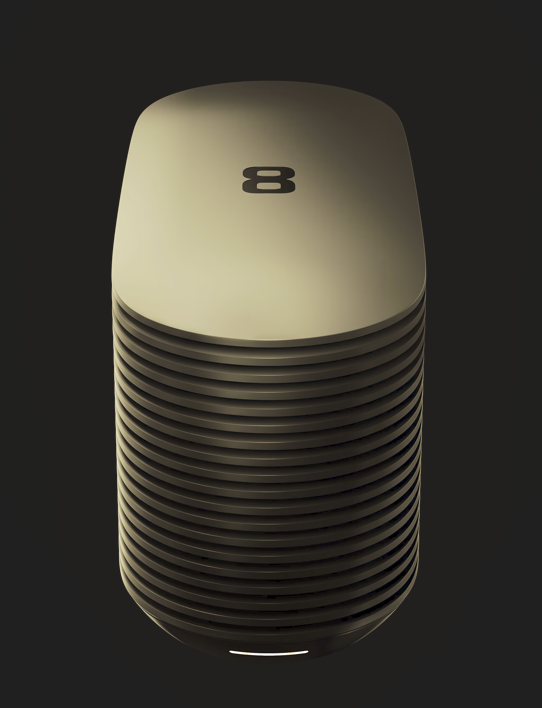
Eight Sleep Pod 6
Excellent. Expensive. Accurate. Quiet.
Quick answers
Is Eight Sleep safe to use during pregnancy?
Yes. The Pod cools the sleeping surface by circulating water through a cover. There is no contact with your body beyond the cover’s temperature. Eight Sleep built Pregnancy Mode specifically for pregnancy and the early months after birth. If you have specific medical concerns, raise them with your obstetrician.
When should I start using Pregnancy Mode?
First trimester. The mode is designed to run continuously from week one through 24 weeks after birth. You can activate it later, and it will calibrate from your current week. Starting earlier gives a cleaner baseline.
Does Pregnancy Mode work after the baby is born?
Yes, for 24 weeks. It manages the hormonal night sweats common in the first two to three months after birth, which matters especially if you are breastfeeding. After that, the Pod returns to standard Autopilot.
How is Pregnancy Mode different from the standard Pod?
Standard Autopilot learns from your own sleep data. Pregnancy Mode runs a schedule anchored to your week of pregnancy, built from 45,000 nights of pregnancy sleep data. It cools ahead of the changes, not after them, and reads your numbers in the context of pregnancy.
What does the research say about sleep and pregnancy outcomes?
The associations are drawn from peer-reviewed research. Short sleep is linked to higher risk of gestational diabetes (Reutrakul et al., 2018), preeclampsia (Pamidi et al., 2014), perinatal depression (Fu et al., 2023), and longer labour with higher caesarean rates (Lee and Gay, 2004). These are associations between sleep quality and pregnancy outcomes. The Pod improves sleep quality. It is not a clinical intervention and does not prevent any of these conditions.
The associations cited in this article are drawn from peer-reviewed research:
- Gestational diabetes and short sleep: Reutrakul et al., 2018, Sleep Medicine Reviews (PMID 29198616), pooled OR 1.70 for sleep under seven hours.
- Preeclampsia and sleep-disordered breathing: Pamidi et al., 2014, American Journal of Obstetrics and Gynecology (PMID 24360515), pooled aOR 2.34.
- Perinatal depression and antenatal sleep: Fu et al., 2023, Journal of Affective Disorders (PMID 36963366), OR around 3.46.
- Labour duration and caesarean rate: Lee and Gay, 2004, American Journal of Obstetrics and Gynecology (PMID 15592289), 4.5-fold caesarean risk for sleep under 6 hours in late pregnancy.
- Pregnancy physiology, including the 45% blood volume increase and basal temperature rise: Soma-Pillay et al., 2016, Cardiovascular Journal of Africa (PMID 27354921).
- HRV and resting heart rate across gestation: Sarhaddi et al., 2022, Sensors (PMID 35759282).
- Hot flash prevalence: Thurston et al., 2013, Fertility and Sterility (PMID 24035604).
- Sleep disturbance prevalence: Mindell et al., 2015, Sleep Medicine (PMID 25666847).
These are associations between sleep quality and pregnancy outcomes. The Pod improves sleep quality. It is not a clinical intervention and does not prevent any of these conditions.
Eight Sleep Pod 6
Excellent. Expensive. Accurate. Quiet.
Last Updated on 3 October 2026 by tfk the5krunner
Small things I always use
- Garmin 90-degree charging adapter: Charges your Garmin from any USB-C cable. Essential when travelling. I use one.
- Body Glide: The blue anti-chafe stick swimmers and runners carry. I use it.
- Speedo earplugs: Fewer ear infections and no cold-water dizziness. I use them.
- Dryrobe Advance: My winter changing robe for open-water swims. I use one. A cheaper option is the AONYIYI changing robe.
- Maurten: Race fuel that stays easy on the stomach. I use them.
- Garmin charging puck: The quickest way to top up before a session. I use one.
- Injinji: Toe socks that stop rubbing, so you run more. I use them.
- Ultimate toe protectors: Stop black toenails on long runs. They work. I use them.
- Compressport R2 v2 calf sleeves: My calf sleeves of choice. I use them.
- Cellucor C4: My pre-workout before hard sessions.
- TPU tubes: Schwalbe Aerothan, Tubolito and Pirelli SmarTube. Light, tiny spares. I use all three.
- G8 insoles: Adjustable insoles that are good. I use them.
- Cycplus Cube: A 97g electric pump that gets a road tyre rideable in two minutes. I carry one. 5% off with code THE5KRUNNER.
Watches and sensors
- Polar H10: My daily driver for waking HRV.
- Polar Verity Sense: My backup arm-worn HR sensor.
- Nomad bedside charger: Charges my iPhone and Apple Watch overnight. I use it, and many of their bands.
- Train.Red: The best muscle oxygen sensor I’ve used.
- Tymewear: Accurate heart rate and reliable ventilatory zones. I use it to pace endurance rides over an hour.
- Garmin Forerunner 970: A pro-grade triathlon watch. I use this.
- Apple Watch Ultra 4: My daily smartwatch. No phone needed on rides.
- Garmin Fenix 9 Pro: I’ve just bought one.
On the bike
- Continental GP5000 for everyday riding, and Aero 111 on the front for special occasions.
- Helmets: Specialized S-Works Evade 3 for road riding, and Rudy Project Wing for TT-style races. I use both.
- Ravemen FR300: A front light that mounts under your Garmin or Wahoo. I use one.
- Wahoo TRACKR Radar: I use it on one bike and Varia on the other. They perform the same.
- Garmin Varia RTL515: Radar that warns you of cars from behind. I use this model.
- Wahoo ELEMNT Roam 3: The bike computer that’s easy to use. I use mine on most rides.
- Favero Assioma Pro RS2: Accurate power pedals that swap easily between bikes. I use this model.
Home and indoor training
- NPE Runn: Makes my basic treadmill smart, sending more accurate speed and distance to my watch and Zwift. I use it.
- Google Wifi: Keeps Zwift connected in my pain cave. I use it.
- Apple TV 4K: Zwift on the big screen. I use two.
- Google Nest Doorbell (wired, 2nd gen): My video doorbell, running in both Google Home and Apple Home. I use it.
Health, recovery and sleep
- FreeStyle Libre 3 Plus: Shows how my blood sugar responds to diet.
- hDrop: Measures my sweat loss in summer and indoors.
- Fourth Frontier Zone: Checks my heart under load in hard sessions.
- Oura Ring 5: My partner’s recovery tracker of choice.
- Kineon MOVE+: Red light therapy for niggles. It works.
- Eight Sleep: A cooling mattress cover my partner and I use nightly.
Reader-Powered Content
This content is not sponsored. It’s mostly me behind the labour of love, which is this site, and I appreciate everyone who supports it.
Support the site: Follow (free, fewer ads) · Subscribe (paid, ad-free) · Buy Me A Coffee ❤️
Written by real people, with AI assistance. Fact-checked and verified for originality. See the Editorial Policy. FTC: Affiliate Disclosure — some links pay commission. As an Amazon Associate, I earn from qualifying purchases.
tfk is the founder and author of the5krunner, an independent endurance sports technology publication. With 20 years of hands-on testing of GPS watches and wearables, and competing in triathlons at an international age-group level, tfk provides in-depth expert analysis of fitness technology for serious athletes and endurance sport competitors. ID
