Anti-doping in virtual cycling: where MyWhoosh, Zwift and the UCI stand
MyWhoosh announced this week that it will introduce biological anti-doping testing across its prize-money racing, with the first round scheduled for the Sunday Race Club on 17 May 2026. The platform has appointed International Doping Tests and Management, a provider that has run WADA-aligned testing since 1991, to collect urine, venous blood, and dried blood spot samples from riders at their declared locations within 3 hours of an event.
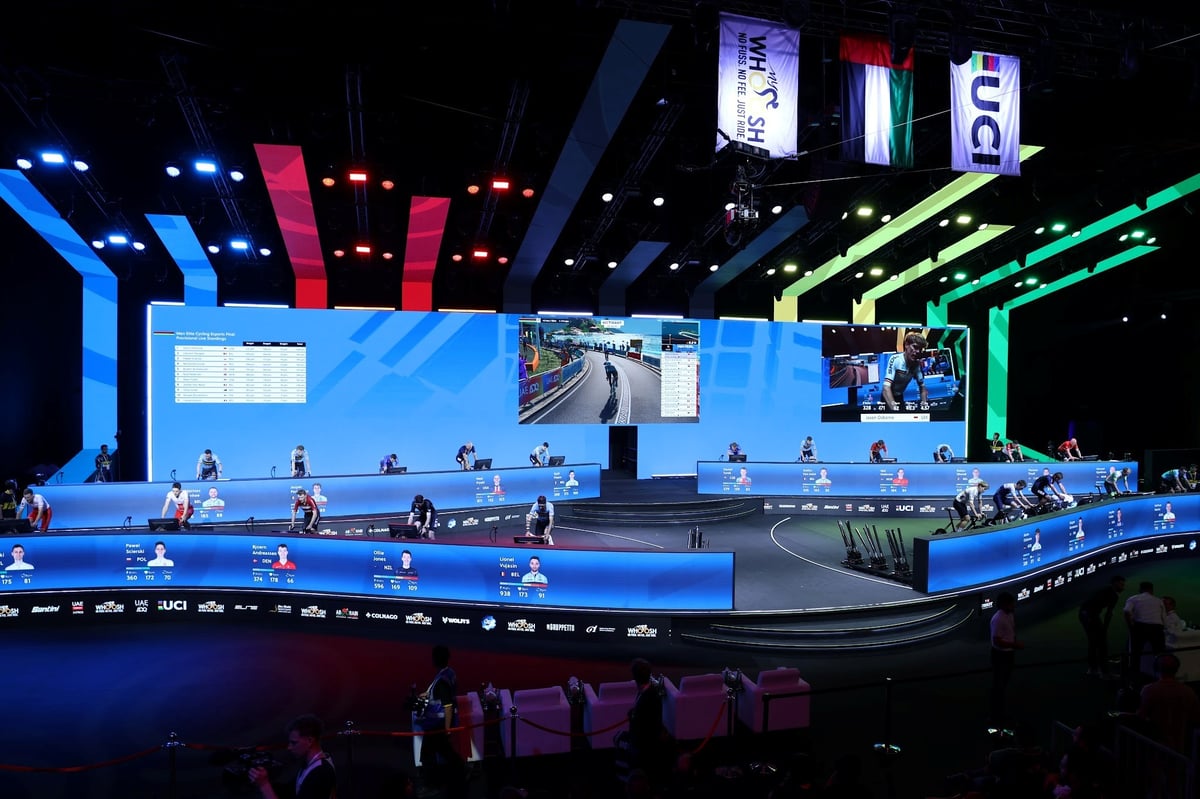
The press release describes the initiative as the world’s first anti-doping programme for e-racing. That is not strictly accurate. The UCI Cycling Esports World Championships have operated under full WADA Code testing administered by the International Testing Agency since the 2022 edition, with qualifying riders placed into registered testing pools and subject to whereabouts requirements. The novelty is therefore not biological testing in cycling esports, which already exists, but its extension beyond a single annual sanctioned event into a platform’s own ongoing weekly competitions. MyWhoosh will run the programme under a private contractual framework that references the WADA Prohibited List rather than enforce the WADA Code directly.
Zwift sits at the other end of the spectrum. Its ZADA function, originally branded the Zwift Anti-Doping Agency and now Zwift Accuracy and Data Analysis, was renamed and refocused in 2019 on performance and data verification. Zwift’s stated position is that a full anti-doping programme is not appropriate for a platform whose users are mostly recreational, and that biological testing belongs at the UCI Worlds level via the ITA. The MyWhoosh announcement widens the gap between the two largest virtual cycling platforms on this question.
Mechanical integrity is a wholly separate problem and an instructive contrast. In road cycling, mechanical doping means a hidden motor. The UCI uses magnetic tablets pre-stage, backscatter and X-ray post-stage, and RFID-tagged bikes during stages. The 2023 Tour de France produced 997 checks and zero positives. The 2024 edition added a new non-intrusive inspection tool. The only confirmed case at the elite level remains Femke Van den Driessche at the 2016 cyclocross World Championships. In esports, the question is turned around. Every competitor must produce the same effort for the same reward. Hence, the integrity issue is not what is concealed in a frame but whether the smart trainer, the power data and the rider’s declared weight are honest.
Both platforms address that through approved hardware lists, dual recording from a second power source, weight and height verification and post-race file analysis. The 2024 UCI Cycling Esports World Championship final, hosted on MyWhoosh, used 30 standardised Elite Justo 2 trainers, calibrated to a 1% power accuracy specification, bearing the Approved by UCI label. Day-to-day, ZADA performs the verification function for Zwift’s marquee events. MyWhoosh runs equivalent checks under its own performance verification system. The biological layer announced this week adds to those existing controls.
The substance use question is worth a note as well. A typical Sunday Race Club event lasts under an hour, which makes stimulants, caffeine, pseudoephedrine and short-cycle EPO the relevant concerns rather than long-cycle blood manipulation. Whether testing of podium finishers and intelligence-led targets, with a three-hour window at a declared location, deters cheating for a four-figure prize purse is an open question. So is reciprocity. A positive result on MyWhoosh under a private contractual framework does not automatically transfer to a UCI or national federation sanction. A rider banned from the platform could continue to race elsewhere unless other bodies accept the finding.
Testing begins on 17 May 2026. The first useful indicator will be how many riders are tested in the opening month and whether MyWhoosh publishes sanctions or details. Until then, the announcement marks a clear shift: a private platform, not a federation, taking on the cost and reputational risk of biological testing.
Does virtual cycling have anti-doping testing?
Yes, but only at the federation level until now. The UCI Cycling Esports World Championships have been tested by the International Testing Agency since 2022. MyWhoosh’s announcement extends biological testing to private platform racing for the first time, beginning with the Sunday Race Club on 17 May 2026.
How does Zwift’s approach to doping differ from MyWhoosh’s?
Zwift focuses on data and equipment verification through ZADA, which stands for Zwift Accuracy and Data Analysis. It treats biological testing as a federation responsibility for marquee events such as the UCI Worlds. MyWhoosh is now adding biological testing on top of equivalent equipment checks for its own weekly racing.
Is mechanical doping a problem in virtual cycling?
The risk takes a different form. In road cycling, mechanical doping refers to a concealed motor, and the UCI checks for it using magnetic tablets, backscatter, and X-ray. In virtual cycling, every rider must produce identical effort for identical reward, so the equivalent risk is misreporting by a smart trainer or false rider weight. Both MyWhoosh and Zwift address this through hardware homologation, dual recording and post-race file analysis.
Last Updated on 7 May 2026 by the5krunner
My favourite kit and nutrition
- Garmin Fenix 9 Pro — I’ve just bought one.
- Injinji – Runners protect your toes. Avoid discomfort and minor injury. Run more. Run faster. I use them.
- Garmin 90-degree charging adapter — A small keyring adapter you can use anywhere. Essential when away. I use one.
- Garmin charging puck — the fastest and most reliable way to top up your Garmin before a session. I use one.
- Ravemen FR300 — Front light that mounts directly under your Garmin or Wahoo head unit. Keeps your bars clean and your beam pointed where it matters. I use one.
- Body Glide – The blue anti-chafe stick that all swimmers and many runners use. I use it.
- Maurten — The race nutrition trusted by elite athletes. Gels and drink mixes engineered to be easy on the stomach. I use them.
- Garmin Varia RTL515 — A radar rear light that alerts you to vehicles approaching from behind. Pairs with your Edge or Wahoo. I use this model.
- Favero Assioma Pro RS2 — The power-meter pedals most serious cyclists choose. Accurate, easy to move between bikes. I use this model.
- Garmin Forerunner 970 — A serious choice for a pro-grade triathlon watch. I use this.
- Polar H10 — My daily driver for accurate, waking HRV readings.
- Wahoo ELEMNT Roam 3 — The bike computer that has the feature Garmin lacks: usability. I use mine on most rides.
Reader-Powered Content

This content is not sponsored. It’s mostly me behind the labour of love, which is this site, and I appreciate everyone who supports it.
Support the site: Follow (free, fewer ads) · Subscribe (paid, ad-free) · Buy Me A Coffee ❤️
All articles are written by real people, fact-checked, and verified for originality. See the Editorial Policy. FTC: Affiliate Disclosure — some links pay commission. As an Amazon Associate, I earn from qualifying purchases.
tfk is the founder and author of the5krunner, an independent endurance sports technology publication. With 20 years of hands-on testing of GPS watches and wearables, and competing in triathlons at an international age-group level, tfk provides in-depth expert analysis of fitness technology for serious athletes and endurance sport competitors. ID
