Good Coach App: A Coaching Platform Built Around the Coach
Most “training apps” in endurance sports are built around the self-coached athlete: log a run, see fitness trends, watch the curves move. The coach’s actual job — building plans for ten or twenty or fifty athletes at once, reusing structure across a roster, knowing who needs what this week, communicating without losing the thread — is a different problem. Coaches who try to do it in spreadsheets tend to hit a wall around ten to fifteen athletes. Coaches who use TrainingPeaks pay for analytical depth they don’t always need, in a tiered-and-fee structure that gets expensive as their roster grows. There is a middle ground, and Good Coach App is built for it.
It’s coaching software designed around the coach’s day, not the athlete’s dashboard.
How Coaches Use It
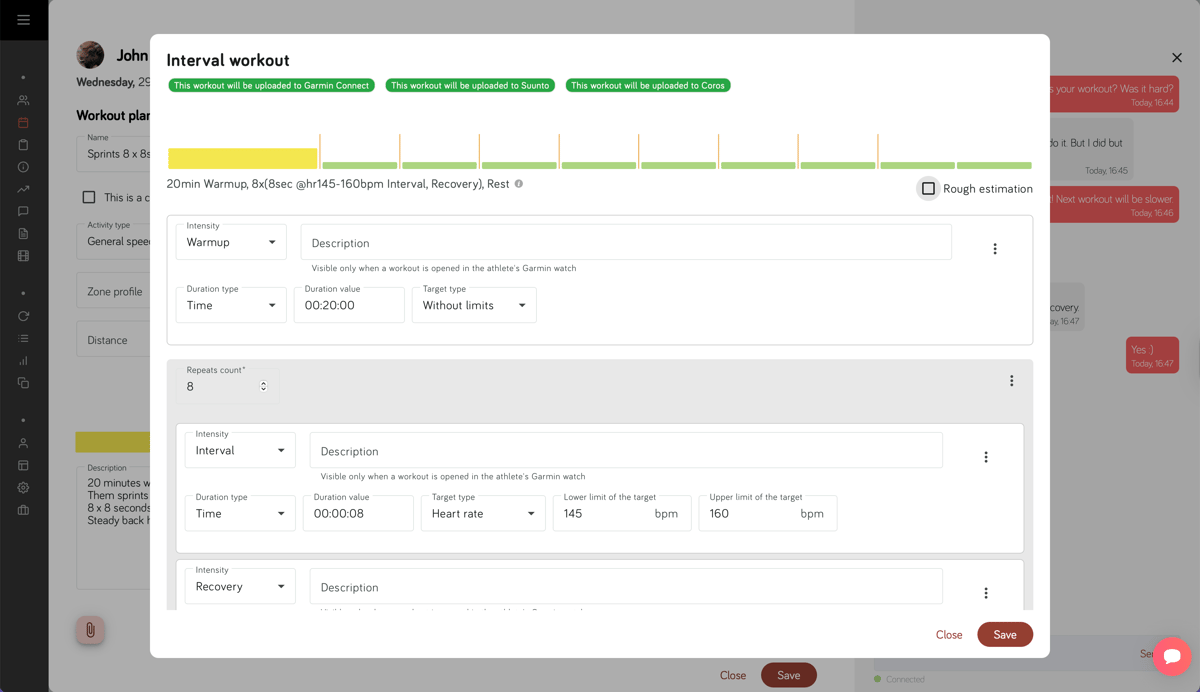
The first session for a coach in Good Coach usually involves adding a small group of athletes and building a few reusable workout blocks — a tempo session, a long run, intervals, and a recovery-week template. From there, the daily workflow runs through a multi-athlete calendar where the coach can see the whole roster’s week at a glance, copy workouts between athletes, and adjust individual sessions without rebuilding the plan from scratch.
The reusable block system is the core efficiency feature. Building plans for ten athletes no longer means writing ten plans — it means building a library once, then assembling and adjusting. Internal data show coaches comfortably running rosters of 50 or more athletes on the platform, compared to the 5 to 15 that most coaches report being capped at in spreadsheets.
What Athletes See
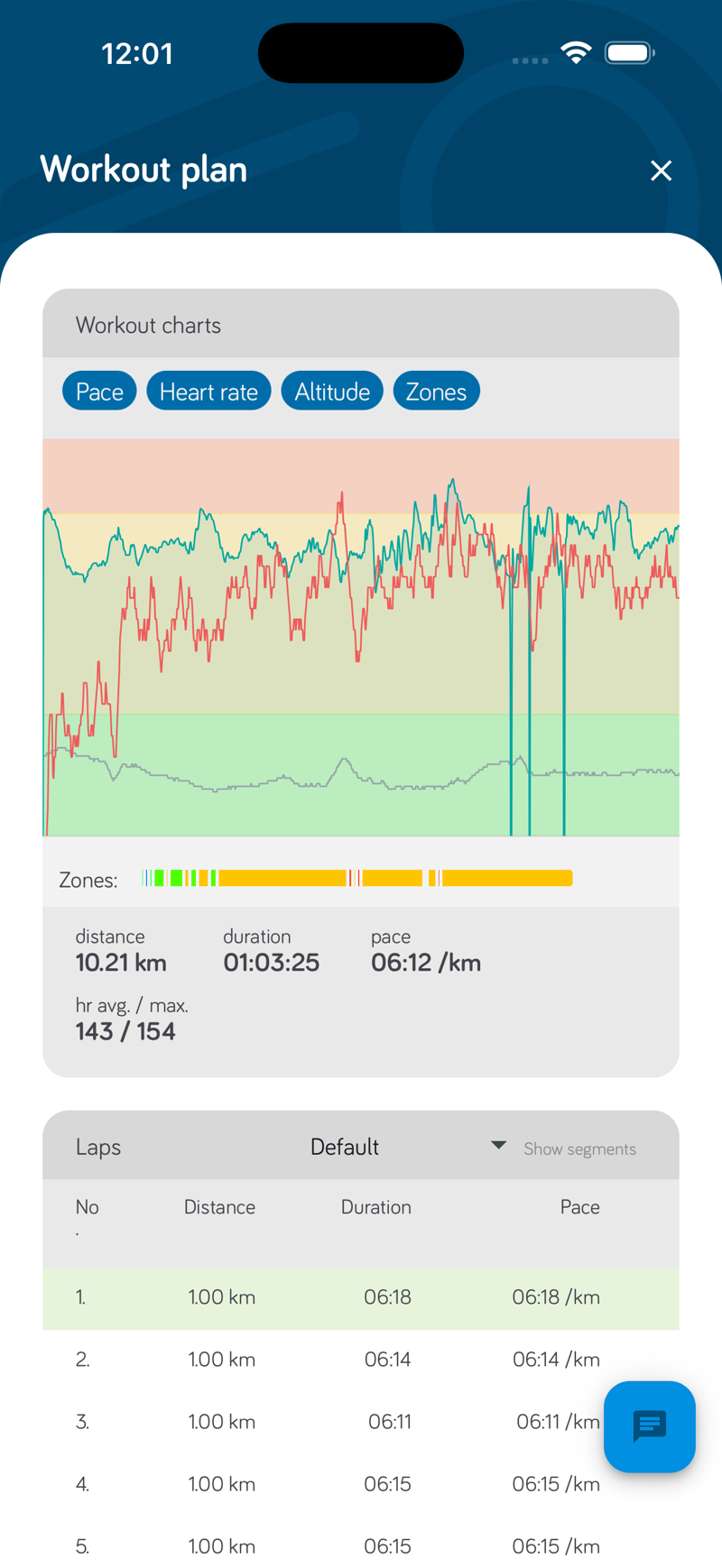
Athletes get a calendar of upcoming workout plans, structured interval sessions they can push to their watch, and a chat thread back to their coach. There is no separate athlete subscription — athletes use the platform free, with the cost falling entirely on the coach side.
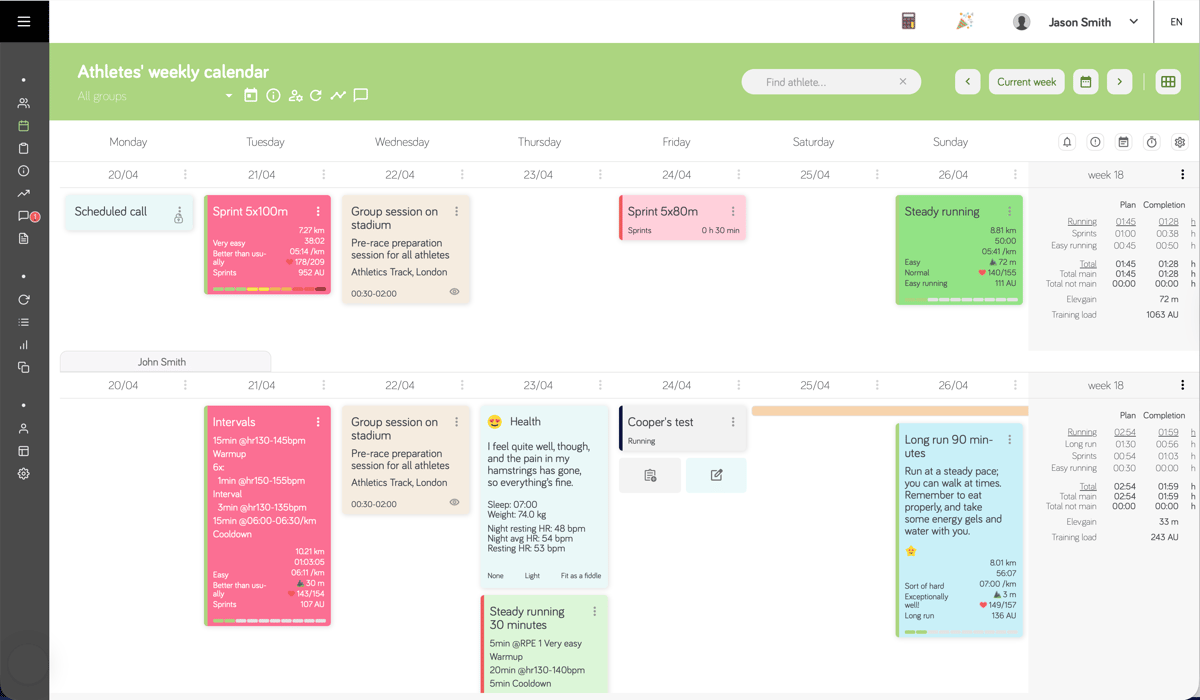
Watch integration covers the major endurance platforms. Structured workouts export to Garmin, COROS, Suunto, Apple Watch, Rouvy and Wahoo. There is also an import of activities from Polar and Strava as a bridge for unsupported watches (like Amazfit). Completed activities sync back automatically. Apple Watch support specifically includes structured intervals, which most coaching platforms offer in a very simple way.
Plans, Templates, and Multi-Coach Clubs
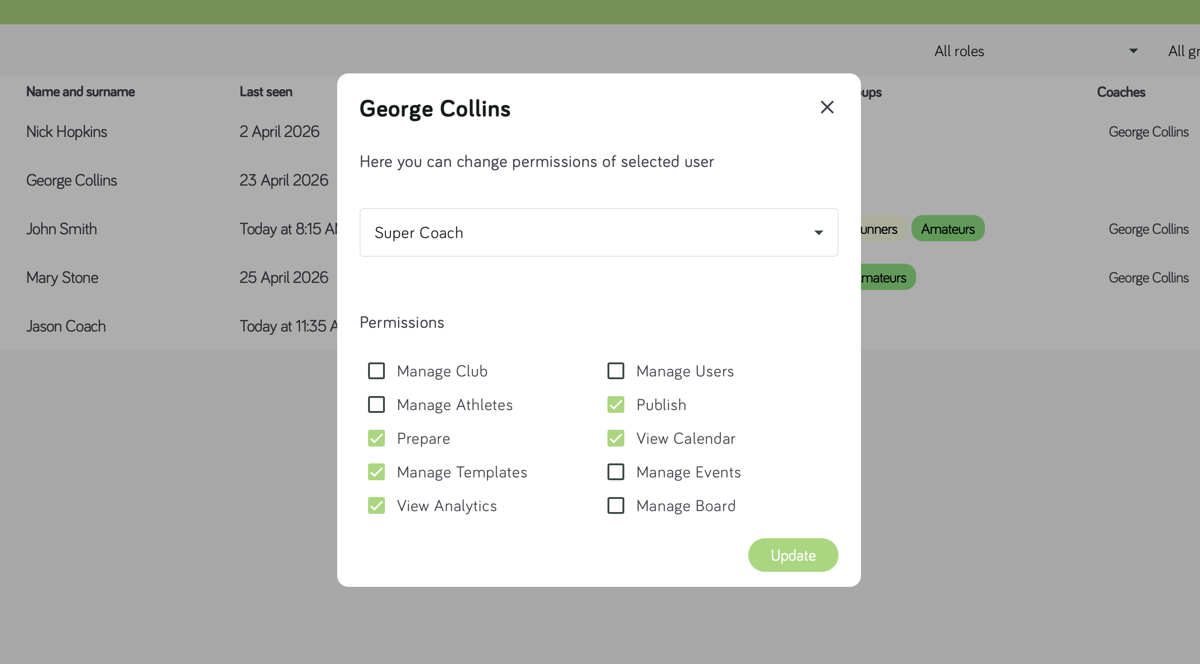
Beyond individual workouts, Good Coach App handles longer-cycle planning: multi-week training blocks, periodisation, and race tapers. Templates can be shared between coaches in club setups — useful for running clubs, triathlon teams, and academies where multiple coaches work with overlapping athletes. Permissions are granular: a head coach can build the framework, an assistant coach can deliver sessions to a specific group, and an athlete sees only what’s relevant to them.
The Club plan is the structural answer for teams and academies: multiple coaches under one billing account, a shared athlete pool, a shared template library, and separate roster views per coach.
Languages and Geography
Good Coach App is available in six languages — English, Polish, Spanish, Portuguese, Italian, and Czech (German and French are planned) — and supports paying coaches in more than twenty countries. This matters more than it first sounds. Most established coaching platforms (TrainingPeaks, Final Surge, Training Tilt) are English-only, which makes them awkward to deploy with non-English-speaking athletes or in coaching businesses serving Latin America, Southern Europe, or Eastern Europe.
Pricing
The coach pays. Athletes are free.
- Free for up to 2 athletes, no time limit
- €3 per athlete per month for 3–15 athletes
- €1.50 per athlete per month for 16–29 athletes
- No additional per-athlete charge between 30 and 99 athletes — the single coach plan is capped at €60/month for up to 100 athletes
- €1 per athlete per month for 100 or more athletes
- Single coach plan capped at €60/month for up to 100 athletes
- Club plan simple pricing from €2.5 to €1/month per athlete, without an additional fee depending on the number of coaches
Support
Support sits closer to the product than is typical for software at this scale. Coaches who write in talk to people who have actually coached athletes and run coaching practices — not first-line script-readers. Questions that span the line between “how does this feature work” and “how should I structure my training week” both get real answers, and feature requests reach the people building the platform directly. A meaningful share of what coaches ask for ends up shipped within weeks rather than disappearing into a roadmap.
For coaches running small businesses without an operations layer, this matters more than it might sound at first. The relationship doubles as a sounding board for the work itself — pricing decisions, how to onboard a difficult athlete, and when to push back on a client who isn’t doing the sessions. Not every conversation goes that deep; most are still “I can’t see this button.” But the option is there when it’s needed.
What It Doesn’t Do
Worth being explicit about scope:
- Not originally designed for athletes training independently. Intervals.icu and Strava are better suited to the needs of athletes who record and analyse their own training sessions. Although the app assumes a coach is involved in the process, individual athletes can also create their own training plans and access most of the available features.
- Less analytical depth than TrainingPeaks. TSS, CTL, ATL, and TSB-style frameworks are not surfaced in the same first-class way. Coaches who plan around those metrics will still need to supplement.
- No training plan marketplace. There is no built-in storefront for selling plans to consumers. Coaches sell directly or through external platforms.
- No built-in payment processing. Coaches who want client billing inside the platform should look at Training Tilt or Final Surge.
Background
Good Coach App was built in 2018 by a practising endurance coach who hit the spreadsheet wall around fifteen athletes — the point where Excel stops being a tool and starts being a second job. The alternatives at the time were either too expensive or too complex for what most coaches actually need day-to-day. Eight years and roughly 2.25 million workouts later, the platform serves coaches across more than twenty countries on a bootstrapped, no-investor model.
Summary
For an endurance coach who has outgrown spreadsheets but doesn’t need (or doesn’t want to pay for) the full TrainingPeaks ecosystem, Good Coach App fills that exact gap. The free tier covers two athletes indefinitely, which makes it cheap to test against an existing workflow before committing. Above that, pricing scales down per athlete as the roster grows, then flattens between 30 and 100 athletes — the inverse of the per-athlete fee structure used by most competing platforms.
Free for up to 2 athletes · From €1 to €3 per athlete per month · 6 languages
More: goodcoach.app
Author: MarcinS, edited by the5krunner
Last Updated on 7 May 2026 by the5krunner
My favourite kit and nutrition
- Garmin Fenix 9 Pro — I’ve just bought one.
- Injinji – Runners protect your toes. Avoid discomfort and minor injury. Run more. Run faster. I use them.
- Garmin 90-degree charging adapter — A small keyring adapter you can use anywhere. Essential when away. I use one.
- Garmin charging puck — the fastest and most reliable way to top up your Garmin before a session. I use one.
- Ravemen FR300 — Front light that mounts directly under your Garmin or Wahoo head unit. Keeps your bars clean and your beam pointed where it matters. I use one.
- Body Glide – The blue anti-chafe stick that all swimmers and many runners use. I use it.
- Maurten — The race nutrition trusted by elite athletes. Gels and drink mixes engineered to be easy on the stomach. I use them.
- Garmin Varia RTL515 — A radar rear light that alerts you to vehicles approaching from behind. Pairs with your Edge or Wahoo. I use this model.
- Favero Assioma Pro RS2 — The power-meter pedals most serious cyclists choose. Accurate, easy to move between bikes. I use this model.
- Garmin Forerunner 970 — A serious choice for a pro-grade triathlon watch. I use this.
- Polar H10 — My daily driver for accurate, waking HRV readings.
- Wahoo ELEMNT Roam 3 — The bike computer that has the feature Garmin lacks: usability. I use mine on most rides.
Reader-Powered Content
This content is not sponsored. It’s mostly me behind the labour of love, which is this site, and I appreciate everyone who supports it.
Support the site: Follow (free, fewer ads) · Subscribe (paid, ad-free) · Buy Me A Coffee ❤️
All articles are written by real people, fact-checked, and verified for originality. See the Editorial Policy. FTC: Affiliate Disclosure — some links pay commission. As an Amazon Associate, I earn from qualifying purchases.
tfk is the founder and author of the5krunner, an independent endurance sports technology publication. With 20 years of hands-on testing of GPS watches and wearables, and competing in triathlons at an international age-group level, tfk provides in-depth expert analysis of fitness technology for serious athletes and endurance sport competitors. ID
