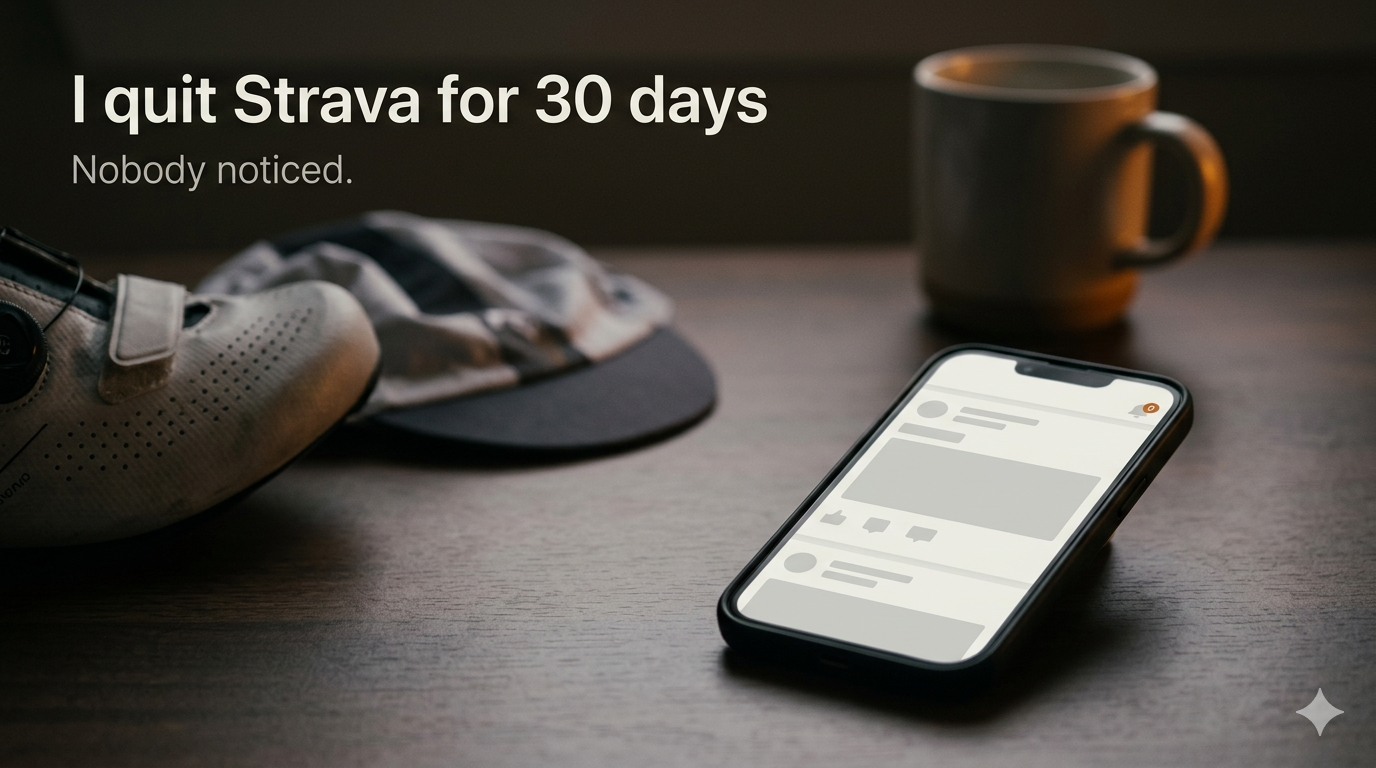
I quit Strava for 30 days: what I missed and what I kept
I quit Strava for thirty days, then came back using it exactly as I always did, and confirmed I am not the audience the platform is built for.
Strava is the social platform endurance athletes are supposed to live on. Twelve years on the platform, 3,043 activities, 18,666 km logged, and an age-group international racing record. By every conventional measure, I am the athlete the company was built to serve.
But my thirty-day quit suggested otherwise.
Nobody noticed I had gone, or at least not enough to say anything to me. To be fair, my activities continued to upload through the auto-upload chain, so the feed side of my profile looked normal from the outside. What went quiet was the consumption: no kudos given, no comments left, no scrolling, and no responding to questions. The friends and training partners who were used to my kudos and comments noticed nothing. That single fact undercuts the social claim Strava is built on more efficiently than any of the academic literature I read while preparing this piece.
Background and design
I run three Strava accounts: one dormant that feeds HRV4Training; one tied to this site for data conversion and testing new features, which Strava occasionally subscribes me to at no charge; plus a personal one I pay for every three years or so when I feel guilty about not paying for something I use. The latter is a reasonably accurate log of my travails over the years, with few duplications. Because of the gear I use, I update it manually to avoid duplicates. #TimeConsuming.
My current training load runs at eleven sessions a week. My serious analysis lives in Xert, Golden Cheetah, and a few other niche tools. The Best Efforts tab on my Strava profile cheerfully credits me with a 12:37 5K and a 3:45 mile, both of which make me the fastest human in the country – or as I like to say, “If it’s on Strava, it’s definitely true!” The platform is a passive pipe and a record of segments. Nothing more.
So I tested it. I left the auto-upload chain intact, vowing not to use any of the files it shared between platforms, the head unit paired, the laptop logged in. Pure willpower. If thirty days off changed anything, the change would have to happen in me, not in the friction.
Thirty days off
Thirty days off did not change much.
The first pull came on day three. A training partner had ridden well, and I wanted to see his segment times. The trigger was mostly social, with a tad of analyticality thrown in. I sat on the moment. It passed.
I did not crack emotionally. The closest I came was a mini disaster where I knew Strava would save me time. One vendor’s data, mid-way through a blog piece, was extractable only via Strava. I worked around it. The workaround cost me at least an hour. “Strava is my ecosystem chokepoint” is a sharper indictment than anything the social-comparison literature offers up. The platform has embedded itself in the wider data infrastructure to the point that even those of us trying to leave it can’t escape.
The training itself did not change. No drop in enjoyment, no rise.
One nuance worth flagging: on two rides, I may have held back very slightly where the segment carrot might have previously pulled extra effort out of me. Whether that is good or bad depends on what your session plan actually wants. For someone built on motivation and Strava’s specific incentive layer, those would be missed opportunities. I missed very little.
The academic literature on Strava is largely focused on social comparison and FOMO. Przybylski’s 2013 FOMO Scale describes the fear of missing rewarding experiences that others are having. What I did miss, in a quiet way, was the once-a-week scroll through my training buddies’ rides. I realised that the true digital social aspect of my cycling life is our WhatsApp group, which carried on unbothered by my absence from Strava for 30 days. Real conversation with real friends, planning and stupid memes thrown in (thank you, Donald, for all you have given). This had higher worth to me than kudos or a one-line ride title.
The exception is the once-a-year group cycling holiday, where Strava is the perfect accompaniment to either beer or coffee (never food, except cake). We check daily to find some aspect of the day where one of us beats the other – the hill, the segment or a potential KOM if we chain-ganged it in an obscure place. This is precisely where the social maps onto the platform.
The wider industry, and what I kept
A word on the wider industry, because I review wearables for a living, and people often expect me to be more critical than I am (hmm). Strava is not the engagement trap that quitting-Strava pieces tend to claim. The product holds me for a few minutes a day at most, nothing close to the hours people give to TikTok or Facebook. The sharper problem sits next door at the device end. Garmin’s Body Battery and Training Readiness scores look highly actionable. The science underneath them is mostly nonsense, dressed in confident numbers and watch-face graphics. Athletes believe them, look at Garmin’s recommendations, and then probably do further research. That is the engagement story worth writing.
So what did I change on return? Nothing. Same auto-upload, same accounts, same passive use. What I kept is the same minimal use I had before: a pipe for data, a record of segments, and an occasional scroll through what my training partners have been doing. The experiment confirmed that my engagement with it is my own version of optimal. I am not the athlete Strava was built for, and I never have been. The platform serves cyclists and runners who want kudos, comparison, segment rivalries, and a public log of every ride. Those are real needs for real people. Just not mine.
If you recognise yourself in any of this, the takeaway is simple. Keep on pedalling. Log on to Strava if you want to.
Last Updated on 3 October 2026 by tfk the5krunner
Small things I always use
- Garmin 90-degree charging adapter: Charges your Garmin from any USB-C cable. Essential when travelling. I use one.
- Body Glide: The blue anti-chafe stick swimmers and runners carry. I use it.
- Speedo earplugs: Fewer ear infections and no cold-water dizziness. I use them.
- Dryrobe Advance: My winter changing robe for open-water swims. I use one. A cheaper option is the AONYIYI changing robe.
- Maurten: Race fuel that stays easy on the stomach. I use them.
- Garmin charging puck: The quickest way to top up before a session. I use one.
- Injinji: Toe socks that stop rubbing, so you run more. I use them.
- Ultimate toe protectors: Stop black toenails on long runs. They work. I use them.
- Compressport R2 v2 calf sleeves: My calf sleeves of choice. I use them.
- Cellucor C4: My pre-workout before hard sessions.
- TPU tubes: Schwalbe Aerothan, Tubolito and Pirelli SmarTube. Light, tiny spares. I use all three.
- G8 insoles: Adjustable insoles that are good. I use them.
- Cycplus Cube: A 97g electric pump that gets a road tyre rideable in two minutes. I carry one. 5% off with code THE5KRUNNER.
Watches and sensors
- Polar H10: My daily driver for waking HRV.
- Polar Verity Sense: My backup arm-worn HR sensor.
- Nomad bedside charger: Charges my iPhone and Apple Watch overnight. I use it, and many of their bands.
- Train.Red: The best muscle oxygen sensor I’ve used.
- Tymewear: Accurate heart rate and reliable ventilatory zones. I use it to pace endurance rides over an hour.
- Garmin Forerunner 970: A pro-grade triathlon watch. I use this.
- Apple Watch Ultra 4: My daily smartwatch. No phone needed on rides.
- Garmin Fenix 9 Pro: I’ve just bought one.
On the bike
- Continental GP5000 for everyday riding, and Aero 111 on the front for special occasions.
- Helmets: Specialized S-Works Evade 3 for road riding, and Rudy Project Wing for TT-style races. I use both.
- Ravemen FR300: A front light that mounts under your Garmin or Wahoo. I use one.
- Wahoo TRACKR Radar: I use it on one bike and Varia on the other. They perform the same.
- Garmin Varia RTL515: Radar that warns you of cars from behind. I use this model.
- Wahoo ELEMNT Roam 3: The bike computer that’s easy to use. I use mine on most rides.
- Favero Assioma Pro RS2: Accurate power pedals that swap easily between bikes. I use this model.
Home and indoor training
- NPE Runn: Makes my basic treadmill smart, sending more accurate speed and distance to my watch and Zwift. I use it.
- Google Wifi: Keeps Zwift connected in my pain cave. I use it.
- Apple TV 4K: Zwift on the big screen. I use two.
- Google Nest Doorbell (wired, 2nd gen): My video doorbell, running in both Google Home and Apple Home. I use it.
Health, recovery and sleep
- FreeStyle Libre 3 Plus: Shows how my blood sugar responds to diet.
- hDrop: Measures my sweat loss in summer and indoors.
- Fourth Frontier Zone: Checks my heart under load in hard sessions.
- Oura Ring 5: My partner’s recovery tracker of choice.
- Kineon MOVE+: Red light therapy for niggles. It works.
- Eight Sleep: A cooling mattress cover my partner and I use nightly.
Reader-Powered Content
This content is not sponsored. It’s mostly me behind the labour of love, which is this site, and I appreciate everyone who supports it.
Support the site: Follow (free, fewer ads) · Subscribe (paid, ad-free) · Buy Me A Coffee ❤️
Written by real people, with AI assistance. Fact-checked and verified for originality. See the Editorial Policy. FTC: Affiliate Disclosure — some links pay commission. As an Amazon Associate, I earn from qualifying purchases.
tfk is the founder and author of the5krunner, an independent endurance sports technology publication. With 20 years of hands-on testing of GPS watches and wearables, and competing in triathlons at an international age-group level, tfk provides in-depth expert analysis of fitness technology for serious athletes and endurance sport competitors. ID

I quit Strava six years ago. Nothing happened, nobody noticed 🙂
Strava is a strange beast. I’m happy for the people that love it, I myself don’t.
I like:
– It’s fun keeping up with what your social circle is doing.
– It can be motivating seeing what your social circle is doing.
– Segments are a great idea in most instances, mostly for competing against yourself.
I don’t like:
– It’s a little nosy keeping up with what your social circle is doing.
– It can be a little bad for your mental health always comparing yourself with what your social circle is doing.
– Segments are a terrible idea in some instances, causing some egregious behavior (nasty interactions at best, car accidents at worst).
– I find self-promotion particularly uncomfortable, and the whole idea of a platform for that to be off-putting (as I do any social media platform)
When I had a Strava account I never really followed any other segments than some short, but brutally steep climbs by bicycle and some running segments, but I hope downhill cycling segments are not allowed. It would be a highway to hell.