No published validation, and a 781-student study found it barely matched how stressed people said they felt
Seeing how sleep, illness, alcohol or a hard training week show up in the body at rest
Blank during workouts, and it cannot say what caused a high reading
In practice: ‘Stress Level’ is the best definition for this measure that most people understand, but it really is more a measure of how your body is coping with whatever life is throwing its way, be that a large meal, extreme exertion or an argument with your boss, all of them different kinds of stressors. There are too many stressors during the day for this measure to be meaningful except when you wake up. That said, raised ‘stress’ means something is going on; you just can’t be sure what.
Quick answers
What is a good stress level on Garmin?
Lower is better at rest. Garmin’s scale runs from 0 to 25 for a resting state, 26 to 50 for low stress, 51 to 75 for medium stress and 76 to 100 for high stress. Below 25, the body’s rest-and-digest system is more active, and Garmin says stress is usually lowest during sleep. Long spells under 25 overnight can signal the body is recovering.
Why is my Garmin stress level high when I feel relaxed?
The watch reads the body’s physical state from heart rate and heart rate variability, not the wearer’s mood. Garmin names excessive exercise, stimulants such as caffeine, poor nutrition and getting ill as causes of higher than normal readings, alongside pressure and excitement.
Does Garmin measure stress during exercise?
No. Garmin does not record a stress level during physical activity, because the strain of exercise would read as stress, and those periods show as “Unmeasurable” in Garmin Connect. Garmin measures the effect of training with other features, such as Training Load.
How does Garmin calculate stress?
Garmin estimates stress from heart rate and heart rate variability recorded by the optical sensor on the back of the watch, using an engine from the Garmin Human Performance Lab. Less variation between heartbeats gives a higher number. Garmin does not publish the weighting, but says the analysis adapts to the wearer, especially when the watch is worn to bed.
Stress level – a deep dive
When stress level is actually useful
Although the data is not scientifically meaningful on its own most of the time, it remains another metric that probably has some meaning when trended over days and weeks. Day-to-day changes sometimes have obvious causes and sometimes not. But when the causes are obvious, why do you need a watch to tell you that?
Introduction
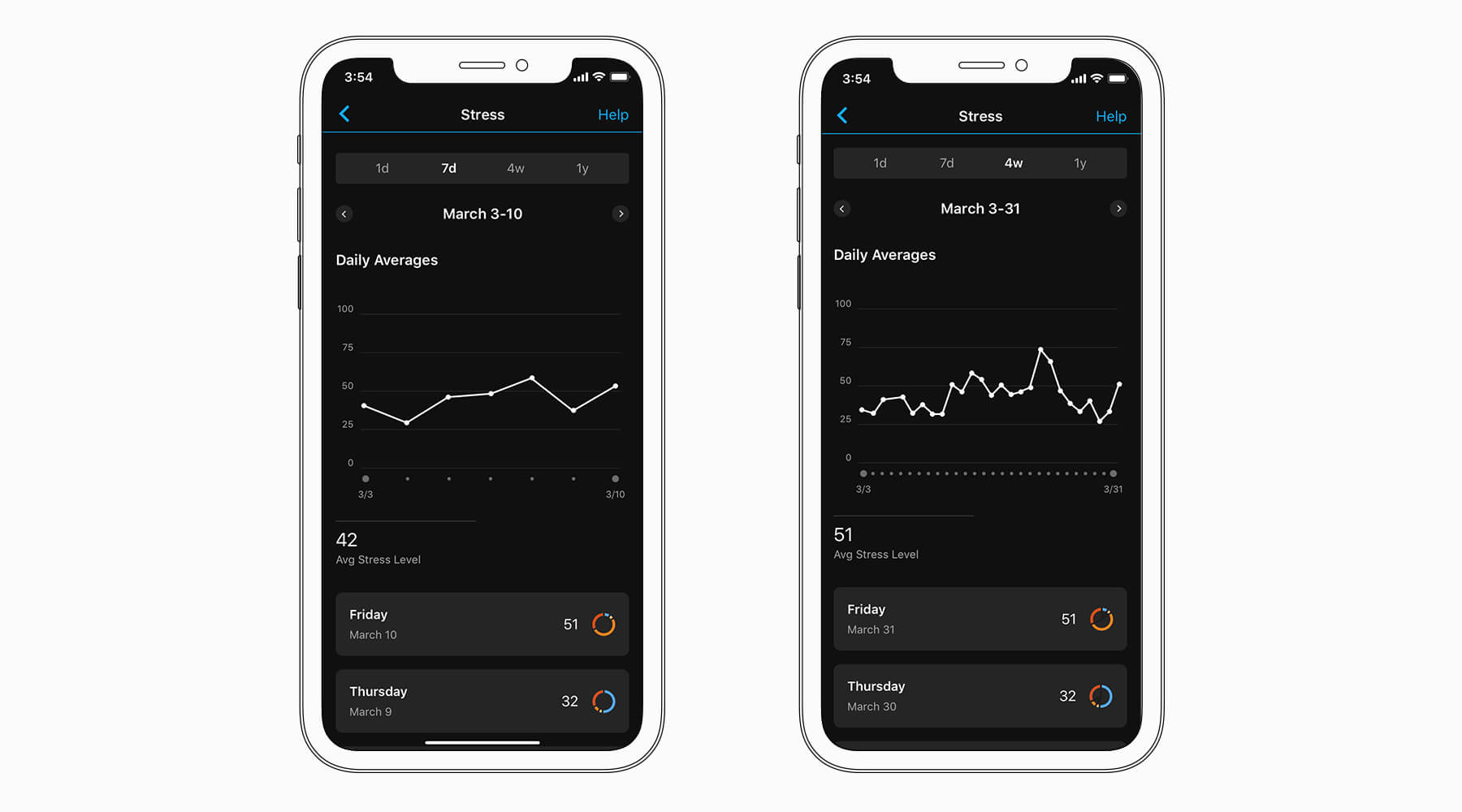
The Garmin stress level is an all-day estimate of physiological stress. Garmin’s support page puts it this way: “The stress level feature on your Garmin device estimates your current stress based on your heart rate variability (HRV).” The score runs from 0 to 100, and Garmin calls the feature Stress Tracking on its technology pages. An older, different feature called Stress Score was a three-minute standing test on the fēnix 3 HR and Forerunner 735XT, which needed a chest strap on the Forerunner.
Stress level also feeds Body Battery and Training Readiness. Its limitation is that it reports a state without a cause: the same number can come from an argument, a coffee, a fever or excitement before a race.
What stress level actually means
Garmin splits the scale into four bands: 0 to 25 is a resting state, 26 to 50 low, 51 to 75 medium and 76 to 100 high. The stress chart on the watch and in Garmin Connect shows orange bars above 25 and blue bars below it. Around 25, Garmin says, the fight-or-flight and rest-and-digest branches of the nervous system are roughly balanced. Garmin publishes no age or sex norms, so the bands are the same for every wearer. Garmin Connect also writes a daily Stress Balance statement, which needs at least 15 hours of stress data on a day with recorded sleep, or 8 hours without.
How Garmin calculates stress level
Garmin states that stress levels are estimated “primarily using a combination of HR and HRV data” from the optical heart rate sensor, by an engine from the Garmin Human Performance Lab. Its support page states the direction: less variability between heartbeats means higher stress, and more variability means lower stress. Garmin’s technology page cites a Firstbeat white paper on stress and recovery analysis from 24-hour heart rate variability as the basis. Firstbeat, the Finnish company behind much of Garmin’s physiology, was bought by Garmin in 2020.
Garmin also states that the analysis adapts to each wearer, and that wearing the watch as much as possible, especially while asleep, makes the readings more personal. Garmin does not publish how that adaptation works. The most plausible explanation is that each measurement is compared against the wearer’s own resting range, built from those nights, and Garmin says intermittent wear still gives some insight but less personal detail. The weighting of heart rate against heart rate variability, and the length of each measurement window, are unknown.
What affects the reading
Garmin’s technology page names work pressure, social anxiety and an aggressive driver as everyday causes, and adds that happy events such as a new job or pre-race nerves raise the number too. It also lists excessive exercise, stimulants, poor nutrition and illness. Garmin’s support page adds training and physical activity to the list, so a hard session can still show in the readings after the workout has ended.
How accurate is Garmin stress level
Garmin publishes no validation of stress level against a reference measure. The largest independent test is Siepe and colleagues (2025), who followed 781 students wearing a vívosmart 4 for three months and asked them to rate their stress up to four times a day. The watch’s stress data showed almost no association with what most students reported. The5krunner’s analysis of that study points out that the vívosmart 4’s 2018 sensor had never been validated for HRV, and that self-reported stress and physiological stress are not the same thing.
The score tracks how aroused the nervous system is, not how stressed a person feels, and the study shows how far apart the two can be. Day-to-day trends from the same watch, worn the same way, are more useful than any single reading.
Competitor equivalents
- COROS Daily Stress gives a 0 to 100 score from heart rate and HRV measured every five minutes against a personal baseline, which settles after about a week of wear.
- WHOOP Stress Monitor compares continuous HRV and resting heart rate against the member’s HRV baseline from the past 14 days.
- Oura Daytime Stress combines heart rate, HRV, motion and skin temperature, and shows Stressed, Engaged, Relaxed or Restored instead of a number.
- Suunto shows a Resources gauge with an active, inactive, recovering or stressed state, based on optical heart rate and the wearer’s maximum and resting heart rate settings.
No all-day stress score was found in Polar or Apple documentation. Polar’s nearest equivalent is the ANS charge in Nightly Recharge, which measures recovery during the first hours of sleep.
Which Garmin devices support stress level
Garmin introduced all-day stress tracking in 2017 on the vívosmart 3. It has since spread across Garmin’s watches and trackers with wrist heart rate, but Garmin publishes no device list, and its support page sends readers to each owner’s manual instead. Some Edge cycling computers can also show the current stress level when paired with a compatible Garmin heart rate strap.
Where to find stress level on Garmin
- On the watch: the stress glance shows the current level, the day’s breakdown and the previous seven days. You can add it through the glance list if it is missing.
- Garmin Connect app: More > Health Stats > Stress, with the daily timeline, daily averages and the time spent in each band.
- Garmin Connect web: Health Stats > Stress for each day, and Reports > Health & Fitness > Stress Level for averages over seven days to a year.
- Relax reminder: on select watches, an alert when stress is unusually high, with a prompt to start a guided breathing exercise.
Common problems and misreadings
A high reading while sitting calmly is the most common complaint. See Quick answers above.
Gaps marked “Unmeasurable” are normal during workouts and other high activity, and they are not a fault.
The figure in Garmin Connect is the day’s overall stress value, while the live value appears only on the watch, so the two rarely match. A missing Stress Balance statement means the day had too little data: under 15 hours with sleep recorded, or under 8 hours without.
How to improve stress level
Garmin’s advice is to balance stressful periods with relaxing moments and good sleep. Cutting back on caffeine and other stimulants, and taking recovery days after hard training, works on the causes Garmin lists above. Select watches add a relaxation reminder that prompts a guided breathing exercise when the level is unusually high.
Scientific basis
Firstbeat Technologies. Stress and Recovery Analysis Method Based on 24-hour Heart Rate Variability. Firstbeat white paper, cited by Garmin as 2015. The method Garmin names as the basis of all-day stress tracking.
Siepe BS, Tutunji R, Rieble CL, Proppert RKK and Fried EI. Journal of Psychopathology and Clinical Science, 2025. DOI 10.1037/abn0001013. Found almost no link between vívosmart 4 stress data and self-reported stress in 781 students over three months.
How stress level connects to other Garmin features
Stress level reads the same heart rate variability during the day that HRV Status reads overnight. Garmin lists stress among the inputs to Body Battery, and three days of stress history make up one of the six factors in Training Readiness. Overnight HRV also sits among the five vitals in Health Status, and Health Snapshot gives a two-minute reading of heart rate and HRV on demand.
2026 Seasonal Gifts
- Garmin CIRQA: Garmin’s screenless band, which uses your phone as the display. I tested it and sometimes use it as a backup on the site.
- HoloSwim 3 Pro: Swim goggles with GPS and your pace in the lens, so you can swim without a watch. Code THE5KRUNNER takes 10% off. I tested them.
- Kineon MOVE+: Red and infrared light for sore knees, Achilles and other joints after hard training. I use it.
- Fitbit Air: A screenless band for steps, sleep and heart rate, with no subscription needed. It was closest to a manual 9,000-step test. I use it as a backup sometimes.
Small things I always use
- Garmin 90-degree charging adapter: Charges your Garmin with any USB-C cable. Essential when travelling. I use one.
- Body Glide: The blue anti-chafing stick swimmers and runners carry. I use it.
- Speedo earplugs: Fewer ear infections and no cold-water dizziness. I use them.
- Dryrobe Advance: My winter changing robe for open-water swims. I use one. A cheaper option is the AONYIYI changing robe.
- Maurten: Race fuel that stays easy on the stomach. I use them.
- Beet It Sport nitrate shots: Beetroot shots I take in the days before a race. I use them.
- Garmin charging puck: The quickest way to top up before a session. I use one.
- Injinji: Toe socks that stop rubbing, so you run more. I use them.
- Ultimate toe protectors: Stop black toenails on long runs. They work. I use them.
- Compressport R2 v2 calf sleeves: My calf sleeves of choice. I use them.
- Cellucor C4: My pre-workout before hard sessions.
- TPU tubes: Schwalbe Aerothan, Tubolito and Pirelli SmarTube. Light, tiny spares. I use all three.
- G8 insoles: Adjustable arches, perfect position. I use them.
- Cycplus Cube: A 97g electric pump that gets a road tyre rideable in two minutes. I carry one. 5% off with code THE5KRUNNER.
Health, recovery and sleep
- FreeStyle Libre 3 Plus: Shows how my blood sugar responds to diet. Occasional use.
- hDrop: Measures my sweat loss in summer and indoors. I use it.
- Fourth Frontier Zone: Checks my heart under load in hard sessions.
- Oura Ring 5: My partner’s recovery tracker of choice.
- Eight Sleep: A cooling mattress cover my partner and I use nightly (see next).
- Chilipad 2.0: Cools or heats your side of the bed on a schedule, with no subscription. US only. I am testing it; it seems pretty good.
Watches and sensors
- Polar H10: My daily driver for waking HRV.
- Polar Verity Sense: My backup arm-worn HR sensor.
- Nomad bedside charger: Charges my iPhone and Apple Watch overnight. I use it, and many of their bands.
- Train.Red: The best muscle oxygen sensor I’ve used. Occasional use.
- Tymewear: Accurate heart rate and reliable ventilatory zones. I use it to pace endurance rides over an hour.
- Garmin Forerunner 970: A pro-grade triathlon watch. I use this.
- Apple Watch Ultra 4: My daily smartwatch. No phone needed on rides.
On the bike
- Continental GP5000 for everyday riding, and Aero 111 on the front for special occasions. I use both.
- Helmets: Specialized S-Works Evade 3 for road riding, and Rudy Project Wing for TT-style races. I use both.
- Ravemen FR300: A front light that mounts under your Garmin or Wahoo. I use one.
- Ravemen FR1000: The light and the computer mount in one unit, so nothing else goes on the bars. Better than mine.
- Ravemen FR1500SE: 1,500 lumens hanging under your Garmin, for proper night rides.
- Ravemen FR1100SE: 1,100 lumens under your Garmin, and up to 46 hours on slow flash.
- Ravemen FR500: A brighter FR300 with the same mount.
- Wahoo TRACKR Radar: I use it on one bike and Varia on the other. They perform the same.
- Garmin Varia RTL515: Radar that warns you of cars from behind. I use this model.
- Wahoo ELEMNT Roam 3: The bike computer that’s easy to use. I use mine on most rides.
- Favero Assioma Pro RS2: Accurate power pedals that swap easily between bikes. I use this model.
Home and indoor training
- NPE Runn: Makes my basic treadmill smart, sending more accurate speed and distance to my watch and Zwift. I use it.
- Google Wifi: Keeps Zwift connected in my pain cave. I use it.
- Apple TV 4K (4th generation): Zwift on the big screen. I use two.
- Google Nest Doorbell (wired, 2nd gen): My video doorbell, running in both Google Home and Apple Home via Starling. I use it.
Reader-Powered Content

This content is not sponsored. It’s mostly me behind the labour of love, which is this site, and I appreciate everyone who supports it.
Support the site: Follow (free, fewer ads) · Subscribe (paid, ad-free) · Buy Me A Coffee
Written by real people, with AI assistance. Fact-checked and verified for originality. See the Editorial Policy. FTC: Affiliate Disclosure — some links pay commission. As an Amazon Associate, I earn from qualifying purchases.
