Race Predictor
Useful as a marker of progress, not a precision race-day target
Tracking aerobic fitness progress over weeks and months; setting a realistic starting-point target for a first race at a given distance.
Marathon and half-marathon predictions are structurally optimistic, particularly for runners without distance-specific race conditioning.
Plain English: Race Predictor shows four estimates — one each for the 5K, 10K, half-marathon, and marathon — based on how fit the watch thinks you are today. An improved predicted time means a higher aerobic fitness level has been detected. Predictions will be inaccurate if your VO2 max is unstable due to inconsistent training and may be adjusted to account for race-day factors such as heat.
In practice, predicted times across all four distances are broadly indicative of current capability but not precise enough to serve as pacing targets, particularly at longer distances, where distance-specific conditioning plays a role. My Race Predictor times were wildly inaccurate last year, but once I put in a near-maximal effort, they improved notably. Even so, based on recent 5K and HM races, my 5K prediction currently runs about 15 seconds faster than my capability, while my marathon prediction is likely 10 minutes slow. Watching the predictions for each race distance trend over time in Garmin Connect is one of the more useful features: it reflects the type of work being done and tracks progression. Still, it functions best as a motivational indicator rather than a precision race-planning tool.
Quick answers
How accurate is Garmin Race Predictor?
Firstbeat’s own validation studies report a mean absolute percentage error of approximately 5% in VO2 Max estimation under controlled conditions; field studies using optical wrist heart rate show larger errors. Race Predictor is most reliable as a trend indicator — a progression from a 4:05 predicted marathon to a 3:50 predicted marathon reflects genuine aerobic improvement, rather than an absolute race-day forecast.
Why does my Garmin Race Predictor say I can run a much faster marathon than I actually can?
Race Predictor is driven by aerobic fitness but cannot model the demands that make the marathon distinctively hard: glycogen management, pacing discipline, and neuromuscular fatigue in the final miles. Runners who have not completed marathon-specific training often find that the predicted marathon time is 30 to 60 minutes faster than their actual capability, and Garmin’s own research confirms this structural gap at longer distances.
Why is my Garmin Race Predictor not updating?
The predictions only change when the VO2 Max estimate updates, which requires a qualifying outdoor run of at least ten minutes at approximately 70 per cent of maximum heart rate or higher, with GPS and heart rate active. Short runs, easy runs below the aerobic threshold, and activities recorded as trail or ultra runs with VO2 Max updates disabled will not trigger a change.
Why do my Race Predictor times on the watch and in Garmin Connect show different values?
The watch displays predictions from its on-device VO2 Max estimate, while Garmin Connect can draw on a broader picture of synced training history and performance data; the two can diverge if recent activities have not fully synced or if the app cache is stale. Closing and restarting the Garmin Connect app after a full sync typically resolves the discrepancy; if the gap persists, clearing the app cache has been reported to restore alignment.
Race Predictor — A Deep Dive
When Race Predictor Is Actually Useful
- When my 5K prediction crept 30 seconds ahead of a recent race time, it confirmed that the good performance had significantly improved the prediction’s accuracy. In previous years, I’ve dismissed older, inaccurate versions of the predictor too readily; in my experience, the newer algorithm needs hard performance figures at a single distance to lock in predictions, rather than somewhat wishy-washy forecasts based on erroneous VO2 max estimates.
- My predicted times noticeably fell across all four distances after a block of increased volume, which clearly reflected the change in training emphasis — a useful confirmation that the volume was positively registering on my capability.
- The feature works well when checked monthly: a trend chart in the app showing up to a year gives a clear picture of how different training stimuli appear to affect abilities across the full range of race distances.
- In the absence of deeper sports science knowledge, Race Predictor might produce an approximate target for your first ever race up to the HM distance, much less so for the full distance.
Garmin Race Predictor translates a runner’s current aerobic fitness into estimated finish times for the 5K, 10K, half-marathon, and marathon. The estimate updates automatically as the runner’s fitness changes, without requiring a separate time trial or manual entry.
Race Predictor estimates finish times for the 5K, 10K, half-marathon, and marathon using a combination of VO2 Max, recent training history, and known race performances where available.
The central limitation of Race Predictor is that it remains primarily a fitness-based estimate rather than a full race simulation. Although Garmin now incorporates training history and, for planned races, adjustments for environmental and course factors, the model cannot fully account for individual pacing strategy, race execution, nutrition strategy, or day-to-day physiological variability.
What the Number Actually Means
Each predicted time represents the finish time Garmin’s algorithm estimates based on the runner’s current fitness profile, including the VO₂ Max estimate, recent training patterns, and associated data.
The predictions are benchmarks of aerobic capacity, not race readiness. A runner returning from injury may carry a residually high VO2 Max estimate — and correspondingly fast predicted times — while lacking the specific endurance to sustain marathon pace. The predictions do not account for this distinction.
Age and sex context enter indirectly through the VO2 Max estimate itself, which is generated using age- and sex-adjusted reference data from the Firstbeat Analytics model. The predicted times reflect the current VO2 Max value on its own terms; Garmin does not publish separate age-graded or sex-adjusted prediction tables for Race Predictor.
How Garmin Calculates It
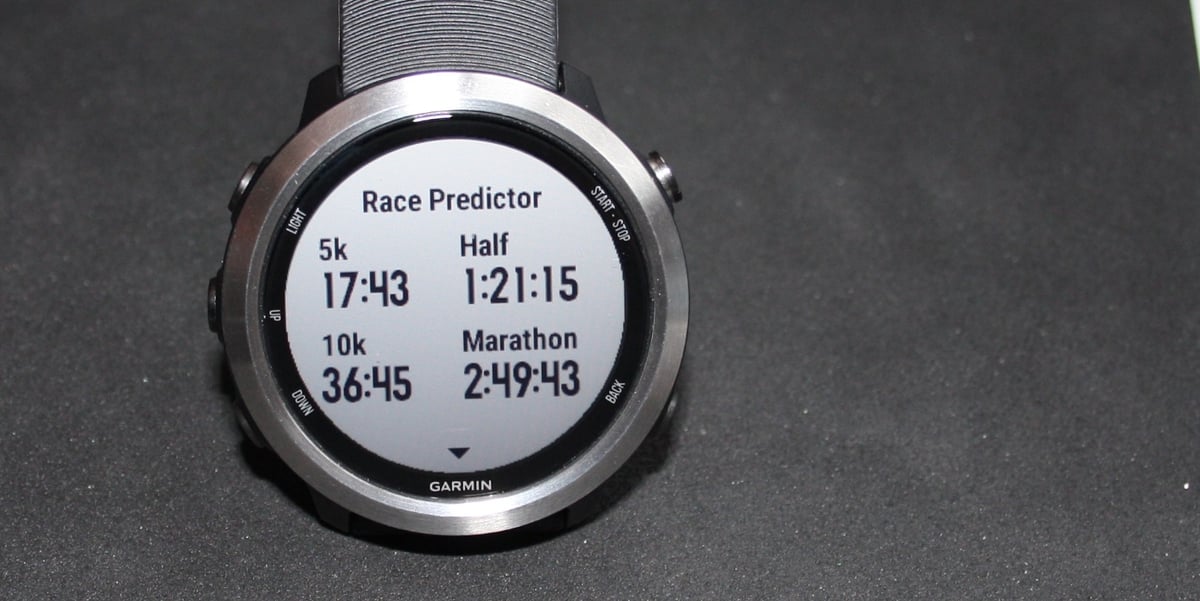
Race Predictor uses a fitness model derived from VO₂ Max estimates, along with training history and past running performance. Garmin’s internal Firstbeat-derived physiological models analyse these inputs to estimate performance potential across standard race distances. Firstbeat, acquired by Garmin in 2020 and now an internal engineering team, developed the physiological modelling that underpins both the VO2 Max estimate and the race time projections.
The prediction model builds on the established relationship between aerobic capacity and endurance performance but extends it to include additional inputs, such as recent training load, running history, and known race results when available. This relationship has been formalised in peer-reviewed literature — most notably in work by Daniels and Gilbert (1979) — and is widely used in coaching to set training paces and race targets. Garmin’s implementation follows the same general framework, scaling performance predictions according to the energy-cost characteristics of each distance.
A software update in September 2024 extended the model to incorporate a runner’s recent fastest runs, producing more responsive estimates following speed work. Garmin confirmed the update; its effect on absolute accuracy on race day has not been independently validated.
The calculation requires a stable VO₂ Max estimate, along with sufficient recent running data, for the device to assess training patterns and performance trends. The estimate must be sufficiently stable — Garmin recommends consistent training data over several weeks — before predictions become meaningful. If VO2 Max has not yet been established, Race Predictor does not display values. Predictions update automatically as fitness metrics such as VO₂ Max, training history, and performance indicators evolve.
Qualifying runs require sustained effort at approximately 70 per cent of maximum heart rate or higher for at least 10 minutes, with GPS pace data and heart rate input enabled. Activities recorded as trail runs or ultra runs can be excluded from VO2 Max updates via device settings; this exclusion carries through to Race Predictor. Such run types would yield incorrect (low) VO2 Max estimates and, hence, low predicted times.
What Affects the Reading
Because VO₂ Max remains a primary input, factors that distort the VO₂ Max estimate can still influence predicted times. However, the prediction model also incorporates training history and performance indicators, which moderate the effect of short-term fluctuations in VO₂ Max. Heart rate accuracy is the dominant variable. Wrist-based optical heart rate sensors perform less consistently than chest straps during high-intensity running and at low cadences or in cold conditions. An elevated heart rate at a given pace yields a lower VO2 Max estimate and, therefore, slower predicted times. A suppressed heart rate reading produces faster predicted times.
Environmental heat temporarily suppresses the VO2 Max estimate. Garmin displays a heat or altitude indicator on the VO2 Max widget when conditions affect the estimate, but this indicator does not appear in Race Predictor itself. Predicted times will slow during periods of consistent training in hot conditions, then recover as the device re-establishes a baseline in cooler conditions.
Altitude affects the estimate in the same direction as heat: the cardiovascular cost of running at a given pace at altitude is higher than at sea level, and the model interprets this as reduced fitness rather than environmental suppression. Predicted times will slow while the athlete is training or living at altitude.
Inconsistent training — whether due to injury, illness, or a significant reduction in training volume — allows the VO2 Max estimate to drift downward, pulling predicted times along with it. A short return to training after a break does not immediately restore the prior estimate; several weeks of qualifying data are typically required before the estimate stabilises at a representative level.
When a primary race event is set in the Garmin calendar, the prediction model can apply event-specific adjustments based on available data about:
- course elevation profile
- expected temperature and environmental conditions
- altitude
These adjustments modify the predicted time relative to the runner’s baseline fitness estimate.
Runners who race well above or below their training-implied potential — through superior or poor race execution — will find the predictions less accurate in absolute terms.
How Accurate Is It
Accuracy in Race Predictor is bounded upstream by the accuracy of the VO2 Max estimate and downstream by the degree to which the physiological model captures individual performance variation.
Firstbeat’s own validation studies report a mean absolute percentage error of approximately 5% in VO2 Max estimation under controlled conditions using chest-strap heart rate data. Independent studies report errors of five to eight per cent under field conditions with chest strap HR, widening further with optical wrist HR. Anderson et al. (2019), examining the Garmin Fenix 5X, found a mean error of 2.16 ml/kg/min; Pearson et al. (2018) found errors averaging 7.6 ml/kg/min in high-fitness participants using GPS watches. A five per cent error in VO2 Max propagates into a corresponding error in predicted race times.
The distinction between absolute accuracy and trend reliability is important. Race Predictor is most useful as a relative indicator: a progression from a 4:05 predicted marathon to a 3:50 predicted marathon over several months of training reflects genuine aerobic improvement, even if neither figure reflects what the athlete would run on a given race day. Using the predictions as trend markers rather than absolute targets produces more practical outcomes for most recreational runners.
At the marathon distance specifically, the physiological demands diverge substantially from what aerobic capacity alone predicts. Glycogen depletion, pacing errors, and the neuromuscular stress of late-race fatigue all introduce variance that the VO2 Max-to-performance model cannot account for. Independent assessments of VO2 Max-based marathon predictors — including studies by Midgley et al. (2007) — note that prediction errors at the marathon are systematically larger than at shorter distances, particularly for runners with limited long-course racing experience.
Race Predictor is not validated as a precision tool for race planning. It is most accurately described as an aerobic fitness benchmark expressed in race-time units.
Competitor Equivalents
- Polar: Polar devices display predicted race times for the 5K, 10K, half-marathon, and marathon via the Running Performance feature, derived from Running Index — Polar’s proprietary aerobic fitness score that functions analogously to VO2 Max. Polar uses its own scaling model rather than a Daniels-derived framework.
- Apple: Apple Watch does not offer predicted race times.
- Coros: Coros devices display predicted race times for the 5K, 10K, half-marathon, and marathon within the Training Hub in the Coros app. The predictions are derived from Coros’s aerobic fitness score, calculated from heart rate and pace data collected during outdoor GPS runs. Coros does not reliably document the conversion model it applies to translate fitness scores to predicted times.
- Suunto: Suunto devices display predicted running pace for various distances via the Progress widget. These are derived from VO₂max estimates based on training load (TSS) during runs. The calculation methodology is not detailed.
Which Garmin Devices Support It
Garmin introduced Race Predictor alongside VO2 Max estimation. The feature has been present on devices supporting VO2 Max since the Forerunner 620 generation (2013) and has been a standard feature on all mid-range and flagship running devices since then.
Current device families supporting Race Predictor include:
- Fenix 8 series (AMOLED and Solar, 47mm and 51mm, including Fenix E)
- Enduro 3
- Forerunner 970
- Forerunner 570
- Forerunner 265 series (265S and 265)
- Forerunner 255 series (255S and 255)
- Forerunner 165 (Music and standard)
- Epix Pro (Gen 2, 42mm, 47mm, 51mm)
- Venu 4 series (Venu 4S and Venu 4)
- Venu X1
- Vívoactive 6
- Tactix 8 series
- D2 Mach 2
- Quatix 8 Pro
Race Predictor is not available on entry-level devices that do not support running VO2 Max estimation, including the Forerunner 55.
Higher-end devices support a distinct Course and Weather-Specific Race Predictor, accessible via the primary race glance when a race event is set in the Garmin Connect calendar. This variant applies course and environmental adjustments to the baseline prediction and is listed separately in Garmin’s product specifications for devices such as the Forerunner 965 and 970. The standard Race Predictor — showing flat estimates across the four distances — is present on all compatible devices, regardless of tier.
Where to Find It
On the watch, Race Predictor appears primarily as part of the VO2 Max widget, as a performance glance, and on the primary race glance. Navigation varies by device generation; on current devices, press the Up or Down button from the watch face to reach the running performance glance, then press Start to access the predictions.
Race Predictor is not available as a data field during a recorded activity. The predictions are a resting reference metric, not a real-time in-activity display. During a run, Performance Condition serves as real-time fitness feedback.
Race Predictor is not available as a watch face complication on current devices.
In Garmin Connect Mobile, predicted race times are available in the Performance Stats section. The four distances appear together with the current VO2 Max value. Historical trend data for the VO2 Max estimate are available, but Garmin Connect does not maintain a dedicated trend chart for the predicted race times.
On the Garmin Connect web page, the Performance Stats section similarly displays the four predictions alongside the VO2 Max figure. The web presentation is functionally equivalent to the mobile app for this metric.
Access to Race Predictor data does not require a Garmin Connect Plus subscription. The feature is available to all Garmin Connect accounts on compatible devices.
Common Problems and Misreadings
The most frequently reported issue is predicted times that feel implausibly fast or slow relative to the athlete’s known race performances. See FAQ above for details. Verify that the maximum heart rate entered in the user profile matches the athlete’s actual physiological maximum as the first diagnostic step.
Predicted times often appear to slow significantly during summer training or following a period at altitude. This is expected behaviour. The device is detecting a temporarily suppressed VO2 Max estimate due to environmental heat or a reduced partial pressure of oxygen. The predictions will recover as training returns to temperate conditions and the estimate stabilises. It does not indicate a loss of fitness.
Many runners observe that Race Predictor produces marathon predictions notably faster than their actual marathon performance, even when the 5K and 10K predictions are broadly accurate. See FAQ above for details.
A Race Predictor that is not displaying values indicates that no valid running VO2 Max estimate has been established. The most common causes are insufficient outdoor running data, activities logged exclusively as trail or ultra runs with VO2 Max updates disabled, or a new watch with no prior activity history. Running outdoors to collect GPS and heart rate for several weeks of moderate effort will typically establish the estimate.
Some runners are surprised to find that Race Predictor does not update during or after every run. See FAQ above for details.
How to Improve It
Race Predictor reflects the running VO2 Max estimate, and improving it requires increasing aerobic capacity. The most reliable method is to increase weekly aerobic running volume at an intensity below the lactate threshold—typically at a conversational pace at which the runner can speak in full sentences. Research consistently shows that the largest gains in VO2 Max for recreational runners come from increasing total aerobic work, not from adding high-intensity sessions alone. For most runners training fewer than five days per week, adding an easy run produces faster VO2 Max progression than adding a second interval session.
Once aerobic volume is sufficient, structured high-intensity work produces further gains. Intervals at or near the pace associated with VO2 Max — faster than a 5K race effort — stimulate adaptations that improve VO2 Max. These sessions require adequate recovery between them; two high-intensity sessions per week is the upper limit for most recreational runners without risking accumulated fatigue that suppresses the estimate.
Scientific Basis
Daniels, J. and Gilbert, J. (1979). Oxygen Power: Performance Tables for Distance Runners. Published privately. This work formalised the mathematical relationship between VO2 Max and running performance across standard race distances. It established the tables that form the basis for most VO2 Max-to-race-time conversion models, including those used in commercial implementations of this feature category.
Midgley, A.W., McNaughton, L.R., and Jones, A.M. (2007). Training to Enhance the Physiological Determinants of Long-Distance Running Performance. Sports Medicine, 37(10), 857–880. This review examined the accuracy of VO2 Max-based marathon predictors and identified systematic underestimation of marathon difficulty at higher distances, particularly for athletes without race-specific conditioning — a finding directly relevant to Race Predictor’s known limitation at the marathon distance.
Kodama, S. et al. (2009). Cardiorespiratory Fitness as a Quantitative Predictor of All-Cause Mortality and Cardiovascular Events in Healthy Men and Women. JAMA, 301(19), 2024–2035. This meta-analysis established the dose-response relationship between cardiorespiratory fitness (VO2 Max) and mortality risk, thereby conferring clinical significance to the metric beyond athletic performance.
Firstbeat Technologies (2014). Automated Fitness Level (VO2max) Estimation with Heart Rate and Speed Data. Firstbeat White Paper. This primary technical document describes the Firstbeat Analytics algorithm for estimating VO2 Max from heart rate and pace data during outdoor GPS runs — the calculation that Race Predictor relies entirely on for its inputs.
How It Connects to Other Features
Race Predictor sits at the downstream end of Garmin’s performance estimation chain. One of its primary inputs is the running VO₂ Max estimate, supplemented by training history and performance data, making VO2max the foundational dependency. Any feature that influences the VO2 Max estimate — including Training Status, which tracks whether training is producing the fitness improvement that would raise VO2 Max — indirectly influences Race Predictor outputs.
Performance Condition operates in a related but distinct domain. Where Race Predictor provides a static benchmark based on current fitness, the Performance Condition provides a real-time offset during a recorded activity, indicating how the athlete’s output compares to the VO2 Max baseline on that specific day. The two features answer different questions: Race Predictor asks what the athlete could achieve in a race given their current fitness; Performance Condition asks how the athlete is performing relative to their current fitness.
Training Load and Training Effect influence Race Predictor by determining whether training produces aerobic adaptations that improve VO2 Max. A consistent pattern of productive training loads, reflected in improving Training Status, should produce a gradual upward trend in Race Predictor outputs over weeks and months.
PacePro is the natural complement to Race Predictor for race execution. Once a target finish time has been identified from the Race Predictor output — or from a race goal set independently — PacePro generates a segment-by-segment pacing strategy for a specific course. The two features serve adjacent stages of race preparation: Race Predictor establishes a fitness-based time target; PacePro structures the execution of that target across a real course.
Lactate Threshold is relevant to the accuracy of Race Predictor at longer distances. The half-marathon and marathon predictions assume the athlete can sustain close to their aerobic threshold throughout the race. Runners whose lactate threshold occurs at a relatively low percentage of VO2 Max will find the predictions less accurate because they cannot sustain the pace implied by the aerobic model.
