Garmin Training Status
Only as good as the activity data recorded over the preceding weeks
Athletes training consistently in one sport over a four-to-six-week block
Cannot account for stress, illness, or unrecorded activity outside the watch
Quick answers
Why does Garmin Training Status say Unproductive when my training feels good?
Unproductive means training load is elevated, but VO2 max has not yet responded upward — a pattern common in the first two to three weeks of a new training block before the aerobic system catches up. The label does not mean training is wrong; it reflects a lag in the algorithm’s assessment window rather than a genuine fitness problem.
How does Garmin Training Status work?
Training Status compares acute training load over the preceding seven days against the VO2 max trend over the preceding three to four weeks. Load is derived from EPOC values calculated from heart rate responses during each recorded activity. The combination of load level and VO2 max direction determines which of the seven status labels is assigned.
How long does Garmin Training Status take to update?
The status recalculates after each qualifying activity, but the underlying VO2 max trend uses a three-to-four-week assessment window, so a single session shifts the label only when it materially changes that trend. Day-to-day oscillation between adjacent labels — such as Productive and Maintaining — is normal and expected.
Does Garmin Training Status work for cycling as well as running?
Training Status is available on Garmin cycling computers and on watches when cycling activities are recorded. On cycling computers, a power meter significantly improves load accuracy. On watches recording cycling without a power meter, the EPOC calculation relies on heart rate alone, which is less precise for cycling than for running.
Garmin Training Status — A Deep Dive
When Training Status Is Actually Useful
- I often train hard and sometimes too hard. On many occasions, I’ve increased my planned rest when confronted with an unexpected “Unproductive” Training Status.
- For serious races, I properly follow my plan. When doing that, I almost always get ‘Peaking’ sometime after the peak load phase, i.e., as I taper. This can happen at any time up to one week before race day. If this happens early, “Unproductive” may well show on race day, and there isn’t much you can do about that, but on many of those occasions, I’ve still performed well.
- I sometimes follow plans that brought success 15 years ago. Inevitably, I can’t handle the load as well as I used to, and the occasional “Overreaching” flag always gets me to add a rest day or two, even if that hinders the load build.
Training Status indicates whether recent training is improving fitness, maintaining it, or degrading it. Garmin Training Status evaluates the relationship between an athlete’s recent training load and their VO2 max trend to produce a single-word assessment that updates after each qualifying activity. It draws on the Firstbeat Analytics methodology developed since Garmin acquired Firstbeat Technologies on 30 June 2020. Illness, life stress, poor nutrition, and fatigue accumulated outside recorded activities affect an athlete’s actual fitness trajectory without appearing in the calculation.
What the Number Actually Means
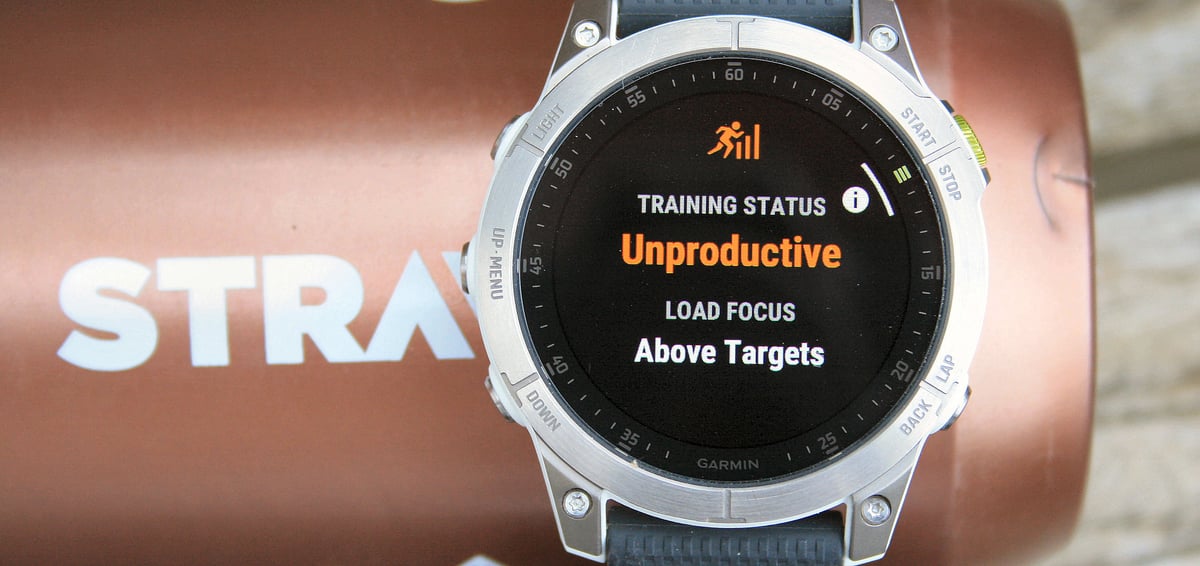
Training Status produces a categorical label rather than a numerical score. Productive indicates load is rising in a range that correlates with VO2 max improvement. Maintaining indicates the load is sustaining current fitness without further gains. Peaking indicates a taper phase with reduced load and elevated fitness markers. Recovery indicates intentionally reduced load. Unproductive indicates elevated load with a flat or declining VO2 max trend. Overreaching is a more acute version of the same pattern. Detraining indicates the load has fallen to a level associated with fitness decline.
How Garmin Calculates It
The calculation compares acute training load over the preceding seven days against the VO2 max trend over the preceding three to four weeks. Training load is derived from EPOC values generated during each recorded activity, based on heart rate response relative to aerobic and anaerobic thresholds. The combination of load level and VO2 max direction determines which label applies.
The watch requires at least seven days of recorded activity data to produce a stable reading. Fewer than three activities in the assessment window cause the status to display as No Status or remain unchanged from the last confirmed reading.
| Status Label | What It Indicates |
|---|---|
| Productive | Training load is in a range associated with improving VO2 max. Fitness is trending upward. |
| Maintaining | Training load is sustaining current fitness without producing further measurable gains. |
| Peaking | Load has reduced, and fitness markers are elevated. Consistent with a taper phase ahead of a target event. |
| Recovery | Training load is intentionally low. Associated with a planned rest period. |
| Unproductive | Load is elevated, but VO2 max is flat or declining. Consistent with accumulated fatigue or insufficient recovery between sessions. |
| Overreaching | A more acute version of Unproductive. Load is high, and VO2 max is declining materially. Associated with short-term overtraining. |
| Detraining | Training load has fallen to a level associated with fitness decline. Associated with extended rest or inactivity. |
What Affects the Reading
Heart rate accuracy is the primary hardware variable. Wrist-based optical sensors produce elevated error rates during high-intensity intervals, significant wrist movement, and cold conditions. A chest strap yields more consistent EPOC readings. Unrecorded activities — strength training, yoga, active commuting — contribute physical stress without contributing load data.
VO2 max readings are sensitive to heat, humidity, and altitude, each of which suppresses heart rate efficiency relative to effort. A hot-weather training block can temporarily push status toward Unproductive even as underlying fitness holds steady. Illness and non-training stressors produce anomalous heart rate patterns that generate unreliable EPOC estimates.
How Accurate Is It
Training Status is a categorical interpretation of two derived metrics rather than a direct physiological measurement. Firstbeat’s EPOC-based VO2 max algorithm has been found to produce estimates within approximately 5% of laboratory-measured values under controlled conditions. Still, accuracy degrades in heat, with wrist-based heart rate, and with unfamiliar activity types. No published study has assessed the Training Status label directly against objective performance outcomes.
The metric is more reliable as a trend indicator than as a single-day verdict. A consistent Productive reading over several weeks is a meaningful signal; a one-day shift to Unproductive warrants attention but not alarm.
Competitor Equivalents
- Polar’s Training Load Pro assesses cardio, muscle, and perceived load separately and produces a weekly strain-versus-tolerance comparison, with no single-word status label.
- Apple Watch generates no categorical fitness-trend assessment; Training Load summary data is available in the Fitness app on watchOS 11 and later.
- Coros offers a Fitness/Fatigue/Form model using a TSS approach, expressed numerically rather than as a label, with cycling power meter data feeding it more directly than Garmin’s implementation.
- The Suunto Race and Vertical series present a 7-day-to-28-day load ratio as a numerical figure and a trend chart, with no single-word status label.
- Wahoo ELEMNT computers do not produce a Training Status equivalent; load data is available through integration with Today’s Plan and TrainingPeaks.
Which Garmin Devices Support It
Garmin introduced Training Status in 2018 on the Forerunner 935 and Fenix 5 Plus. The feature is present on all subsequent mid-tier and flagship devices. Entry-tier devices — including the Forerunner 55, Forerunner 165, Vivoactive 6, Lily 2, and Vivosmart 5 — do not support it. Current supported families: Fenix 8 series (AMOLED and Solar, 47mm and 51mm, including Fenix E and Fenix 8 Pro); Enduro 3; Tactix 8; Quatix 8; D2 Mach 2 and D2 Air X15; Forerunner 970 and 570; Forerunner 965 and 265; Venu 4 series and Venu X1; Instinct 3 (Training Status available; full Training Load suite limited); Epix Pro Gen 2 and MARQ Gen 2; Edge 540, 840, and 1050 (cycling-specific, power meter data improves accuracy).
Where to Find It
- Watch widget: full-screen widget showing the current label, VO2 max estimate, and explanatory sentence. Fenix 8 and Forerunner 970 add card views with contributing load and VO2 max trend data.
- Widget glance: single-line label summary on all devices that support the full widget.
- Activity data field: displays the label from the most recent completed assessment; updates between activities, not in real time.
- Morning Report: appears alongside Recovery Time and Body Battery on compatible devices.
- Garmin Connect app: Performance Stats section; current label, written description, and 12-week historical trend chart.
- Garmin Connect web: Performance section; trend chart may render at reduced granularity.
A Garmin Connect Plus subscription is not required to access Training Status or its historical trend data.
Common Problems and Misreadings
A persistent Unproductive or Overreaching status during apparently good training typically means the load has increased faster than VO2 max has responded. See FAQ above for details. The status usually resolves to Productive after one to two weeks of consistent training once the VO2 max trend catches up.
A Detraining label that persists longer than expected after illness or a rest block reflects the three- to four-week assessment window. Even one week of reduced activity materially depresses the load figure; the label will not shift until sufficient qualifying activities have accumulated.
Oscillation between Productive and Maintaining with no clear pattern usually indicates an unstable VO2 max estimate, most often caused by mixing sport types across the assessment window. See FAQ above for details. Consistent activity types within a training block stabilise the reading.
A Training Status that is persistently wrong — showing Unproductive regardless of training quality, or producing implausible VO2 max estimates — is almost always a data quality problem rather than a genuine fitness signal. The calculation depends entirely on accurate heart rate zones and the correct maximum heart rate. Allowing Garmin to set zones automatically yields unreliable results; zones derived from a proper maximal-effort test are a prerequisite for the metric to function as intended. Athletes using Physio TrueUp to combine data from multiple devices should also verify that each device is using consistent zone settings, as conflicting zone configurations across devices compound the error.
How to Improve It
Training Status moves toward Productive when load increases incrementally over several weeks, and the aerobic system responds with fitness gains. Progressive overload over a four-to-six week mesocycle followed by a recovery week maps onto the conditions the algorithm rewards. Weekly load increases of roughly ten per cent are a commonly cited ceiling for managing injury risk and avoiding Overreaching.
Aerobic base training produces the most reliable Productive readings because steady effort generates clean heart rate data that the EPOC algorithm handles well. Runners who balance one or two interval sessions against a higher volume of easy running tend to produce more stable readings than those whose training is dominated by hard efforts.
Scientific Basis
Rusko, H., Pulkkinen, A., Suni, J., Enqvist, J., and Rahkila, P. Pre-Determination of Training-Induced Changes in Maximal Oxygen Uptake. International Journal of Sports Medicine, 1993. Established the relationship among training load, EPOC accumulation, and VO2 max change that underpins the Training Status calculation.
Firstbeat Technologies. Sports Technology White Paper: Automated Fitness Level (VO2max) Estimation with Heart Rate and Speed Data. Firstbeat Technologies Ltd, 2014. Documents the EPOC-based VO2 max estimation algorithm that underpins the Training Status inputs.
Firstbeat Technologies. Sports Technology White Paper: Training Effect. Firstbeat Technologies Ltd, 2012. Describes how EPOC values are translated into categorical training effect assessments — the conceptual architecture Training Status extends to a multi-week load-fitness relationship.
Bangsbo, J., Iaia, F.M., and Krustrup, P. The Yo-Yo Intermittent Recovery Test. Sports Medicine, 2008. Provides supporting evidence that short-term load indicators can predict medium-term fitness direction — the principle underlying the Productive and Unproductive labels.
How It Connects to Other Features
Training Status is the interpretive layer above Training Load and VO2 max, providing context for both metrics when combined.
Training Readiness is the day-level complement — Training Status assesses the multi-week trajectory; Training Readiness assesses whether the athlete is prepared to train on a given day. Repeated training before Recovery Time clears accumulated stress without allowing VO2 max to respond, driving Overreaching and Unproductive labels.
Training Effect provides the session-level input, with each activity’s scores feeding the long-term load accumulation that Training Status assesses.
Daily Suggested Workouts takes Training Status as one input, shifting recommendations toward recovery when Overreaching is active.
