Garmin Max Heart Rate
Garmin Max Heart Rate is the highest heart rate achieved during maximal physical exertion. It is a foundational physiological ceiling: every heart rate zone, training load calculation, and VO2 max estimate on a Garmin device is calibrated against this single figure.
Garmin uses max heart rate primarily to calculate personalised heart rate training zones, which in turn inform Training Effect scores, Training Load distribution across aerobic and anaerobic effort, and the accuracy of VO2 max estimation. The chief limitation is that max heart rate varies widely and declines with age. Yet most athletes never reach their true maximum in a standard workout, so the stored value is frequently underestimated.
What the Number Actually Means
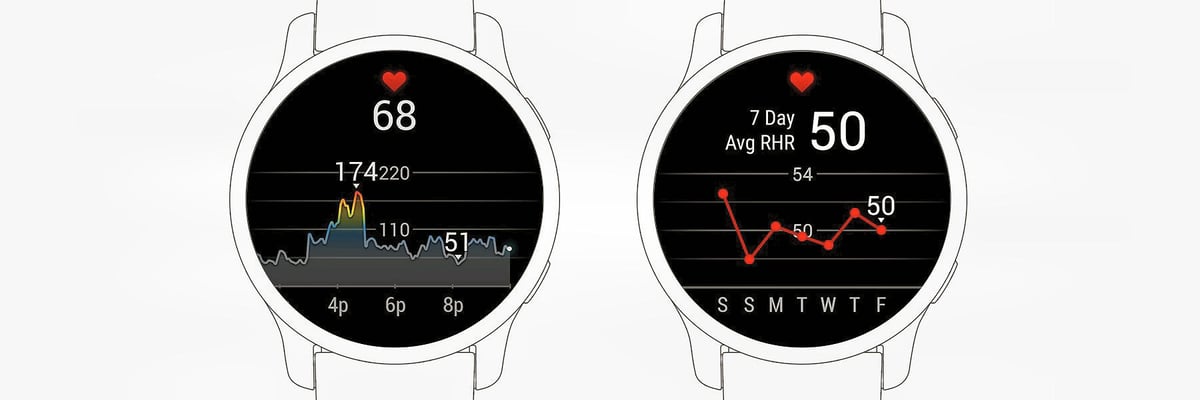
Max heart rate is expressed in beats per minute (bpm) and represents an absolute physiological ceiling rather than a target. A higher max heart rate does not indicate greater fitness. Two athletes with identical VO2 max values can have max heart rates 20 bpm apart.
The figure does carry age-related significance. Max heart rate declines at approximately one beat per minute per year from early adulthood. An athlete in their fifties will typically have a substantially lower max heart rate than the same athlete measured in their twenties, regardless of how well they have maintained aerobic fitness. Sex differences are present but smaller in magnitude than age effects and do not materially alter zone boundaries when an accurate individual max is available.
How Garmin Calculates It
Garmin allows max heart rate to be set in one of three ways: auto-detection from recorded activity data, entry of a manually tested value, or acceptance of the age-based formula. The default on most devices is the formula (208 − 0.7 × age) applied to the birth date entered during device setup.
The auto-detect function monitors peak heart rate across recorded activities and updates the stored max when a new peak is observed. This update is one-directional: Garmin raises the value when a higher reading is recorded, but does not lower it automatically if no new peak is reached over subsequent weeks. The watch requires a recorded activity with heart rate data for auto-detection. It does not update from resting or sleep data.
When auto-detection is off, and no manual value has been entered, the age-based formula remains in effect for all downstream calculations. The formula produces a population average, not an individual measurement, and the standard deviation around published estimates is approximately ten to twelve beats per minute, meaning the formula value can be materially wrong for a substantial proportion of athletes.
| Age (years) | Estimated HRmax (bpm) 208 − 0.7 × age |
Typical range ± 1 SD (bpm) |
|---|---|---|
| 20 | 194 | 187–201 |
| 25 | 190 | 183–197 |
| 30 | 187 | 180–194 |
| 35 | 184 | 177–191 |
| 40 | 180 | 173–187 |
| 45 | 177 | 170–184 |
| 50 | 173 | 166–180 |
| 55 | 170 | 163–177 |
| 60 | 166 | 159–173 |
| 65 | 163 | 156–170 |
| 70 | 159 | 152–166 |
Source: Tanaka et al, 2001
What Affects the Reading
Heat and humidity raise the heart rate response to a given workload without raising the true physiological maximum. An athlete running in a hot environment may observe the highest heart rate figure of their season without having produced a genuine maximal effort. Garmin will record this peak and may raise the stored max accordingly, potentially inflating all zone thresholds.
Wrist-based optical heart rate sensors introduce measurement artefacts, particularly during high-intensity intervals and sprints where arm movement and skin contact vary. The watch may record a transient spike above the athlete’s true maximum due to motion interference rather than genuine cardiac output. Using a chest strap heart rate monitor during efforts intended to establish or verify max heart rate substantially reduces this risk.
Illness and overreaching elevate resting and submaximal heart rate but do not raise true max heart rate. An athlete with a high heart rate during illness may attribute poor performance to poor fitness rather than recognising cardiac drift as a physiological warning sign.
Activity type affects the observed maximum. Running typically produces the highest max heart rate values in most athletes. Cycling produces values five to ten beats lower on average, and swimming lower again, due to differences in muscle mass recruited, body position, and the cooling effect of water. Garmin supports sport-specific heart rate zones on the Fenix 8 series and Forerunner 970, allowing a separate max heart rate to be configured for each sport profile. On devices without this capability, a single max heart rate value applies across all activities, which will produce systematically miscalibrated zones in at least one sport.
Treadmill running at a steep grade or with forced-pace protocols can produce peak heart rates higher than the athlete typically reaches during road or track sessions. These values are valid measurements of physiological maximum if the effort was genuinely maximal, but should be verified against a second test before being accepted as the stored figure.
How Accurate Is It
The 220-minus-age formula is the most widely cited population estimate but carries a known margin of error. A meta-analysis by Robergs and Landwehr (2002) reviewed published formulas and found standard deviations of ten to twelve beats per minute around age-predicted values, with some individuals differing from the formula by twenty beats or more. The formula is a statistical convenience, not a measurement.
A directly measured max heart rate — obtained in a graded exercise test to volitional exhaustion — is accurate to within the measurement error of the heart rate sensor used. Chest strap monitors validated against electrocardiography show mean absolute errors of one to two beats per minute in controlled conditions. Optical wrist sensors exhibit higher error under motion artefact conditions. Where the goal is accurate zone training rather than approximate zone training, a laboratory or field test to establish a true maximum is the most reliable approach.
Competitor Equivalents
- Polar: Polar devices support manual entry and auto-detection of max heart rate, with sport-specific zones available on the Polar Vantage and Grit X series. Polar’s age-based default formula (211 minus 0.64 × age) differs from Garmin’s 220-minus-age default and yields slightly different values for athletes over 40.
- Apple: Apple Watch estimates max heart rate from workout data and uses it to calculate cardio fitness (VO2 max equivalent). Apple does not expose the stored max heart rate figure directly to the wearer, and manual entry is not available; this limits an experienced athlete’s ability to override an incorrect auto-detected value.
- Coros: Coros supports manual entry of max heart rate and auto-detection. Zones are calculated from the stored max using the same percentage-of-maximum method as Garmin. Sport-specific zone sets are available on the Vertix 2S and Apex 2 Pro.
- Suunto: Suunto Race and Suunto Vertical support manual entry and auto-detection. Suunto’s default formula is 220 minus age, matching Garmin’s approach. Heart rate zones can be based on either maximum heart rate or lactate threshold heart rate, selectable per sport.
- Wahoo: Wahoo ELEMNT head units store a single max heart rate value used for zone calculation across all activities. Manual entry only; no auto-detection from ride data. The approach is functional but less integrated than Garmin’s multi-sport zone architecture.
Which Garmin Devices Support It
Garmin introduced max heart rate as a manually configurable athlete profile setting on the Forerunner 305 in 2006, the first Garmin GPS running watch to display heart rate zones derived from a stored HRmax value.
Max heart rate storage and manual entry are available across the full current Garmin lineup, including entry-level devices such as the Forerunner 55 and Forerunner 165. All devices apply the stored value to heart rate zone calculation regardless of whether it was auto-detected or manually entered.
Sport-specific heart rate zones — which allow a different max heart rate to be stored and applied per sport profile — are available on the Fenix 8 series (including Fenix E and Enduro 3), the Forerunner 970, the Forerunner 570, the Venu 4, the Venu X1, and later models in the same tier. The Forerunner 265 and Forerunner 165 use a single global max heart rate value across all sport profiles. The Forerunner 55 similarly operates with a single global value.
Auto-detection of max heart rate from activity data is supported on mid-tier and above devices. The Forerunner 165 and Forerunner 55 rely on manual entry or the age-based formula. On all devices in the Fenix 8 platform — including the Tactix 8, Quatix 8, and D2 Mach 2 — auto-detection operates across all recorded activities with heart rate data from the Elevate Gen 5 optical sensor or a paired chest strap.
Where to Find It
On the watch, the max heart rate is not displayed as a standalone widget. It is accessed via the device settings menu under User Profile, then Heart Rate, where the auto-detect toggle and the manual entry field are both located. The current stored value is visible in this menu at all times.
In the Garmin Connect mobile app, max heart rate is found under More, then Settings, then User Settings, then Heart Rate. The same manual entry and auto-detect toggle are available here. Garmin Connect mobile does not display a historical trend chart for max heart rate; it shows only the current stored value.
On the Garmin Connect web, max heart rate is accessible under the account menu at the top right, then Settings, then User Settings. The web interface mirrors the app for entry and toggle control. Heart rate zone ranges derived from the stored max are visible in the Health Stats section under Heart Rate Zones, and the section updates dynamically when the stored max is changed.
No Garmin Connect Plus subscription is required to view or edit max heart rate. The setting and its downstream zone calculations are available on all Garmin Connect tiers.
Common Problems and Misreadings
An athlete who has never reached true maximal effort during a recorded workout will find that the auto-detected value is lower than their physiological maximum. Every heart rate zone will then be set too low, making Zone 2 efforts feel easy, and Zone 4 efforts appear sub-threshold on the watch. The fix is to enter a verified max from a dedicated field test rather than relying on values accumulated from moderate training sessions.
Optical sensor artefacts during high-intensity intervals can produce readings above the athlete’s true maximum. When Garmin auto-detects one of these spikes and raises the stored value, all zone thresholds shift upward, making subsequent sessions appear easier than they are. Reviewing the heart rate trace from the suspect activity in Garmin Connect and cross-referencing with perceived exertion will usually identify an artefact reading. Resetting the stored value manually corrects the downstream zones.
Athletes who train across multiple sports frequently encounter the single-global-max problem on devices that lack sport-specific zones. A running max of 185 bpm, used as the ceiling for cycling zones, will place easy cycling rides in a zone below their true aerobic demand. The same value applied to swimming will exaggerate the difficulty of pool sessions. On devices that support sport-specific zones, configuring separate maxima for run, cycle, and swim resolves this systematically.
The watch’s stored max heart rate does not automatically sync to Garmin’s VO2 max calculation in the same update cycle. Following a manual change to the stored max, running an activity that meets the conditions for a VO2 max recalculation is necessary before the VO2 max figure reflects the updated zone calibration.
Some athletes interpret a declining max heart rate reading over time as evidence of overtraining or illness. This is not necessarily the correct interpretation. Auto-detection only raises the stored value, never lowers it, so a declining trend cannot appear in the auto-detected figure without manual intervention. If an athlete believes their true maximum has changed — which occurs naturally with age — the stored value should be updated manually after a fresh maximal test.
How to Improve It
Max heart rate is not meaningfully trainable in the way that VO2 max or lactate threshold are. It is a genetic ceiling that declines with age. The goal is not to raise max heart rate but to accurately know it, so that all downstream training metrics are calibrated correctly.
The most reliable method for establishing a true max heart rate is a graded exercise test performed to exhaustion. On a track or treadmill, run at progressively increasing pace over ten to fifteen minutes, finishing with a maximal sprint of sixty to ninety seconds. Record the peak heart rate from a chest strap monitor. Repeat the test on a second occasion within two weeks. If both results differ by two to three beats, accept the higher value as the stored figure.
For athletes who train with a power meter on the bike or use a structured running protocol, an interval session designed to elicit maximal cardiovascular effort — such as four-minute intervals at race pace with short recoveries — typically produces readings within three to five beats of the laboratory-measured maximum. These field tests are less controlled than graded exercise tests but are sufficient for practical zone calibration in most training contexts.
Other Points
A higher age-predicted HRmax reserve — the gap between resting heart rate and max heart rate — is associated with reduced risk of all-cause and cardiovascular mortality in large population studies. Research by Kodama et al., published in JAMA in 2009, pooled data from 33 cohort studies covering over 100,000 participants and found that each 3.5 ml/kg/min increment in cardiorespiratory fitness was associated with a 13 per cent reduction in all-cause mortality and a 15 per cent reduction in cardiovascular events. Max heart rate is one component of the physiological substrate underlying cardiorespiratory fitness, though the mortality association is driven by fitness capacity rather than by the HRmax figure in isolation.
Frequently Asked Questions
- How do I set the max heart rate manually on my Garmin? On the watch, navigate to Settings, then User Profile, then Heart Rate. Select Max. HR and enter the value directly. The same field is accessible in the Garmin Connect mobile app under More, Settings, User Settings, Heart Rate. Changes sync to the watch on the next Bluetooth connection.
- Should I turn auto-detect on or off? Auto-detect is useful if the stored value is the default age-based estimate and the athlete has not performed a dedicated max test. It will raise the figure over time as genuine high-intensity efforts are recorded. Turn it off once a verified, manually tested max is entered — otherwise, a motion artefact spike from an optical sensor could overwrite a known-accurate value.
- Why does my Garmin show a different max heart rate than my phone’s health app? Apple Health, Google Fit, and similar platforms calculate or infer max heart rate independently, using their own age-based formulas or observations of peak readings from connected sensors. Garmin’s stored value and the figure used by a third-party health platform are not automatically synchronised. Each system operates its own calculation independently.
- Does max heart rate affect VO2 max on Garmin? Yes. Garmin’s VO2 max estimate, developed by Firstbeat Analytics, uses the relationship between heart rate and pace (or power) relative to the stored max. An incorrect (high) max heart rate causes the algorithm to overestimate VO2 max by making training efforts appear easier than they are. The accuracy of the max heart rate figure is a prerequisite for accurate VO2 max estimation.
- My max heart rate has dropped since I started training hard. What does that mean? The auto-detected stored value cannot drop on its own — Garmin only updates it upward from new peaks. A lower figure will only appear if it has been entered manually or if the device was reset. If perceived max effort during workouts now yields a lower peak than it did previously, this may reflect cumulative fatigue, improved pacing discipline, or the natural age-related decline in max heart rate. A controlled field test will establish whether the physiological maximum has genuinely changed.
- Can I set different max heart rates for running and cycling on Garmin? Sport-specific heart rate zones, including sport-specific max heart rate, are supported on the Fenix 8 series, Forerunner 970, Forerunner 570, Venu 4, and Venu X1. On these devices, navigate to the sport profile settings for each activity and configure a separate max. On earlier or entry-tier devices, a single global value applies across all activities.
Scientific Basis
- Robergs, R.A. & Landwehr, R. (2002). “The surprising history of the HRmax=220-age equation.” Journal of Exercise Physiology Online. Reviewed the derivation and statistical validity of age-predicted formulas, finding standard deviations of ten to twelve bpm around population means and substantial individual variation.
- Tanaka, H., Monahan, K.D. & Seals, D.R. (2001). “Age-predicted maximal heart rate revisited.” Journal of the American College of Cardiology. Proposed the revised formula 208 minus 0.7 × age based on a larger and more broadly sampled dataset than the 220-minus-age derivation; found the revised formula reduced but did not eliminate individual prediction error.
- Firstbeat Analytics (2014). “Automated Fitness Level (VO2max) Estimation with Heart Rate and Speed Data.” Firstbeat Technologies white paper. Documents how Firstbeat’s algorithm uses the ratio of heart rate response to exercise intensity, anchored to stored max heart rate, to produce running VO2 max estimates without a laboratory test.
- Achten, J. & Jeukendrup, A.E. (2003). “Heart rate monitoring: applications and limitations.” Sports Medicine. Reviews the relationship between max heart rate, heart rate zones, and training prescription, noting the dependency of all percentage-of-maximum zone schemes on the accuracy of the underlying max figure.
How It Connects to Other Features
Max heart rate is the calibration anchor for [LINK: heart-rate-zones] on every Garmin device. Without an accurate stored maximum, percentage-of-maximum zone boundaries are systematically offset, and every training metric that references zone distribution — including Training Load, [LINK: training-effect], and [LINK: load-focus] — is calculated against an incorrect baseline.
The [LINK: vo2-max] estimate produced by Firstbeat Analytics on Garmin devices uses the relationship between observed heart rate and running pace relative to the stored max heart rate. An inflated max causes the algorithm to underestimate cardiovascular demand and produce a higher VO2 max figure; a deflated max causes the opposite effect. The stored max heart rate should be verified before treating a VO2 max trend as meaningful.
On devices that support sport-specific zones — including the Fenix 8 series and Forerunner 970 — max heart rate feeds independently into the zone configuration for each sport profile. This directly affects [LINK: training-effect] classification in cycling and swimming activities, where a running-derived max would lead to systematic inaccuracies in categorising aerobic and anaerobic effort.
Lactate threshold heart rate, an alternative calibration anchor for zone prescription, is calculated relative to max heart rate in some presentations and independently in others. Garmin’s lactate threshold detection identifies a threshold heart rate as an absolute value in bpm, but the placement of that threshold as a percentage of maximum — and the zone structure that follows — depends on the accuracy of the stored max. When both lactate threshold and max heart rate are available, reviewing the ratio between them (a threshold heart rate typically falls between 85 and 95 per cent of maximum for trained athletes) provides a useful cross-check to see whether either figure is implausible.
