| Manufacturer | Huawei |
|---|---|
| Type | Basic fitness band |
| Series | Band |
| Released | Announced 26 February 2026, on sale from early March 2026 |
| Price at launch | GBP £39.99 (durable polymer case) to £49.99 (aluminium alloy case) |
| Predecessor | Huawei Band 10 |
| Successor | Not yet announced. |
| Sizes | 42.6 x 28.2mm (single size) |
| Colours | Beige, Green, Purple, White, Black (aluminium alloy case); Purple, Black (durable polymer case) |
Specifications as at launch, sourced from Huawei’s official specification page.
Jump to: Expert opinion | What’s new | Specifications | Battery life
Expert opinion
The Band 11 is the Band 10 with a bigger, brighter screen and newer Bluetooth, for a few pounds more; GPS still isn’t part of the deal.
It carries over the same core health tracking as the Band 10: more than 100 workout modes, sleep-stage analysis, sleep breathing awareness, heart-rate variability, stress tracking and SpO2, through the Huawei Health app. The 1.62 inch AMOLED display runs to 286 x 482 pixels at 347 PPI and up to 1,500 nits peak brightness, a step up from the Band 10’s 1.47 inch screen, and Bluetooth moves to version 6.0. The case, aluminium alloy or polymer depending on colour, weighs around 16 to 17g without the strap. As with the Band 10, there’s no onboard GNSS, so phone-free outdoor route recording isn’t available, and Huawei’s battery figures are unchanged at up to 14 days light use, 8 days typical use and 3 days with the always-on display.
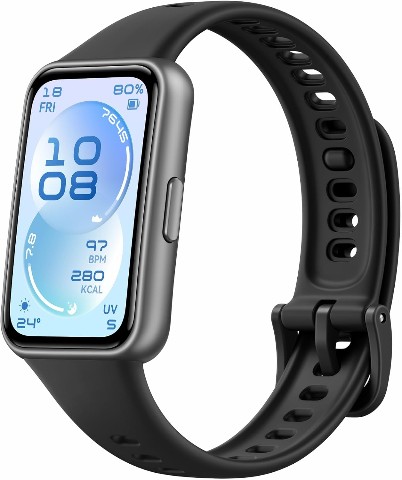
Huawei Band 11
A bigger, brighter screen than the Band 10, with the same two weeks of battery life.
What’s new versus the Band 10
Hardware
- Display grows to 1.62 inches from 1.47 inches, a 27 per cent increase in area per Huawei’s own figure, at 286 x 482 pixels and 347 PPI, up from 194 x 368 and 282 PPI
- Peak brightness rises to 1,500 nits, roughly three times the Band 10’s figure per Huawei’s own comparison
- Bluetooth upgraded to 6.0 from 5.0
- Case weight rises to approximately 17g (aluminium) or 16g (polymer), up from the Band 10’s 15g and 14g, a consequence of the larger screen
Software
- Sleep Breathing Awareness added as a new feature; not present on the Band 10
- Emotion and Stress Assistant Tracker named explicitly as part of the typical-use battery test conditions, where the Band 10’s equivalent test referenced automatic SpO2 monitoring and stress detection without this specific naming
- Battery life unchanged at up to 14 days maximum and 8 days typical use
Specifications
| Display | |
|---|---|
| Size | 1.62 inch |
| Type | AMOLED, touch and swipe gestures |
| Resolution | 286 x 482 pixels, 347 PPI |
| Physical | |
| Case size | 42.6 x 28.2 x 8.99mm. Thickness figure excludes the sensor area |
| Weight | Approximately 17g (aluminium alloy case) or 16g (durable polymer case), without strap |
| Case material | Aluminium alloy or durable polymer, depending on colour |
| Controls | Full-screen touch plus a single side button |
| Strap | Colour-matched fluoroelastomer |
| Wrist fit | 130 to 210mm (Black, Green, White) or 120 to 190mm (Purple, Beige) |
| Water rating | 5 ATM under ISO 22810:2010. Not rated for diving |
| Operating range | 0C to 35C |
| Sensors and positioning | |
| Sensors | 9-axis IMU (accelerometer, gyroscope, magnetometer), optical heart rate, ambient light. No ECG, no barometer, no onboard GNSS |
| Connectivity and storage | |
| Bluetooth | 2.4GHz, Bluetooth 6.0, BLE |
| Compatible systems | Android 9.0 and above, iOS 13.0 and above |
| Charging | Magnetic charging port, 5V/1A |
| Box contents | Band, charging cable, user guide, safety information, warranty card |
Battery life
Huawei quotes a maximum, typical-use and always-on display figure.
| Mode | Battery life |
|---|---|
| Maximum use | Up to 14 days |
| Typical use | Up to 8 days |
| Typical use, always-on display | Up to 3 days |
A full charge takes 45 minutes, from a 300mAh cell.
Small things I always use
- Garmin 90-degree charging adapter: Charges your Garmin from any USB-C cable. Essential when travelling. I use one.
- Body Glide: The blue anti-chafe stick swimmers and runners carry. I use it.
- Speedo earplugs: Fewer ear infections and no cold-water dizziness. I use them.
- Dryrobe Advance: My winter changing robe for open-water swims. I use one. A cheaper option is the AONYIYI changing robe.
- Maurten: Race fuel that stays easy on the stomach. I use them.
- Beet It Sport nitrate shots: Beetroot shots I take in the days before a race. I use them.
- Garmin charging puck: The quickest way to top up before a session. I use one.
- Injinji: Toe socks that stop rubbing, so you run more. I use them.
- Ultimate toe protectors: Stop black toenails on long runs. They work. I use them.
- Compressport R2 v2 calf sleeves: My calf sleeves of choice. I use them.
- Cellucor C4: My pre-workout before hard sessions.
- TPU tubes: Schwalbe Aerothan, Tubolito and Pirelli SmarTube. Light, tiny spares. I use all three.
- G8 insoles: Adjustable insoles that are good. I use them.
- Cycplus Cube: A 97g electric pump that gets a road tyre rideable in two minutes. I carry one. 5% off with code THE5KRUNNER.
Watches and sensors
- Polar H10: My daily driver for waking HRV.
- Polar Verity Sense: My backup arm-worn HR sensor.
- Nomad bedside charger: Charges my iPhone and Apple Watch overnight. I use it, and many of their bands.
- Train.Red: The best muscle oxygen sensor I’ve used.
- Tymewear: Accurate heart rate and reliable ventilatory zones. I use it to pace endurance rides over an hour.
- Garmin Forerunner 970: A pro-grade triathlon watch. I use this.
- Apple Watch Ultra 4: My daily smartwatch. No phone needed on rides.
- Garmin Fenix 9 Pro: I’ve just bought one.
On the bike
- Continental GP5000 for everyday riding, and Aero 111 on the front for special occasions.
- Helmets: Specialized S-Works Evade 3 for road riding, and Rudy Project Wing for TT-style races. I use both.
- Ravemen FR300: A front light that mounts under your Garmin or Wahoo. I use one.
- Ravemen FR1000: The light and the computer mount in one unit, so nothing else goes on the bars. Better than mine.
- Ravemen FR1500SE: 1,500 lumens hanging under your Garmin, for proper night rides.
- Ravemen FR1100SE: 1,100 lumens under your Garmin, and up to 46 hours on slow flash.
- Ravemen FR500: A brighter FR300 with the same mount.
- Wahoo TRACKR Radar: I use it on one bike and Varia on the other. They perform the same.
- Garmin Varia RTL515: Radar that warns you of cars from behind. I use this model.
- Wahoo ELEMNT Roam 3: The bike computer that’s easy to use. I use mine on most rides.
- Favero Assioma Pro RS2: Accurate power pedals that swap easily between bikes. I use this model.
Home and indoor training
- NPE Runn: Makes my basic treadmill smart, sending more accurate speed and distance to my watch and Zwift. I use it.
- Google Wifi: Keeps Zwift connected in my pain cave. I use it.
- Apple TV 4K: Zwift on the big screen. I use two.
- Google Nest Doorbell (wired, 2nd gen): My video doorbell, running in both Google Home and Apple Home. I use it.
Health, recovery and sleep
- FreeStyle Libre 3 Plus: Shows how my blood sugar responds to diet.
- hDrop: Measures my sweat loss in summer and indoors.
- Fourth Frontier Zone: Checks my heart under load in hard sessions.
- Kineon MOVE+: Red and infrared light for sore knees, Achilles and other joints after hard training. I use it.
- Oura Ring 5: My partner’s recovery tracker of choice.
- Eight Sleep: A cooling mattress cover my partner and I use nightly.
Reader-Powered Content

This content is not sponsored. It’s mostly me behind the labour of love, which is this site, and I appreciate everyone who supports it.
Support the site: Follow (free, fewer ads) · Subscribe (paid, ad-free) · Buy Me A Coffee
Written by real people, with AI assistance. Fact-checked and verified for originality. See the Editorial Policy. FTC: Affiliate Disclosure — some links pay commission. As an Amazon Associate, I earn from qualifying purchases.
