| Manufacturer | Huawei |
|---|---|
| Type | Blood pressure monitoring smartwatch |
| Series | Watch D Series |
| Released | September 2024, refreshed with new colourways in September 2025 |
| Price at launch | GBP £350 at current UK retail. USD and EUR pricing not confirmed. |
| Predecessor | Huawei Watch D |
| Successor | Huawei Watch D3, launched 2 September 2026 |
| Sizes | One case size (48 x 38mm), M and L strap options |
| Colours | Blue, Black, Gold |
Specifications as at launch, sourced from Huawei’s official specification page.
Jump to: Expert opinion | Clinical validation | Specifications | Battery life | Comparisons
Expert opinion
The Watch D2’s real distinction against every optical blood-pressure watch on the market is mechanical, not algorithmic: a genuine inflatable cuff built into the strap measures pressure by compressing the wrist artery, the same oscillometric principle used by a clinical upper-arm monitor, rather than estimating it from a pulse waveform. Huawei quotes six days of typical battery life, falling to a single day with 24-hour ambulatory monitoring enabled, a real cost for continuous clinical-style data rather than a single daily reading. The design carries the bulk an inflatable mechanism requires, and the watch trails Huawei’s mainstream models on smart features and app support.
Clinical validation
An independent validation study by Zhou et al., published in Hypertension Research in 2025, tested the Watch D2 against a mercury sphygmomanometer in 85 subjects at rest and against a cuff-based ambulatory monitor (A&D TM-2430) in 35 subjects over a full 24-hour period. Mean differences at rest were -1.6/-1.9 mmHg for systolic and diastolic pressure against the reference device, narrowing slightly to -1.1/1.0 mmHg across the full 24-hour ambulatory comparison. The study concluded the Watch D2 met the AAMI/ESH/ISO Universal Standard (ISO 81060-2:2018/AMD1:2020) for both rest and ambulatory blood pressure measurement, and found acceptable agreement against 24-hour ABPM specifically, the harder test given continuous real-world conditions rather than a single seated reading. The lead author discloses fees from several blood pressure device manufacturers, including a Huawei competitor, though not from Huawei itself. Full citation: Zhou Y, Zhang W, Wang XY, Zhou Y, Li Y, Wang JG. Accuracy of a wearable watch-type oscillometric blood pressure monitor in rest and ambulatory blood pressure measurements. Hypertens Res 48(11):2961-2968, 2025. PMID: 40866549.
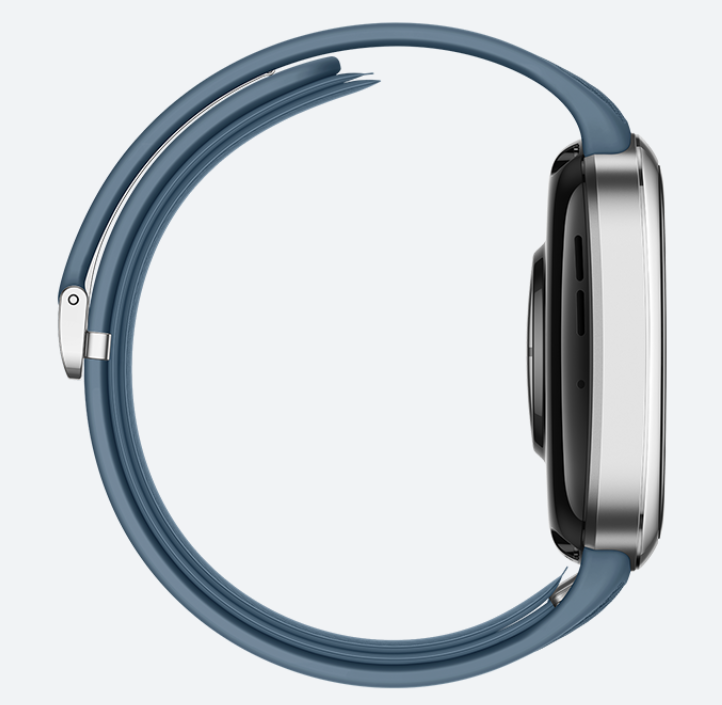
Huawei Watch D2
Micro-pump inflatable cuff, 24-hour ambulatory blood pressure monitoring. Measures pressure directly, no optical calibration required.

Specifications
| Display | |
|---|---|
| Size | 1.82 inch |
| Type | AMOLED |
| Resolution | 480 x 408 pixels, 347 PPI |
| Physical | |
| Case size | 48 x 38 x 13.3mm. Thickness figure is at the case’s thinnest point, excluding the sensor area |
| Weight | Approximately 40g without strap |
| Case material | Aluminium alloy |
| Controls | Rotating crown, function and ECG button |
| Strap | Blue composite leather, black fluoroelastomer, or white composite leather. Airbag strap, 26.5mm width, M (130 to 160mm) and L (161 to 210mm) sizes supplied |
| Water rating | IP68. Not designed for swimming, showering or any activity involving water immersion |
| Operating temperature | 5C to 40C. Storage/transport: -20C to 55C |
| © the5krunner. Link required. | |
| Sensors and positioning | |
| Sensors | 9-axis IMU (accelerometer, gyroscope, magnetometer), optical heart rate, ECG, ambient light, barometer, temperature, differential pressure (the blood pressure cuff sensor), Hall sensor |
| GNSS | Not listed on the official specification page |
| Connectivity and storage | |
| Bluetooth | Bluetooth 5.2, BR and BLE, 2.4GHz |
| NFC | Supported. Availability varies by country and region |
| Compatible systems | Android 8.0 and above, iOS 13.0 and above |
| Charging | Wireless only, 5V/1A |
| Box contents | Device with L-sized airbag strap and short strap, M-sized airbag strap, wrist circumference ruler, charging cradle with cable, quick start guide, safety information, warranty card, wearing guide |
Battery life
Huawei’s typical-use figure assumes six blood pressure measurements and five ECG measurements a day. Enabling 24-hour ambulatory blood pressure monitoring (ABPM), which takes a reading roughly every 15 minutes around the clock, cuts battery life sharply.
| Mode | Battery life |
|---|---|
| Typical use | Up to 6 days |
| ABPM enabled (15-minute intervals) | Up to 1 day |
| © the5krunner. Link required. | |
Comparisons and upgrade guides
- Huawei Watch D3 vs D2, whether the newer model is worth the premium
