| Manufacturer | Huawei |
|---|---|
| Type | Rectangular GPS fitness watch |
| Series | Watch Fit |
| Released | 15 May 2025 (announced), 26 May 2025 (on sale) |
| Price at launch | GBP £149.99, EUR €169.99. Not officially sold in the United States. |
| Predecessor | Huawei Watch Fit 3 |
| Successor | Huawei Watch Fit 5 |
| Sizes | 43 x 38mm (single size) |
| Colours | Purple, White, Black, Gray |
Specifications as at launch, sourced from Huawei’s official product page. Some figures come from the page’s own Fit 4 vs Fit 4 Pro vs Fit 3 comparison table rather than a dedicated specifications tab.
Jump to: Expert opinion | What’s new | Specifications | Battery life
Expert opinion
The Fit 4 sits below Huawei’s GT and Watch lines specifically because it drops the ECG sensor and premium case materials both carry, in exchange for a lower price and a smaller, lighter body. Dual-band GNSS and a barometer, both added over the Fit 3, bring its positioning and altitude tracking closer to Huawei’s pricier watches despite the basic aluminium case. Huawei quotes up to 10 days of battery life in light use, falling to 4 days with the always-on display enabled, in the same range as most rivals at this price. NFC payment support was new to this generation; Bluetooth calling and a full smartwatch app catalogue were not.
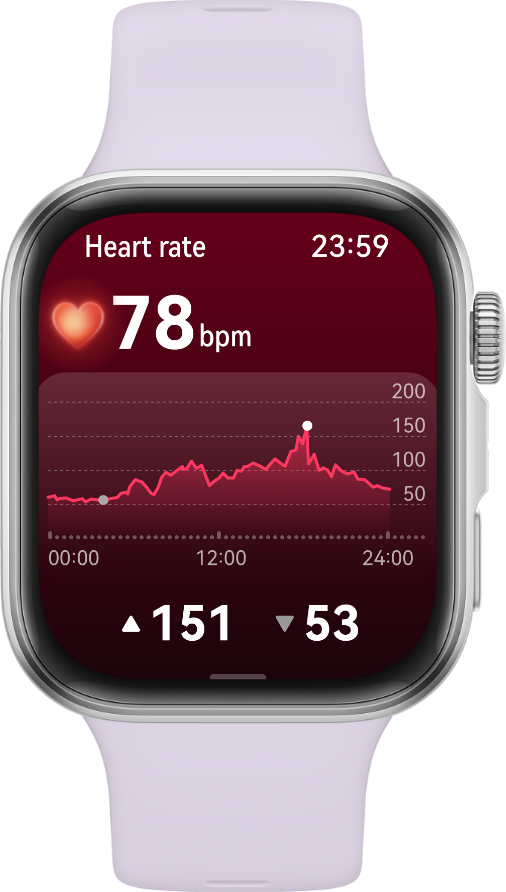
Huawei Watch Fit 4
Heart rate and SpO2 tracking with dual-band GNSS positioning, in an aluminium case rated for up to 10 days of battery life.

What’s new versus the Watch Fit 3
Hardware
- Case grows slightly to 43 x 38 x 9.5mm from the Fit 3’s 43.2 x 36.3 x 9.9mm, though the watch is marginally thinner and heavier, at approximately 27g versus the Fit 3’s approximately 26g
- Screen brightness rises to 2,000 nits peak, up from 1,500 nits on the Fit 3
- GNSS upgraded to dual-band, five-system positioning (the HUAWEI Sunflower Positioning System), from the Fit 3’s single-band, five-system GNSS
Software
- HRV measurement and Health Insight added; neither feature was on the Fit 3
- Barometer added, enabling altitude, accumulated ascent and storm-warning data; the Fit 3 had no barometer
- Water sport route tracking added, covering sailing, rafting, motorboating and rowing; not available on the Fit 3
- Offline map route navigation added; the Fit 3 had none
- NFC payment added; the Fit 3 did not support it
- Battery life unchanged at up to 10 days maximum use
Specifications
| Display | |
|---|---|
| Size | 1.82 inch, 80 per cent screen-to-body ratio |
| Type | AMOLED |
| Resolution | 480 x 408 pixels |
| Brightness | Up to 2,000 nits peak |
| Physical | |
| Case size | 43 x 38 x 9.5mm. Thickness figure excludes the sensor area |
| Weight | Approximately 27g without strap |
| Case material | Aluminium alloy |
| Controls | Rotating crown (home button) and a customisable side button |
| Strap | Fluoroelastomer or woven nylon |
| Water rating | 5 ATM. Rated for swimming, not for freediving |
| Sensors and positioning | |
| Sensors | Optical heart rate and SpO2 (multi-channel module), barometer. No ECG sensor |
| GNSS | Dual-band, five-system GNSS (HUAWEI Sunflower Positioning System) |
| Connectivity and storage | |
| NFC | Supported |
| Bluetooth calling | Supported, via the Huawei Health app |
| Compatible systems | Android 8.0 and above, iOS 13.0 and above, with the Huawei Health app installed |
| Charging | Wireless only, 2nd-generation HUAWEI Wireless SuperCharger, 75 minutes for a full charge |
Battery life
Huawei’s typical-use figure assumes 180 minutes of exercise a week with stress monitoring and sleep tracking enabled; the maximum figure assumes lighter 90-minutes-a-week use with those extra monitoring features off.
| Mode | Battery life |
|---|---|
| Maximum use | Up to 10 days |
| Typical use | Up to 7 days |
| Typical use, always-on display | Up to 4 days |
