| Manufacturer | Huawei |
|---|---|
| Type | Lightweight GPS running watch |
| Series | Watch GT Runner |
| Released | Announced late February 2026 around MWC 2026. Security update window begins 31 March 2026, indicating that as the on-sale date |
| Price at launch | GBP £349, EUR €399 |
| Predecessor | Huawei Watch GT Runner |
| Successor | Not yet announced. |
| Sizes | 43.5mm (single size) |
| Colours | Racing Legend, Dusk Blue, Dawn Orange, Midnight Black |
Specifications as at launch, sourced from Huawei’s official specification page.
Jump to: Expert opinion | What’s new | Specifications | Battery life
Expert opinion
Over four weeks of testing, the GT Runner 2’s GPS produced some of the best tracks I’ve recorded from any watch in difficult conditions: through a fifty-metre tunnel, alongside eight-storey buildings, and across forty switchback turns, output measurably ahead of the Apple Watch Ultra 3 and Garmin Forerunner 970 tested alongside it. That same watch scored 90 per cent on my standard ten-mile test, tied with the Ultra 3 but behind the Suunto Vertical, Coros Pace 3 and Forerunner 970’s shared 92 per cent, a result driven by occasional inconsistency in easy, open conditions rather than the difficult ones. Heart rate tracking held up across running and cycling closely enough that I used it in place of a chest strap, a rare result for a wrist sensor in my testing; it failed during swimming and briefly overestimated during one steady-state run. Battery life needed only two charges across the full test period. The Huawei Health app remains the weak point: reliable and feature-rich, but built for general fitness rather than a running-first Western audience, and third-party integration trails Garmin’s.
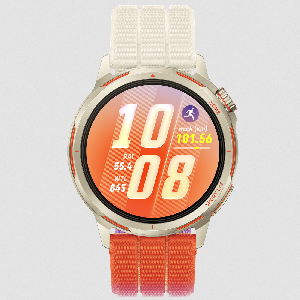

What’s new versus the Watch GT Runner
Figures below are drawn from the site’s own Watch GT Runner 2 review, which compiled a direct comparison table against the original Watch GT Runner.
Hardware
- Case shrinks to 43.5mm from 46.4mm, and thins to 10.7mm from 11mm. Body weight drops to approximately 34.5g from 38.5g
- Case material changes to titanium alloy front with fibre-reinforced composite rear, from the original’s durable polymer fibre
- Screen crystal upgraded to Kunlun Glass 2, harder than Gorilla Glass and less brittle than sapphire; the original used a curved glass lens
- Display shrinks to 1.32 inches from 1.43 inches at the same 466 x 466 resolution; peak brightness rises to a stated 3,000 nits from approximately 564 nits measured on the original
- GPS antenna design changes to a dielectric bezel, where the bezel itself acts as the antenna, from the original’s floating antenna design
- GNSS gains tri-band BeiDou reception and NavIC; the original supported dual-band, five-system reception without either
- ECG sensor added; the original had none
- Water rating gains IP69 and freediving certification to 40m; the original was rated 5 ATM only
- Bluetooth upgraded to 6.0 from 5.2
Software
- Running power, dynamic lactate threshold and Marathon Mode added; the original offered an AI running coach and Running Ability Index without these
- Trail running, freediving and golf with maps added as new sport modes
- Outdoor workout GPS battery life rises to a tested 32 hours from the original’s stated 20 hours. Typical battery life is unchanged at 14 days
Specifications
| Display | |
|---|---|
| Size | 1.32 inch |
| Type | AMOLED |
| Resolution | 466 x 466 pixels, 352 PPI |
| Lens | 2nd generation Kunlun Glass |
| Physical | |
| Case size | 43.5 x 43.5 x 10.7mm |
| Weight | Approximately 34.5g without strap |
| Case material | Titanium alloy front, high-performance fibre-reinforced composite rear |
| Controls | Home button (rotating crown) and side button |
| Strap | Each colourway ships with a colour-matched HUAWEI AirDry woven strap and a fluoroelastomer strap |
| Wrist fit | 120 to 190mm |
| Water rating | 5 ATM and IP69. Rated for freediving to 40m under EN13319 |
| Operating range | -20C to +45C |
| Sensors and positioning | |
| Sensors | Accelerometer, gyroscope, magnetometer, optical heart rate, barometer, temperature, ambient light, ECG, depth |
| GNSS | GPS (L1 and L5 dual-band), GLONASS, BeiDou (B1I, B1C and B2a tri-band), Galileo (E1 and E5a dual-band), QZSS (L1 and L5 dual-band), NavIC |
| Connectivity and storage | |
| Bluetooth | Bluetooth 6.0, BR and BLE, 2.4GHz |
| NFC | Supported |
| Compatible systems | Android 9.0 and above, iOS 13.0 and above |
| Charging | Wireless only, 5V to 10V DC, 2A maximum |
Battery life
Huawei publishes a light-use, typical-use and outdoor-workout-mode figure. Across four weeks of mixed testing, the site’s review needed only two charges.
| Mode | Battery life |
|---|---|
| Light use | Up to 14 days |
| Typical use | Up to 7 days |
| Outdoor workout mode, continuous GPS | Up to 32 hours |
