Full specifications, features and battery life for the Suunto Vertical 2, the brand’s GPS multisport adventure watch with onboard maps.
| Manufacturer | Suunto |
| Type | GPS multisport adventure watch |
| Series | Vertical |
| Released | September 2025, deliveries from October 2025 |
| Price at launch | Steel: €599 / $599 / £529. Titanium: €699 / $699 / £629. |
| Predecessor | Suunto Vertical (2023) |
| Successor | — |
| Thickness | 13.6mm. Case diameter is not stated in official materials. |
| Weight | Steel 87g, titanium 74g |
Specifications and features as at launch.

Expert opinion | What’s new | Specifications | Battery life | Features | Further reading
Expert opinion
GNSS and altimetry test well; heart rate does not, using the same optical sensor generation as Race 2 rather than a newer one, with a stated accuracy of around ±3.7 BPM on steady runs that struggles further during HIIT. Suunto’s new Ambiq Apollo510 processor renders, pans and zooms onboard maps faster than Garmin’s, some of which take over 10 seconds to fully render. Battery life matches the outgoing Vertical 1 Solar’s 65-hour GNSS claim without solar charging, achieved through the AMOLED LTPO display’s variable refresh rate rather than a panel change. Suunto has no onboard map intelligence for automatic off-route rerouting; Garmin does, and Suunto routes rerouting through the phone app instead.
What’s new versus Vertical 1
Hardware
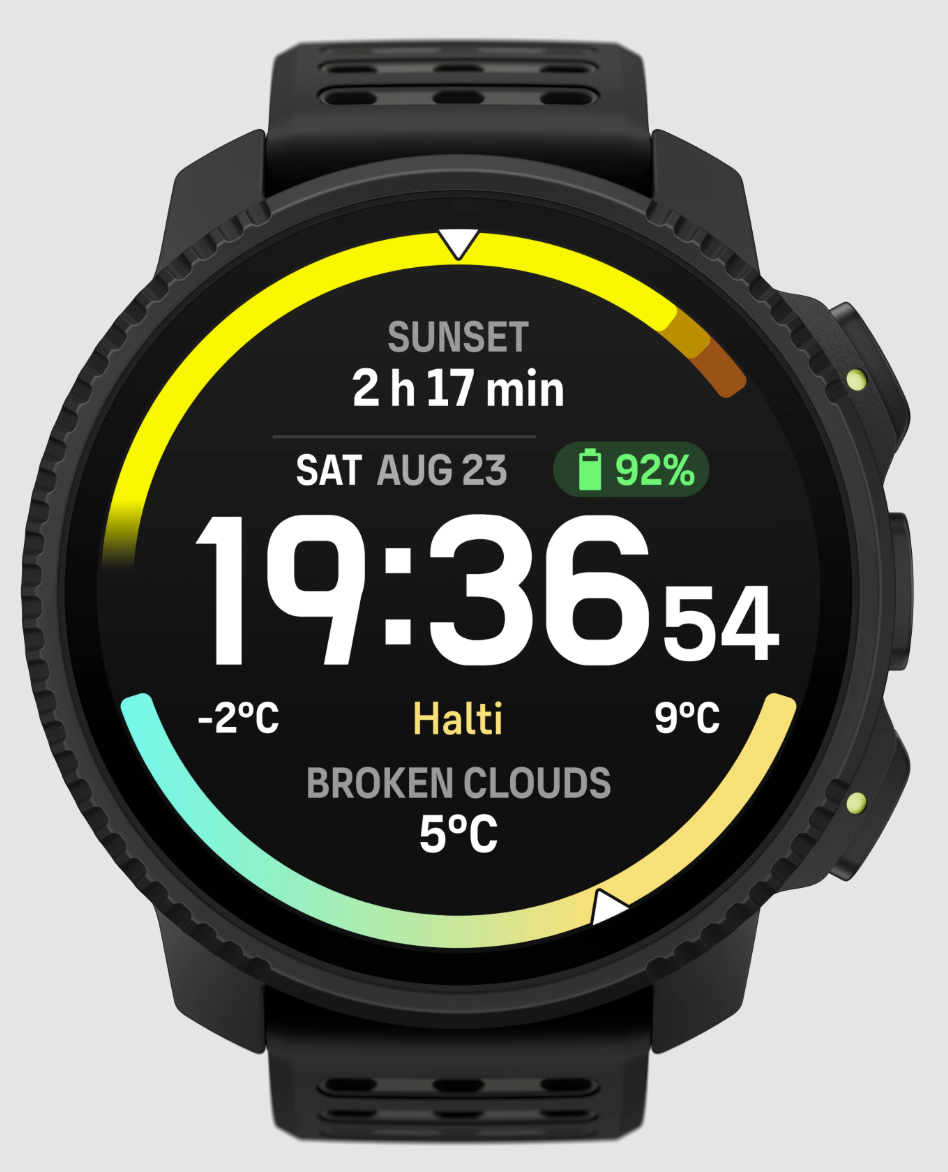
- Display changes from MIP to 1.5in AMOLED LTPO, 466 x 466px, 2,000 nits
- Solar charging removed
- New Ambiq Apollo510 SoC, Arm Cortex-M55 with Helium vector extensions, for a more responsive interface and faster map rendering
- Redesigned optical heart rate sensor, 6 LEDs and 4 photodetectors, still built on a dual-frequency Sony GNSS chipset
- LED flashlight added, integrated into the bezel: two white LEDs and one red, four white brightness levels, plus SOS and alert flashing patterns
Software
- Maps can now be downloaded without a charger connection
- Climb guidance added, showing a colour-coded elevation profile with POIs
- Mid-activity route swapping
- Multiple Bluetooth sensors of the same type can now be paired simultaneously, for example two heart rate straps or two power meters
- Custom multisport profiles added, shared with Race 2
- Training load and recovery widgets now use TrainingPeaks algorithms
Specifications
| Display | |
|---|---|
| Type | AMOLED, LTPO variable refresh rate |
| Size | 1.5in |
| Resolution | 466 x 466px |
| Brightness | 2,000 nits |
| Lens | Sapphire |
| Physical | |
| Weight | Steel 87g, titanium 74g |
| Thickness | 13.6mm |
| Case options | Stainless steel or titanium, military-grade case construction |
| Flashlight | Bezel-integrated LED: 2 white, 1 red. Four white brightness levels (25/50/75/100%), SOS and alert flashing patterns. |
| Sensors and positioning | |
| GNSS | Dual-frequency, Sony chipset |
| Optical heart rate | 6 LEDs, 4 photodetectors. Stated accuracy around ±3.7 BPM on steady-state runs; less reliable during HIIT. |
| ABC sensors | Altimeter, barometer, compass |
| Processor | Ambiq Apollo510 SoC, Arm Cortex-M55 with Helium vector technology |
| Connectivity and battery | |
| Wireless | Bluetooth, with simultaneous pairing of multiple sensors of the same type |
| Maps | Onboard, downloadable without a charger connection |
| App ecosystem | SuuntoPlus third-party app store |
| Battery, full GNSS recording | Up to 65 hours |
| Battery, smartwatch mode | Up to 20 days |
Battery life
Suunto claims up to 65 hours of continuous full-GNSS activity recording and up to 20 days in smartwatch mode. The 65-hour figure matches the outgoing Vertical 1 Solar model despite Vertical 2 dropping solar charging entirely, a result of the AMOLED LTPO panel’s variable refresh rate rather than any change to the battery cell itself.
Features
Full feature detail is covered on the Suunto specifications index.
Navigation
- Onboard maps, downloadable without a charger connection
- Climb guidance with colour-coded elevation profile and POIs
- Mid-activity route swapping
- No onboard map intelligence; off-route rerouting is handled through the Suunto app rather than on the watch
Training and multisport
- Custom multisport profiles, for structured brick workouts or triathlon combinations such as pool swim, road bike and cross-country run
- Training load and recovery widgets built on TrainingPeaks algorithms
- Simultaneous pairing of multiple Bluetooth sensors of the same type
LED flashlight
Bezel-integrated, with two white LEDs and one red. Four white brightness levels and SOS, pulsing and alert flashing patterns are available. Activating it mid-activity is currently awkward; Suunto has said this will be addressed in a future update.
Further reading
Related
Race 2 shares the same internals in a slimmer case with a digital crown rather than a full button interface, and a shorter 55-hour GNSS battery claim.
