ANT+ Is Dying a Slow Death: One Year On
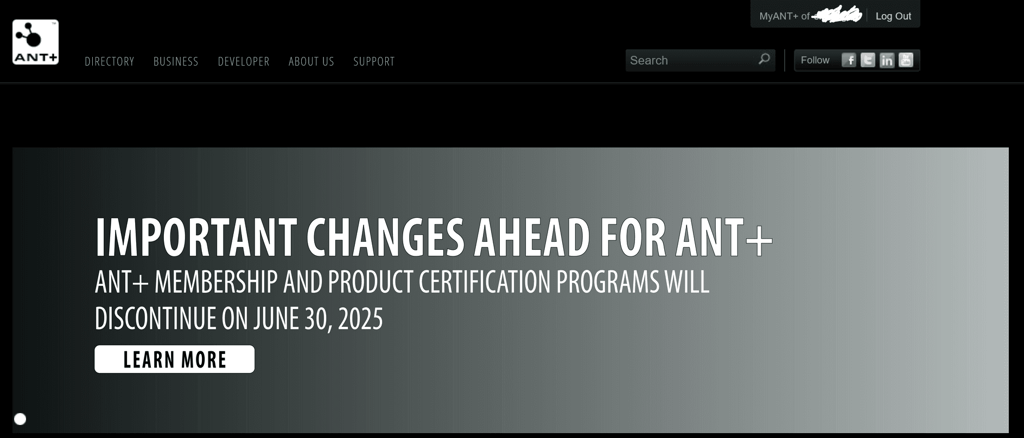
When this site reported in January 2025 that Garmin was winding down the ANT+ membership and certification programmes, the framing was that ANT+ would fade rather than vanish. A year on, that call holds. What has sharpened is the picture around it: the EU’s cybersecurity provisions have taken effect, encrypted Bluetooth heart rate straps are shipping, Polar has added secure BLE to the H10, and Garmin’s new Varia radar has become the first clear example of the fragmentation risk that always sat behind the transition.
The original January 2025 article is preserved below for context. A new section covers what has actually changed in the year since, followed by an extensive FAQ.
The Rise and Fall of ANT+
Introduced in 2004, ANT+ became the backbone of wireless communication for fitness and cycling products. It was valued for low power consumption, simple implementation, and interoperability across brands. ANT+ allowed heart rate monitors, power meters, speed sensors, and other accessories to connect simultaneously to devices such as Garmin Edge computers and Forerunner watches.
Bluetooth Low Energy arrived in the mass market around 2010 and grew steadily. Its advantage was universal presence in smartphones, tablets, and wearables. That ecosystem was something ANT+ could never match, and brands reluctant to license ANT+ from Garmin, including Polar and later Coros, adopted BLE as their preferred route to interoperability.
Why the Certification Programmes Ended
Garmin cited a changing regulatory landscape when it confirmed the closure of the ANT+ membership and certification programmes. The specific trigger is the cybersecurity provisions of the EU Radio Equipment Directive, activated by Delegated Regulation (EU) 2022/30 and mandatory from 1 August 2025. These provisions apply to Articles 3.3(d), (e), and (f) of the directive and require wireless devices to protect personal data, maintain network integrity, and guard against fraud. Encryption and authentication are the standard compliance routes.
The underlying ANT protocol supports AES-128 encryption, but the public ANT+ profiles that matter in practice, including heart rate and cycling power, never implemented it. Adding encryption and authentication to those profiles would significantly change how messages are structured and break backward compatibility across the installed base. Garmin concluded that no meaningful appetite existed to fund that work given the maturity of BLE as an alternative, and wound the certification programmes down rather than rebuild them.
Despite the closure, ANT+ support continues. Garmin has indicated it will keep ANT+ available via dual ANT+/BLE chipsets for the foreseeable future, device profiles and developer documentation remain freely available, and licensing for the underlying ANT wireless protocol is unaffected.
The BLE Advantage
Several factors have contributed to BLE’s growing dominance. BLE is embedded in nearly every modern smartphone, wearable, and tablet, creating a vast interconnected ecosystem that ANT+ cannot match. The protocol is regularly updated to meet data security and privacy requirements, keeping it aligned with evolving regulatory demands. It offers developers a single, standardised platform with room to evolve, and it now supports multiple simultaneous device connections in practice, typically two or three concurrent receivers on a single sensor.
What Has Actually Changed in the Year Since
Several concrete developments have arrived since the original article.
Encrypted Bluetooth heart rate straps are now shipping. Garmin launched the HRM 200 in January 2025. Per DC Rainmaker, the HRM 200 is the first Garmin standalone heart rate sensor with authentication and encryption capability on the Bluetooth side, with that capability optional so existing watches and apps continue to work normally. Garmin followed with the higher-end HRM 600 in May 2025, adding running dynamics, standalone activity recording, and a rechargeable battery.
Polar has added secure BLE to the H10. Firmware 4.0.4, released on 4 December 2025, introduces Bluetooth Low Energy secure connection support for the H10 alongside factory reset via Polar Flow and training file access control. This is directly confirmed in Polar’s release notes.
Coros has taken the BLE-only route on its mid-range and higher-end watches. Coros’s own support documentation lists Apex 2, Apex 2 Pro, Vertix 2, Vertix 2S, Pace 3, Pace 4, Pace Pro, Nomad, and Apex 4 as supporting only Bluetooth accessories. Older Coros watches retain ANT+.
The most significant development is the Garmin Varia RearVue 820 radar. Per DC Rainmaker’s in-depth review published in February 2026, the RearVue 820 broadcasts three distinct signals concurrently: the open-standard ANT+ Radar profile, the open-standard ANT+ Bicycle Light profile, and a new Garmin-proprietary secure Bluetooth connection for cycling radar. On recent Garmin Edge head units, the secure Bluetooth connection is paired by default and unlocks new features such as vehicle size estimation and lateral position display. Third-party head units continue to work via ANT+ for basic rear-approach alerts, but Garmin has told DC Rainmaker it does not plan to release the new Bluetooth protocol to third parties.
That last point is the heart of the fragmentation concern. Basic profiles, including heart rate, cadence, speed, power, and pedal balance, remain interoperable across brands. Advanced categories, including cycling radar, richer running dynamics, and future sensor types yet to arrive, risk becoming locked to the sensor maker’s own ecosystem where the proprietary BLE profile is not shared. The medium-term question is whether brands cooperate on open extended BLE profiles or each retreat into private ones, with knock-on effects for interoperability, price competition, and innovation from smaller sensor makers.
Key Dates
- 3 January 2025: Updated ANT+ Adopter Agreement published.
- 31 March 2025: Final deadline for ANT+ certification applications.
- 30 June 2025: ANT+ membership and certification programmes officially end. Profiles and developer documentation remain available.
- 1 August 2025: EU RED cybersecurity provisions, under Delegated Regulation 2022/30 covering Articles 3.3(d), (e), (f), become mandatory for wireless devices placed on the EU market.
Final Thoughts
For two decades, ANT+ was a cornerstone of wireless interoperability in sport. Its relevance is declining, but existing accessories will keep working for years. Garmin’s commitment to dual-chipset support protects the installed base, and most owners will see no immediate change.
The concern is not the near term. It is whether the post-ANT+ world preserves the open cross-brand interoperability that ANT+ delivered from 2004 onwards. That outcome depends on whether the industry agrees extended open BLE profiles for advanced sensors or allows proprietary profiles to proliferate. The Varia RearVue 820 is the first test case. More will follow.
Frequently Asked Questions
Will my existing ANT+ sensors stop working?
No. The end of the ANT+ certification programme does not disable any existing sensor. An ANT+ heart rate strap, power meter, speed sensor, or cadence sensor will continue to work with any compatible receiver and with future Garmin watches and bike computers for the foreseeable future.
How long will new Garmin watches support ANT+?
Garmin has indicated it will keep ANT+ support available via dual ANT+/BLE chipsets on new products. No specific end date has been set. Given the scale of the installed base, meaningful ANT+ support in new Garmin hardware looks likely for years to come.
Do I need to replace my heart rate strap?
No. Any existing ANT+ or standard BLE strap will continue to pair and transmit. Buyers who want encrypted BLE specifically, for privacy or to use features that depend on it, can choose a strap that supports it, such as the Garmin HRM 200, Garmin HRM 600, or a Polar H10 running firmware 4.0.4 or later.
What is the EU RED cybersecurity requirement?
The EU Radio Equipment Directive has been in force since 2014. What became mandatory on 1 August 2025 is the cybersecurity Delegated Regulation 2022/30, which activates Articles 3.3(d), (e), and (f) of RED. These require wireless devices to avoid harming the network, protect personal data and privacy, and guard against fraud. Encryption and authentication are the standard routes to compliance rather than explicit universal mandates, but they are the practical outcome for sensors that transmit physiological data.
Why couldn’t Garmin just add encryption to ANT+?
Garmin has stated, and DC Rainmaker has reported in detail, that adding authentication and encryption to common ANT+ profiles such as heart rate and cycling power would change the structure of transmitted messages and break backward compatibility with the existing installed base. Given the scale of that change and the lack of industry appetite to fund a rebuild, Garmin chose to wind down the ANT+ certification programme rather than redesign it.
Should I buy ANT+ or Bluetooth sensors now?
Dual-protocol where possible. Most current products from Garmin, Wahoo, and similar brands remain dual-protocol. Dual-protocol sensors preserve ANT+ compatibility with older receivers and BLE compatibility with phones, new watches, and any future encrypted BLE requirements.
Does Bluetooth Low Energy support multiple simultaneous connections?
Yes, within limits. Modern BLE sensors typically support two or three simultaneous connections, which covers most real-world cases such as a watch and a bike computer paired to the same strap. ANT+ supports a very high number of concurrent receivers in practice, so heavy multi-receiver setups remain easier on ANT+.
Will I lose cycling power meter data by switching to Bluetooth?
Depends on the sensor and the head unit. Basic power, cadence, and often left-right balance transmit cleanly over standard BLE profiles. Richer metrics such as pedal smoothness, torque effectiveness, and detailed pedalling dynamics are available reliably over ANT+, because a standardised public profile exists for them. Some manufacturers transmit equivalent data over proprietary BLE profiles, but interoperability across head units varies. For rich power metrics across mixed-brand equipment, keep ANT+ in the pairing chain.
What happens to Stryd and running dynamics?
Stryd continues to work over both protocols. The standardised public ANT+ running dynamics profile is frozen as of the end of the certification programme. Any new metrics introduced after June 2025 will not be added to ANT+ and will arrive through BLE only. Whether they remain interoperable across watch brands will depend on whether open BLE profiles exist for them.
What about the Garmin Varia RearVue 820?
It broadcasts concurrently over ANT+, using the open-standard radar and bicycle light profiles, and over a new Garmin-proprietary secure Bluetooth connection. Third-party head units can pair over ANT+ for standard rear-approach alerts. The new features, including vehicle size estimation and lateral position display, require the proprietary Bluetooth connection, which Garmin has told DC Rainmaker it does not plan to share with third parties.
What about earlier Varia models?
The RTL515, RVR315, and RCT715 all support Bluetooth alongside ANT+ using the earlier, non-secure implementation, which third-party apps and head units can connect to. Suunto’s April 2026 firmware added Varia support targeting this older Bluetooth implementation, so these earlier radars work with Suunto watches running current firmware.
What about Di2 and SRAM wireless shifting?
Shimano Di2 and SRAM eTap AXS integrations with head units have relied on ANT+ in recent generations and will continue to work with existing receivers. Any future evolution of wireless shifting integration is likely to involve BLE. Whether that remains cross-brand-interoperable depends on whether open profiles are agreed.
What about smart trainers?
The trainer market is splitting. Most high-end trainers continue to support ANT+ FE-C alongside BT FTMS. The low end increasingly supports BT FTMS only. Garmin watches and bike computers currently rely on ANT+ FE-C for trainer control, so if a BLE-only trainer is on the shopping list, check trainer-to-head-unit compatibility before buying.
Will older watches receive RED-related firmware updates?
Major brands have rolled RED-related firmware to a wide range of current and recent devices during 2025. Very old watches may not. Check the manufacturer’s firmware notes for the specific model and run a manual update check if in doubt.
Will ANT+ sensor prices rise as the protocol declines?
Not broadly, in the short term. Dual-protocol sensors benefit from scale and are still the default at the mid and high end. In the longer term, if advanced sensor categories lock into proprietary BLE ecosystems, expect reduced price competition in those specific niches rather than a broad price rise across all sensors.
Will innovation slow for small sensor makers?
That is the structural risk. ANT+ let a small manufacturer develop a new sensor type once, define an open public profile, and have it work across every major watch brand. A post-ANT+ world without equivalent open BLE profiles forces the same manufacturer to build and maintain separate integrations for each watch ecosystem. That raises the cost of entry for novel sensor categories and favours large incumbents.
Is there any chance of a new open protocol replacing ANT+?
In the short to medium term, no. The practical path is extended BLE profiles, either through the Bluetooth SIG or through multilateral agreement between sports technology brands. A wholly new open protocol is theoretically possible but commercially unlikely given the cost of fielding new radios across the installed base.
What should a buyer do today?
Buy dual-protocol sensors where available. Check that any new watch or bike computer supports encrypted BLE if buying a new heart rate strap. Enable any privacy and lock features on the watch if it holds personal data. For advanced cycling power metrics, keep at least one ANT+ pairing in the setup for the next several years.
Further reading: DC Rainmaker on the Beginning of the End for ANT+ Wireless, ANT+ programme changes on thisisant.com, Power Meter Market in 2024: Sales and Trends.
Last Updated on 21 April 2026 by the5krunner
My favourite kit and nutrition
- Garmin Fenix 9 Pro — I’ve just bought one.
- Injinji – Runners protect your toes. Avoid discomfort and minor injury. Run more. Run faster. I use them.
- Garmin 90-degree charging adapter — A small keyring adapter you can use anywhere. Essential when away. I use one.
- Garmin charging puck — the fastest and most reliable way to top up your Garmin before a session. I use one.
- Ravemen FR300 — Front light that mounts directly under your Garmin or Wahoo head unit. Keeps your bars clean and your beam pointed where it matters. I use one.
- Body Glide – The blue anti-chafe stick that all swimmers and many runners use. I use it.
- Maurten — The race nutrition trusted by elite athletes. Gels and drink mixes engineered to be easy on the stomach. I use them.
- Garmin Varia RTL515 — A radar rear light that alerts you to vehicles approaching from behind. Pairs with your Edge or Wahoo. I use this model.
- Favero Assioma Pro RS2 — The power-meter pedals most serious cyclists choose. Accurate, easy to move between bikes. I use this model.
- Garmin Forerunner 970 — A serious choice for a pro-grade triathlon watch. I use this.
- Polar H10 — My daily driver for accurate, waking HRV readings.
- Wahoo ELEMNT Roam 3 — The bike computer that has the feature Garmin lacks: usability. I use mine on most rides.
Reader-Powered Content

This content is not sponsored. It’s mostly me behind the labour of love, which is this site, and I appreciate everyone who supports it.
Support the site: Follow (free, fewer ads) · Subscribe (paid, ad-free) · Buy Me A Coffee ❤️
All articles are written by real people, fact-checked, and verified for originality. See the Editorial Policy. FTC: Affiliate Disclosure — some links pay commission. As an Amazon Associate, I earn from qualifying purchases.
tfk is the founder and author of the5krunner, an independent endurance sports technology publication. With 20 years of hands-on testing of GPS watches and wearables, and competing in triathlons at an international age-group level, tfk provides in-depth expert analysis of fitness technology for serious athletes and endurance sport competitors. ID

As someone loves ant+ for having multiple devices hocked up to my powermeter. Love it but we all see this coming
Happy training
yes ANT+ makes my life easier when attaching many watches/bike computers to any given sensor. I’m a niche use case of course.
I know it may differ from person to person, but here is my experiences
My ancient Suunto Ambit 3 I used 10ish years ago didn’t had ant+. Most reviews said that was a major drawback. Never missed if.
After the Ambit 3 I got 2 garmins, a forerunner 935 for over 6 years and a 965 for about one and a half year. In that time, the only ant only thing I had was a garmin cheststrap. Running footpods (milestonepod and stryd) and bike cadence and power meters all had bluetooth.
So, I had no concerns when I switched back to Suunto and bluetooth only again.
Maybe reviewers who want to connect multiple devices for review purposes find ant a must have feature, but others won’t notice it if it’s gone.
yes I mostly agree with your summary
there will be issues for ‘normal’ people trying to multi-use their sensors eg via Apple TV, apps or gym equipment. but dual-BLE mostly sorts that out.
Multi channel isn’t a BLE advantage over ANT+. ANT+ is broadcast, you can have an infinite number of receivers per sensor (well, as many as you can fit in range) and receivers easily handle lots of concurrent senders. Multichannel is a band-aid to a problem ANT+ never had.
yes.
Broadcasting is not unique to ANT+. It is available in BLE since its introduction as a part of Bloetooth spec. 4.0 in 2010.
That means we will see even more proprietary / private BLE in the future. More attempts at walling off ecosystems, etc. because everyone thinks they are Apple.
What are cyclists with n+1 bikes supposed to do?! Stock up on current gen bike computers and sportwatches with ANT and bike sensors?
Not to mention how scared I am that some one is highjacking my cadence data with that horrible insecure ANT…
Another great news for consumers. 🙁
I don’t understand……
Is this irony?
the only proprietary format is Garmin’s ANT, Bluetooth is and a Industry Standard that Garmin killed in ANT since they bought Dynastream and added a lot of Garmin only/tuned features, Bike radars for example only work in a way Garmin had it first. Thete was never a moment Garmin calked fir papers but in typical Garmin fashion: hey we have a new feature inplemenation here for you to underwrite.