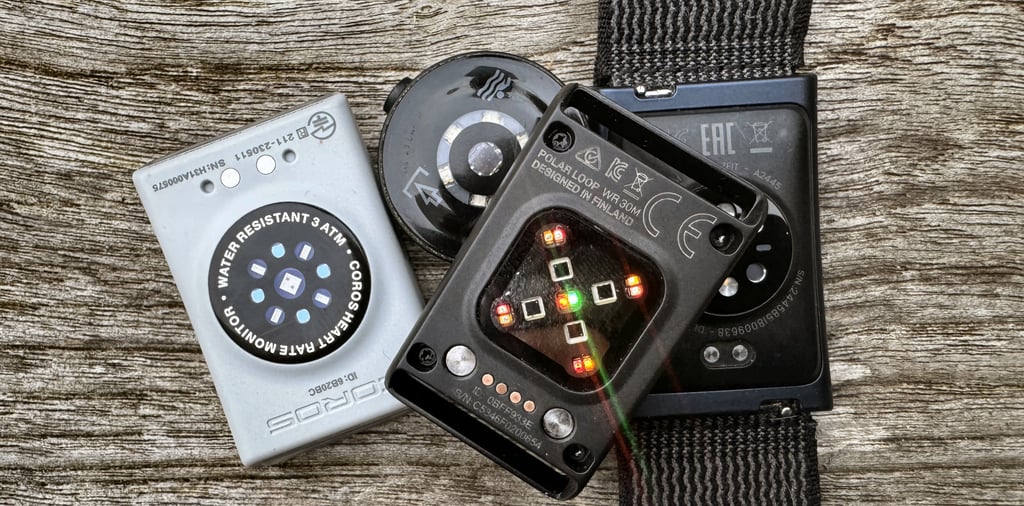
Polar LOOP Review: Strong Accuracy, App Still Catching Up to Whoop
Polar LOOP might be a Whoop competitor, but it isn’t. At least not yet.
There are some specific issues that I’ll talk you through and get straight to the point in these key areas:
- The app
- The band format – aesthetics and wearability, and
- The reliability of the band and its data.
Heads up: This is a media loaner from Polar, and Polar does not pay for this content. Please join our supporters or buy from an affiliated link to keep the independent work alive. Thank you.
Alternative: Whoop Review
The sensor has modest teething troubles and the app urgently needs the 2026 update.
Best for: Existing Polar owners, budget users.
Not for: Those wanting the full WHOOP experience
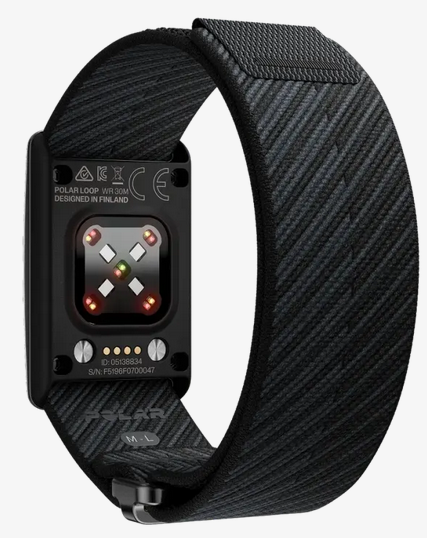

Pros
- Mature Polar ecosystem
- Good aesthetics
- Mostly accurate
- Decent value
- No subscription
Cons
- App needs the 2026 updates ASAP
- Needs a biceps sleeve
- Strap change hassles
- Auto workout detection is not sufficiently reliable for me
Polar LOOP – The positives
Polar LOOP has two key positives. First, unlike Whoop, it’s relatively inexpensive and doesn’t require a subscription. It’s free to use for life after you’ve bought it. Second, it slips very sweetly into the Polar ecosystem—great for existing Polar owners.
Those two positives indicate precisely who Polar LOOP is best suited for
- Existing Polar Owner – Sometimes you don’t want to wear your Polar watch – when asleep, for example. Polar LOOP fills in data gaps and analyses your sleep and general daytime activities.
- On a budget – You can’t justify the cost of Whoop, but you want a 24×7 activity and sports tracker.
Other arguments around supporting a European company are important for some of you.
Polar LOOP – The Negatives
I’m slightly disappointed for those hoping for a more direct competitor to Whoop. Here’s why
Negative 1: The Polar LOOP Band and the overall form factor – compare to what Whoop does
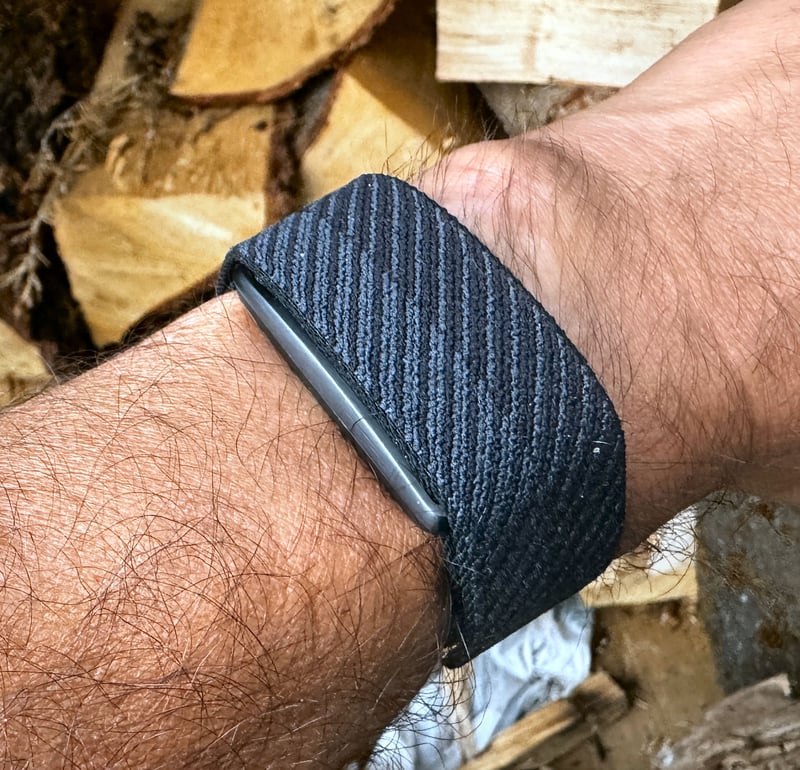
The product’s format is nice enough, and the Loop strap and pod are well-made. However, there are three design drawbacks.
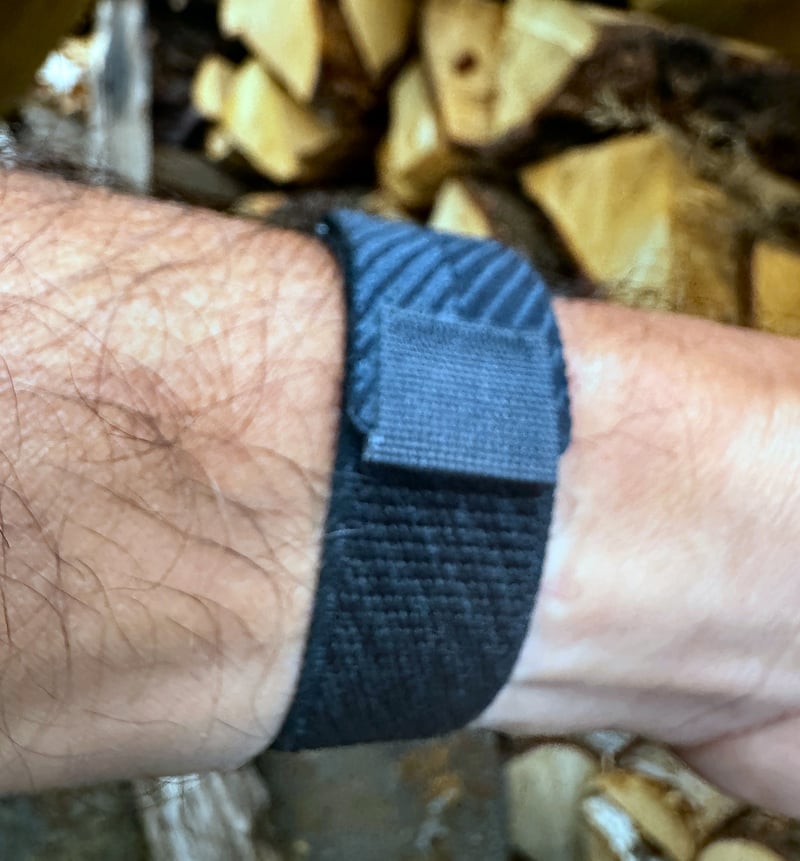
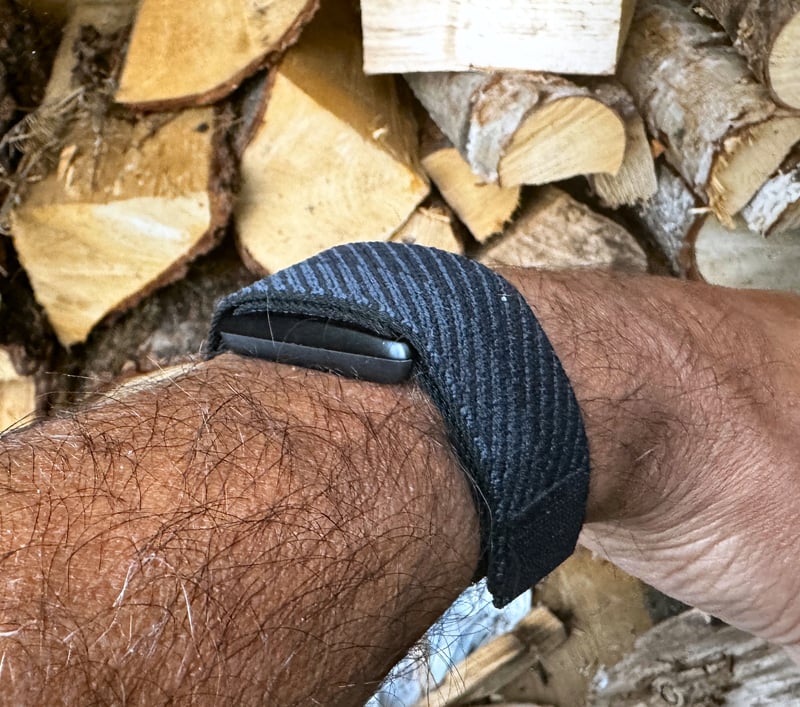
LOOP needs an arm sleeve option for use during sport or sleep. I’ve worn mine on the biceps with the sleeves and straps from other brands, which boosts wearability and accuracy. But Polar needs to do that with its own shipped product; failing that, there needs to be an after-market accessory.
Then there is the product’s lifestyle aspect. Whoop sells a comprehensive range of spare bands and apparel that its pod can be slipped into; this range grew in size and scope as the company expanded. We can’t expect Polar to sell lots of branded apparel from day one, but we should expect them to ship a product with a band that’s more easily swapped several times a day. I can change a Whoop band in 10 seconds; changing the Polar LOOP band takes 30-60 seconds. This might seem trivial, but the current design adds the faff factor if you want to swap a sweat-drenched one from your lunch break to a clean one to wear at work in the afternoon.
Negative 2: The Polar FLOW App
The Polar FLOW app is nowhere near as capable as the Whoop app. This is a major hurdle, as the app is key to the experience for this type of display-free product. To counter that, Polar does have the core knowledge, experience, and science behind the scenes, but it’s not manifested in the app in the same comprehensive way it is with Whoop.
The Polar Flow smartphone app is very much a reporting and charting tool. Whoop is significantly more advanced, adding extra layers of insight and knowledge with its Coach and well-designed dashboard.
Polar realises this and has shared conceptual plans for launching a reimagined Polar FLOW app next year. But that’s not now.
Then we come to the launch bugs. As things stand today, several forum reports of pairing and syncing issues are spoiling some people’s experience, with some claiming to have returned the device. From my perspective, in my usage, the iOS version of FLOW has been broadly OK, aside from the specific issues.
The app – what it delivers today
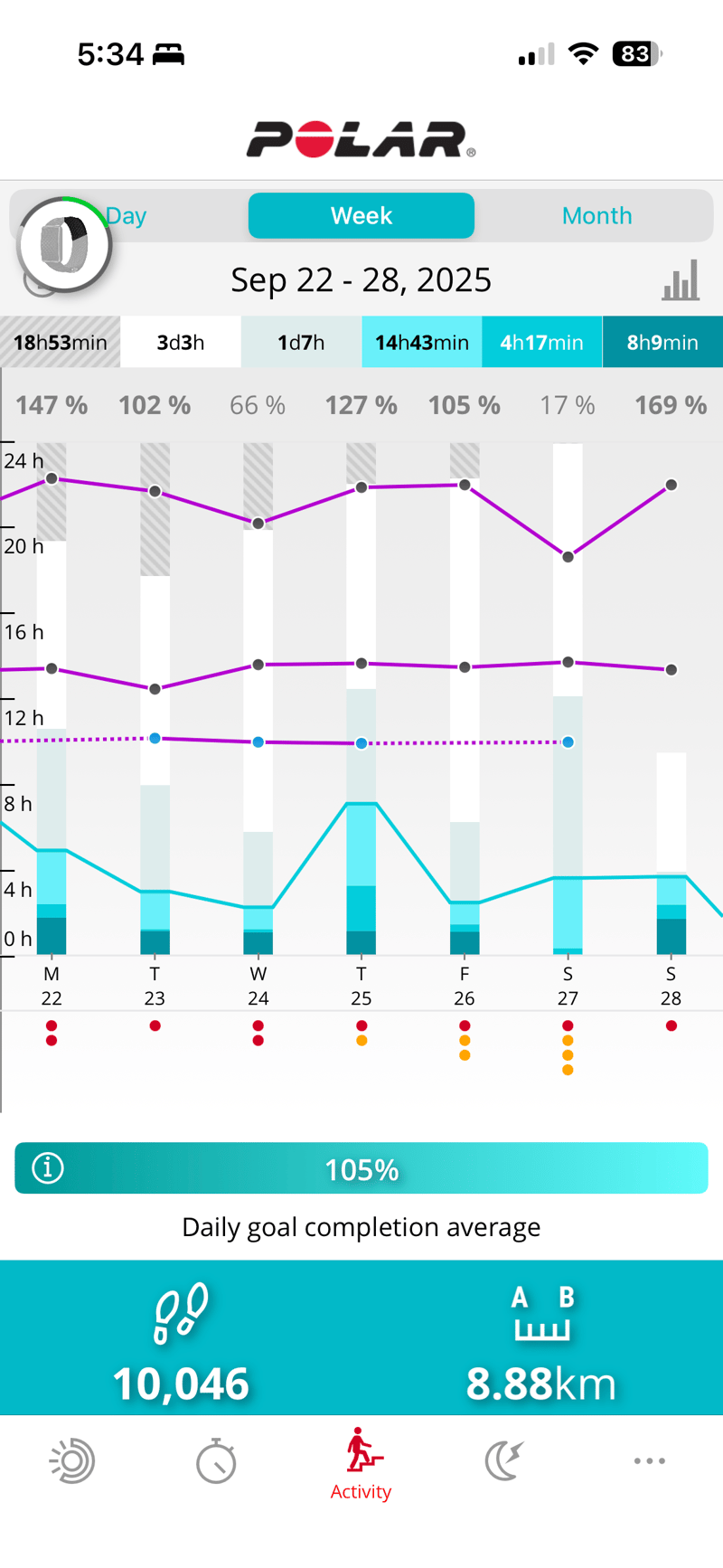
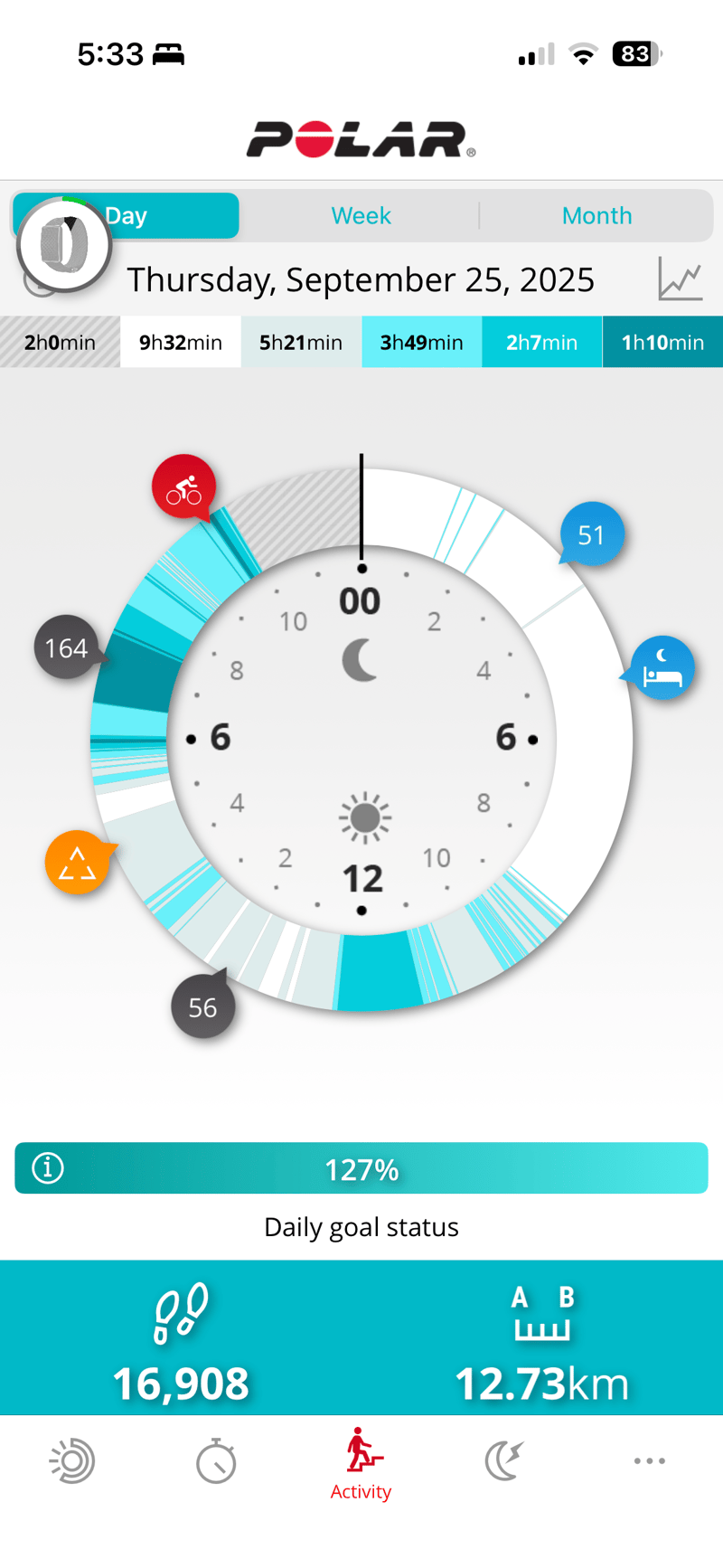
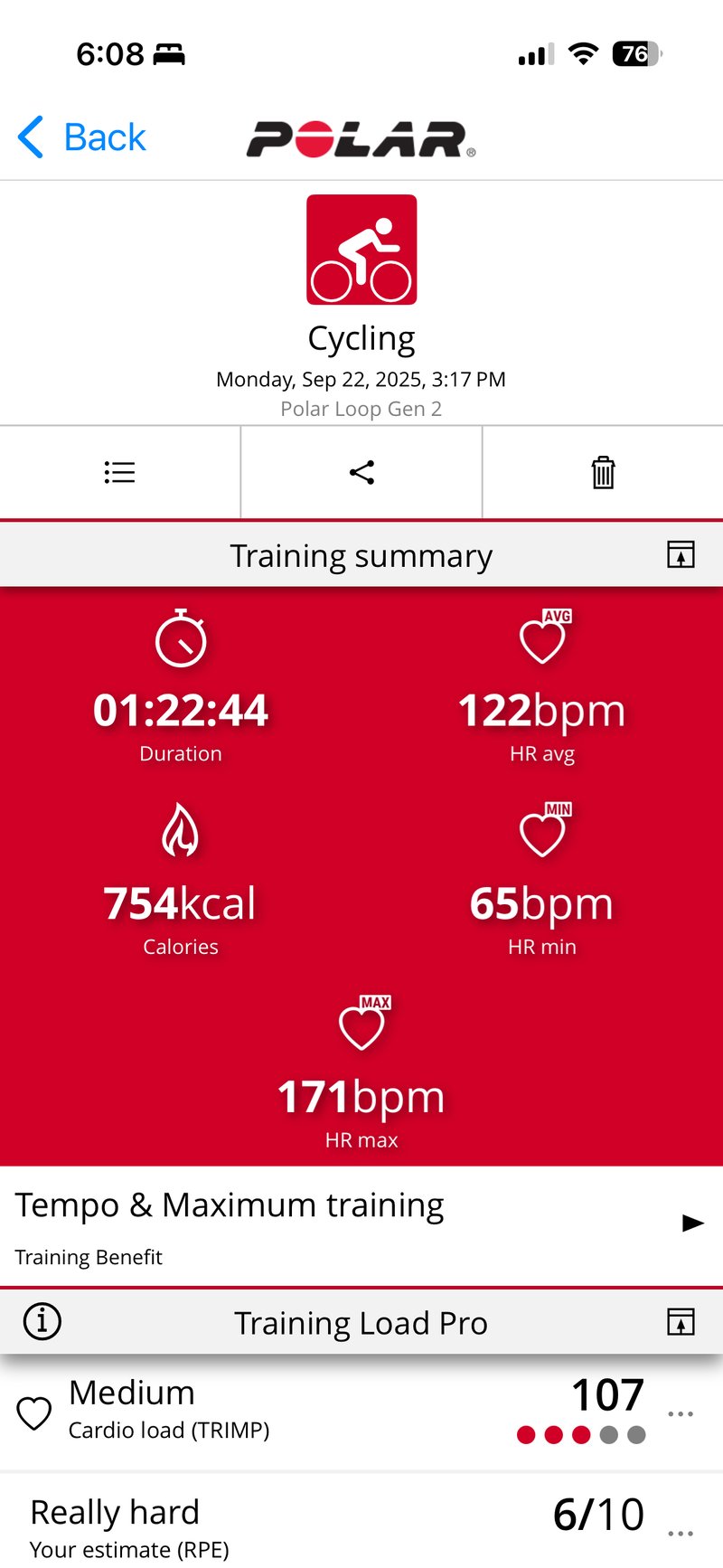
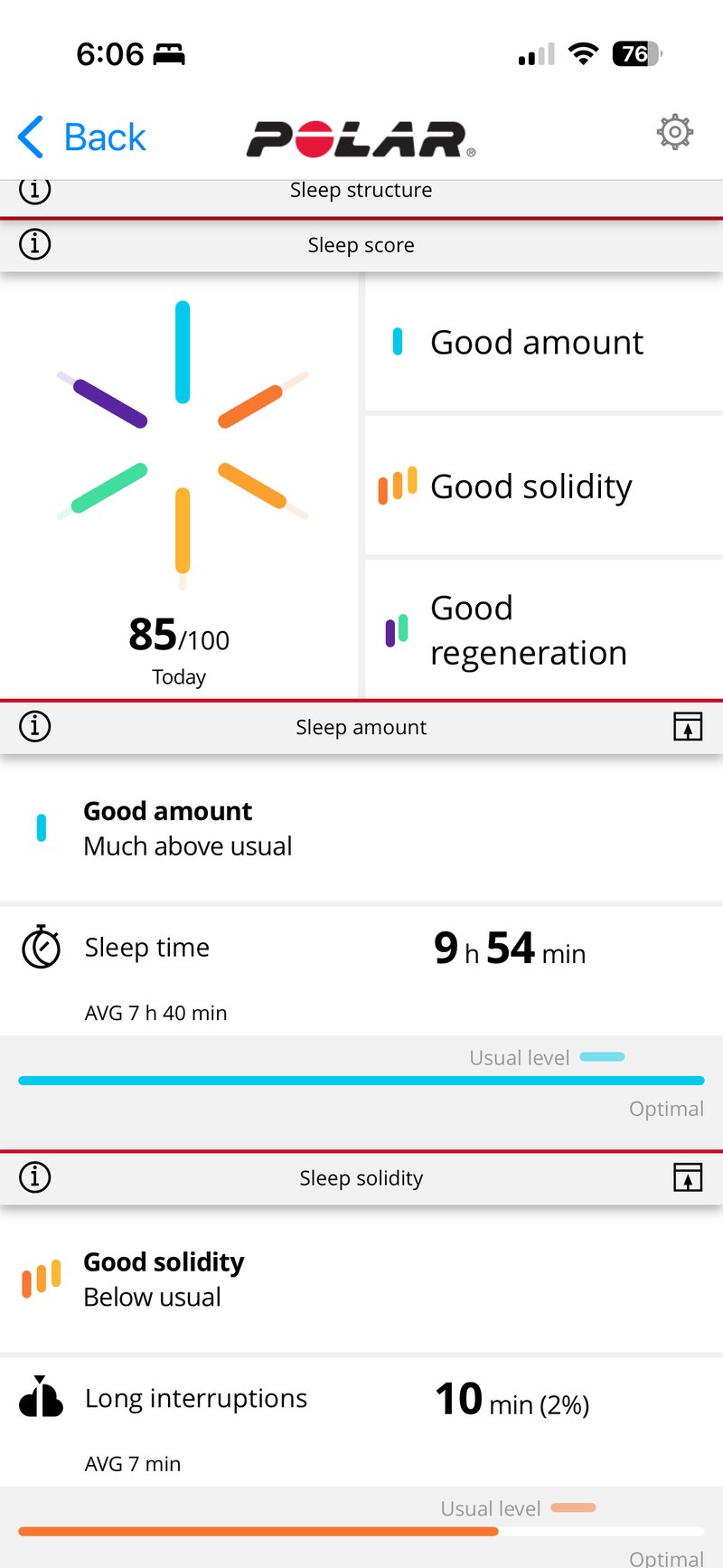
Even though the app will soon change, I’ve included a few screenshots to give those of you thinking of getting one an idea of what to expect now. For example, Polar FLOW gives you a doughnut view of the day with tappable highlights, including your workout, maximum HR, HRrest, and HR while asleep.
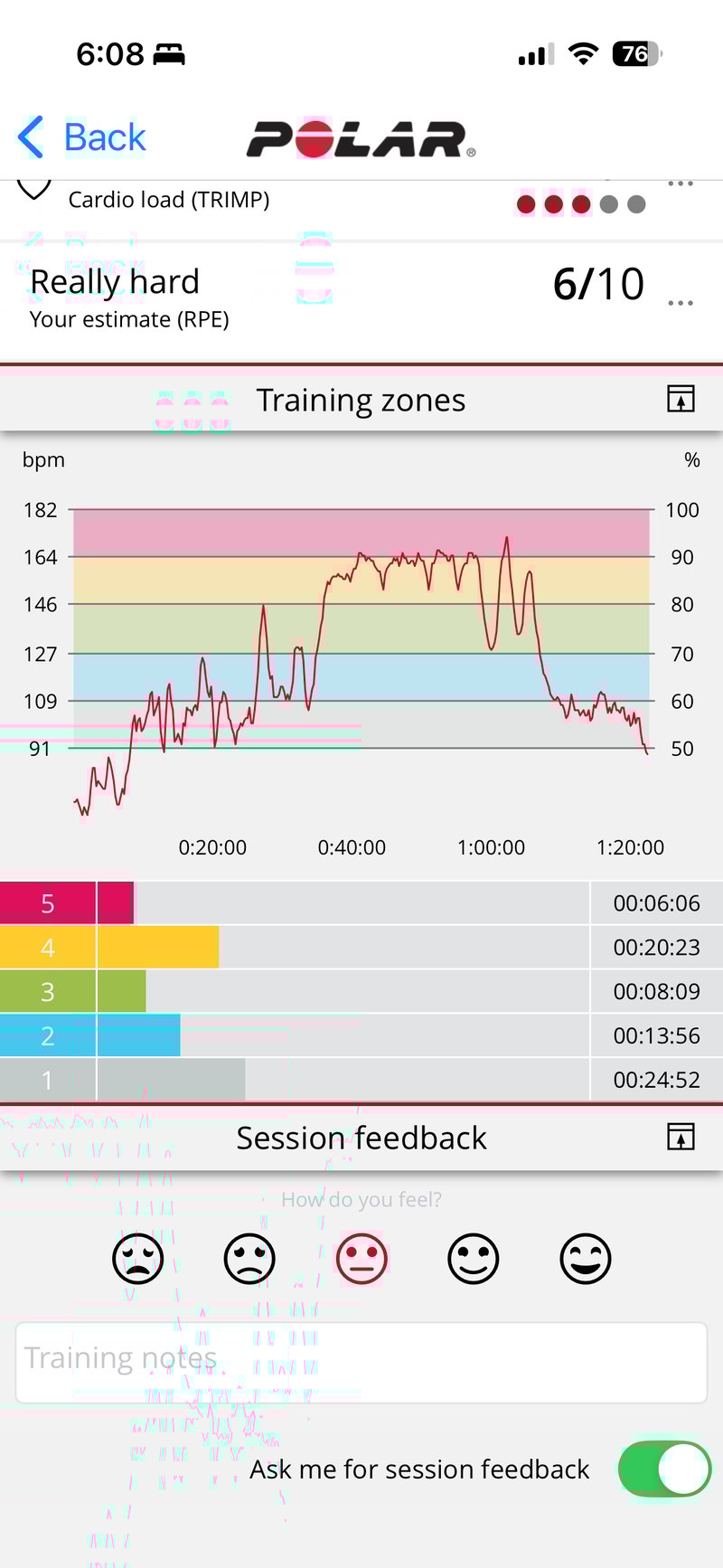
The clear and concise workout view shows workout highlights and heart rate zone details, providing good, glanceable information.
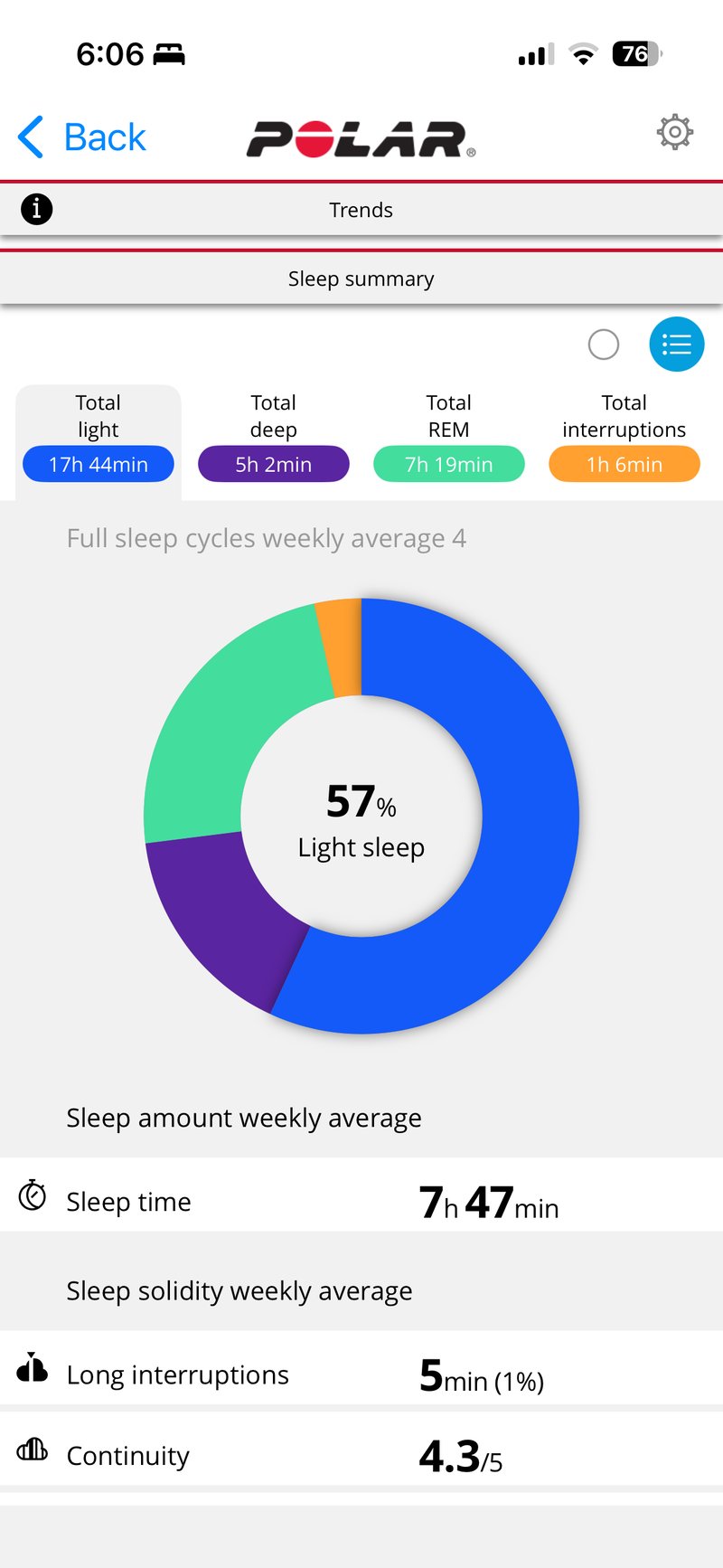
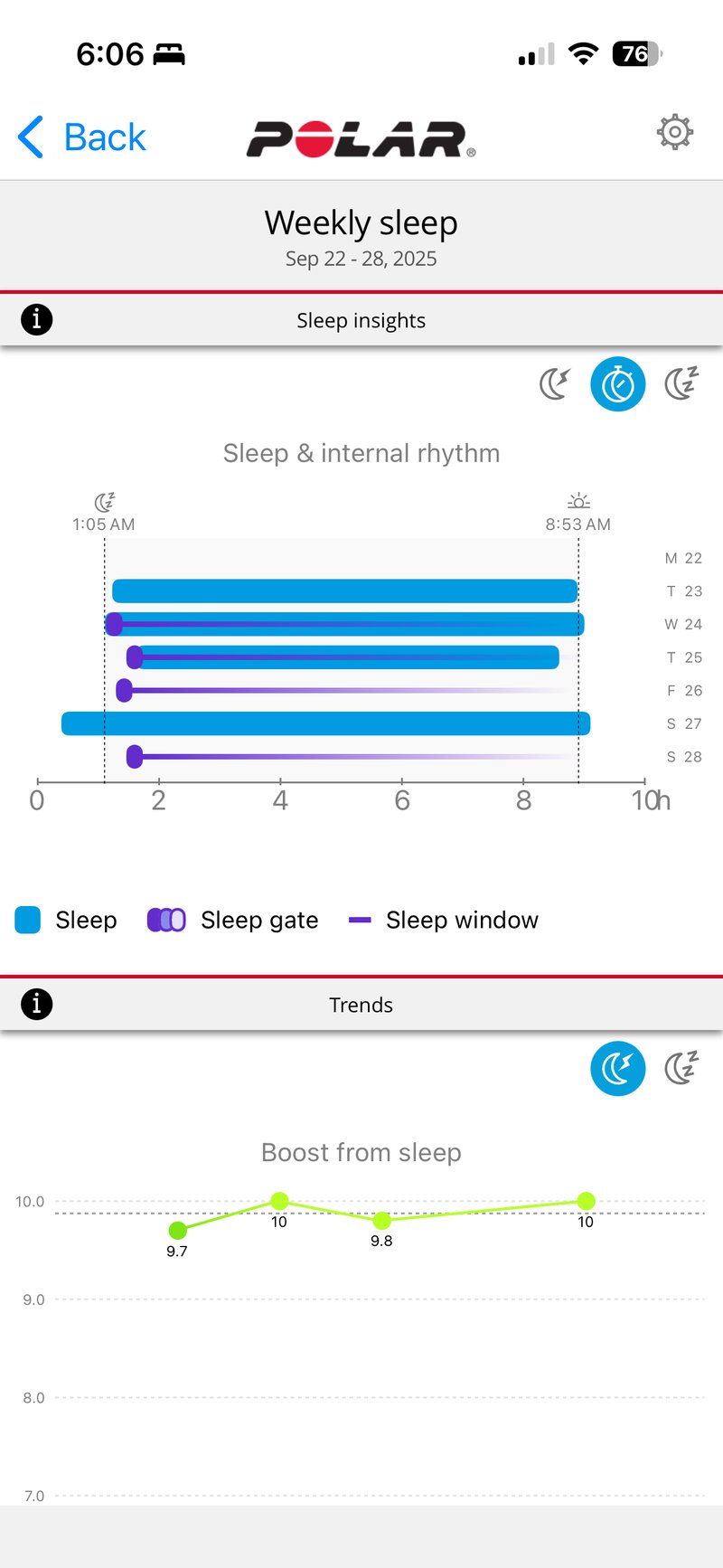
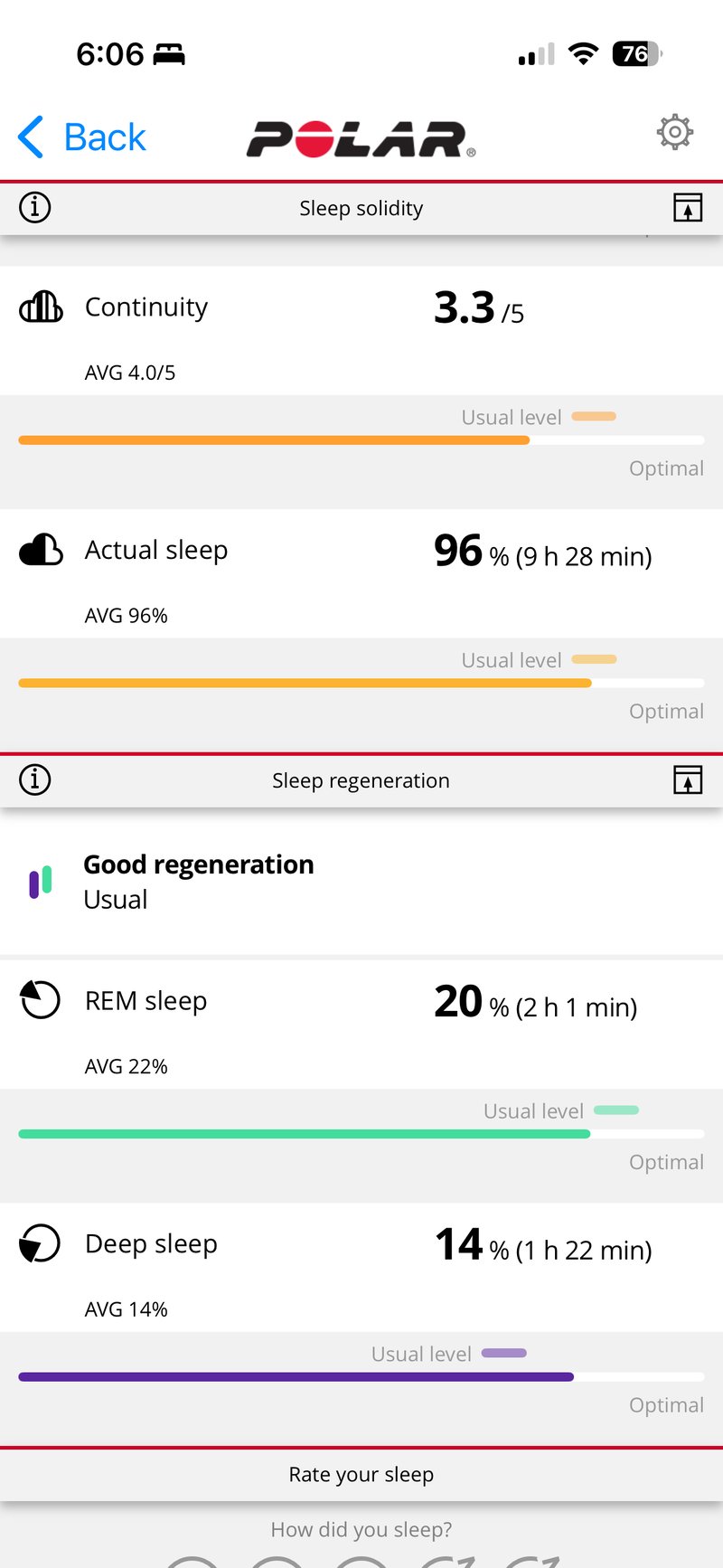
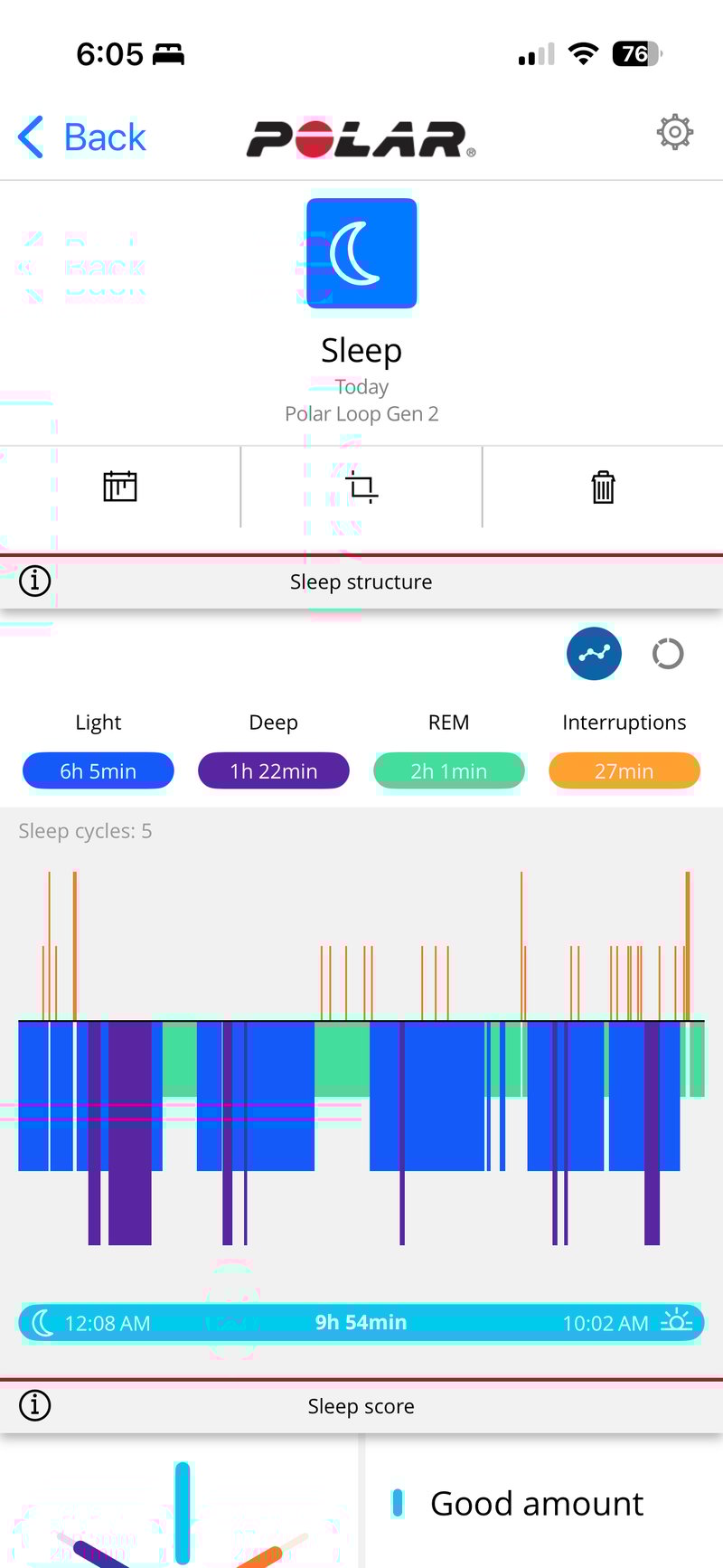
Turning to the sleep data, Polar captures all the key sleep metrics. However, its data presentations were novel when launched, but now look dated and overwhelming in scope for the casual Loop owner just coming for a recap or to see the night’s exceptions.
Polar LOOP Accuracy
Several other early LOOP adopters report incorrect calorie counts, steps, and workouts with incorrect start and finish points. There’s some truth in all of that, but I’ll leave those points standing and go straight to my detailed accuracy tests and results of sports-grade activities.
As an overview of the accuracy piece, I’ll say two things. Firstly, LOOP is more accurate when worn on the biceps (not a big surprise there), but, oddly, it’s less accurate than its OH1/Verity Sense predecessor, which I have used for years as a reference-grade device for optical HR.
That said, the overall level of accuracy on the biceps feels sufficiently accurate for the job when taken in the round, at least in my tests (n=1). Let’s go through some of the details.
Test Methodology
I overlay heart rate tracks from multiple recording devices in each test. This is the best format for understanding why any discrepancies exist. If you plot the correlations between devices, you don’t see the details. For example, you might see a 98% correlation over a 100-minute workout, but 100% of the error could come from lagging optical HR after a hard effort has finished.
Here, I’ve tested across various sports, including a triathlon race, a Hyrox simulation, a gym workout, yoga, running, and cycling. One note I will make is that all these tests are recorded during a workout initiated by the FLOW app, and then the phone is left behind. From what Polar says, this should mean that LOOP post-processes and corrects my data during the workout.
When recording training directly with Polar Loop, the device applies a correction algorithm to heart rate data every 90 seconds, ensuring the highest possible accuracy. [Source: Polar]
All the tests are proper workouts that form part of my regular training, not just me making random shopping trips or going to work and back.
The results clearly show some errors, and I’ve annotated the charts to highlight the more interesting areas.
Polar Loop Accuracy Test results for Running
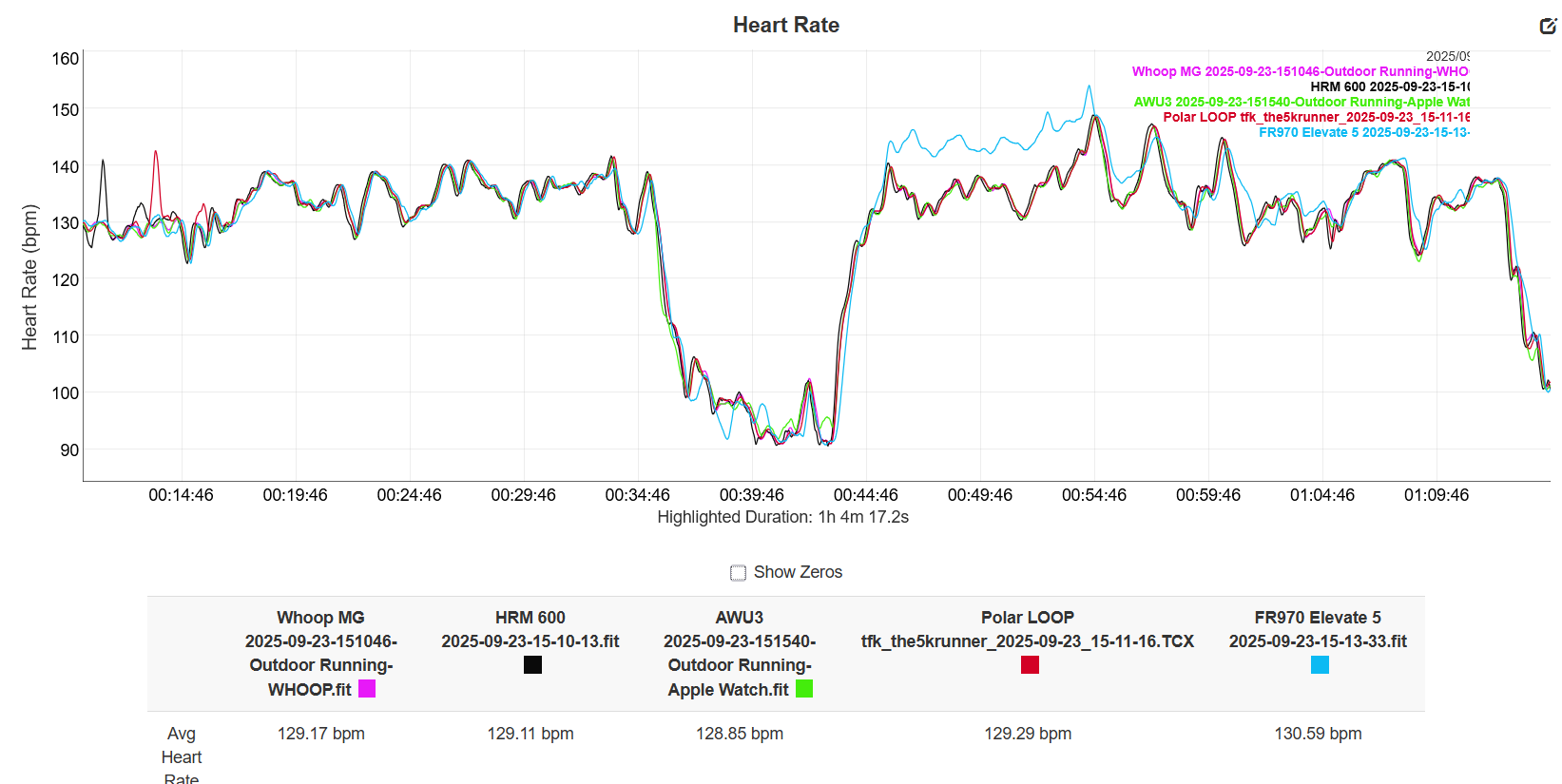
This was a relatively steady hour-long run, during which I bumped into an old friend halfway around for a chat. Polar LOOP performed perfectly here and aligned with Apple Watch Ultra 3 and the reference HRM 600. In the second half of the run, you can see that the Garmin Elevate 5 OHR sensor struggled to respond to restarting the workout – you would miss that detail in a simple plot demonstrating correlations.
Polar LOOP easily gets a 9/10 here.
Polar Loop Accuracy Test results in the gym
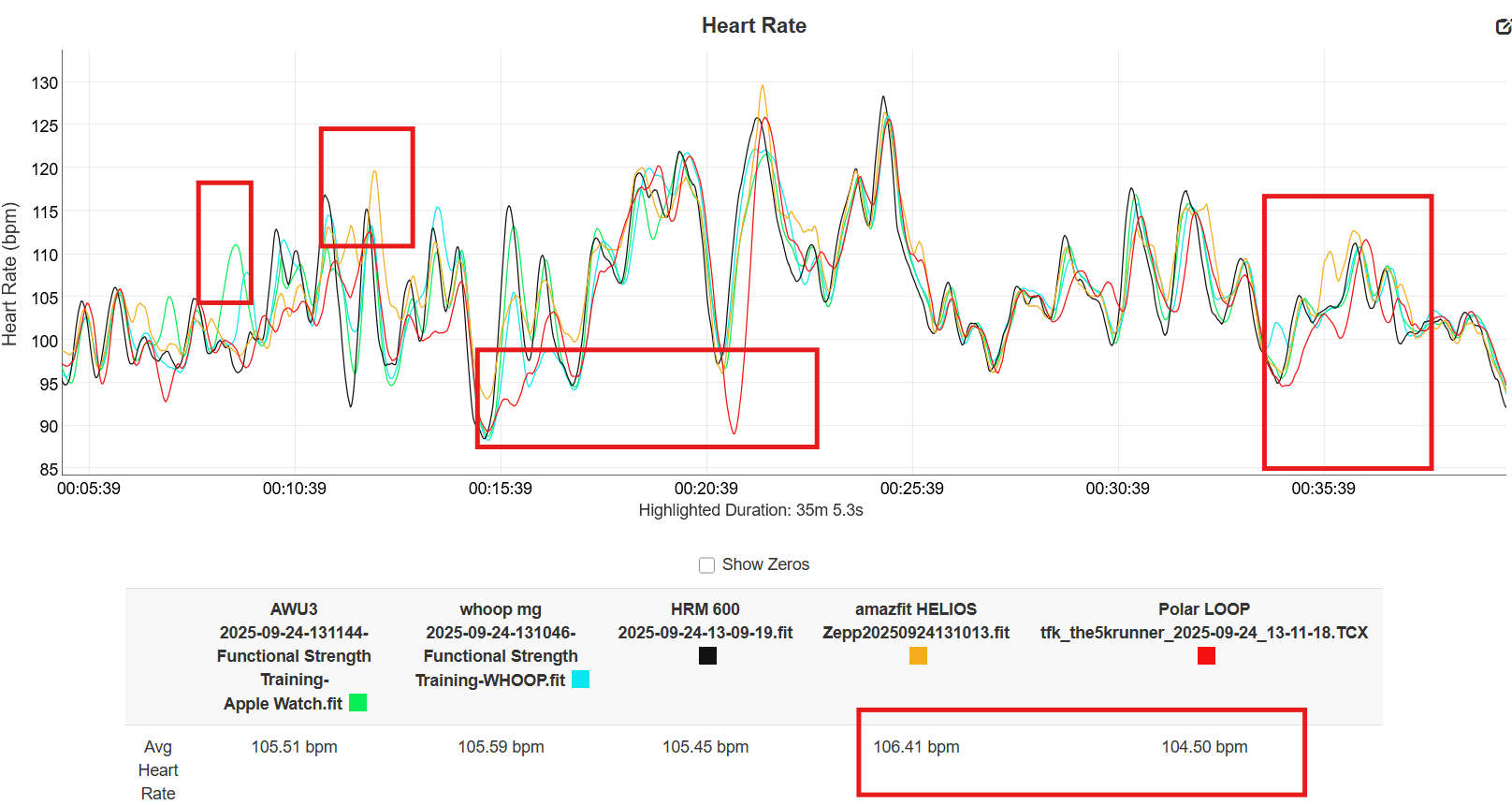
I brought an Amazfit Helio into the mix for a gym session where I mainly focused on upper-body work, which will most likely negatively impact arm-worn sensors like LOOP. Polar LOOP struggled a little bit here at times, and I’ve highlighted those on the chart – you can see that it didn’t always register peaking efforts, and, as a result, the overall workout average (selection) was 104.50bpm, which was 1 or 2 beats lower than all the other devices on test. You can also see that Amazfit Helio overreports to the reference device by 1 bpm, and Whoop is spot on with the HRM 600.
These differences from the reference track across all devices have no real-world significance for the subsequent calculations the apps perform. Even if they did have a material impact, measuring HR during weights is pointless unless you have a method to determine the muscular strain (Whoop does, Polar does, Helio doesn’t).
Polar LOOP gets a 7/10 here.
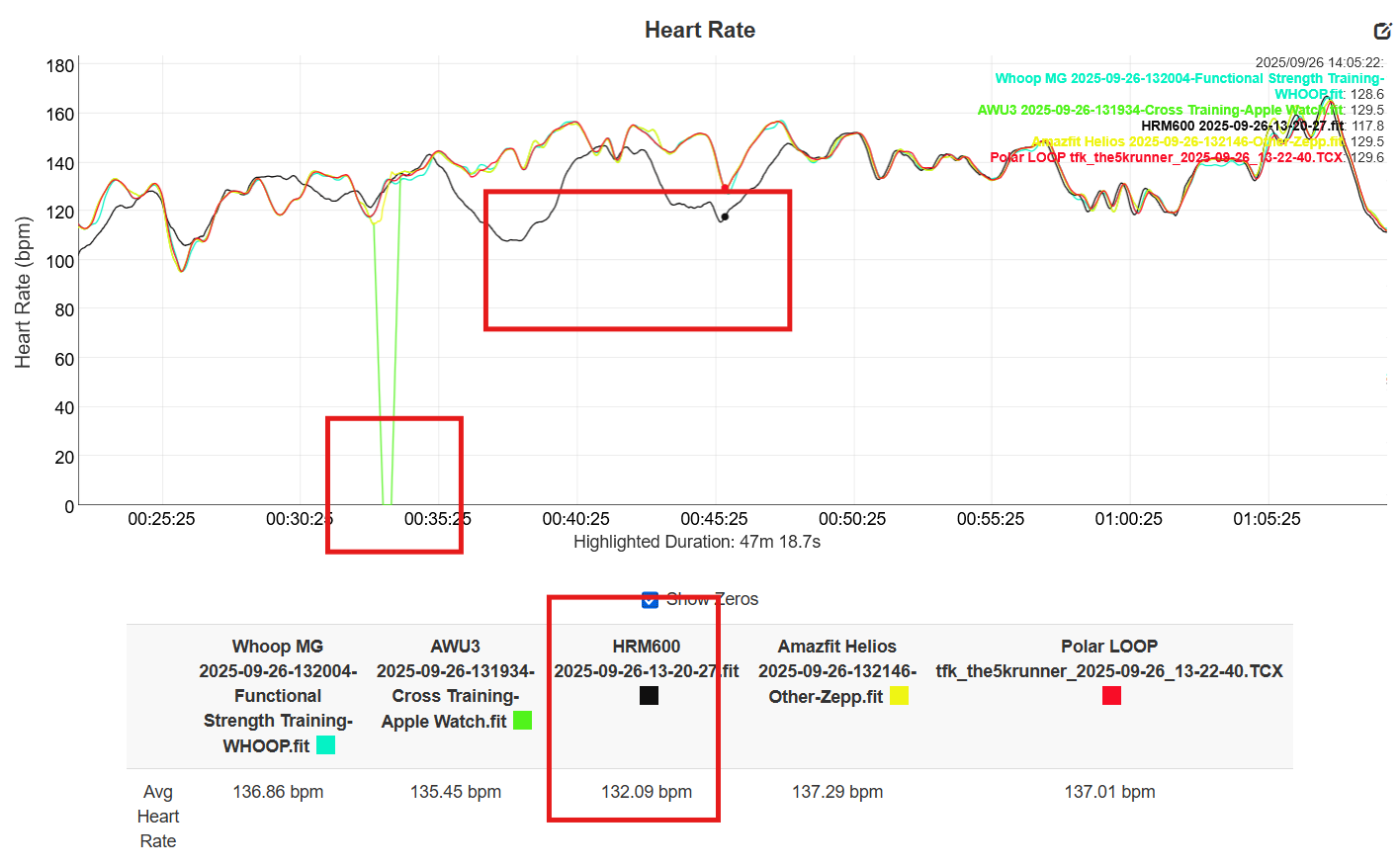
Polar Loop Accuracy Test results in Hyrox
I’ve recently gotten into the habit of doing two Hyrox simulations in the gym each month. These intersperse running with 8 specific activities. The activities target the entire body, with particular emphasis on the quads. The carrying, pulling and throwing activities involve significant wrist and arm movements. The test results very oddly show the reference device to likely be wrong – I can’t explain that one, and they also showed Watch Ultra 3 with an HR dropout period (which is not unusual). Putting those two devices aside, Whoop, Polar LOOP and Amazfit Helio report virtually identical results. This is surprisingly good and probably a 10/10 for Polar LOOP!
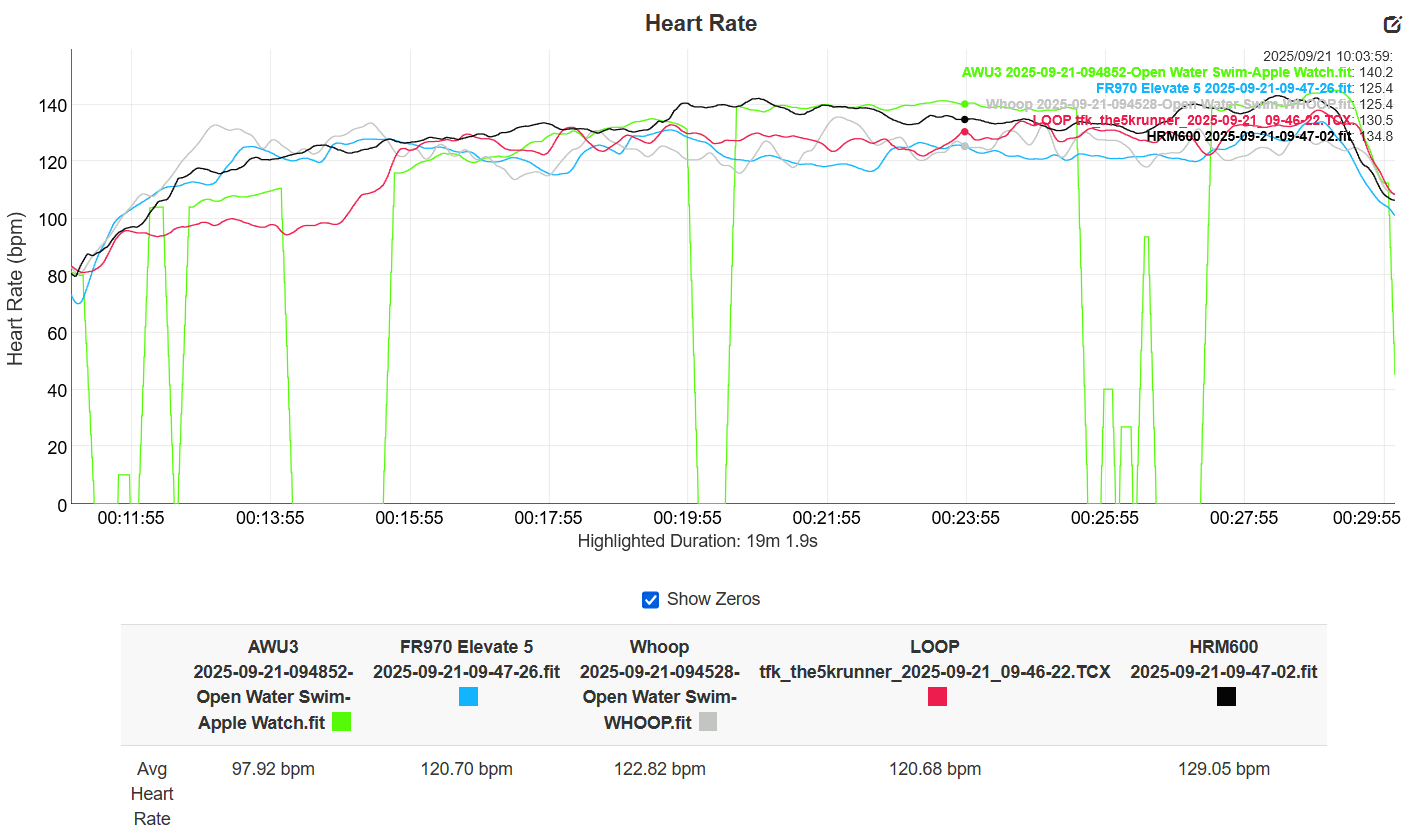
Polar Loop Accuracy Test results in Open water Swim (Wetsuit)
LOOP performs surprisingly poorly during an open water swim while wearing a wetsuit. Although not as bad as the Apple Watch Ultra 3, which experienced numerous dropouts, LOOP significantly underreported at the start of the workout and slightly underreported the reference device for the remainder. Garmin and Whoop were similar; both got a good start on the reference device but fell behind it, like LOOP, as the workout progressed. Interestingly, the Garmin and Polar recorded a similar average of 10 beats below the reference device, a significant amount.
Explanation: LOOP was worn with a Coros biceps band and was in contact with the wetsuit. Potentially, the movement of the wetsuit material during swimming physically moved LOOP more than normal, perhaps explaining the results. IDK. Just a thought.
Oh dear, Polar scores 5/10 here.
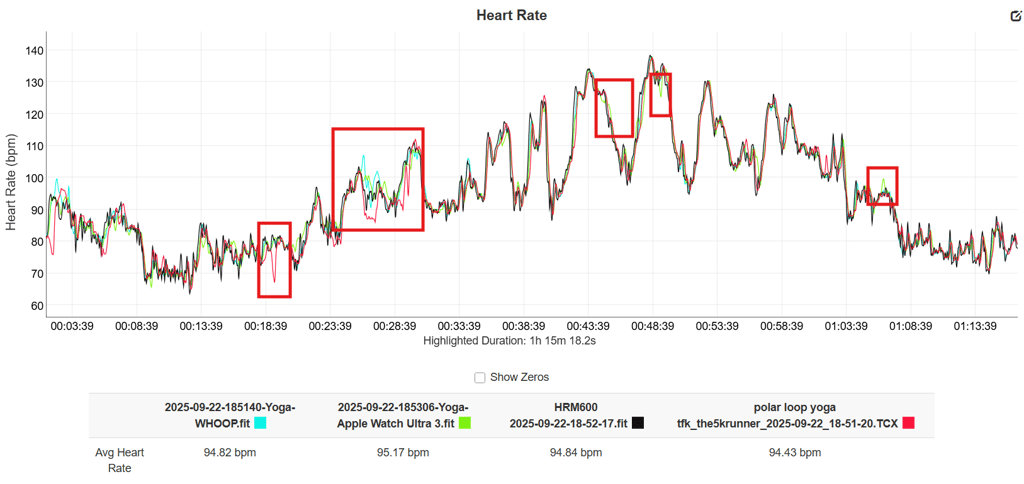
Polar Loop Accuracy Test results for yoga
I’m reasonably OK at yoga, and oddly enough, my heart rate usually goes higher than when doing weights. The yoga movements are extreme and will affect blood flow, but they don’t strain the arm muscles in quite the same way as weights, at least not for me.
Over an hour, I compared the warm-up, cool-down, and intense middle period, and Polar LOOP only had a small number of sections where it slightly underreported by +/-2bpm compared to the Apple Watch Ultra 3, Garmin HRM 600, and Whoop. The underreporting occurred in the 70-100bpm range, where any discrepancy will make zero difference to a traditional ATL/CTL/TRIMP score. These errors are irrelevant for sports usage.
Polar gets another 9/10 for accuracy
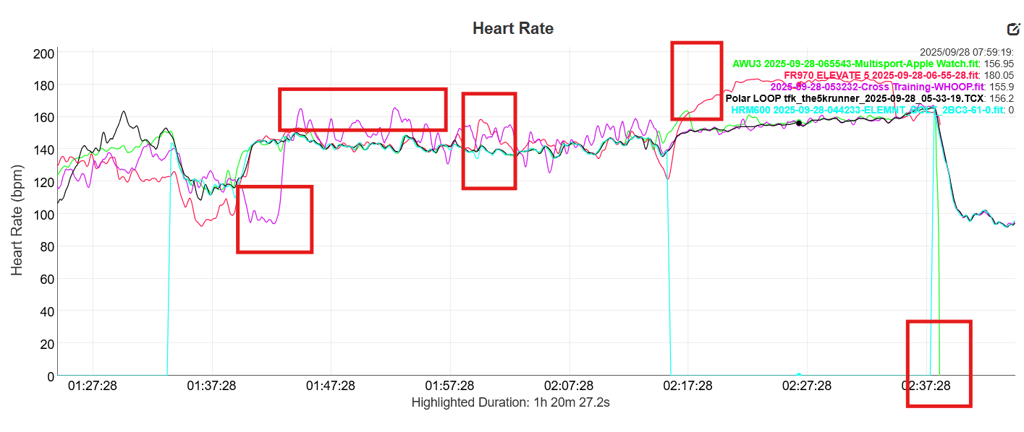
Polar Loop Accuracy Test results for Triathlon
In a non-wetsuit triathlon race, I wore a tightly fitting tri-suit in cool weather. I forgot to set the HRM600 to record on its own, so I only have data from the bike computer. Whoop was not great this time; despite being in roughly the right range, it either over- or under-reported the reference device. Perhaps the tri-suit was pulling on the arm sleeve it covered? Contrast that to the Polar LOOP, which was worn with an old Coros band around the biceps and recorded a good track. Garmin Elevate 5 was OK until it got to the run, where it inexplicably reported it significantly over and was just plain wrong – that sort of error is bad in a material way.
Good performance from Polar LOOP, 8/10.
Polar Loop Accuracy Test results for Outdoor running
The following chart shows the results of a 90-minute trail-and-road run. It was a steady-state effort, but it included some hard uphill off-road sprints. The Apple Watch Ultra 3 again experienced some dropouts, but there was near-perfect agreement among the other devices and with the reference track.
Great job from Polar here, scoring 9.5/10
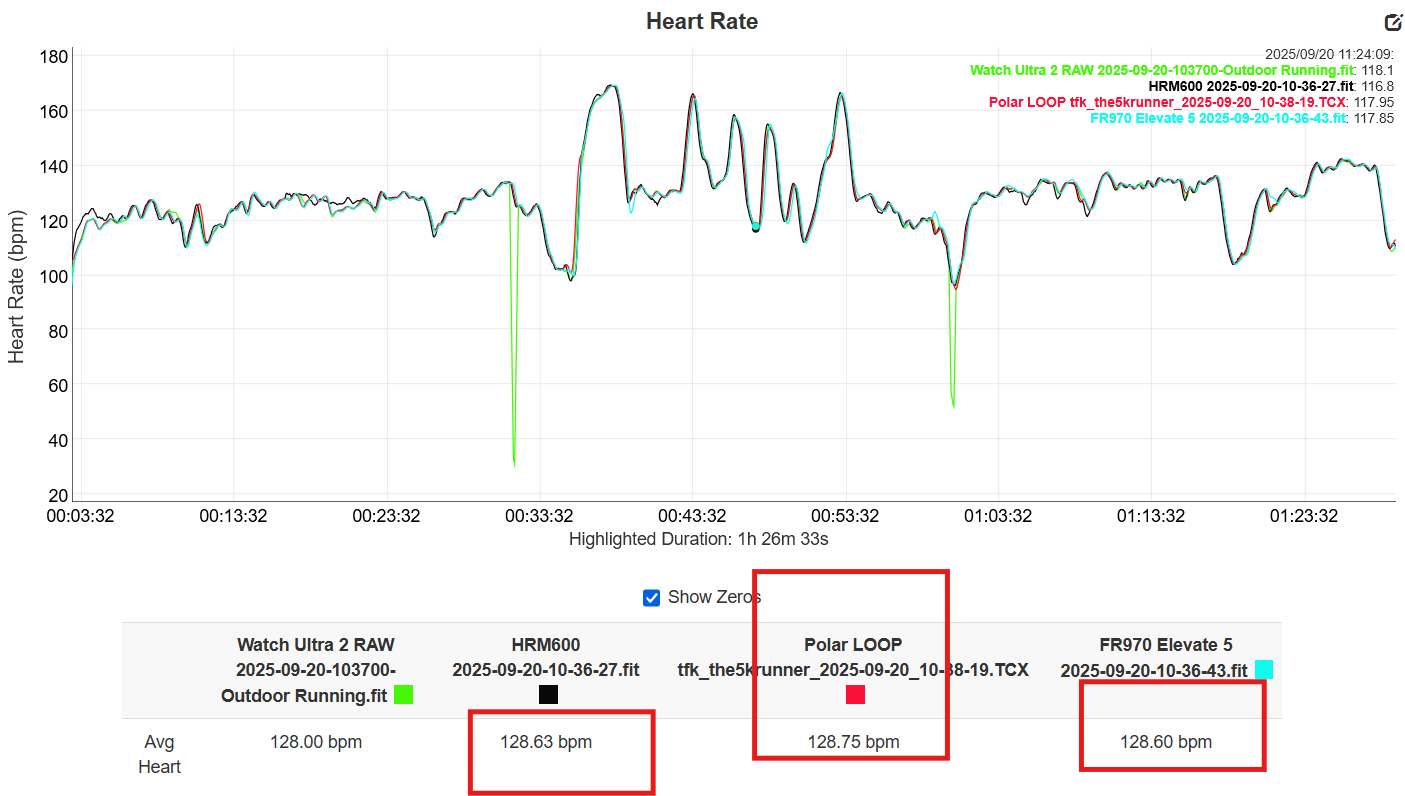
Note: The test used software version 3.0.31, which was the launch version, superseded on 29 September. If you wear LOOP on the wrist, the accuracy will not be as good as I recorded here. The wrist is an unreliable and challenging location for accurately recording optical HR.
Whoop Competition – the state of play
If you are looking for a direct Whoop competitor, there isn’t one. Polar LOOP isn’t it. Several companies are clearly heading towards adapting their ecosystem to take Whoop head-on; it’s just a case of who gets there first and when. For an up-to-date overview of the full competitive landscape, including Fitbit Air, Garmin CIRQA and the smart ring alternatives, see our guide to recovery trackers and lifestyle bands.
Garmin – Garmin’s Index Sleep Monitor was a missed opportunity to develop a strong 24/7 product, given its generally good Elevate 5 sensor package. You can wear Garmin’s Index band all day if you want, but the experience is tailored towards sleep – hence its name. Its recent Health Status and Lifestyle Logging features will likely be steps toward building competencies in the app to make it a more cohesive Whoop competitor, perhaps as soon as next Spring (2026).
Amazfit Helio is probably the most competitive and cheapest Whoop competitor in 2025. It seems to be a one-trick pony, precisely aimed at undercutting Whoop’s price and copying its easier features. It hasn’t yet reached the polish and depth of the Whoop app’s features, but it’s well on its way.
There are many other heart rate bands, but few, if any, have the long enough battery life or the app to compete with Whoop as a sports and health lifestyle coach.
Polar Loop – Legal Case
Whoop has filed a lawsuit against Polar, alleging that Polar’s product is a ‘copycat’. If Whoop is successful, Polar will stop selling LOOP in the USA and redesign a new version, which would likely take two years. This wouldn’t affect products that have already been sold.
Polar Loop – Anecdote
My partner, a longtime Polar lover, is currently using Loop exclusively and absolutely loves it. The form factor, the looks, the app, the weight, the simplicity, everything.
Maybe it’s just me?
Wrap Up – Polar Loop Review
Polar LOOP is an excellent add-on for existing Polar watch customers. It’s a decent sleep and activity tracker—or at least it will be once Polar pushes out a few firmware tweaks—nothing too major.
As a Lifestyle competitor to Whoop, I’m unconvinced about the strap fastening mechanism and lack of a biceps sleeve. But Polar has probably done enough on the physical design for a credible 24/7 offering. What I’ve seen of the next-gen app and its screen mockups is good, but you won’t buy Polar LOOP based on promises, and neither will I recommend it on that basis.
Loop’s core HR accuracy for the biceps is very good but not excellent. I’m surprised Polar has not nailed its algorithms for widespread use over the last year or so, especially with the latest version of its sensor package on the B2B version of LOOP.
Over the next 6 or so months, Polar will struggle to match the customer perception of Amazfit Helio, which, to some degree, is already seen as a better-looking app and cheaper product than Whoop. Amazfit has the potential to be nimble, adding and refining features to stay ahead. But historically, Amazfit has seemed to lose interest in software improvements for its products, so don’t hold your breath. Garmin appears to be a credible competitor to Whoop in the medium term. No doubt they will eventually produce something plausible, but like its predecessors, I suspect whatever comes will be a great piece of hardware, but software well below the high bar set by Whoop. Garmin struggles big time to make software with a good user experience.
In summary, buy Polar LOOP to complement your Polar Watch. Wait for the app update if that doesn’t describe you. If you want to take a punt now, it’s OK; Polar is in this for the long term.
No one is threatening Whoop’s dominance, just yet.
For the complete guide to Polar watches, sensors and training science, see the Polar hub on this site.
Polar Loop price: where to buy
The 2025 model costs $199, £149 and €180.
Check Polar LOOP’s latest pricing here (supports the site, thank you):
Quick answers
Polar Loop vs Amazfit Helio Strap: which recovery tracker is better?
The Polar Loop benefits from Polar’s mature ecosystem, including Sleep Plus Stages, Nightly Recharge and Training Load Pro. The Amazfit Helio Strap offers a lower price point and tighter integration with Amazfit watches. If you already use Polar products, the Loop fits seamlessly. If you prioritise price and use an Amazfit watch, the Helio Strap is the more practical choice. Neither yet matches Whoop’s depth of recovery analytics.
Does the Polar Loop require a subscription?
No. Unlike Whoop, the Polar Loop does not require a monthly subscription. All features, including sleep tracking, recovery metrics and training guidance, are included with the hardware purchase. This is the single largest advantage over Whoop for cost-conscious buyers.
Is the Polar Loop a genuine Whoop competitor?
The Loop targets the same category (screenless, recovery-focused wearable) but does not yet match Whoop’s strain-tracking granularity or community features. Polar’s strength is its established sports science platform and the absence of a subscription. For athletes who want basic recovery tracking without ongoing costs, the Loop delivers. For those who want the deepest recovery analytics available, Whoop remains ahead.
For full context on WHOOP hardware, accuracy, and competitive position, see the WHOOP hub.
Last Updated on 3 October 2026 by tfk the5krunner
Small things I always use
- Garmin 90-degree charging adapter: Charges your Garmin from any USB-C cable. Essential when travelling. I use one.
- Body Glide: The blue anti-chafe stick swimmers and runners carry. I use it.
- Speedo earplugs: Fewer ear infections and no cold-water dizziness. I use them.
- Dryrobe Advance: My winter changing robe for open-water swims. I use one. A cheaper option is the AONYIYI changing robe.
- Maurten: Race fuel that stays easy on the stomach. I use them.
- Garmin charging puck: The quickest way to top up before a session. I use one.
- Injinji: Toe socks that stop rubbing, so you run more. I use them.
- Ultimate toe protectors: Stop black toenails on long runs. They work. I use them.
- Compressport R2 v2 calf sleeves: My calf sleeves of choice. I use them.
- Cellucor C4: My pre-workout before hard sessions.
- TPU tubes: Schwalbe Aerothan, Tubolito and Pirelli SmarTube. Light, tiny spares. I use all three.
- G8 insoles: Adjustable insoles that are good. I use them.
- Cycplus Cube: A 97g electric pump that gets a road tyre rideable in two minutes. I carry one. 5% off with code THE5KRUNNER.
Watches and sensors
- Polar H10: My daily driver for waking HRV.
- Polar Verity Sense: My backup arm-worn HR sensor.
- Nomad bedside charger: Charges my iPhone and Apple Watch overnight. I use it, and many of their bands.
- Train.Red: The best muscle oxygen sensor I’ve used.
- Tymewear: Accurate heart rate and reliable ventilatory zones. I use it to pace endurance rides over an hour.
- Garmin Forerunner 970: A pro-grade triathlon watch. I use this.
- Apple Watch Ultra 4: My daily smartwatch. No phone needed on rides.
- Garmin Fenix 9 Pro: I’ve just bought one.
On the bike
- Continental GP5000 for everyday riding, and Aero 111 on the front for special occasions.
- Helmets: Specialized S-Works Evade 3 for road riding, and Rudy Project Wing for TT-style races. I use both.
- Ravemen FR300: A front light that mounts under your Garmin or Wahoo. I use one.
- Wahoo TRACKR Radar: I use it on one bike and Varia on the other. They perform the same.
- Garmin Varia RTL515: Radar that warns you of cars from behind. I use this model.
- Wahoo ELEMNT Roam 3: The bike computer that’s easy to use. I use mine on most rides.
- Favero Assioma Pro RS2: Accurate power pedals that swap easily between bikes. I use this model.
Home and indoor training
- NPE Runn: Makes my basic treadmill smart, sending more accurate speed and distance to my watch and Zwift. I use it.
- Google Wifi: Keeps Zwift connected in my pain cave. I use it.
- Apple TV 4K: Zwift on the big screen. I use two.
- Google Nest Doorbell (wired, 2nd gen): My video doorbell, running in both Google Home and Apple Home. I use it.
Health, recovery and sleep
- FreeStyle Libre 3 Plus: Shows how my blood sugar responds to diet.
- hDrop: Measures my sweat loss in summer and indoors.
- Fourth Frontier Zone: Checks my heart under load in hard sessions.
- Oura Ring 5: My partner’s recovery tracker of choice.
- Kineon MOVE+: Red light therapy for niggles. It works.
- Eight Sleep: A cooling mattress cover my partner and I use nightly.
Reader-Powered Content

This content is not sponsored. It’s mostly me behind the labour of love, which is this site, and I appreciate everyone who supports it.
Support the site: Follow (free, fewer ads) · Subscribe (paid, ad-free) · Buy Me A Coffee ❤️
Written by real people, with AI assistance. Fact-checked and verified for originality. See the Editorial Policy. FTC: Affiliate Disclosure — some links pay commission. As an Amazon Associate, I earn from qualifying purchases.
tfk is the founder and author of the5krunner, an independent endurance sports technology publication. With 20 years of hands-on testing of GPS watches and wearables, and competing in triathlons at an international age-group level, tfk provides in-depth expert analysis of fitness technology for serious athletes and endurance sport competitors. ID

Thank you for your insights, but so far there is nothing that compels me to try it. Let’s see how the situation evolves. Moreover “When recording training directly with Polar Loop, the device applies a correction algorithm to heart rate data every 90 seconds, ensuring the highest possible accuracy” it’s something that makes me turn up nose.
Not interested in a subscription, but a watch is too heavy and bright to wear at night.
I’ve been watching for Loop
reviews. Thank you for sharing your early experience.
Hello, I share my opinion acter 1 month. Sleep tracking is indeed very accurate when it comes to sleep and wake times. It even captures nighttime awakenings, like when you get up to use the bathroom. That’s where the Helio Strap seems to fall short, based on what people are saying.
As for sleep perception and overnight recovery, the data aligns well with how I feel. Heart rate tracking is also consistently precise for me. It varies from person to person, of course, but I’m always in sync with the Coros HRM or my Suunto Race S paired with the H10. The average values are within 1 or 2 bpm, and the min/max heart rates are also very similar.
The only difference I’ve noticed is that the Loop uses automatic detection, which sometimes starts or ends an activity too early or too late, causing variability in the data. But when I start it manually, the values match perfectly with other sensors (for running, trail running, and road cycling). I can’t speak for other sports. I also do strength training, but sensors are always unreliable for that.
The one real downside for me is the detection: it’s quite random. It works well for walking and running, but not for cycling. For example, during a downhill section, my heart rate drops and the Loop assumes the activity is over. So I end up with 3 or 4 separate activities for a 3–4 hour ride, even though it’s all one session. I haven’t found a way to merge activities yet.
Special mention for the Loop’s design, it’s beautiful and gives a sense of quality, whereas the Helio looks cheap, like a plastic toy. The strap is soft and comfortable; it’s the first time I’ve been able to sleep with a wrist sensor without it bothering me. Another key point that’s rarely mentioned: the sensor is flat and doesn’t stick out like most heart rate monitors, so it doesn’t leave red marks or cause discomfort during the day.
Coming from Garmin and now using Suunto and Coros, I do find Flow a bit behind Suunto, but much better than Garmin, which, in my opinion, has the ugliest and most unreadable app interface. Polar does a good job summarizing key moments of the day when you open the agenda,it’s well thought out. It’s the activity management part of the app that I find poorly designed, but hopefully that will improve soon. You really need to take time to explore the app and not get frustrated.
One last negative point: activity detection is always just “indoor sport” or “outdoor sport.” There’s no other categorization, so I have to manually label it later in Polar Flow.
Finally, regarding the metrics that Helio offers but Loop doesn’t, studies show that stress measurement is pure fantasy. The Loop is definitely not a Whoop killer. It’s a fitness band aimed at a specific segment of users. Comparing them is pointless, they serve different purposes at different price points. It’s like comparing a Ferrari to an entry-level Skoda: both are cars, but they’re made for entirely different consumers
hi i think i agree with all of that
you say, “studies show that stress measurement is pure fantasy” yep. i’v been banging that drm for years but, other than scientists, few people seem to believe me.
regarding ‘how you feel’. its interesting to do a correlation of that with a waking, rested, seated 1 mintue hrv. in my case there was no correlation which shows i dont know how i feel! or perhaps more correctly that my perceptions of ‘readiness/coping’ dont match the specific reading type
Thanks for your feedback. I get what you mean about stress — it’s an extremely strange metric. On my Garmin Instinct Solar 1 and 2 watches, stress levels were sometimes very closely aligned with intense moments like oral exams or job interviews, where I knew I was stressed because I had nausea and other outward signs.
But I have to admit, most of the time — even during calm periods at work and in life — Garmin would show stress spikes even though everything felt fine and I was sleeping well. And other times, the watch would interpret stress during moments of intense joy.
Worst of all, checking my stress levels became stressful in itself. I was fixated on the watch, and it made me feel ridiculous. That’s why a device like the Loop suits me better, even if it’s not perfect. It’s still a device that didn’t deserve the backlash it got at launch. Polar probably bears some responsibility for having really oversold the dream beforehand. I like my loop, i like flow, i am happy 😉
🙂
two things
1. think of it as ‘how yo are coping’ not stress. that is more correct
2. this is a pretty definitive view on hrv and to the point. it’s all correct with no nonsense. https://the5krunner.com/2025/05/20/hrv-everything-you-need-to-know-garmin-whoop-oura-hrv-hrv4training-training-readiness/
My Polar Loop hasn’t worked for a few weeks now. Is there a connection problem between my phone and device? Despite several sets of instructions sent by Polar experts , the problem has still not been resolved. I know that problem is not with my phone becouce i still using Polar Verity Sense without any problem.
Sinse two week I have not answer from you customer service.
I’m very disappointed with the help I’ve received.