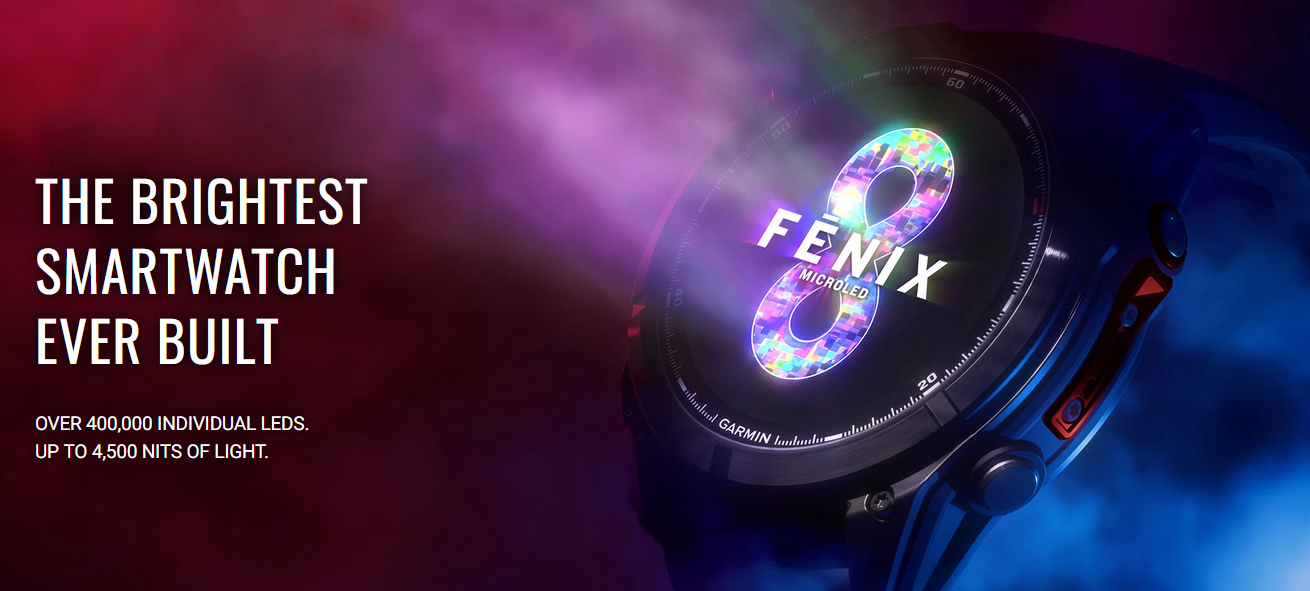
Garmin confirms touch microLED displays are coming.
In a wide-ranging interview with Tom’s Hardware, Ralph Polshak, Display Technology Manager at Garmin, provided some background on the company’s decision to bring the first microLED display to a wearable device to market. He also confirmed that a touchscreen will (eventually) come and expressed surprise that people thought that microLED would be lower powered than OLED – an odd comment considering that’s what the entire industry, including AU Optronics (AUO), Garmin’s supplier, has been saying for years.
Background
Garmin launched the Fenix 8 Pro microLED in September 2025, making it the world’s first MicroLED smartwatch, a surprise to industry insiders who expected TAG Heuer or Samsung to win the race, Apple having publicly stepped back from its commitments to the technology in 2024.
The Development Effort
After discovering AUO was working on a wearable-sized display, Polshak confirmed it “was a two-year development effort” to get the tech to a production-grade watch, a relatively quick turnaround.
He further noted the tech’s promise and that Garmin continues to research additional ways to integrate the technology into other models.
“I believe it has the ability to be a game-changing technology in the industry. We definitely plan to continue to explore ways we can use it.”
MicroLED Benefits vs. AMOLED
MicroLED’s key benefit for Garmin in 2025 is that it offers an inorganic display panel, which, in simple terms, will significantly reduce or even eliminate burn-in, an issue that plagues existing technology. There are other performance benefits with a better image that’s more easily read at shallow viewing angles.
| Feature | MicroLED Advantage | Quote |
| Performance | Brighter, better colour, and clarity than OLED. | “…screen performance, the colour, the clarity, the brightness, even brighter than OLED…” |
| Longevity | Inorganic, not susceptible to burn-in or age-in. | “it addresses that burn-in issue of OLED… The more you use it, the more you lose it on an OLED display. It’s a consumable. MicroLED is inorganic.” |
| Visibility | More efficient light output; better viewing angle. | “The light output from the LED is better. It’s more efficient than OLED, and that’s what gives you that viewing angle.” |
Challenges in Development
AU Optronics had to deal with the complex manufacturing of the display panel, which contained over 400,000 individual LEDs, each measuring the size of a human hair (40-50 microns). Garmin then had to adapt the existing Fenix 8 Pro design, incorporating an entirely new control circuit. A further issue with the Gen 1 implementation is that the display panel is not yet as well-integrated into the complete screen as with the older technology, resulting in a 1mm thicker case on the microLED model of the Fenix 8 Pro.
Further issues included reconfiguring the internal space and considering the impact on the performance of other components, such as the GNSS chipset – for example, by considering electrical interference.
Polshak’s comments rounded off with his take on the future with integrated touch control.
“All of the OLEDs we use have integrated touch. The MicroLED does not yet. That will be something that comes later.”
The Battery Life Disappointment
Fenix 8 Pro microLED currently has shorter battery life than the AMOLED version, which surprised many industry insiders.
“There was a huge misconception about power,” says Polshak. “The best thing I can say is OLED’s got a 25-year head start… I don’t know who put it out there that MicroLED would suddenly magically be lower power than OLED. It will get there, but not today.”
Polshak’s comments are odd. One of the key selling points of microLED is that it has demonstrated energy savings over OLED, albeit on larger-scale panels and in test scenarios. As evidence, here are direct quotes from AUO:
- From May 13, 2024: AUO states, “Micro LED display technology stands out with its high resolution, high brightness, low power consumption, and high reliability features, positioning it as the best solution for next-generation displays.”

- From May 22, 2023: AUO describes MicroLED as offering “higher resolution, increased brightness, lower power consumption, and enhanced reliability.” auo.com

Either way, Garmin is aware of the disappointment and says that poorer power consumption is the “limit of the technology right now.”
Future Outlook
Looking to the future, it’s clear that Garmin is still working with the tech. It is widely known that, at the moment, manufacturing has high failure rates (low yield) and is therefore challenging to produce in high volumes. Consequently, component costs are increased more than for OLED. This means that future watches can only be ‘Pro-like’ models that command a higher-than-normal premium and which sell in modest volumes.
Reading between the lines, it’s also clear that Polshak hopes to see touch-microLED and a better-integrated and thinner overall screen.
As to the fabled lower battery consumption rates that will be down to panel manufacturers like AU Optronics to achieve
Last Updated on 29 January 2026 by the5krunner
Reader-Powered Content

This content is not sponsored. It’s mostly me behind the labour of love, which is this site, and I appreciate everyone who supports it.
Support the site: Follow (free, fewer ads) · Subscribe (paid, ad-free) · Buy Me A Coffee ❤️
All articles are written by real people, fact-checked, and verified for originality. See the Editorial Policy. FTC: Affiliate Disclosure — some links pay commission. As an Amazon Associate, I earn from qualifying purchases.

tfk is the founder and author of the5krunner, an independent endurance sports technology publication. With 20 years of hands-on testing of GPS watches and wearables, and competing in triathlons at an international age-group level, tfk provides in-depth expert analysis of fitness technology for serious athletes and endurance sport competitors.

I wonder why did they even release this watch. I see the potential of the tech, but at the moment is mostly downsides, which is why other companies postponed microled and willll refine it first in-house. Garmin launched one of the most expensive watches to serve as public consumer testing? Seems pointless, specially if there are 0 benefits to it, excluding viewing angle that is not even a significant feature.
I wonder why did they even release this watch. I see the potential of the tech, but at the moment is mostly downsides, which is why other companies postponed microled and willll refine it first in-house. Garmin launched one of the most expensive watches to serve as public consumer testing? Seems pointless, specially if there are 0 benefits to it, excluding viewing angle that is not even a significant feature.
They released it to be able to say they were first, and to generate headlines and buzz. I don’t think they ever genuinely expected to sell more than a handful of them. Point in fact, they didn’t really even send any to any of their retail partners. Amazon, REI, etc, none of them have ever stocked or sold any of these microled watches, you can only really buy it directly from Garmin, which limits their exposure and allows them to make sure they don’t end up making way more microled watches than the few dozen they can sell.
For Garmin, this watch launch was a success. Not being people are buying it – they aren’t. It was a success because they can say they beat all the other big players to make a microled watch, and it’s getting a ton of media coverage. And the watch LOOKS impressive, even if the spec sheet disagrees. Mission accomplished for Garmin. Now hopefully they’ll improve it enough soon and make it a product that people actually want.
yes, i pretty much agree with that.
on the other hand, had the AUO backpane been better engineered to give the battery savings that ARE possible then Garmin would have been selling the heck ouf of the microLED version. I suspect they started off hopefully (like apple) but when the battery life reality hit home Apple HAD to back out whereas garnin has more options open to it because of its product range.
And to get people used to the high prices right away, once it becomes really usable. No future surprises there :/
Personally I don’t think this is a success to brag about. Yeah, nice display but consumes power like Apple Watch. Than it’s not for Garminians, also not for Appleians, actually for no one.
I wonder how the battery life would be if they limited the light emition of the display. Instead of some 4 thousand nits how much power would it consume when set to 2000 nits, or less for night usage.
Maybe all the display circuitry etc. is consuming a lot of power too.
about 20% more battery life if you turn down the brightness on microled. obvisouly it varies depending on precise usage so that’s indicative. ie halving the brightness does not double the battery life.
The gas lighting is amazing garmin said the microled will be good on battery life but released a terrible product anyways.
I certainly said that, I don’t think Garmin did.