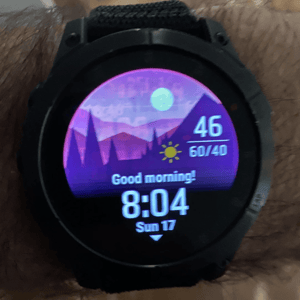
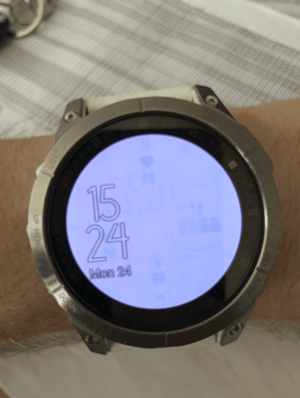
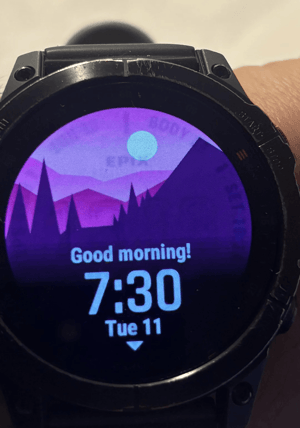
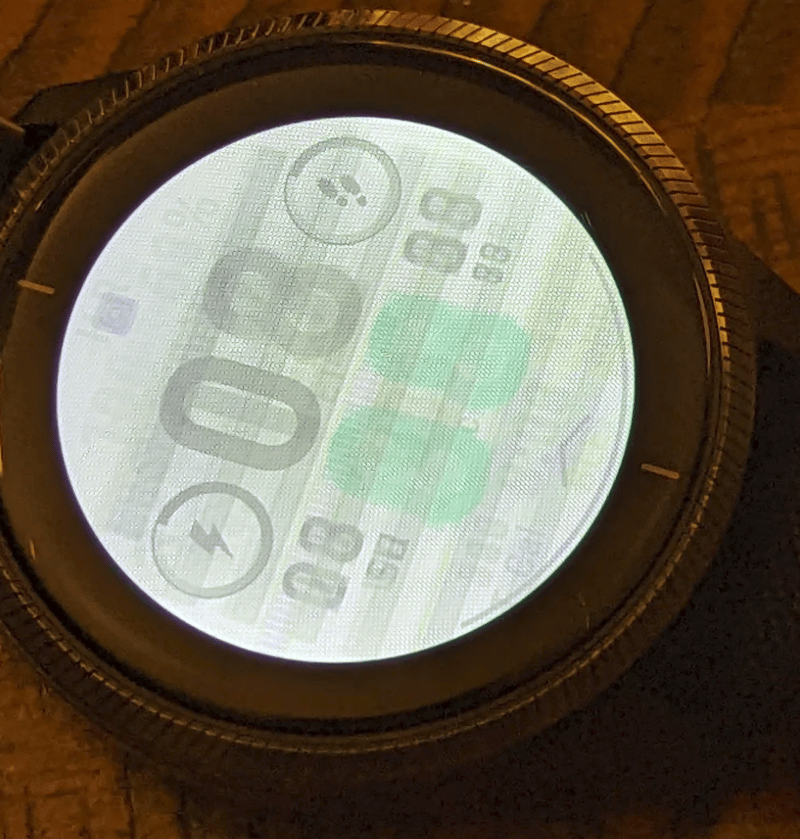
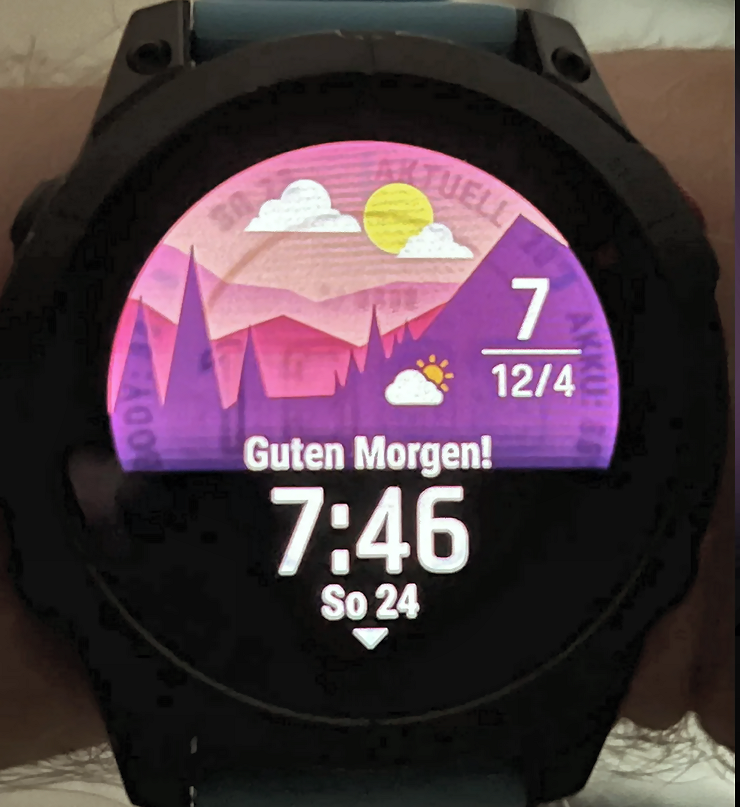
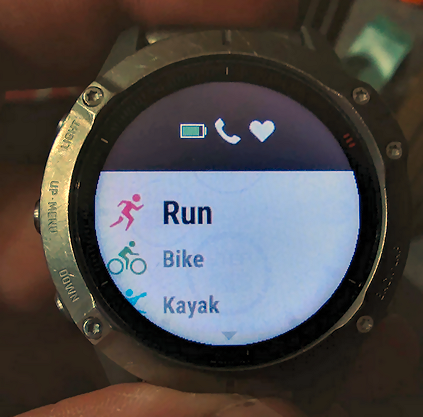
LED industry experts reassure us that “AMOLED Burn In is a thing of the past”. Try telling that to these unlucky Garmin owners. Let’s discuss the issues and what to do about them.
The Facts
Burn-in is an inherent risk with all AMOLED displays, including those used in smartwatches like the Garmin Epix Gen 2 and Venu series. However, its severity and likelihood depend on several factors, including usage, display settings, and how well the manufacturer offsets burn-in risk through software. Surprisingly, even Garmin’s older Memory-in-Pixel (MIP) displays, used in the Fenix 6 Pro and Fenix 7, have shown burn-in, despite their transreflective nature being more resistant to this issue.
AMOLED screens work by individually lighting up organic pixels. Over extended periods, these organic materials degrade at different rates, made worse when displaying static images for prolonged periods. This results in the ghosting effect you can see in the pictures above. Typically, the burn-in will be remnants of previously displayed images, usually watch faces, that remain visible. For MiP displays, burn-in is less common but can occur with prolonged static content, as seen in a documented case of a five-year-old Fenix 6 Pro.
Interestingly, the latest wave of screen tech – MicroLED displays – uses durable inorganic materials, which are considered significantly less prone to burn-in than AMOLED or OLED, but not entirely immune. Potential issues, including LED ageing, are different from showing prolonged static and high-brightness content, manufacturing imperfections, and minor thermal effects that might cause uneven performance. While these risks are minimal, extended use of static elements with Always-On Display could theoretically cause subtle degradation over many years.
Q: Is Burn-In Inevitable?
Yes and no.
- Yes, in the long run: All OLED/AMOLED displays, and to a lesser extent MiP displays, degrade over time, making burn-in an eventual reality if used long enough.
- No, for most users: Many people will replace or upgrade their smartwatch before a noticeable burn-in occurs.
Q: What Worsens My Chances of Ruining My $1,000 Watch?
Simply put, you run a higher risk if you have a static, bright image on any part of the display for a long time.
- Always-On Display (AOD) – Keeping the screen on 24/7 with static elements accelerates degradation, as reported with the Garmin Epix Gen 2 after four years of AOD use.
- High Brightness Levels – Brighter pixels degrade faster, particularly on AMOLED screens.
- Static Screen Elements – Persistent images like watch faces, status bars, and widgets “burn in” faster.
- Long-Term Use – Devices worn daily for years, such as the Fenix 6 Pro or Epix Gen 2, will inevitably show some wear on the display.
How Manufacturers Reduce Burn-In
Garmin, Apple, and other smartwatch makers implement various techniques to delay or minimise burn-in:
- Pixel Shifting – Slightly and repeatedly move screen elements, avoiding long periods of static images.
- Auto-Dimming – to reduce brightness in certain conditions.
- Screen Timeouts – that turn off the display after inactivity.
- Adaptive screen Elements – Some screen elements are designed to fade or change position subtly over time or in certain conditions. Garmin offers dynamic watch faces that relocate elements periodically to reduce static display time.
Does your 3rd-party CIQ watch face override any of these mitigation strategies? You might want to think very carefully about using 3rd-party watch faces, not tuned to minimise burn-in risks.
Preventing or Delaying AMOLED and MiP Burn-In
You bought a Garmin watch with a beautiful AMOLED or MiP display to show it off in its glory. As you’ve probably guessed, the solution is to NOT show it off in all its glory!
- Limit Always-On Display: Use the display only when necessary, especially for AMOLED models like the Epix Gen 2 or Venu 3.
- Lower Brightness: Use auto-brightness or manually reduce it to preserve pixel life.
- Change Watch Faces Regularly: Avoid static elements that stay on-screen; opt for Garmin’s dynamic watch faces.
- Enable Battery Saver Mode: Many watches reduce display activity in this mode.
- Use Darker Watch Faces: AMOLED pixels degrade faster when showing bright colours; darker themes reduce stress on pixels.
- Enable Gesture-Based Display: For models supporting it, use wrist gestures to activate the display instead of AOD.
Q: If I Get AMOLED or MiP Burn-In, Can I Get a Garmin Replacement?
You have a good case, especially if this happens within 2 years, regardless of how you used your watch brightness settings and watch faces. After two years, things get trickier.
The manufacturer’s warranty in the UK does not compromise your legal rights under the Consumer Rights Act (2015). To get a remedy, you must show:
- AMOLED or MiP screen burn-in is a design flaw or premature defect rather than expected ageing. Reports of burn-in on MiP displays, like the Fenix 6 Pro, may strengthen this argument.
- The product did not meet reasonable durability expectations for its price and intended use.
- Other users have experienced similar premature burn-in, indicating a possible widespread issue (see photos from Reddit forums for Epix Gen 2 and Fenix 6 Pro).
If you had bought a $50 watch 3 years ago, I doubt you have a case. However, if you’ve spent £1000 on a watch like the Epix Gen 2 or Fenix 7, expecting it to last more than 2 years without significant burn-in is reasonable, especially given Garmin’s marketing of these devices as durable fitness trackers.
Take Out
AMOLED and MiP burn-in is a real issue on Garmin watches, including high-end models like the Epix Gen 2 and Fenix 6 Pro. It just takes quite a long time to materialise. It will likely take over two years for burn-in to be noticeable on AMOLED screens, and even longer for MiP displays. As the Garmin Epix Gen 2 was released on January 18, 2022, I expect these stories to become more widely reported. If it happens to you after 2 years from purchase, your only recourse will likely be directly with Garmin. You should outline your problem with pictures of similar problems taken from Garmin and Reddit forums as evidence for a widespread issue, and then stress to Garmin your expectation of “reasonable durability”, citing other owners’ examples of the problem, including MiP display cases.
Good luck.
If it has not happened to you, turn down the brightness, change the screensavers/watch faces regularly, and consider disabling AOD or using gesture-based display activation to extend your watch display’s lifespan.
Last Updated on 3 October 2026 by the5krunner
Small things I always use
- Garmin 90-degree charging adapter: Charges your Garmin from any USB-C cable. Essential when travelling. I use one.
- Body Glide: The blue anti-chafe stick swimmers and runners carry. I use it.
- Speedo earplugs: Fewer ear infections and no cold-water dizziness. I use them.
- Dryrobe Advance: My winter changing robe for open-water swims. I use one. A cheaper option is the AONYIYI changing robe.
- Maurten: Race fuel that stays easy on the stomach. I use them.
- Garmin charging puck: The quickest way to top up before a session. I use one.
- Injinji: Toe socks that stop rubbing, so you run more. I use them.
- Ultimate toe protectors: Stop black toenails on long runs. They work. I use them.
- Compressport R2 v2 calf sleeves: My calf sleeves of choice. I use them.
- Cellucor C4: My pre-workout before hard sessions.
- TPU tubes: Schwalbe Aerothan, Tubolito and Pirelli SmarTube. Light, tiny spares. I use all three.
- G8 insoles: Adjustable insoles that are good. I use them.
- Cycplus Cube: A 97g electric pump that gets a road tyre rideable in two minutes. I carry one. 5% off with code THE5KRUNNER.
Watches and sensors
- Polar H10: My daily driver for waking HRV.
- Polar Verity Sense: My backup arm-worn HR sensor.
- Nomad bedside charger: Charges my iPhone and Apple Watch overnight. I use it, and many of their bands.
- Train.Red: The best muscle oxygen sensor I’ve used.
- Tymewear: Accurate heart rate and reliable ventilatory zones. I use it to pace endurance rides over an hour.
- Garmin Forerunner 970: A pro-grade triathlon watch. I use this.
- Apple Watch Ultra 4: My daily smartwatch. No phone needed on rides.
- Garmin Fenix 9 Pro: I’ve just bought one.
On the bike
- Continental GP5000 for everyday riding, and Aero 111 on the front for special occasions.
- Helmets: Specialized S-Works Evade 3 for road riding, and Rudy Project Wing for TT-style races. I use both.
- Ravemen FR300: A front light that mounts under your Garmin or Wahoo. I use one.
- Wahoo TRACKR Radar: I use it on one bike and Varia on the other. They perform the same.
- Garmin Varia RTL515: Radar that warns you of cars from behind. I use this model.
- Wahoo ELEMNT Roam 3: The bike computer that’s easy to use. I use mine on most rides.
- Favero Assioma Pro RS2: Accurate power pedals that swap easily between bikes. I use this model.
Home and indoor training
- NPE Runn: Makes my basic treadmill smart, sending more accurate speed and distance to my watch and Zwift. I use it.
- Google Wifi: Keeps Zwift connected in my pain cave. I use it.
- Apple TV 4K: Zwift on the big screen. I use two.
- Google Nest Doorbell (wired, 2nd gen): My video doorbell, running in both Google Home and Apple Home. I use it.
Health, recovery and sleep
- FreeStyle Libre 3 Plus: Shows how my blood sugar responds to diet.
- hDrop: Measures my sweat loss in summer and indoors.
- Fourth Frontier Zone: Checks my heart under load in hard sessions.
- Oura Ring 5: My partner’s recovery tracker of choice.
- Kineon MOVE+: Red light therapy for niggles. It works.
- Eight Sleep: A cooling mattress cover my partner and I use nightly.
Reader-Powered Content

This content is not sponsored. It’s mostly me behind the labour of love, which is this site, and I appreciate everyone who supports it.
Support the site: Follow (free, fewer ads) · Subscribe (paid, ad-free) · Buy Me A Coffee ❤️
Written by real people, with AI assistance. Fact-checked and verified for originality. See the Editorial Policy. FTC: Affiliate Disclosure — some links pay commission. As an Amazon Associate, I earn from qualifying purchases.
tfk is the founder and author of the5krunner, an independent endurance sports technology publication. With 20 years of hands-on testing of GPS watches and wearables, and competing in triathlons at an international age-group level, tfk provides in-depth expert analysis of fitness technology for serious athletes and endurance sport competitors. ID

Just send it to Garmin and you will get a new Watch. Even when you dont have warranty anymore. Customer service is excellent at Garmin.
yes my experience of garmin customer service is generally great in the uk. from stories i hear it does vary in other countries
for most of the feedback over all Amoled family watch on the Garmin forum, this is their reply or good experience with Support.
Garmin take care about this issue even outside the warranty period. Great reaction !
I’m not sure this is wrote somewhere in their warranty policy 😉
Garmin won’t replace all watches with burn-in for free. I had a Venu with severe burn-in and they offered me a Venu 2 at a reduced cost, which was still ok seeing that the Venu was out of warranty for a while already.
Their user manual also states that burn-in is normal, so they’re covering themselves and might deny a claim.
I’m less likely and more cautious to buy a used Amoled watch than a MIP one due to the risk of burn-in.
Hopefully MicroLED will become more affordable soon 🙂
As an Epix 2 owner (3.5 year) I experienced burn-in caused only by activity display (AOD off for non-activity). Obviously I am way out of warranty, but still I don’t think it is state of the art what is offered for a > 1000€ watch. I called Garmin to see whether they can help me.
While they were friendly and emphatic, in the end they cannot offer an exchange for the epix 2 as it is not available anymore. They offer that I can choose a watch and they will provide me with a significant discount. This does not seem to be fixed but probably depends on the selected product. As 30% percent was mentioned during the phone call I would expect something in that range.
My recommendation would be to deactivate AOD also during activity. Personally I have had about 10 hrs of actitivities/wk. Brightness was set to 2/3.
No it’s not, I had a Garmin forerunner that after just over 2 years, suffered from the well known issue where the watch case broke where the strap pins attached. Garmin refused to replace the watch as it was just over two years old (despite many users reporting the same issue).
Garmin offered me a 20% discount on a new watch – needless to say I stopped buying Garmin after this.
It depends on which country. They gave me a discount on a Venu 2 because of bad fading on a Venu, but they didn’t replace it for free, even though I told them it was a known issue on that model.
No it is not. Burnt-in Epix Gen 2 after a bit less than 3 years, never used with AOD, no max brightness. They only offer to replace the screen for about €130, which takes one month. Nothing more. It’s a €1,000 watch, ffs! The quality and customer support is far below what I would expect at this price tag. This is my last Garmin product, I will not buy from them again, ever.
Not using AoD mode reduces the risk of burnout to almost zero.
The solution is simple. Unfortunately, people want to have AoD by force, without analyzing how organic diodes work. Even if the manufacturer provides such a possibility, you need to have knowledge, using new technologies. Then the problems disappear.
Using a feature provided by the device manufacturer as intended should not result in failure of the display. If you have burn-in then it is a design defect. It’s not acceptable to say AOD mode makes it happen.
At least one of those burn-in images is the stock Epix watch face. That should be a warranty replacement of an equivalent device or heavily discounted upgrade.
good point about the stock face
However, it comes stated in the manual
“About the AMOLED Display
Device Information
By default, the watch settings are optimized for battery life and performance (Tips for Maximizing the Battery
Life, page 133).
Image persistence, or pixel “burn-in,” is normal behavior for AMOLED devices. To extend the display life, you
should avoid displaying static images at high brightness levels for long time periods. To minimize burn-in, the
epix display turns off after the selected timeout (Changing the Screen Settings, page 123). You can turn your
wrist toward your body, tap the touchscreen, or press a button to wake the watch.”
They should just state this in their marketing and selling pages, but we all know they wont.
No it does not disappear. I never used AOD or max brightness, I used only stock watch faces, and my Epix Gen 2 is burnt in after less than 3 years. If Garmin provides watch faces that degrade the watch screen, the problem is with them, not with the customer. And when your €1,000 becomes barely usable after less than 3 years and Garmin is only able to ask you a lot of money to repair it, I call it crappy quality and crappy customer support.
One of our most well known reviewers (no names mentioned), always states that burn in is just not a thing anymore…but every month he has a new watch on his wrist.
If someone buys an AMOLED device, they shouldn’t have to limit their use. Some people with older garmins are using them for 5years+ (I’ve seen people saying 8-10 years). The reality with these AMOLED devices is that we can expect maybe half of that. I wish no-name reviewer mentioned above could communicate that to his audience
not sure who you mean, I delve into research in microLED/OLED forums and other products that i don’t especially mention on this blog. it’s not especially relavent in any case as its the responsibility of garmin to make this clear.
regardless, you are correct tht you shouldn’t have to limit your use. (unless that is made clear in the sale)
Here is a quote from one of his many comments:
“By and large, short of some per-unit defect, AMOLED display burn-in just isn’t an issue in modern watches. End of story. All these companies have a vast array of tools in their toolbox to mitigate this, and they use them.
In terms of ‘correct’ here, I’m talking about the most ideal settings, and again, Garmin offers all of these ideal settings and suggests them as defaults. But if someone chooses something else, then, it won’t be ideal – and you could get less battery life (but it won’t hurt the display)”
I just hope that AMOLED doesnt completely take over the fitness wearables market. Im a Polar user and unless they announce something in the next year that is MIP, I will have to look elsewhere. I dont want to change my product every 2 years or limit the way I use it
I don’t want to single out dcr here. Others who should know better in their domain of expertise have said similar things
regarding amoled taking over the market. i’m afraid that is going to happen until there is a similarly ‘bright’ replacement tech (like microLED). MIP-like tech will probably continue to exist at the peripheries.
Yeah DCR is the one who convinced me to buy Epix which I sold after a month and returned to a Fenix. Basically constantly dimming AMOLED can’t replace a MIP screen for real outdoor use and the reason I switched to Garmin from Apple back in 2019 was the freaking wrist gesture and the fact that I didn’t see anything in bright sunlight without it. Try to check your stats during ski mountaineering while holding the poles. Or on a bike by just glancing at the wrist. So him and other reviewers saying that screen burn-in isn’t an issue and AMOLED is just as good under bright sunlight are simply missing the point or they like to do funny things with their hands while running, hiking, biking you name it. And those saying that you’ll probably just replace the watch after two years don’t give a shit about environment.
dcr is an excellent skier, i would have thought his advice on issues around that would be sound.
to be fair: none of us reviewers will have had 3-4 years of continuous usage of a single watch in order to experience burn-in. they haven’t been around long enough. so advice from reviewers at best comes from research that anyone can do or assurances from vendors or other industry experts in the display tech field
Man, I go out into the desert for a few days and come back to a crapstorm….
Look, I’ll defend what I said before – burn-in simply isn’t an issue for the overwhelming vast majority of users in today’s displays. Factually, it isn’t. If it was, we’d hear more than just an occasional user having the issue. Be it Apple, Garmin, Samsung, or otherwise. Obviously, when you ship millions of units of anything, you’re going to have a few units that fail in some capacity (be it due to hardware or software issues). If we want to go back and complain about Venu 1 device from 2019 before Garmin learned a lot about AMOLED displays (software and hardware-wise), fine, but we all know that’s not what we’re talking about in 2025.
If it were a real legit widespread issue (even a 2-3% issue) in 2024/2025, all we’d hear about is burn-in issues. Especially in the case of Apple’s numbers, but these days, also Garmin’s numbers. The numbers don’t lie here. Be it Reddit comments, Garmin forums comments, or comments on sites like this or mine (or other social media channels). I think people forget the scale of tens of millions of units of watches sold between Garmin & Apple on an annual basis here, let alone Samsung/Google and others. If we were having legit burn-in issues at scale (even 2-3% scale), we’d be talking thousands and thousands of posts.
As per the article, the burn-in issues might perhaps start to become more commonplace. Those that have surfaced so far appear not to be from defects but rather perhaps only from people doing unusualy harsh screen usage (AOD, high brightness, fixed watchface).
Not sure how you or I could have tested something that only occurs years down the line. If assurances have been made by suppliers then those need calling out.
You’re assuming:
– people notice the issue (I didn’t, since I use mostly black backgrounds)
– those who notice report it
– those who report it, do so online
– online reports trigger replies causing a mass reaction
– the mass reaction is brought to your attention
And yet, here we are discussing this issue. So maybe there’s good reason for the crap storm?
Mwahaha, fella, you sound like a lawyer – I claim but I don’t claim but it’s a user error, see article 2, para 5.
The fact is you make broad statements which majority take as a gospel, unfortunately. And you block people with counter arguments, using the age old “he a haderrrrr” argument which the elites like to use against valid criticism these days.
Recently you claimed that battery tech in small devices has improved so much there’s no risk of early degradation from high current charging. Which is nonsense, since the chemistry is the same and the only thing that changed is people’s perception of the problem thanks to the systematic programming through grifting community of influencers. Story time: Apple tried to convince everyone – via the grifting community – that they completely eliminated the battery degradation issues over a decade ago, this was their justification for not having an option to limit charging to 80% as other brands. Then magically they introduced the 80% limit a few years back, after a series of pretty unfortunate battery ageing incidents over the years.
People should use their brains and not trust the grifters – if somethings quacks like a duck and walks like a duck, IT’S A DUCK.
Mwahaha “I claim but I don’t claim but it’s a user error but it’s not an issue”.
The fact is, you make broad statements which majority take as gospel, unfortunately. And you block people with counter arguments, using the age old “he a haderrrrr” argument.
Recently you claimed that battery tech in small devices has improved so much there’s no risk of early degradation from high current charging. Which is nonsense, since the chemistry is the same and the only thing that changed is people’s perception of the problem thanks to the systematic programming through grifting community of influencers. Story time: over a decade ago Apple tried to convince everyone – via the grifting community – that they eliminated the battery degradation issues. This was their justification for not having an option to limit charging to 80% as other brands. Then, a few years ago, they magically introduced the 80% limit after a series of pretty unfortunate battery ageing incidents since the original claims.
People should use their brains and not trust the grifters – if somethings quacks like a duck and walks like a duck, IT’S A DUCK.
Ray, you state that the display issues are rare, affecting just a small percentage of users… then why doesn’t Garmin just take care of the user. Wouldn’t that bolster brand loyalty which is much cheaper than any form of advertising. Instead Garmin offers a 20% discount on their all ready overpriced products. How is this discount any different than a May or Black Friday sales event? At 20% off, Garmin is still making a significant profit and all they have done is just gotten more money out of a consumer on product.
While I find you content entertaining… it does trend towards a Garmin bias.
@Tom
If you actually switched from Apple to Garmin, you shouldn’t have been surprised by the (alleged) limitations of an AMOLED display. So maybe you should re-evaluate your personal lessons learned process before blaming other for your bad choices. I have been using Garmin AMOLED watches since the Venu came out and my Epix as well as my current Epix Pro have been great in terms of display readability in almost all light conditions, even with a slightly dimmed display during activities.
Tech obviously has progressed since then so if a reviewer tells me it’s even better than MIP display I trust him to be exactly that. Little did I know you actually still have make that silly gesture in order to see anything in bright sunlight. And also when he says screen burn-in isn’t an issue, many consumers can be misled into thinking it will last just like a MIP Fenix for many many years in AOD mode and it turns out to be far from the truth.
I suggest you just read or watch his reviews to the end and don’t ass-u-me anything. In each of his early Epix reviews and videos he stated that you have to flick your wrist in order to activate the screen. And I can’t recall that he ever stated that you can wear your watch 24/7 for years in AOD with the same watch face without running the risk of burn in. I know, blaming others for the mistakes one makes is an time honored tradition…
Well from what I remember he said numerous times that it’s clearly visible in sunlight, better than MIP and due to pixel shifting there is no risk of a burn-in. I’m not blaming him for my mistakes, after selling the almost new Epix I got Fenix 7 for the same price. I’m only saying that he should reconsider his judgement and stop telling people that AMOLED is the eighth wonder of the world because the tech obviously still is limited. BTW I really like Ray and enjoy watching his reviews, I just don’t agree with him on this one and I’m surprised he keeps claiming that burn-in is not an issue.
Not that old trope again… None of DCR,T5KR and other reviewers have ever said that OLED is the end all of display technologies, superior in _every_ espect or the best choice for _everybody_ or _all_ scenarios.
What they have said is that OLED is superior or equivalent in _most_ (initially many, nowadays almost all) scenarios and for the _vast majority_ of users. That has been borne out by the market: consumers mostly choose OLED watches over MIP or other technologies.
Every technology has limitations, some of which get eliminated or reduced or mitigated through technological progress – eg burn-in appears to be almost a non-issue at this point (Note: does not mean it doesn’t happen at all, but the number of occurences and/or required conditions are so rare that it is peactically not important – and those few instances can be easily and economically addressed through replacements or similar).
At this point, OLED displays are clearly the superior and preferred choice for the vast majority of cases. But there will probably always be a small number of edge cases (watches on bike handlebars) or users who prefer something else/niche technologies (MIP, analog hands, sundial…).
FWIW, all my OLED watches since the Epix Gen 2 have performed perfectly fine and notably superior to MIP ones in _all_ conditions including bright equatorial sun, ski touring etc.
yes and in my opinion oled is the best tech for me too.
i’ve hardly previsouly mentioned burn in (never having experienced it) but certainly will do in the future and, obvisouly, i have in this artcile
There is a reason MIP was used in this kind of watches and the first place. And like I said a thousand times, while I appreciate the choice of Amoled for those who want to live with the tradeoffs, these are very real. And yeah, there’s been some gaslighting about it from some reviewers. “Oh, it’s super visible in all conditions, oh battery life is so great now, oh, you get used to the gestures”. OK.
MIP was used because on balance it was the best avaialable _at the time_.
Technological progress has changed that and _at this point_ OLED displays are on balance far superior. Again, there are some llimitations (fewer and fewer) and some edge cases, for most applications and users these are not relevant or are more than offset by the other advantages of OLED.
Advantages which are nice colors and clear display in dimmer conditions? These are watches, not phones. I glance at them couple of times a day and when I do, I don’t wanna do funny stuff with my hands as if I were dancing to techno. Stop telling people you actually can see the screen (especially in polarized lenses) in bright sunlight without waving your hand.
also classed as jewellery #Pretty
MIP is the best technology for me… so far.
I’ve had a Marq Gen 2 for 2 years and it has no sign of screen burn in even though I keep it in ‘always on’ mode permanently. Whilst there’s no denying OLED looks prettier, the MIP on my Gen 1 was better for outdoor activities, especially cycling, for battery life and for simply telling the time. In bright sunlight, the dimmed ‘always on’ is effectively off; you have to twist your wrist or press a button to see the time or your activity display. Presumably, that’s why Garmin stuck with MIP for the Edge 1050 (although the LCD is now transmissive rather than transflective).
Will microLED be better still?
technically better images for sure – resolution and brightness, but how much better makes a difference to the viewer? maybe better resolution would aid map display?
i suspect the advantages of microLED are linked to power, probably also pixel by pixel control to support strategies to reduce burn in.
This happend to my Garmin Marq 2 Expedition, they have replaced the watch
I have a 965 and with a test app that uses a solid background I’m able to see some slight variation in brightness on the screen. The edges are a bit brighter in some places. I think this is because they aren’t used as much as other parts of the screen when displaying content. So, the middle has worn out and faded a bit more, I think. While using the normal watch face, glances, etc. it isn’t noticeable and without the test app I wouldn’t have known about it or noticed anything.
I had something similar on a Venu 2, where I could see some unevenness using the test app. And that’s probably what it’s like for most users. It’s there after a few years, but not noticeable and will probably degrade over time to the point where it is. By then the battery will probably already have degraded as well, and it becomes e-waste. I’m hoping newer models will be more repairable and allow us to replace the screen and battery.
thanks for that info.
repairable: yep kudos for Google Pixel for doing that. It obvisouly can be done.
I’ve done a bit more research and it could also be Amoled panel uniformity variance / aging, which apparently isn’t uncommon. It looks worse when the display dims and I don’t see any obvious patterns / text.
I purchased the Epix Gen 2 47mm when released. Use it 24/7. AOD off but on during activity with gestures. I ride or trail run most days. In 2 years, map screen showed burn in of the activity screens. In ’24 Garmin replaced it. Today it’s just under 2 years with the replacement and showing a lot of burn in on the map screen. With most tech today 5 years is my expected useful life. My Fenix 5X 51mm I might have kept using but the few changes and the gorgeous screen made the Epix Gen 2 compelling. Still love the watch and will use it till I find something more compelling. I just cannot rationalize over $500 for a watch that has a useful life of 2 years. While I trust reviewers experience with the features, owning the devices, and seeing how they appear in 2 years is key to making any judgement. I am not upgrading to an 8 at $849 for an expected 2-year life, a warranty claim, etc… I am a Garmin shareholder and while it allows me to buy Garmin’s best products, I’m not seeing a logical path for my next Garmin watch.
i agree that reviewers (including me) often and usually do not cover longevity and usability. Definitely the latter should be included, the former is next to impossible
Baví mě zdejší komentáře. Já mám epix gen 2 a vypálení je za 3.5roku obrovské. Za tu dobu je vystřídalo asi 5 ciferníku. Vypínání po 4s a zapnuté gesto na zápěstí. Jas je na 2. Nepomáhá nic. Graminu jsem napsal a je jim to líto s tím že to není výrobní vada a nabízejí opravu za cca 200eur. Se asi zbláznili abych jim dal ještě dal vydělat za jejich průser.
Epix Gen 2 OLED burn-in at 4 years — full account of Garmin’s out-of-warranty process and mediation outcome.
Sharing my experience in full in case it helps others.
The issue: Garmin epix Gen 2 Porsche Edition, purchased January 2022, developed permanent OLED burn-in after approximately four years of normal use. Persistent dark patches and ghosting visible across all watch faces and brightness settings. No physical damage.
Garmin’s response: Out of warranty (3-year legal period). Repair fee: €353.06 upfront, covers repair or replacement at their discretion after physical inspection. If replaced, with a refurbished unit. No itemised quote, no option to confirm outcome before payment.
Formal mediation: I filed through CICAP (Portuguese consumer arbitration). Garmin’s formal position during mediation: defect is not of manufacturing origin because it appeared after 4 years; €353.06 stands. The mediator acknowledged the legal difficulty — outside the warranty period, the burden of proof falls entirely on the consumer, which in practice is close to impossible for a latent defect like OLED burn-in.
Outcome: Unresolved. I’m not paying €353 on a device I paid ~€1,000 for four years ago.
Has anyone here had a different outcome with Garmin support for OLED degradation — in Europe or elsewhere? Curious whether this is consistent across markets or whether some regions get a different response.