
Wahoo Moves to Ban $599 JetBlack Victory Trainer from US Market
Wahoo Fitness just filed legal papers to block Australian rival JetBlack from selling its budget Victory trainer in the United States—and the move could work within months. If successful, indoor cyclists will lose access to one of the few sub-$600 direct-drive smart trainers on the market, potentially keeping prices higher across the board.
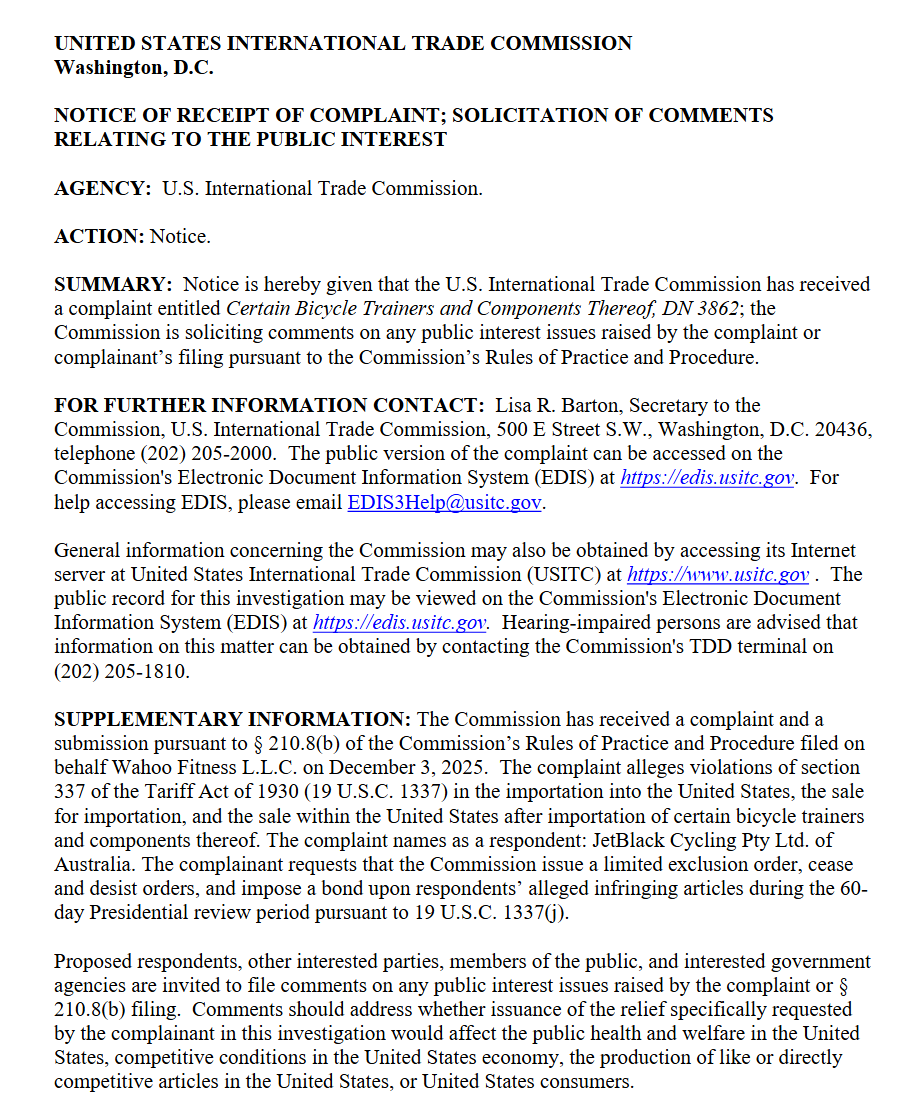
The Atlanta-based company filed a complaint with the U.S. International Trade Commission (ITC) in December 2025, targeting JetBlack’s $599 Victory trainer that launched in July 2024. This is the second time Wahoo has gone after JetBlack—the Australian company was previously forced to pull its earlier Volt trainer from US and European markets in 2023.
What This Means for Cyclists
- The JetBlack Victory ($599) could be banned from US import by mid-2026
- This removes direct competition for Wahoo’s $799 KICKR Core
- If you already own a Victory, warranty and support could be affected
- Fewer budget trainer options = potentially higher prices industry-wide
- JetBlack’s US dealer network may collapse if the ban succeeds
The Products at Stake: Victory vs KICKR Core
| Feature | JetBlack Victory | Wahoo KICKR Core 2 |
|---|---|---|
| Price | $599 USD | $799 USD |
| Max Power | 2,200W | 2,000W |
| Accuracy | ±2% | ±1% |
| Flywheel Weight | 5.9kg | 5.8kg |
| Max Gradient | 16% | 20% |
| US Availability | At risk – import ban pending | Available now |
The Victory undercuts Wahoo’s entry-level offering by $200—a significant margin in the competitive indoor cycling market where Zwift’s own Hub trainer sells for $499.
How Wahoo’s Legal Strategy Works
Wahoo isn’t filing a traditional lawsuit that could take years. Instead, they’re using what’s called a Section 337 complaint with the U.S. International Trade Commission—essentially a fast-track process to stop competing products at US Customs.
What Wahoo is asking for:
- Limited Exclusion Order (LEO): Stops US Customs from allowing Victory trainers into the country
- Cease and Desist Orders: Prevents JetBlack from distributing any Victory units already in the US
- Border enforcement within 12-18 months (much faster than normal patent litigation)
The company claims JetBlack infringes on “several of its patents,” particularly around electromagnetic resistance control—the core technology that governs how a smart trainer creates realistic ride feel and power accuracy.
The 2022 Patent War: How We Got Here
This isn’t Wahoo’s first legal head-to-head with JetBlack. Here’s the timeline:
October 2022: Wahoo Sues Both Zwift and JetBlack
Wahoo filed separate patent complaints against Zwift (for the new Hub trainer) and JetBlack (for the Volt trainer). Both products competed directly with Wahoo’s KICKR Core at lower price points.
August 2023: Zwift Settles, Gets License
Zwift reached an “amicable settlement” and agreed to pay Wahoo licensing fees. The companies now work together—Wahoo even sells a KICKR Core 2 variant with Zwift’s Cog and Click system included.
2023: JetBlack Withdraws from US/Europe
JetBlack settled on poor terms, agreeing to pull the Volt trainer from the United States and Europe—Wahoo’s most important markets. The Australian company was effectively locked out of major revenue sources.
July 2024: JetBlack Launches “Victory”
After the Volt defeat, JetBlack spent time developing what it hoped was a patent-safe alternative. The Victory trainer launched with different resistance technology, aiming to avoid Wahoo’s patent claims while re-entering the US market.

December 2025: Wahoo Strikes Again
Wahoo files the new ITC complaint, claiming the Victory still infringes its patents. Round two begins.
Wahoo’s Patent Arsenal
Wahoo maintains an extensive patent portfolio protecting its trainer technology. The most relevant patents in this case:
- U.S. Patent No. 12,343,608 – “Bicycle Trainer” (granted July 1, 2025)
- U.S. Patent No. 12,440,724 – “Indoor Bicycle Adjustment Method and System” (granted October 14, 2025)
- U.S. Patent No. 12,465,811 – “Indoor Bicycle Training Device” (granted November 11, 2025)
- U.S. Patent No. 12,429,921 – “Cover System for Computing Device Ports” (granted September 30, 2025)
- U.S. Patent No. 12,330,036 – “System and Method for Controlling a Bicycle Trainer” (granted June 17, 2025)
Notice the grant dates—these patents were approved in 2025, giving Wahoo fresh ammunition after JetBlack thought it had designed around the earlier patents.
Why This Matters Beyond One Product
The Budget Trainer Market Is Shrinking
Indoor cyclists seeking quality direct-drive trainers under $700 now have limited options:
- Zwift Hub: $499 (but basic features, single-speed flywheel)
- JetBlack Victory: $599 (if it survives this legal challenge)
- Wahoo KICKR Core: $799 (the market leader)
- Elite Suito: ~$600 (limited US availability)
If Victory disappears, the gap between the $499 Zwift Hub and $799 KICKR Core becomes a canyon. Wahoo faces less pricing pressure to lower the Core’s price.
The Innovation Question
Wahoo argues this is about protecting innovation: “Without patent protection, companies will be less likely to invest in R&D that ultimately gives us better products.”
Critics counter that aggressive patent enforcement can stifle competition and keep prices artificially high, primarily when the patents cover fundamental trainer operation rather than novel inventions.
What Happens to Existing Victory Owners?
If Wahoo wins the import ban:
- Warranty claims become complicated (no new units for replacements)
- Software updates may continue (doesn’t require physical imports)
- Spare parts could become unavailable
- Resale value will likely tank
JetBlack’s US dealer network would likely collapse, leaving Victory owners without local support.
What Happens Next: Timeline
Q1 2025 (Now): ITC reviews Wahoo’s complaint, decides whether to investigate
Q2-Q3 2025: If the investigation proceeds, ITC collects evidence and holds hearings
Q4 2025 – Q1 2026: ITC makes initial determination on patent infringement
Mid-2026: Final determination and potential issuance of import ban
Throughout: JetBlack can negotiate a settlement or licensing deal to avoid a ban
This process moves far faster than traditional patent litigation, which can drag on for 3-5 years. That’s precisely why Wahoo chose this route.
The Bigger Picture: Wahoo’s Market Position
This case isn’t really about patents—it’s about market control at the entry-level price point.
Wahoo already has a problem: its partner Zwift sells the Hub trainer for $200 less than the KICKR Core. Now JetBlack wants to slot in at $599, creating even more pricing pressure.
Wahoo’s calculation: Better to spend money on lawyers now than compete on price later. The company has the resources for extended legal battles; smaller competitors like JetBlack typically don’t.
The result: Wahoo protects its 40%+ profit margins on the KICKR line while maintaining the appearance of defending legitimate patent rights. Both can be true simultaneously.
Should You Buy a Victory Trainer Right Now?
Short answer: Risky.
If you’re considering a Victory:
- Current owners report good performance and accuracy
- At $599, it’s legitimately good value if support continues
But…
- Import ban could happen within 12 months
- Warranty support could evaporate overnight
- Resale value is now uncertain
Better bet: Wait to see how the ITC case develops (check back in Q2 2025), or spend the extra $200 for the KICKR Core’s security and established support network.
Take Out
So no, Wahoo is not taking a play out of the Strava legal playbook.
This case is all about Wahoo protecting its position at the lower end of the market. It already has enough of a problem with hardware price competition from its partner, Zwift; it certainly doesn’t want JetBlack forcing it to lower prices and margins any further. Sure, Wahoo could handle that financially, but it just doesn’t want to. Fair enough.
Plus, of course, the company is seeking to protect its inventions; without protection, companies will be less likely to invest in innovation (R&D) that ultimately gives us better products.
What do you think? Should budget smart trainers be allowed to compete with established brands like Wahoo, even if they use similar technology? Let me know in the comments below.
Update Schedule: I’ll update this article as the ITC case progresses. Bookmark this page or subscribe to the newsletter for alerts when major developments happen.
Last updated: December 13, 2025
Last Updated on 3 October 2026 by tfk the5krunner
Small things I always use
- Garmin 90-degree charging adapter: Charges your Garmin from any USB-C cable. Essential when travelling. I use one.
- Body Glide: The blue anti-chafe stick swimmers and runners carry. I use it.
- Speedo earplugs: Fewer ear infections and no cold-water dizziness. I use them.
- Dryrobe Advance: My winter changing robe for open-water swims. I use one. A cheaper option is the AONYIYI changing robe.
- Maurten: Race fuel that stays easy on the stomach. I use them.
- Garmin charging puck: The quickest way to top up before a session. I use one.
- Injinji: Toe socks that stop rubbing, so you run more. I use them.
- Ultimate toe protectors: Stop black toenails on long runs. They work. I use them.
- Compressport R2 v2 calf sleeves: My calf sleeves of choice. I use them.
- Cellucor C4: My pre-workout before hard sessions.
- TPU tubes: Schwalbe Aerothan, Tubolito and Pirelli SmarTube. Light, tiny spares. I use all three.
- G8 insoles: Adjustable insoles that are good. I use them.
- Cycplus Cube: A 97g electric pump that gets a road tyre rideable in two minutes. I carry one. 5% off with code THE5KRUNNER.
Watches and sensors
- Polar H10: My daily driver for waking HRV.
- Polar Verity Sense: My backup arm-worn HR sensor.
- Nomad bedside charger: Charges my iPhone and Apple Watch overnight. I use it, and many of their bands.
- Train.Red: The best muscle oxygen sensor I’ve used.
- Tymewear: Accurate heart rate and reliable ventilatory zones. I use it to pace endurance rides over an hour.
- Garmin Forerunner 970: A pro-grade triathlon watch. I use this.
- Apple Watch Ultra 4: My daily smartwatch. No phone needed on rides.
- Garmin Fenix 9 Pro: I’ve just bought one.
On the bike
- Continental GP5000 for everyday riding, and Aero 111 on the front for special occasions.
- Helmets: Specialized S-Works Evade 3 for road riding, and Rudy Project Wing for TT-style races. I use both.
- Ravemen FR300: A front light that mounts under your Garmin or Wahoo. I use one.
- Wahoo TRACKR Radar: I use it on one bike and Varia on the other. They perform the same.
- Garmin Varia RTL515: Radar that warns you of cars from behind. I use this model.
- Wahoo ELEMNT Roam 3: The bike computer that’s easy to use. I use mine on most rides.
- Favero Assioma Pro RS2: Accurate power pedals that swap easily between bikes. I use this model.
Home and indoor training
- NPE Runn: Makes my basic treadmill smart, sending more accurate speed and distance to my watch and Zwift. I use it.
- Google Wifi: Keeps Zwift connected in my pain cave. I use it.
- Apple TV 4K: Zwift on the big screen. I use two.
- Google Nest Doorbell (wired, 2nd gen): My video doorbell, running in both Google Home and Apple Home. I use it.
Health, recovery and sleep
- FreeStyle Libre 3 Plus: Shows how my blood sugar responds to diet.
- hDrop: Measures my sweat loss in summer and indoors.
- Fourth Frontier Zone: Checks my heart under load in hard sessions.
- Oura Ring 5: My partner’s recovery tracker of choice.
- Kineon MOVE+: Red light therapy for niggles. It works.
- Eight Sleep: A cooling mattress cover my partner and I use nightly.
Reader-Powered Content

This content is not sponsored. It’s mostly me behind the labour of love, which is this site, and I appreciate everyone who supports it.
Support the site: Follow (free, fewer ads) · Subscribe (paid, ad-free) · Buy Me A Coffee ❤️
Written by real people, with AI assistance. Fact-checked and verified for originality. See the Editorial Policy. FTC: Affiliate Disclosure — some links pay commission. As an Amazon Associate, I earn from qualifying purchases.
tfk is the founder and author of the5krunner, an independent endurance sports technology publication. With 20 years of hands-on testing of GPS watches and wearables, and competing in triathlons at an international age-group level, tfk provides in-depth expert analysis of fitness technology for serious athletes and endurance sport competitors. ID

While I’m sure the facts of the case and the research etc is original, parts of this article made me wonder if it was finished with the help of ChatGPT. Not sure how I feel about that. I still appreciate the content