ChatGPT Health Launches: The ‘Digital God’ of Fitness May Arrive in 2026
OpenAI has just announced its intention in the digital Health and Fitness space.
TL;DR – OpenAI’s new ChatGPT Health service links all your health and fitness data from disparate sources like b.well and Apple Health into a familiar chat interface to make sense of it all for you. This is the arrival of the Digital God in your pocket.
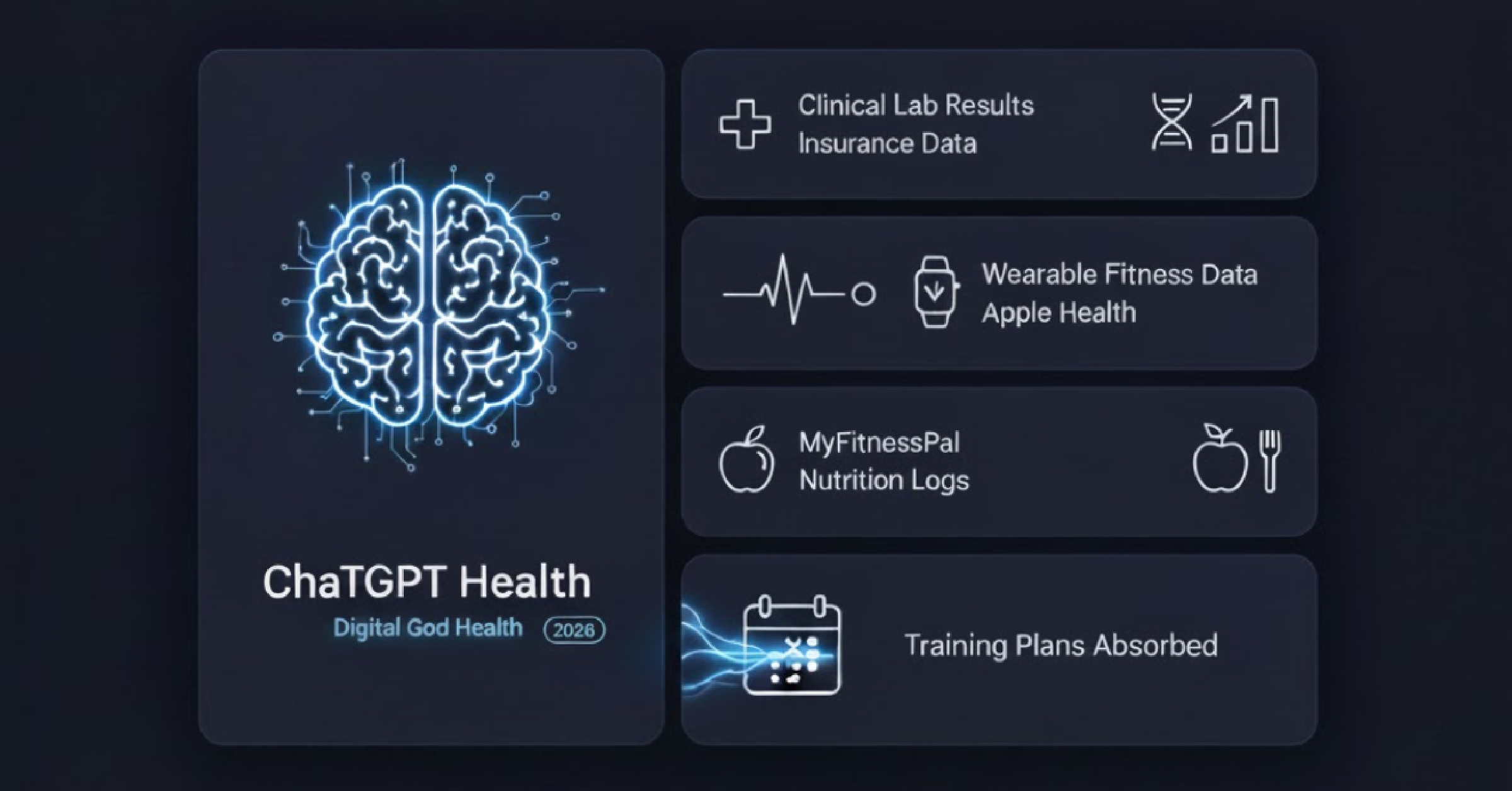
In essence, it will revolutionise (in a bad way for apps) the entire digital health and fitness industry within two years. ChatGPT Health isn’t planning to be another app—it plans an enveloping assault on almost every company and app that built a business helping us understand our bodies, train smarter, or get healthier.
Worried? You should be. The clue is in the phrase ‘Digital God’.
ChatGPT Announces Its Intent to Replace Fitness and Wellness Apps
OpenAI’s new ChatGPT Health consolidates medical records, fitness tracking, and wellness apps into a single AI-powered interface. This will make standalone health applications like those piggyback Apple Health obsolete.
This is an intentional strategy to position ChatGPT as the singular point of access for all health and fitness information, relegating the specialised apps we see today to the role of expendable data provider or, in the worst case, making them obsolete.
While OpenAI insists this is a support tool and not a medical-fitness replacement, the industry impact tells a different story.
230 Million People Weekly Are Already Asking Health Questions
With over 230 million people globally already using ChatGPT for health and wellness queries each week, the launch of ChatGPT Health merely publicly formalises one of the platform’s most common use cases for AI chatbots.
While fitness and training questions represent a smaller subset today, the infrastructure to capture that market aggressively is effectively identical. OpenAI knows precisely how many people are already asking about workout plans, race preparation, and training advice. You can be sure the number is growing daily and will continue to grow, and that OpenAI will address that growing need soon.
How ChatGPT Health Unifies Medical and Fitness Data
ChatGPT Health connects disparate data sources—from clinical lab results to MyFitnessPal nutrition logs—creating a unified health profile that no single wellness app has ever achieved.
Medical Records Meet Meal Tracking Meet Workouts
The scope is staggering: athletic training apps, doctors’ medical records, insurance company data, nutrition tracking, sleep monitoring, and wearable fitness data all flow into a single conversational interface that understands the relationships among these previously siloed information streams.
More specifically: the scope is YOU.
MyFitnessPal and Peloton Become Data Feeds, Apple Health An Aggregator
Major fitness and wellness platforms risk being repositioned as mere data sources that feed into ChatGPT’s conversational interface rather than destinations people visit directly and dwell for a while.
The architecture is important to grasp: Apple Health and Google Health serve as aggregation layers that ChatGPT Health oversees, while companies like Garmin, MyFitnessPal, Whoop, Wahoo, and Polar remain sources that potentially feed your data into those aggregation layers.
This creates a dangerous dependency chain in which the value flows upstream to the AI layer, while the data-capture layer becomes commoditised.
Would you pay $10 a month for a Garmin Connect+ subscription that can’t quite log food properly or $10 a month to access a feature with God-like insight to the entirety of published science plus your health and physical performance?
The Death of Single-Purpose Health Apps
When people can ask “How’s my cholesterol trending?” or “Give me a workout plan for postpartum recovery” in natural language, specialised apps that do only one thing lose their reason to exist. The app that only tracks runs, only analyses nutrition, or only monitors sleep becomes obsolete when a single interface synthesises all of these simultaneously and answers questions about their interactions.
Every app that currently relies on getting data from, say, Apple Health will die. Quickly.
Is it the same for fitness apps like Strava?
A: Yes. If Apple Health and Google Health reach critical mass in storing workouts, why can’t ChatGPT Health, with access to both, replace Strava in a slightly different form? Strava’s only uniqueness has ever been its segments.
Training Plan & Coaching Apps Face Extinction: Final Surge and TrainingPeaks in the Crosshairs
Subscription-based training plan platforms that charge athletes £10-20 monthly for periodised workout schedules face obsolescence when ChatGPT Health will perfectly personalise training programs based on every sports science paper ever written. Through simple conversation, you could have created these plans with AI a year ago.
More threatening still, Agentic AI can provide updated daily advice (or a FIT file structured workout) similar to Garmin’s Daily Suggested Workouts—analysing yesterday’s training session, last night’s recovery metrics, and today’s calendar availability to recommend exactly what workout to do, when to do it, and how hard to push. The static training plan, even the adaptive one, becomes obsolete when AI continuously optimises in real-time.
And by a similar token, your route and race planning needs follow a similar path, using ChatGPT Health’s Heatmap and Best Bike Split race-day power plans.
It’s all included in your standard monthly Digital God subscription.
Hardware ownership is the only remaining moat against AI consolidation.
Companies like Garmin, which capture original data and already keep some health data locked within proprietary ecosystems, may be the only fitness platforms to survive by refusing to become data feeds for OpenAI’s system. This strategy only works if the company is the source capturing the original data, and that data must be either highly niche (like continuous blood sugar readings) or comprehensively cover a specific domain (all your bike computer metrics). Garmin’s advantage is that it owns the hardware that generates the data—you can’t get that information without a device.
However, to enforce the moat strategy, Garmin must prevent us from sharing our data, and in doing so, it loses one of the pillars of its success: openness.
We want the opposite (openness) of what Garmin needs to survive (a moat).
What Happens When the Chatbot Replaces the Dashboard (app)
The fundamental shift from tapping through multiple app interfaces to simply asking questions in natural language may mark the end of the traditional wellness app model.
The situation is more profound than the use of chatbots—we only use that term because it’s familiar. Agentic AI can already easily work in the background on your behalf, analysing patterns you’d never notice, prompting you when intervention is needed, alerting you to emerging issues before they become problems, and continuously optimising your health without requiring you to ask.
The app does not die because conversation is easier than tapping, but because you won’t need to check anything—the AI will tell you what matters, when it matters.
Far-fetched? Why the Shift to AI Health Agents is Happening Now
“This seems impossible” is exactly what people said about previous tech revolutions—they still happened but AI moves faster.
Three reasons this will happen quickly:
- AI is increasingly writing its own code, approaching a self-improvement inflection point (RSI will occur this year or next) that will accelerate development exponentially.
- Competitive pressure forces companies to build AI, even if it’s risky; whoever doesn’t adapt loses the race.
- Most people still see AI as a basic chatbot, missing that agentic AI already exists and can autonomously manage complex tasks, such as analysing your training data and generating tomorrow’s workout without human prompting. All it lacks today is the raw data, and ChatGPT Health is about to get that.
The recent 35-year computer revolution happened at a speed humans could comprehend. AI development happens at speeds machines can comprehend.
Why do you think this won’t happen? Let me know in the comments.
Last Updated on 31 January 2026 by the5krunner
Reader-Powered Content

This content is not sponsored. It’s mostly me behind the labour of love, which is this site, and I appreciate everyone who supports it.
Support the site: Follow (free, fewer ads) · Subscribe (paid, ad-free) · Buy Me A Coffee ❤️
All articles are written by real people, fact-checked, and verified for originality. See the Editorial Policy. FTC: Affiliate Disclosure — some links pay commission. As an Amazon Associate, I earn from qualifying purchases.
tfk is the founder and author of the5krunner, an independent endurance sports technology publication. With 20 years of hands-on testing of GPS watches and wearables, and competing in triathlons at an international age-group level, tfk provides in-depth expert analysis of fitness technology for serious athletes and endurance sport competitors.

It’s already happening. A few weeks ago, I compiled a database in Excel with all of my Garmin runs (that I update daily after every run), plus my daily weight, overnight RHR and HRV, and I’m using Gemini to process and analyse the dataset, create new metrics useful to me, for post-run analysis to make recommendations (e.g. specific stretching and mobility exercises), and to double-check Garmin’s DSW (I’m also using HRV4training for that), not to mention I can create my own dashboards with PowerBI. Honestly, if Garmin were to add this level of AI processing and analysis to Connect+ (maybe partner up with Gemini or some other AI), I would probably consider subscribing, but from what I’ve read their current AI integration is basic at best.
yeah, i think you’re doing the manually intesive stage 1 stuff. it’s gonna get WAY easier. but currently shows the capability
Doing the same thing as Andres. I keep a manual log with the data and take a screenshots from garmin also converted into text by AI. Then it can be analyzed or run queries over by Gemini. Been doing it for quite a while already.
A bit time consuming but outcome is amazing – so much insight, wow.
Wow, you guys are keen with your manual import into ChatGPT for analysis.
I dont currently pay for any fitness related subscription as I’m not that good enough of an athlete.
I just do my run, bike, swim, strength and dog walks and check my body battery, VO2, calories burned, heart rate, etc.
But if there was a service that could advise on how to train safely with niggling injuries and include strategies and methods for injury recovery, I’d pay for that.
I’m impressed. I just asked CoPilot to analyze my 15+ year old Excel running log and it basically crapped the bed and threw its hands up.
I have all my activities in Garmin, with most in SportTracks web, and some in Strava but none of those have the commentary I add to my Excel sheet. Between those an my Oura ring it would be nice to have something show me big picture stuff while I get mired down in the details.