Daily Suggested Workouts
Quick Verdict
Reliable for session type; specific intensity targets should be treated as approximate
Athletes who train without a fixed plan and record all sessions consistently
Only as accurate as the data it receives — unrecorded sessions and wrist HR errors corrupt the output.
Quick answers
Why does my Garmin keep suggesting easy runs or recovery sessions?
A persistent stream of easy suggestions typically reflects accumulated load or incomplete Recovery Time — check Training Status and Recovery Time, and if both indicate high load, the conservative suggestions are working as intended. Extended inactivity can also push DSW toward foundational sessions until a training baseline is re-established.
How accurate are Garmin's daily suggested workouts?
DSW performs most reliably to suggest the broad session type — the signal on whether to run hard, moderate, or easy is broadly consistent with perceived recovery state among athletes who train consistently and record all sessions. No independent peer-reviewed study has evaluated DSW output accuracy specifically, and specific intensity targets should be treated as approximate rather than precise.
Do Garmin's daily suggested workouts work for cycling as well as running?
Yes — suggestions are most accurate when cycling power data are available from a power meter or smart trainer. The cycling suggestion library is less varied than the running library, focusing primarily on base rides rather than structured interval sessions.
Do daily suggested workouts replace a structured coaching plan?
DSW supplements rather than replaces a structured plan with periodised phases. Athletes preparing for a specific event benefit from setting a goal in Garmin Connect or using DSW alongside a formal coaching plan.
Daily Suggested Workouts — A Deep Dive
When Daily Suggested Workouts Are Actually Useful
- DSW is great to use when not following a plan. You still want to improve, but when you’re waiting to start with your running shoes or bike at the ready, it’s often difficult. I’ve been there, and to ensure I’m doing something sensible would take DSW’s suggestion
- DSW is also ideal when I’m following some of my older paper plans that have worked in years gone by, but now perhaps don’t account for my fatigue as well as they might have. DSW knows my fatigue from my HRV response, and sometimes I will take its suggestions when they seem more sensible on tired days.
- I’ve used DSW’s suggestion on easy days. How long is easy? I’m not always sure and will take DSW’s advice in those low-risk scenarios
Garmin Daily Suggested Workouts (DSW) is a training feature that recommends a specific running or cycling session each day — type, target intensity, and approximate duration — matched to an athlete’s current fitness, recent training load, and recovery state. Rather than following a fixed schedule, the system evaluates recent physiological data and adjusts after each recorded activity. The feature is only as accurate as the data it receives: an athlete with an unreliable VO2 max estimate, inconsistent heart rate data, or unrecorded training sessions will receive suggestions misaligned with their true readiness.
What the Suggestion Actually Means
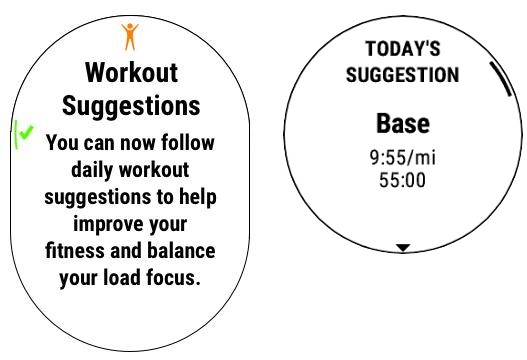
DSW produces a workout prescription — session type, target heart rate zone or pace range, and estimated duration. A suggestion to perform a high-intensity session indicates that the watch judges the athlete to have adequately recovered and to be capable of absorbing hard work. A suggestion to run easy or rest indicates that load has accumulated beyond what recovery has offset, or that foundational fitness is insufficiently established for harder sessions. Workout types span recovery runs and base runs through tempo efforts and interval sessions; the specific session reflects where the athlete sits in the relationship between recent acute load and longer-term training history.
How Garmin Calculates It
DSW draws on the athlete’s VO2 max estimate, Training Status, Training Load (acute and chronic components), Recovery Time, and, on devices that support it, Training Readiness. The physiological modelling originates from algorithms developed by Firstbeat Technologies, acquired by Garmin in June 2020. The algorithm compares the current training state against the athlete’s history: an athlete whose acute load is low relative to chronic load and whose recovery is complete receives a more demanding suggestion; one whose acute load has spiked or whose Recovery Time is still running receives an easier prescription. Where a race goal is set in Garmin Connect, the system weights session types toward the demands of that event and adjusts the upcoming schedule after each recorded activity.
Additional inputs supported by device generation include Load Focus distribution, sleep data, HRV Status, stress history, and the profile of recently performed workouts. Typical suggested workout types include recovery runs, base runs, tempo runs, threshold sessions, VO2 max intervals, and long runs. Cycling suggestions focus primarily on endurance rides and tempo efforts.
What Affects the Suggestion
Heart rate accuracy is the largest source of error. DSW depends on heart rate data to estimate Training Effect, calibrate the VO2 max model, and assess Recovery Time. Wrist-based optical heart rate produces unreliable data during intervals, in cold conditions, and where watch fit is poor; a chest strap eliminates most of this error for the activity itself. Short-term illness and non-training stress — poor sleep, travel, occupational load — remain invisible to the algorithm unless they produce measurable changes in resting heart rate, HRV Status, or overnight Body Battery.
DSW accounts only for sessions that the watch records. Gym work, cross-training, and recreational activity that goes unrecorded is invisible to the load model. An athlete who records five runs but omits three cycling sessions will appear less loaded than they are, and the system will suggest harder sessions than actual fatigue warrants.
How Accurate Is It
No independent peer-reviewed study has evaluated the accuracy of DSW output specifically. Accuracy depends on the combined reliability of its component metrics. Research on Garmin’s VO2 max estimation has found mean errors of roughly 3–5 ml/kg/min relative to laboratory measures under controlled conditions, with larger errors in field conditions. Recovery Time and Training Load have received less independent validation.
Experienced runners report that DSW performs most reliably for session type—the signal on whether to run hard, moderate, or easy is broadly consistent with perceived recovery state among athletes who train consistently and record all sessions. Specific intensity targets should be treated as approximate. Trend reliability over weeks is stronger than day-to-day precision.
Competitor Equivalents
- Polar’s FitSpark provides daily workout suggestions based on cardio load and Nightly Recharge recovery data, with a broader activity-type library than Garmin’s running-centric approach.
- Apple Watch lacks a daily workout prescription feature as of early 2026; an automated session-type recommendation based on recovery state is absent from the native platform.
- Coros Training Suggestions on the Apex 2 Pro and Vertix 2S use Coros’s own load and recovery calculations; Coros publishes less methodology documentation than Garmin, making direct algorithmic comparison difficult.
- Suunto Race and Race S include adaptive training guidance through the Suunto app, though third-party review data suggest it is less granular in session-type variety than DSW.
- Wahoo ELEMNT head units do not offer automated daily workout suggestions; training integration is delivered through third-party platforms such as TrainerRoad and Wahoo X.
Which Garmin Devices Support It
Garmin introduced Daily Suggested Workouts in September 2020 on the Forerunner 745, with broader rollout following firmware updates across the ecosystem. Current supported devices include all recent Forerunner, Fenix, Epix, and Instinct generations. Prior-generation devices carrying DSW on existing firmware include the Instinct 2, Forerunner 965, Forerunner 265 and 265S, Epix Pro Gen 2, and Fenix 7 Pro; these receive maintenance-only firmware and will not receive new DSW capabilities introduced for the Fenix 8 and Forerunner 970 platforms. The Venu 4 (September 2025) supports DSW. Edge 540, 840, and 1040 cycling computers support daily suggested cycling workouts. Entry-tier devices — the Vivoactive 6, Venu 3, Lily 2, and all Vivosmart variants — do not support the feature.
Where to Find It
- Watch widget: a dedicated widget or training prompt in the widget loop that shows session type, target intensity, and approximate duration; the workout can be initiated directly from the widget.
- Widget glance: session type shown in abbreviated form as the athlete scrolls the stack.
- Morning Report: day’s suggested workout summarised alongside Training Readiness and Recovery Time on supported devices; not all devices carrying DSW include the Morning Report.
- Garmin Connect app: Training section shows the day’s suggestion for review before the session.
- Garmin Connect web: DSW presentation is less prominent than in the mobile app.
DSW serves only as a workout initiator; it is not available as a passive data field during free activity recording. A Garmin Connect Plus subscription is not required.
Common Problems and Misreadings
A persistent stream of easy or recovery suggestions when the athlete feels ready for hard work typically reflects accumulated load or incomplete Recovery Time. See FAQ above for details. The suggestion is a recommendation, not an instruction — any activity can be started from the activity list regardless of what DSW shows.
A hard session is suggested when the athlete feels fatigued, which most often occurs when non-training stress leaves no measurable signal in the sensor data. The system interprets only physiological signals recorded by the watch; subjective fatigue from life stress that does not change overnight, HRV or resting heart rate is invisible to the algorithm.
DSW showing the same foundational suggestion for several consecutive days occurs when Training Status enters a detraining state after extended inactivity. Resuming consistent recorded activity typically restores dynamic suggestion behaviour within one to two weeks.
How to Improve It
Establish a reliable VO2 max estimate by recording runs at varied intensities — including sessions that reach lactate threshold effort — with accurate heart rate data. The VO2 max model updates most accurately when both heart rate and pace data are clean, and the effort reaches a meaningful aerobic challenge.
Record every training session, including strength, swim, and cycling work. The algorithm accounts only for fatigue it can measure; sessions completed without the watch should be entered manually in Garmin Connect to provide the system with a partial-load signal. Set a race goal or target event in Garmin Connect: without one, DSW operates in general fitness-maintenance mode rather than a periodised build toward a specific event.
Other Points
A 2020 study by Flatt and colleagues in the International Journal of Sports Physiology and Performance found that HRV-guided training — adjusting daily session intensity based on morning HRV — produced superior gains in aerobic fitness compared to a fixed programme in recreational runners over seven weeks. DSW incorporates HRV via HRV Status and Training Readiness as one component of its daily assessment, suggesting the approach has physiological precedent. However, the study did not evaluate Garmin’s specific implementation.
Scientific Basis
Flatt, A.A., Hettinga, F.J., Layne, G., and Esco, M.R. (2020). “HRV-guided training for enhancing cardiac-vagal modulation, aerobic fitness, and endurance performance.” International Journal of Sports Physiology and Performance. Demonstrated that HRV-guided daily intensity prescription produced superior aerobic adaptations over a fixed programme in recreational runners — the conceptual basis for recovery-guided training prescription systems similar to those used by DSW.
Impellizzeri, F.M., Marcora, S.M., and Coutts, A.J. (2019). “Internal and external training load: 15 years on.” International Journal of Sports Physiology and Performance, 14(2), 270–273. Established the dual-load framework — internal load (heart rate) and external load (pace, distance) — that DSW’s use of Training Effect alongside GPS data reflects.
How It Connects to Other Features
A calibrated VO2 max estimate anchors the intensity zones used in workout targets and underpins Training Status classification, making it a prerequisite for meaningful DSW output.
Training Status is the primary input to session type selection: Productive status yields progressively more challenging suggestions; Maintaining or Overreaching shifts toward consolidation; Detraining yields foundational-volume sessions. Training Load determines whether the system judges the athlete ready for additional stress, with high-intensity sessions withheld when the acute-to-chronic ratio indicates excessive loading.
Recovery Time sets the floor below which only easy sessions are prescribed. On devices that support it, Training Readiness synthesises sleep, HRV Status, Recovery Time, and acute load into the single most direct readiness signal.
Once a suggested workout is completed, Training Effect records the stimulus, updates Training Load and Training Status, and informs the next DSW output. For athletes with a race goal set, the Race Predictor projection also shifts the suggestion distribution toward race-specific intensities as the target date approaches.
Small things I always use
- Garmin 90-degree charging adapter: Charges your Garmin from any USB-C cable. Essential when travelling. I use one.
- Body Glide: The blue anti-chafe stick swimmers and runners carry. I use it.
- Speedo earplugs: Fewer ear infections and no cold-water dizziness. I use them.
- Dryrobe Advance: My winter changing robe for open-water swims. I use one. A cheaper option is the AONYIYI changing robe.
- Maurten: Race fuel that stays easy on the stomach. I use them.
- Beet It Sport nitrate shots: Beetroot shots I take in the days before a race. I use them.
- Garmin charging puck: The quickest way to top up before a session. I use one.
- Injinji: Toe socks that stop rubbing, so you run more. I use them.
- Ultimate toe protectors: Stop black toenails on long runs. They work. I use them.
- Compressport R2 v2 calf sleeves: My calf sleeves of choice. I use them.
- Cellucor C4: My pre-workout before hard sessions.
- TPU tubes: Schwalbe Aerothan, Tubolito and Pirelli SmarTube. Light, tiny spares. I use all three.
- G8 insoles: Adjustable insoles that are good. I use them.
- Cycplus Cube: A 97g electric pump that gets a road tyre rideable in two minutes. I carry one. 5% off with code THE5KRUNNER.
Watches and sensors
- Polar H10: My daily driver for waking HRV.
- Polar Verity Sense: My backup arm-worn HR sensor.
- Nomad bedside charger: Charges my iPhone and Apple Watch overnight. I use it, and many of their bands.
- Train.Red: The best muscle oxygen sensor I’ve used.
- Tymewear: Accurate heart rate and reliable ventilatory zones. I use it to pace endurance rides over an hour.
- Garmin Forerunner 970: A pro-grade triathlon watch. I use this.
- Apple Watch Ultra 4: My daily smartwatch. No phone needed on rides.
- Garmin Fenix 9 Pro: I’ve just bought one.
On the bike
- Continental GP5000 for everyday riding, and Aero 111 on the front for special occasions.
- Helmets: Specialized S-Works Evade 3 for road riding, and Rudy Project Wing for TT-style races. I use both.
- Ravemen FR300: A front light that mounts under your Garmin or Wahoo. I use one.
- Wahoo TRACKR Radar: I use it on one bike and Varia on the other. They perform the same.
- Garmin Varia RTL515: Radar that warns you of cars from behind. I use this model.
- Wahoo ELEMNT Roam 3: The bike computer that’s easy to use. I use mine on most rides.
- Favero Assioma Pro RS2: Accurate power pedals that swap easily between bikes. I use this model.
Home and indoor training
- NPE Runn: Makes my basic treadmill smart, sending more accurate speed and distance to my watch and Zwift. I use it.
- Google Wifi: Keeps Zwift connected in my pain cave. I use it.
- Apple TV 4K: Zwift on the big screen. I use two.
- Google Nest Doorbell (wired, 2nd gen): My video doorbell, running in both Google Home and Apple Home. I use it.
Health, recovery and sleep
- FreeStyle Libre 3 Plus: Shows how my blood sugar responds to diet.
- hDrop: Measures my sweat loss in summer and indoors.
- Fourth Frontier Zone: Checks my heart under load in hard sessions.
- Oura Ring 5: My partner’s recovery tracker of choice.
- Eight Sleep: A cooling mattress cover my partner and I use nightly.
Reader-Powered Content

This content is not sponsored. It’s mostly me behind the labour of love, which is this site, and I appreciate everyone who supports it.
Support the site: Follow (free, fewer ads) · Subscribe (paid, ad-free) · Buy Me A Coffee
Written by real people, with AI assistance. Fact-checked and verified for originality. See the Editorial Policy. FTC: Affiliate Disclosure — some links pay commission. As an Amazon Associate, I earn from qualifying purchases.
