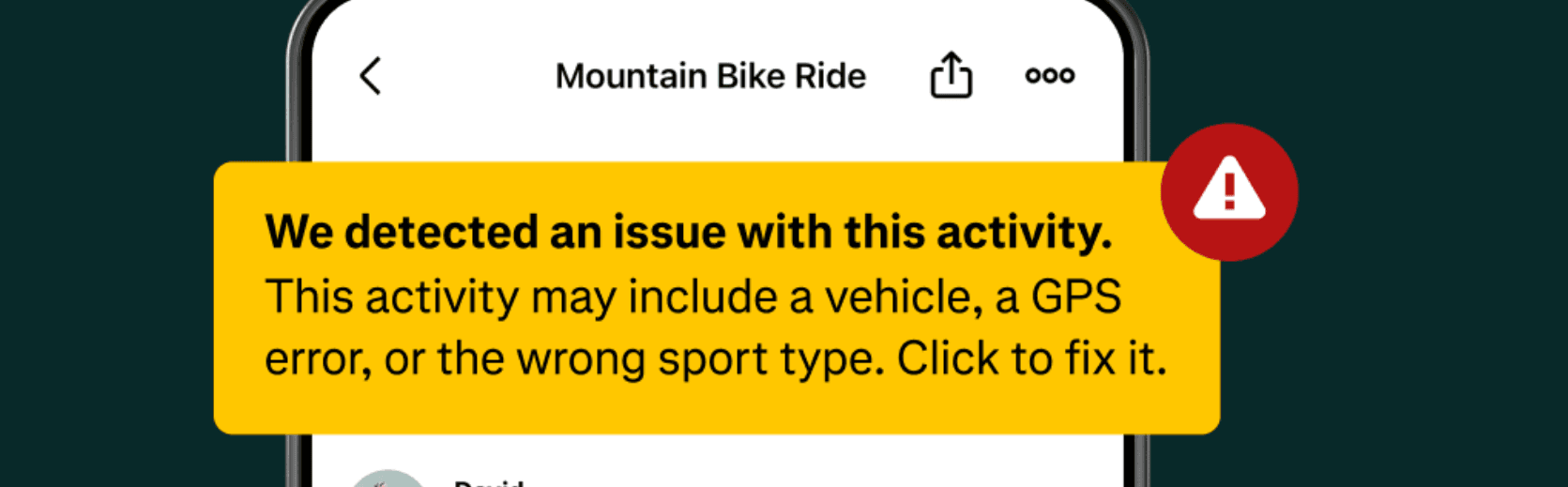
Strava has just removed millions of activities from its public leaderboards. Here’s how they identified and removed cheats and errors.
The Clean-up Explained
At the end of January 2026, Strava engineers announced the completion of a global recalculation of every single ride and run leaderboard. The purpose was to remove incorrectly recorded activities, including rides uploaded as e-bike activities.
A similar process was used to the one employed back in May 2025, when activities recorded in cars were similarly expunged.
This wasn’t a routine update. It involved a full backfill of the top results for every segment on Strava, using advanced machine learning models. The goal was to better distinguish legitimate human-powered efforts from activities assisted by motors or recorded under incorrect sport types.
How Many Activities Were Removed?
- 2.3 million e-bike activities
- 1.6 million vehicle activities
The effect was that approximately 293,000 athletes were rightfully restored to the Top 10 leaderboard positions.
Perhaps surprising, is the sheer number of erroneous activities that exist and no doubt some remain that can’t quite be so easily flagged as incorrect.
How the Model Works
Strava has shared with this site information on how its exclusion algorithm works. Piecing it all together, the model works like this:
- Calculate a series of 57 “features” from every run and ride activity uploaded to Strava.
- This includes simple calculations like averages and variances of velocity or acceleration.
- More complicated ride characteristics are also used, such as “jerk” (the derivative of acceleration) and “average VAM on climbs” (a cycling-specific metric based on human performance limits). The model also considers the effect of varying gradients and momentum.
- Strava then utilises an in-house feature, “Sendrix Coefficient,” developed based on testing of a fast staff cyclist (aka Jimi Sendrix). This assesses how quickly someone can accelerate from a dead stop to 20mph (ca. 32 km/h) and how often this can be repeated before fatigue, helping differentiate accelerating cars from fatiguing cyclists.
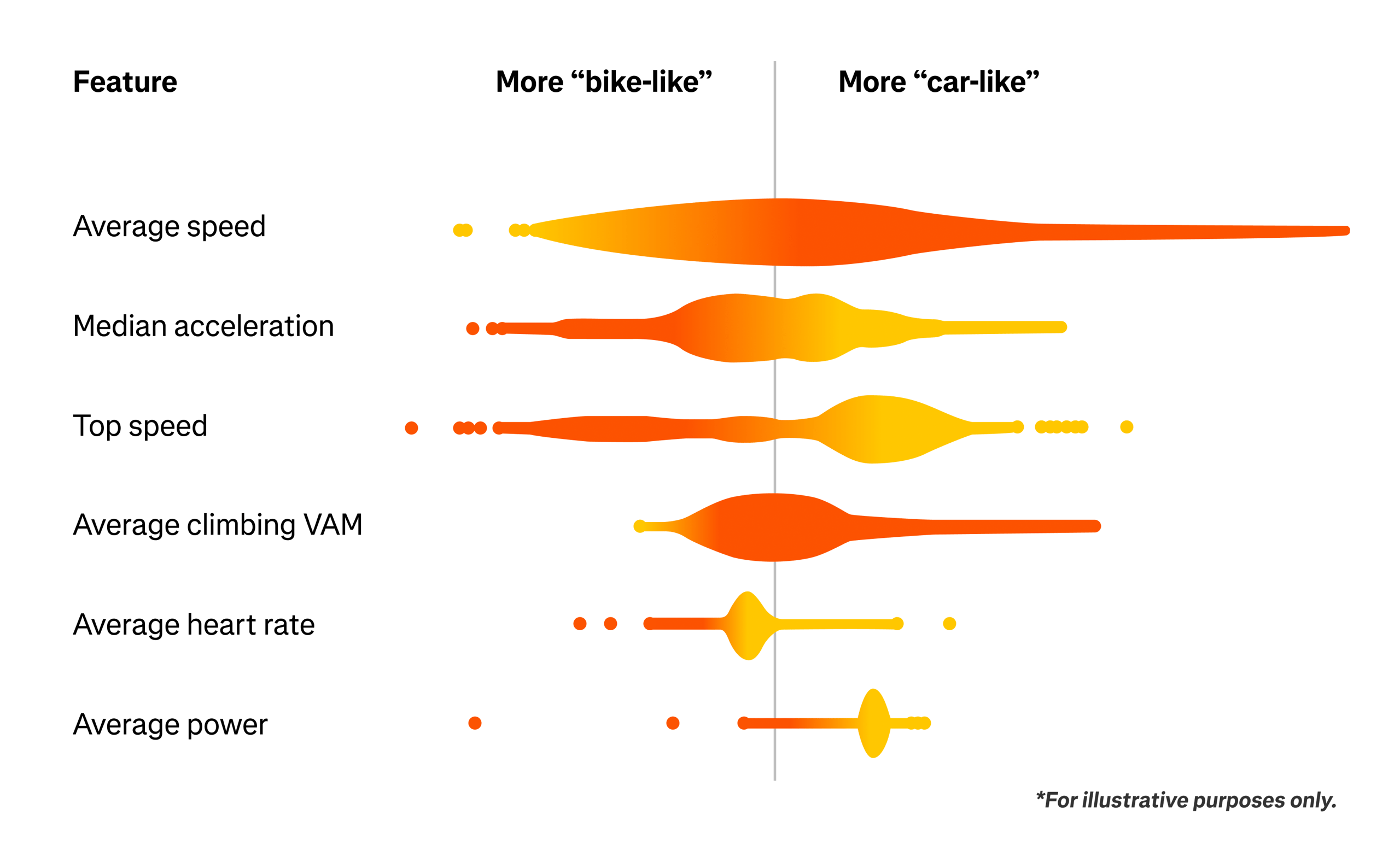
- The model uses xAI (explainable Artificial Intelligence) SHAP values to understand how each of the 57 features contributes to the assessment, weighing data towards “cars” or “bikes”. While individual features might have overlap between vehicles and bikes, looking at all features together clarifies the differences. For instance, a top speed of 80mph (ca. 129 km/h) would heavily weigh towards “car,” whereas 25mph (ca. 40 km/h) might not be as informative (every leaderboard cyclist can reach that speed on the flat), requiring the model to reference other features.
- Finally, individual scores are determined for each before summing them to determine a probability on a scale of 0 to 1 that a vehicle is present.
And there we were, thinking that all Strava had to do was check if we were going 50mph (ca. 80 km/h) uphill.
How the Model Is used
The model has been trained and used over several months and applied to new activities being uploaded. The model has to act on its assessment of the probability of a vehicle being used.
- When the probability exceeds a “classification threshold,” the activity is flagged before it reaches any leaderboards.
- Strava users are then proactively prompted to crop out the vehicle portion or make the activity private for flagged activities.
The model was initially trained on tens of thousands of Strava activities and improved in use over the last year or so. An interesting stat is that Strava claim to flag 81% of activities containing vehicles which might seem a little low but considering the complexity of the task maybe isn’t so bad.
The model was then used in the background over many months to check and remove incorrect, historic activities from leaderboards.
These clean-ups affect some areas more than others. For example, in touristy areas there are many more e-bikes.
Tech Stack
- Strava built this ML model using gradient boosted decision trees via a popular software library called XGBoost.
Now you know!
What This Means for Strava Users
Even though 3.9 million activities were removed from competitive lists, the activities themselves aren’t deleted, for example, E-bike rides will still appear in feeds and profiles.
For any of your activities that were automatically excluded from leaderboard results due to incorrect sport type or improbable data, Strava suggests that you correct the original, namely:
- Crop or split the activity to remove invalid parts
- Correct the sport type (e.g., change a bike ride mistakenly logged as a run)
- Submit a support ticket if the exclusion was in error
Note: Once an activity is excluded from segment results, it won’t reappear unless corrected or reclassified.
Community Reaction
Responses online have been mostly positive but mixed. Naturally, the more competitive among us are pleased that leaderboards are cleaner.
There is limited but valid comeback. For example, e-bikers are a valid part of the community and should not be excluded from Strava but, I would definitely argue, they should be excluded from leaderboards of the wrong sport type. Others question exactly two the activities are flagged. Hopefully the earlier sections of this article go some way to reassuring us that there is a degree of conservatism involved and a process for Strava users to correct errors.
Conclusion
Strava has made significant efforts for over a year to clean up its act. Or, more correctly, clean up our acts on our behalf, as it is us that are the source of the mis-recordings.
That said leaderboards and segments are strategic and fundamental to Strava’s uniqueness. It’s in the company’s own interest to keep its prized assets as clean as humanly possible.
Last Updated on 3 October 2026 by tfk the5krunner
Small things I always use
- Garmin 90-degree charging adapter: Charges your Garmin from any USB-C cable. Essential when travelling. I use one.
- Body Glide: The blue anti-chafe stick swimmers and runners carry. I use it.
- Speedo earplugs: Fewer ear infections and no cold-water dizziness. I use them.
- Dryrobe Advance: My winter changing robe for open-water swims. I use one. A cheaper option is the AONYIYI changing robe.
- Maurten: Race fuel that stays easy on the stomach. I use them.
- Garmin charging puck: The quickest way to top up before a session. I use one.
- Injinji: Toe socks that stop rubbing, so you run more. I use them.
- Ultimate toe protectors: Stop black toenails on long runs. They work. I use them.
- Compressport R2 v2 calf sleeves: My calf sleeves of choice. I use them.
- Cellucor C4: My pre-workout before hard sessions.
- TPU tubes: Schwalbe Aerothan, Tubolito and Pirelli SmarTube. Light, tiny spares. I use all three.
- G8 insoles: Adjustable insoles that are good. I use them.
- Cycplus Cube: A 97g electric pump that gets a road tyre rideable in two minutes. I carry one. 5% off with code THE5KRUNNER.
Watches and sensors
- Polar H10: My daily driver for waking HRV.
- Polar Verity Sense: My backup arm-worn HR sensor.
- Nomad bedside charger: Charges my iPhone and Apple Watch overnight. I use it, and many of their bands.
- Train.Red: The best muscle oxygen sensor I’ve used.
- Tymewear: Accurate heart rate and reliable ventilatory zones. I use it to pace endurance rides over an hour.
- Garmin Forerunner 970: A pro-grade triathlon watch. I use this.
- Apple Watch Ultra 4: My daily smartwatch. No phone needed on rides.
- Garmin Fenix 9 Pro: I’ve just bought one.
On the bike
- Continental GP5000 for everyday riding, and Aero 111 on the front for special occasions.
- Helmets: Specialized S-Works Evade 3 for road riding, and Rudy Project Wing for TT-style races. I use both.
- Ravemen FR300: A front light that mounts under your Garmin or Wahoo. I use one.
- Wahoo TRACKR Radar: I use it on one bike and Varia on the other. They perform the same.
- Garmin Varia RTL515: Radar that warns you of cars from behind. I use this model.
- Wahoo ELEMNT Roam 3: The bike computer that’s easy to use. I use mine on most rides.
- Favero Assioma Pro RS2: Accurate power pedals that swap easily between bikes. I use this model.
Home and indoor training
- NPE Runn: Makes my basic treadmill smart, sending more accurate speed and distance to my watch and Zwift. I use it.
- Google Wifi: Keeps Zwift connected in my pain cave. I use it.
- Apple TV 4K: Zwift on the big screen. I use two.
- Google Nest Doorbell (wired, 2nd gen): My video doorbell, running in both Google Home and Apple Home. I use it.
Health, recovery and sleep
- FreeStyle Libre 3 Plus: Shows how my blood sugar responds to diet.
- hDrop: Measures my sweat loss in summer and indoors.
- Fourth Frontier Zone: Checks my heart under load in hard sessions.
- Oura Ring 5: My partner’s recovery tracker of choice.
- Kineon MOVE+: Red light therapy for niggles. It works.
- Eight Sleep: A cooling mattress cover my partner and I use nightly.
Reader-Powered Content

This content is not sponsored. It’s mostly me behind the labour of love, which is this site, and I appreciate everyone who supports it.
Support the site: Follow (free, fewer ads) · Subscribe (paid, ad-free) · Buy Me A Coffee ❤️
Written by real people, with AI assistance. Fact-checked and verified for originality. See the Editorial Policy. FTC: Affiliate Disclosure — some links pay commission. As an Amazon Associate, I earn from qualifying purchases.
tfk is the founder and author of the5krunner, an independent endurance sports technology publication. With 20 years of hands-on testing of GPS watches and wearables, and competing in triathlons at an international age-group level, tfk provides in-depth expert analysis of fitness technology for serious athletes and endurance sport competitors. ID

Would Strava also exclude the runs with peaks above 45km/h / 28mph which pollute the leaderboards?
It would be even easier than this car/e-bike detection, imo.
“Strava Deliberately Delete 4 Million Activities – Here’s Why and How They Cleaned The Leaderboards”
“Even though 2.3 million activities were removed from competitive lists, the activities themselves aren’t deleted, for example, E-bike rides will still appear in feeds and profiles.”
—
[giant headline] “BREAKING: Strava deletes 4 million activities!!!!11!!!”
…
[2/3rd into the article] “The activities aren’t actually deleted, they’re just removed from the leaderboards”
Such a great example of clickbait journalism, bro.
Ofc you could argue that the word “delete” could mean multiple things in different contexts. But since this is a single article with all the text completely under your control (presumably), you could’ve easily rectified that by not using a headline starting with “Strava Deliberately Delete 4 Million Activities”, which you must realize would be interpreted in a certain way by most people.
I mean there’s no getting around the fact that the headline literally says “Strava…Delete 4 Million Activities” and the article text literally says “Even though 2.3 million activities were removed from competitive lists, the activities themselves aren’t deleted.” You could’ve even said “Strava Delete 4 Million Activities *From Leaderboards*” and that would be a lot more honest than this. But the most honest way to handle this would not have been to use “delete” in 2 completely different ways, where the first usage in the headline is clearly designed to mislead and attract clicks.
Sorry, as written, this post just makes you sound dishonest and manipulative. Like you’re openly telling your readers “I deliberately misled you to get you to click on this post, and now I am unapologetically ‘clarifying’ myself in the article text that you probably won’t read, so you can’t accuse of me getting of the facts wrong”.
I also read the relevant recent announcement by a Strava engineer in r/Strava (which ofc you did not link to or even mention), and the post did not contain the word “delete” (or any variant) even once.
At least you’re not alone, as a lot of other sites breathlessly exclaimed “Strava is deleting millions of activities” (6 days ago) or “Strava wipes 4.45 million activities”.
All of these sites know *exactly* what they are doing. If they wanted to be clear that it’s just removing activities from leaderboards and not literally “wiping” or “deleting” the activities themselves, they could easily do so by changing one word and adding two more, but that would result in far fewer of those precious clicks amirite?
Btw, Strava never used the words “delete” or “wipe” when they wrote about the leaderboard cleanup in their official press release in May 2025, either. Because they’re not trying to mislead people with clickbait headlines.
—
“Even though 2.3 million activities were removed from competitive lists…”
I think you mean 4 million activities. As you noted yourself earlier on in the post, it’s 2.3 million e-bike activities and 1.6 million vehicle activities.
I see your point regarding the technical distinction between database deletion and leaderboard exclusion (deletion from a leaderboard database table). While “delete” is widely used colloquially in news headlines to describe the removal of entries from a public record, I agree that in this context it can be interpreted as the permanent destruction of the original activity data rather then the permanent removal from a leaderboard.
Strictly: For writing/editing contexts, “removed” is often softer and implies editorial choice, while “deleted” suggests finality. These are removed from the leaderboards with finality.
Neverthless, I have updated the headline to “Removes… from Leaderboards” to be more precise and have corrected the total figure in the conclusion to reflect the combined 3.9 million activities mentioned earlier, thank you for pointing out my mistake there. The link to the official engineering post on Reddit has also been added for full transparency. Thanks for the feedback.
Checked my example segment: still third place, slightly behind two leasurely rides (occasionally touching the 30 kph) that clearly ended with a drive. Never flagged those ride-drives, because cars don’t go *that* fast there. Entered full “challenge accepted” mode instead. And sure, a few months later, with a modest tailwind and after a few weeks on a sunny island with a nice mountain, those rides/drives were on second and third place.
Until Strava tried their luck at automatically cleaning leader boards…