Garmin and Apple Are the Most Accurate Smartwatches — Here Is the Evidence
When a smartwatch brand says its products are accurate, many buyers take that claim at face value. Apple, for instance, benefits from a level of consumer trust that few technology companies can match. A significant number of buyers are rightly more sceptical — but scepticism alone does not resolve the question of which device to trust, or why.
The obvious starting point is a trusted reviewer. For heart rate, many turn to DCRainmaker. For GPS accuracy, others may turn to this site. For sleep data, @TheQuantifiedScientist applies rigorous statistical analysis. These are serious efforts. The limitation is not the quality of the work. It is the sample size: each reviewer is, inevitably, a sample of one.
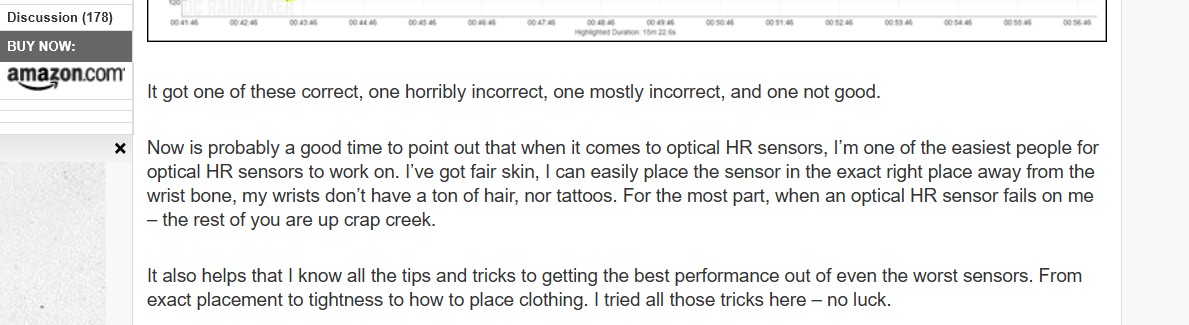
The implications of that constraint matter more than they might appear. DCRainmaker consistently finds Garmin heart rate to be among the most accurate — a finding that almost certainly reflects a genuine hardware advantage. Yet, as he has acknowledged, individual physiology shapes optical heart rate readings in ways that no testing protocol can fully eliminate.
Testing on this site has found Apple, Coros, and Garmin to be the most accurate for GPS across years of accumulated data. Yet the Huawei Watch Runner 2 performed impressively well in GPS testing here this year, while DCRainmaker, testing an identical model, identified two material sources of error. One of those errors was partially replicable in testing here, though with considerably less severity; the other was not replicable at all. Whether that reflects local test conditions or a unit-level defect is, frankly, impossible to determine. A device cannot credibly be described as highly accurate if properly conducted independent tests reach materially different conclusions.
The Quantified Scientist applies genuine scientific rigour to sleep-stage analysis and finds the Apple Watch to be the most accurate wearable in that category. The statistical limitation, however, is inherent to the methodology rather than the analyst.
With PSG itself limited to ~82.6% agreement (~17% error) (Rosenberg & Hrubos-Rohel, 2013), validating a wrist wearable with ~20% proxy error in N=1 merely compounds uncertainty (√(0.17² + 0.20²) ≈ 26%), so the reported accuracy is statistically meaningless (Depner et al., 2020).
The point is not to question the competence of any reviewer — including this one. It is to establish a structural reality: no individual reviewer, however methodologically careful, can produce findings that generalise reliably to the wider population of buyers. That is not a failure of effort. It is a limit of the form.
The more analytically minded reader might consult two or three independent sources and triangulate. That is a reasonable approach. It remains statistically insufficient.
What the Science Actually Says
Scientific studies offer a different kind of evidence — one with its own well-documented limitations. Wearable research is expensive to conduct, which means studies frequently rely on older or lower-cost devices. The planning, execution, and publication cycle for the experiment can take several years, so a paper published in 2026 may evaluate technology from 2021 or earlier. Readers should weigh that context carefully when interpreting findings.
A more powerful instrument than any individual study is the meta-analysis, which applies statistical methods to pool and compare findings across multiple studies simultaneously. A new meta-analysis does exactly that for consumer smartwatches.
Sicbaldi et al. (2026) reviewed up to 39 published studies to assess accuracy across four key metrics: heart rate, step count, energy expenditure, and sleep. The headline finding I would take from the meta review is a tie for the overall best brand between Garmin and Apple, predominantly based on their equal heart rate data performances and a mixed picture with the other data types .
Heart Rate
Heart rate is the most extensively studied metric and the one with the strongest evidence base. Apple and Garmin are effectively level, with bias figures of -0.62 and -0.91 beats per minute, respectively — a difference that is negligible fro sports or clinical useage. Both sit well ahead of Fitbit, which showed a bias of -3.44 bpm and a standard deviation more than twice as large.
| Brand | Comparisons (k) | Bias (bpm) | SD | LoA (bpm) | Models Tested |
|---|---|---|---|---|---|
| Apple | 33 | -0.62 | 4.12 | -8.91 to 7.68 | Watch 5, 6, 7, 8, 9 |
| Fitbit | 27 | -3.44 | 8.01 | -21.14 to 14.26 | Charge 4, Sense, Sense 2, Charge 5, Inspire HR |
| Garmin | 35 | -0.91 | 4.31 | -9.95 to 8.12 | Forerunner 245, Forerunner 945, Venu SQ, Fenix 6, Fenix 6 Pro, Vivoactive 4, Venu 2s |
| Samsung | 6 | +0.52 | 5.71 | -11.04 to 12.09 | Galaxy Fit 2, Galaxy Watch 4, Galaxy Watch 5 |
Step Count
Garmin is the clear leader in step accuracy. Its bias of -4.76 steps per day is trivially small; its limits of agreement are narrow by the category’s standards. Fitbit, the only other brand with sufficient data for comparison, recorded a bias of -137.78 steps — roughly thirty times larger — with a correspondingly wide spread.
| Brand | Comparisons (k) | Bias (steps) | SD | LoA (steps) | Models Tested |
|---|---|---|---|---|---|
| Apple | N/A | N/A | N/A | N/A | Watch 5, 6, 7, 8, 9 |
| Fitbit | 2 | -137.78 | 89.11 | -343.94 to 68.39 | Charge 4, Sense, Sense 2, Charge 5, Inspire HR |
| Garmin | 6 | -4.76 | 26.26 | -59.51 to 49.99 | Forerunner 245, Forerunner 945, Venu SQ, Fenix 6, Fenix 6 Pro, Vivoactive 4, Venu 2s |
| Samsung | – | – | – | – | – |
Energy Expenditure
Apple leads on calorie accuracy, recording the lowest bias across the most comparisons in the dataset. Fitbit performs similarly on bias but with a slightly wider spread. Garmin’s calorie figures show a meaningful positive bias — they tend to overestimate — with the widest limits of agreement among the three brands assessed, albeit based on a small number of datasets. Calorie estimation remains the weakest metric across all manufacturers; buyers should treat these figures as directional rather than precise.
| Brand | Metric | Comparisons (k) | Bias | SD | LoA | Models Tested |
|---|---|---|---|---|---|---|
| Apple | kcal | 9 | -9.68 | 12.23 | -45.29 to 25.91 | Watch 5, 6, 7, 8, 9 |
| Fitbit | kcal | 5 | -9.37 | 10.83 | -47.75 to 29.01 | Charge 4, Sense, Sense 2, Charge 5, Inspire HR |
| Fitbit | MET | 4 | +1.98 | 1.84 | -3.32 to 7.30 | Charge 4, Sense, Sense 2, Charge 5, Inspire HR |
| Garmin | kcal | 2 | +23.03 | 30.33 | -38.36 to 84.43 | Forerunner 245, Forerunner 945, Venu SQ, Fenix 6, Fenix 6 Pro, Vivoactive 4, Venu 2s |
| Samsung | – | – | – | – | – | – |
Sleep
Fitbit records the lowest absolute bias for total sleep time at -4.91 minutes. Apple overshoots by roughly 23 minutes on average, though its standard deviation is tighter than Fitbit’s. Neither Garmin nor Samsung had sufficient data in the reviewed studies. The sleep data overall should be read with particular caution: as noted above, the reference standard itself carries meaningful measurement error, which compounds the uncertainty in any wearable comparison.
| Brand | Comparisons (k) | Bias (min) | SD | LoA (min) | Models Tested |
|---|---|---|---|---|---|
| Apple | 2 | +23.46 | 29.68 | -50.1 to 97.04 | Watch 5, 6, 7, 8, 9 |
| Fitbit | 4 | -4.91 | 37.66 | -81.50 to 71.69 | Charge 4, Sense, Sense 2, Inspire 2, Inspire HR |
| Garmin | – | – | – | – | – |
| Samsung | – | – | – | – | – |
The Verdict
Across the four metrics assessed, Garmin and Apple emerge as the most consistently accurate smartwatch brands in the published literature. Garmin’s advantage is clearest in the metrics that matter most for active tracking — heart rate and steps. Apple leads on calorie estimation and is the most extensively studied brand in the dataset. Fitbit performs creditably on sleep and energy expenditure, but lags materially on heart rate. Samsung’s evidence base remains too thin to support firm conclusions.
No meta-analysis resolves every question. The studies reviewed here predominantly used devices that are now one or more product generations old. Firmware has changed; sensors have improved. These findings are best understood as a structured assessment of the evidence available, not a guarantee of what any individual will experience on their wrist. They do, however, represent a more reliable guide than any single reviewer — including this one — can offer alone.
Last Updated on 10 March 2026 by the5krunner
Reader-Powered Content

This content is not sponsored. It’s mostly me behind the labour of love, which is this site, and I appreciate everyone who supports it.
Support the site: Follow (free, fewer ads) · Subscribe (paid, ad-free) · Buy Me A Coffee ❤️
All articles are written by real people, fact-checked, and verified for originality. See the Editorial Policy. FTC: Affiliate Disclosure — some links pay commission. As an Amazon Associate, I earn from qualifying purchases.
tfk is the founder and author of the5krunner, an independent endurance sports technology publication. With 20 years of hands-on testing of GPS watches and wearables, and competing in triathlons at an international age-group level, tfk provides in-depth expert analysis of fitness technology for serious athletes and endurance sport competitors.
