Amazfit T-Rex Ultra 2 Detailed Review: Out-Maps Instinct 3, Under-Prices Garmin Fenix
| Amazfit T-Rex Ultra 2 | Fenix E | Fenix 8 | Instinct 3 | |
|---|---|---|---|---|
| Price (USD) | $549.99 | $799.99 | $999.99 | $499.99 |
| Case Size | 51mm | 47mm | 51mm | 50mm |
| Maps | Yes | Yes | Yes | No |
| Note | Good features | Prior gen hardware | Full features | Generally capable |
You thought you wanted a large-format adventure watch. But now you’re not sure that Garmin was the right call after all.
I have been testing GPS watches since 2016, using a consistent, well-documented methodology — the accuracy data below mean something.
Listen to the discussion
Amazfit T-Rex Ultra 2 - Summary Review
My Verdict
Buy the T-Rex Ultra 2 (1.5″ AMOLED) over the Garmin Instinct 3 (1.3″ AMOLED) without giving it a second thought. At $549 versus $499, the T-Rex costs more, but its maps make it the better adventure watch. Buy it over the Fenix 8 if price is the real constraint.
If you want the most complete ecosystem for exploration and navigation, the Fenix remains the one to beat — but be honest with yourself about whether you will use the depth of features you are paying for.
That’s the verdict. Here are the key pros and cons. If you need more, the rest of the review is highly detailed and covers key factors such as accuracy.
Pros
- Exceptional battery — 30 days typical, 50 hours high-accuracy GPS
- Premium titanium and sapphire build at a non-premium price
- Preloaded maps and intuitive navigation beat Garmin Instinct
- Usability and menus genuinely better than Garmin day-to-day
- Dual-colour LED flashlight including green night vision mode
- Built-in speaker and microphone for on-trail calls and voice control beats Garmin Instinct
- Decent ecosystem integration, e.g. Strava and Apple Health
Cons
- GPS accuracy is solid but not class-leading — ranks below Instinct 3 in testing
- Heart rate Ok but unreliable at times, e.g., warmup phase of workouts
- Elevation OK, but consistently undercooks reality
- 3rd party apps growing but lagging well behind Garmin
- Bulky and Heavy at 89g — more than the Fenix 8
- Zepp ecosystem lock-in — your data does not travel easily if you switch later
- No music streaming support (unlike Garmin)
- No solar option (unlike Garmin)
What Kind of watch is the Amazfit T-Rex Ultra 2?
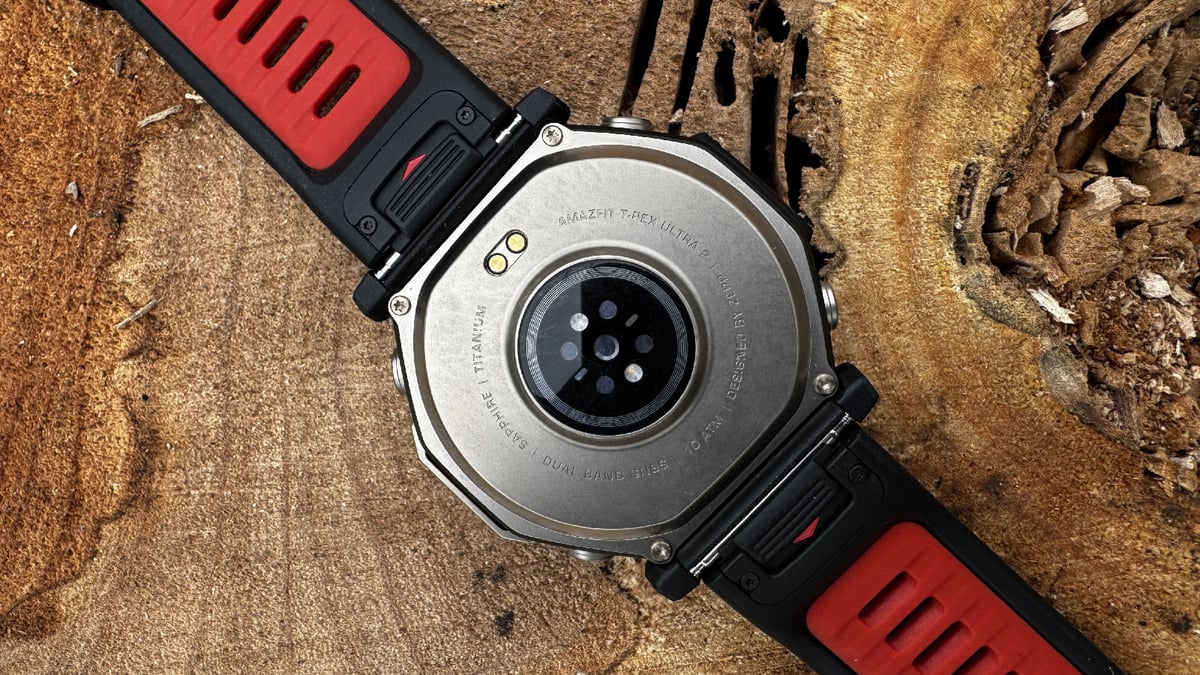
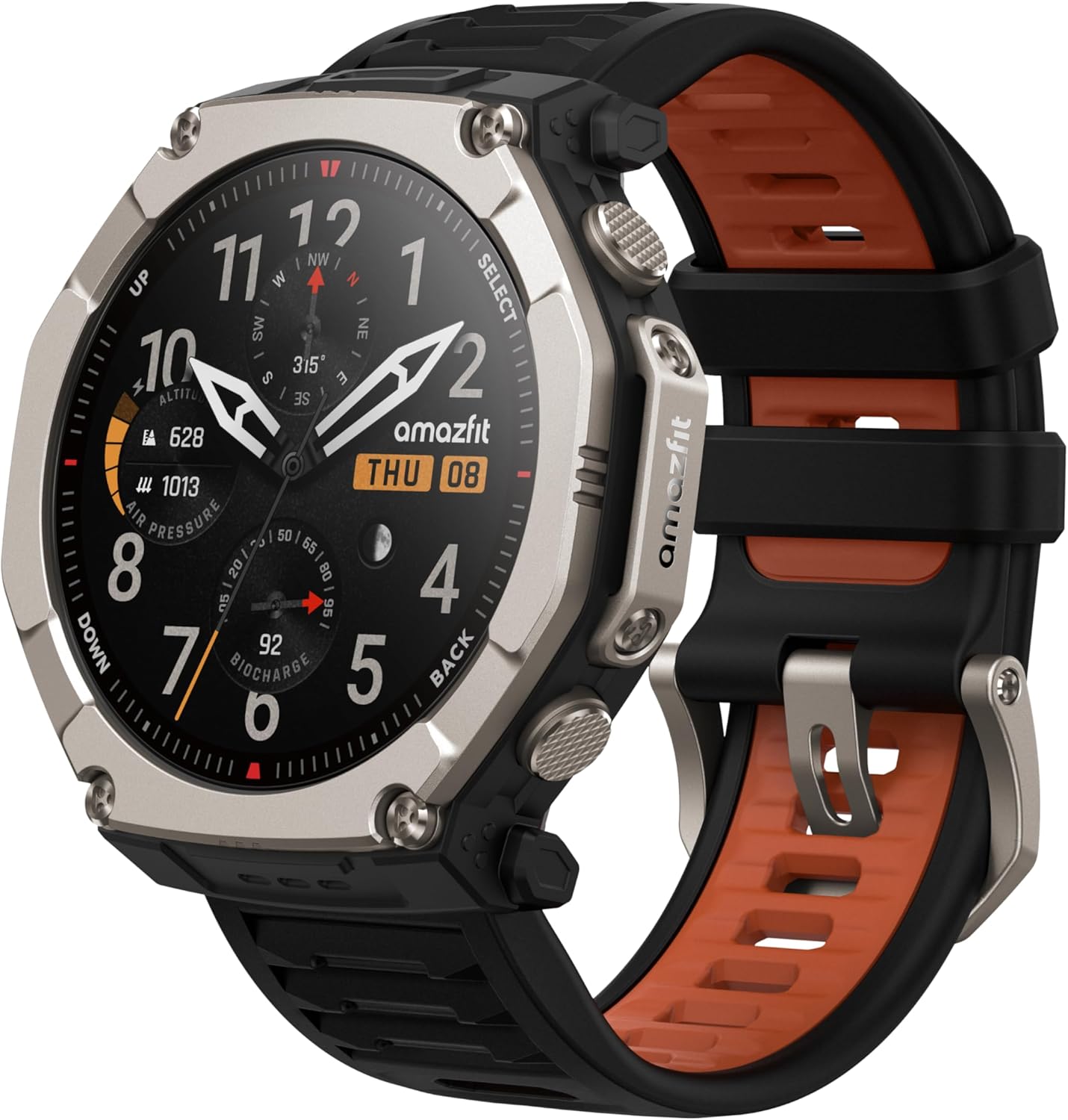
A 51mm smart adventure watch built to withstand extreme environments. It features a 1.5-inch AMOLED display with a peak brightness of 3,000 nits, making it one of the largest on the market and easily readable in direct sunlight. The watch is constructed with a titanium-vanadium (Grade 5) alloy for the bezel, buttons, and back panel, and is protected by a scratch-resistant sapphire crystal. It meets stringent U.S. military standards for shock, humidity, and temperature resistance and is certified for scuba diving to depths of up to 45 meters.
Check out the table below to see why Grade 5 Titanium is the best, and read this Sapphire vs Gorilla vs Kunlun article for all the details on why a sapphire lens is often the best.
| Property | Grade 4 | Grade 5 (best all-round) | Grade 6 |
|---|---|---|---|
| Strength | Medium | High | Medium–High |
| Scratch resistance | Lower | Better | Similar to G5 |
| Finish quality | Matte mostly | Polished + brushed | Limited |
| Watch usage | Common | Very common (premium) | Rare |
Bottom line
What’s New
The product naming is confusing — the Ultra 2 sits above the 3 Pro despite the lower number — but the step-up in real-world capability is genuine.
- A bigger 51mm case and a wider 26mm strap that sits more securely on the wrist during long efforts
- 25% more battery, meaning fewer charging stops on multi-day expeditions
- Double the storage at 64GB — enough room for large offline map regions without manually managing space
- Preloaded global base maps plus downloadable contour and ski maps, so you arrive at the trailhead ready to navigate
- A dual-colour LED flashlight — white for general use, green for preserving night vision
- Grade-adjusted pace, voice memos mid-workout, and climb-by-climb ascent tracking so you know exactly what is ahead on technical routes
Where It Sits in the Amazfit Range
Amazfit has some reasonably strongly recognised sub-brands.
T-Rex and Falcon are the two overlapping contenders for serious outdoor uses. The obvious difference is the T-Rex’s octagonal case, but it also leans towards the explorer buyer, whereas Falcon leans more towards athletes. Active and Cheetah are the running brands.
| Amazfit Sub Brand | Example Models | Target Use / Market | USD MSRP |
|---|---|---|---|
| T-Rex | T-Rex Ultra 2, T-Rex 3 Pro | Outdoor, Rugged | $399 – $549 |
| Balance | Balance 2 | Premium everyday/lifestyle | $299 |
| Active | Active 2, Active 2 Premium, Max, round, Square | Running (entry), Every day active | $99 – $129 |
| Bip | Bip 6 | Budget everyday | $79 |
| Cheetah | Cheetah Pro, Cheetah (Round), Cheetah (Square) | Running | $229 – $299 |
| Falcon | Falcon | Outdoor, Tactical elite | $499 |
All Amazfit watches share the same smartphone app.
T-Rex is a mature product line that has been significantly extended since its 2020 launch, with Ultra 2 being the latest and most expensive ($549). The product is unclearly named and is not a variant of T-Rex 2. It is the T-Rex Ultra (Gen 2.0), based on an improved T-Rex 3 (Pro) architecture – it’s larger, with a larger display, better quality case, and with a better battery life.
- Jan 2020: T-Rex
- May 2022: T-Rex 2
- Oct 2022: Falcon
- Feb 2024: Active (Active/Active Edge)
- Sep 6, 2024: T-Rex 3 (<$300)
- Sep 5, 2025: T-Rex 3 Pro ($399)
- Jan 6, 2025: Active 2
- Mar 31, 2025: Bip 6
- Jun 17, 2025: Active 2 Square
- Jun 24, 2025: Balance 2
- Dec 30, 2025: Active Max
- Feb 19, 2026: T-Rex Ultra 2 ($549)
- Feb 26, 2026: Active 3 Premium
- May 2026: Cheetah 2 Pro
- May 2026: Cheetah 2 Ultra
Test Result & Analysis
Note: Testing March 2026 (firmware 3.1.8.3, Zepp app 10.0.8)
Dual frequency GNSS (GPS) performance came in where I expected — a solid second tier, scoring 85% in my standard test, with that level consistently reflected across all outdoor workouts. The latest Garmin, Coros, Huawei and other watches score higher.
Heart rate was the surprise. I went in pessimistic: the Ultra 2 is theoretically a poor candidate for wrist HR given its size and tendency to shift on the wrist during effort. In practice, it held up better than expected. Deviations from true value were generally within 3 bpm and tended to average out over the course of a workout, resulting in an acceptable level of accuracy. There were dropouts at the start of several workouts — sharp troughs in the data — and when they occurred, they meaningfully dragged down the overall heart rate reading, which could, in turn, affect workout load scores. Worth knowing if you train in precise zones.
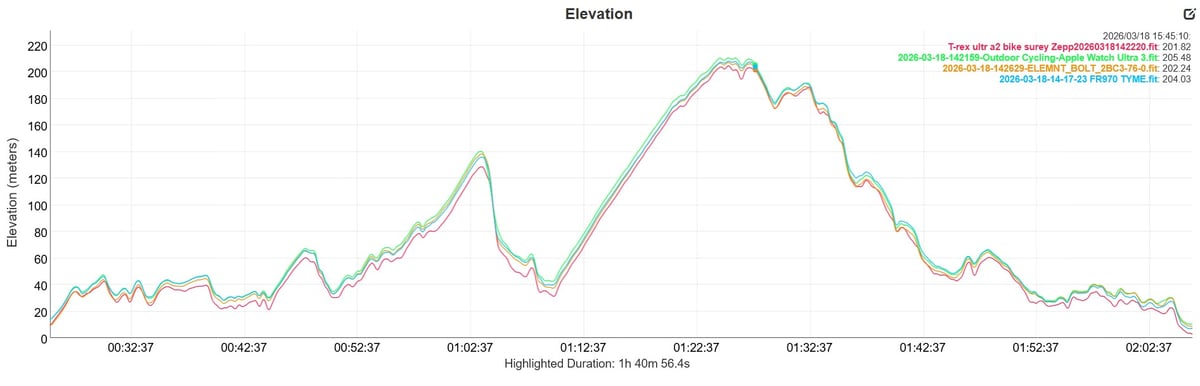
Elevation tracking was broadly reliable — the barometric altimeter followed the correct profile throughout, but consistently underreported total elevation by up to 10 metres compared to reference devices. Acceptable for most use cases, but worth noting if elevation gain matters to your training load or race planning.
All tests were conducted against high-grade reference devices: Apple Watch Ultra 3, Garmin Forerunner 970, Garmin HRM 600, Whoop MG, Polar Sense, Wahoo Bolt 3, and TymeWear Heart Rate Strap. Conditions ranged from indoor sessions to outdoor runs and rides across open ground, tree cover, and hills. Intensity testing coverage was comprehensive — Easy, Tempo, Threshold, VO2max, and Ramp efforts — giving a full picture of how the watch performs across the physiological range rather than just steady-state activity.
T-Rex Ultra 2 Heart Rate Accuracy Test Results
Individual workout results:
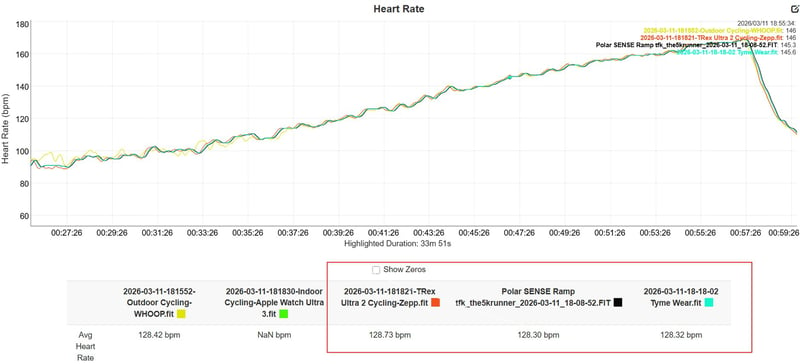
- Indoor bike ramp — Excellent. Accurate to within 0.5 bpm against Polar Sense and TymeWear throughout.
- Treadmill run ramp — Generally within 2 bpm of Apple Watch Ultra 3 and Polar Sense, with occasional deviations up to 10 bpm.
- Tempo bike — Generally accurate with occasional short drifts up to 5 bpm. One significant trough lasting four minutes coincided with bumpy ground — likely due to sensor movement on the wrist.
- Tempo run — Generally within 2 bpm, occasionally drifting to 5 bpm.
- Threshold run — Accurate as a workout average, but individual point errors up to 5 bpm.
- Easy run with short intervals — Precise during the intervals themselves. Significant errors of tens of bpm during the warmup phase, settling once the effort stabilised.
- Easy run with VO2max interval — Accurate as a workout average, but with individual errors up to 10 bpm.
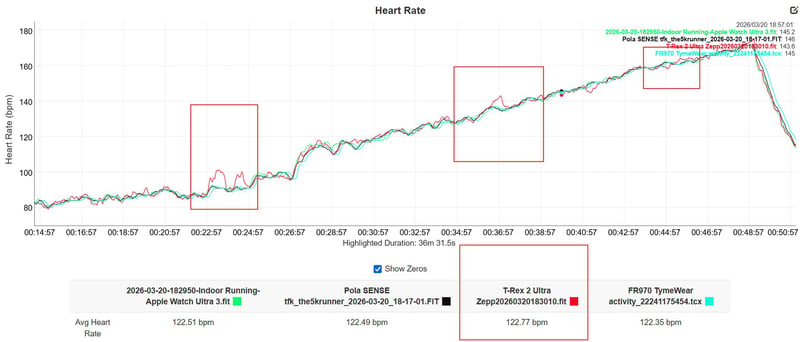
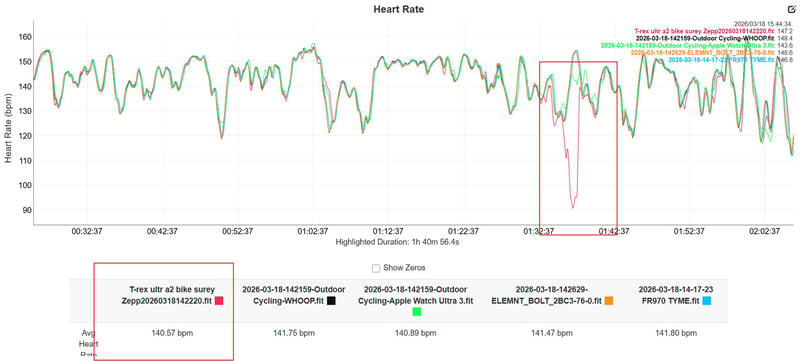
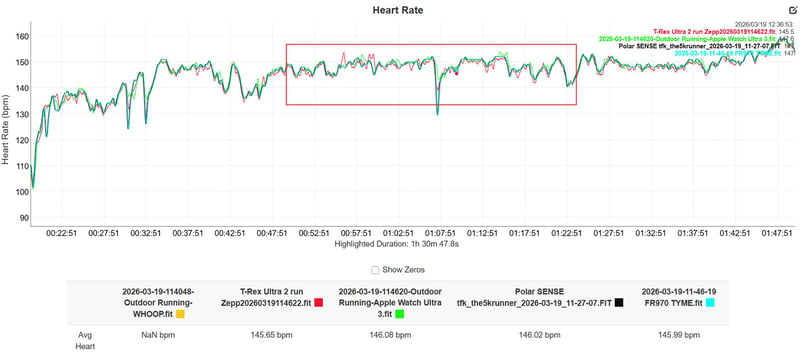
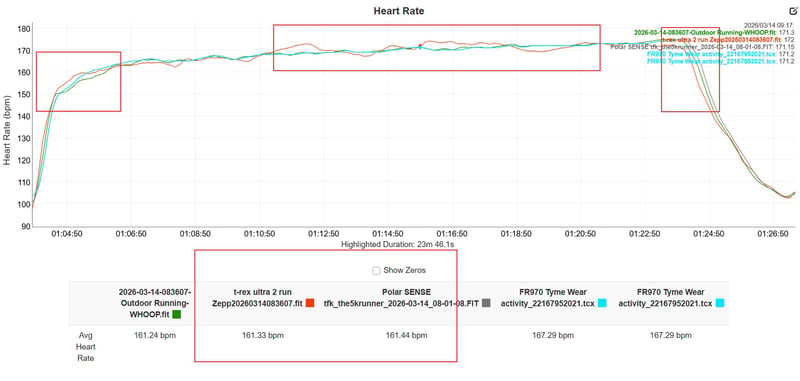
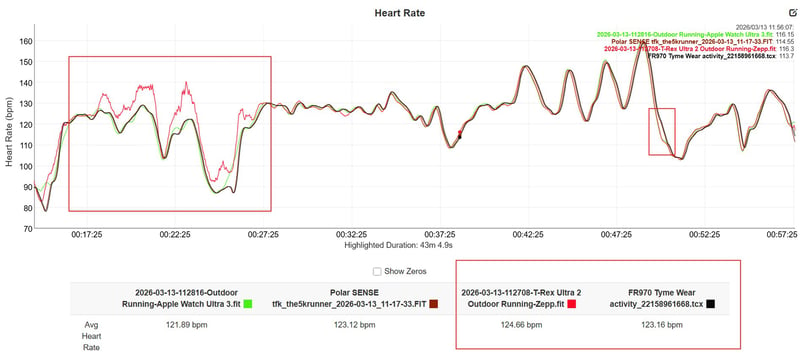
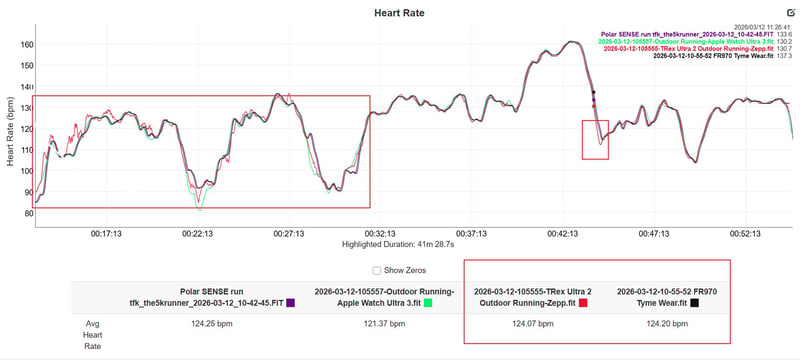
The warmup finding is both the most practically significant and the most baffling. Buyers who track workout load or zones from the first minute will see inflated or deflated early data. It needs a good warmup for the sensor to settle before trusting the readings in the workout proper.
T-Rex Ultra 2 Elevation Accuracy Test Results
T-Rex Ultra 2 GNSS (GPS) Test Results
Ultra 2 was an average GPS performer over my 10-mile running test across a variety of conditions following this strict methodology. This test showed Ultra 2 to be not quite as good as either the Instinct 3 or the T-Rex 3; in reality, a normal buyer would not notice any difference.
| Rank | Brand | Model | Score |
| 1 | Suunto | Vertical (2023) | 92% |
| 1 | Coros | Pace 3 | 92% |
| 1 | Garmin | Forerunner 970 | 92% |
| 4 | Huawei | Watch GT Runner 2 | 90% |
| 4 | Apple | Apple Watch Ultra 3 | 90% |
| … | … | … | … |
| 9 | Garmin | Instinct 3 50mm AMOLED | 87% |
| … | … | … | … |
| 15 | Amazfit | T-Rex 3 | 85% |
| … | … | … | … |
| 24/160 | Amazfit | T-Rex Ultra 2 | 83% |
Bike Test – Road, Suburban and Rural
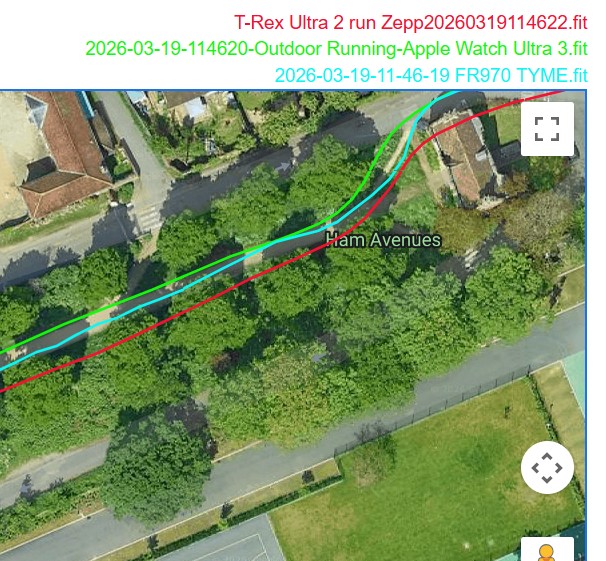
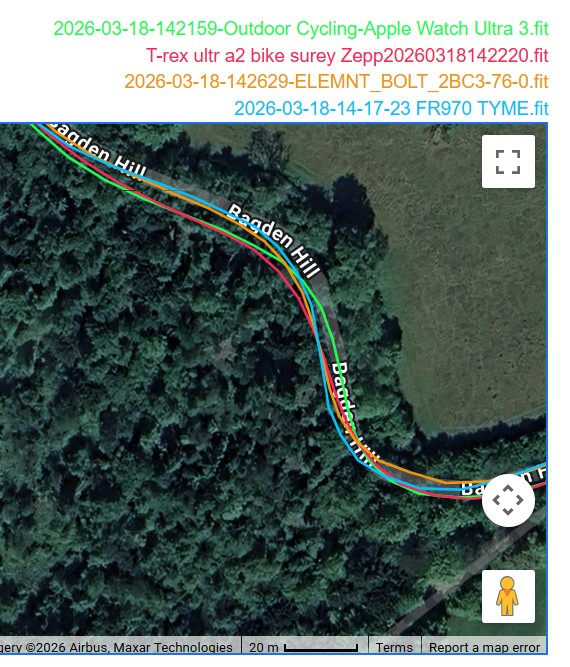
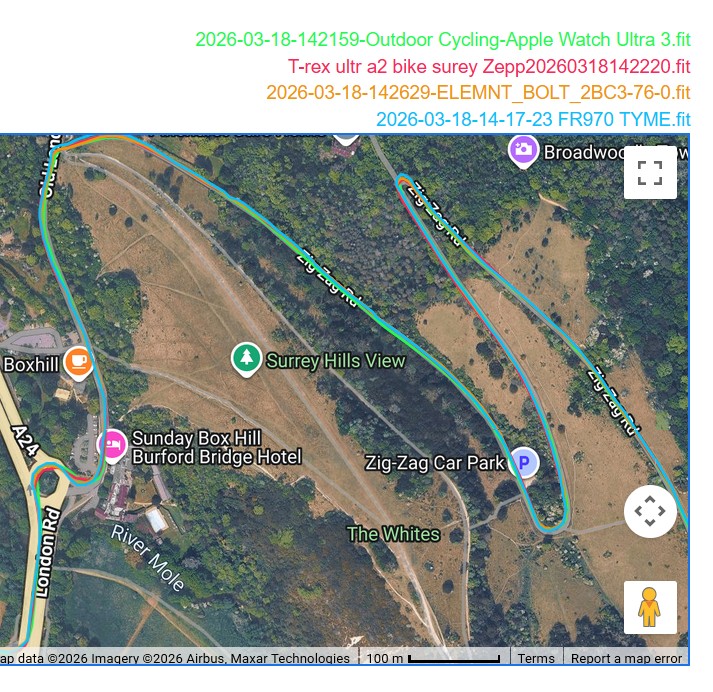
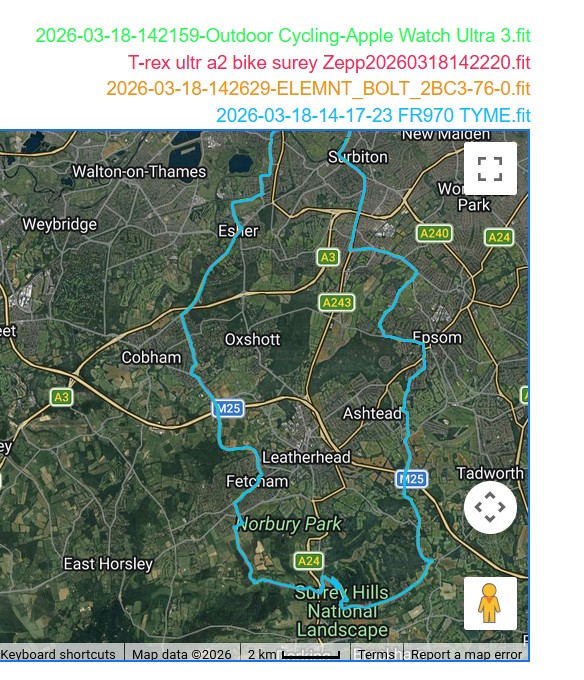
As expected, accuracy on a road bike was as close to perfect as it needs to be. The tracks below show two particular points of difficulty: one where T-Rex handles the switchbacks on Box Hill perfectly, and the other where there is a very modest deviation while going fast downhill through the trees on a tight curve.
Run Test – Riverside with trees and open spaces
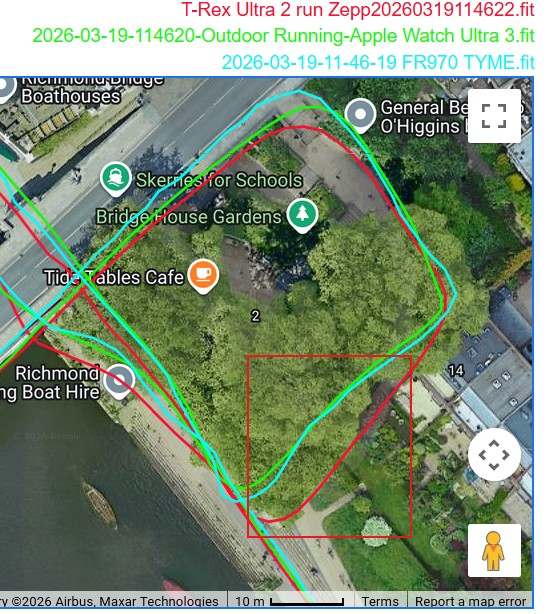
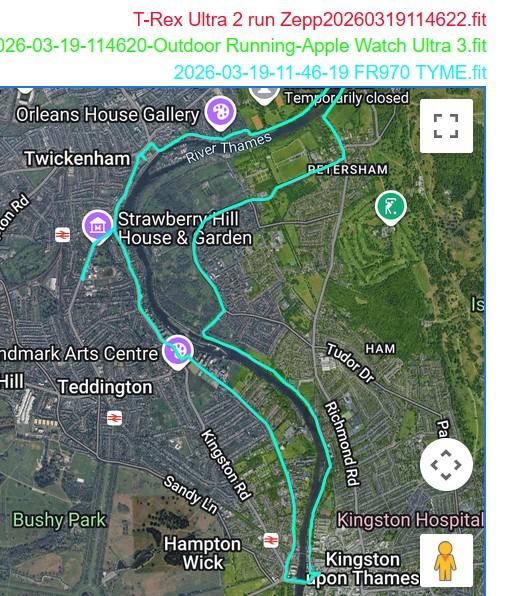
Unfortunately, this test failed on my 2nd backup. I can only show two tracks, but the repeated track segments show that the T-Rex’s GPS shift error is consistent. This is an algorithmic or antenna issue, albeit very minor and one which almost everyone will never notice.
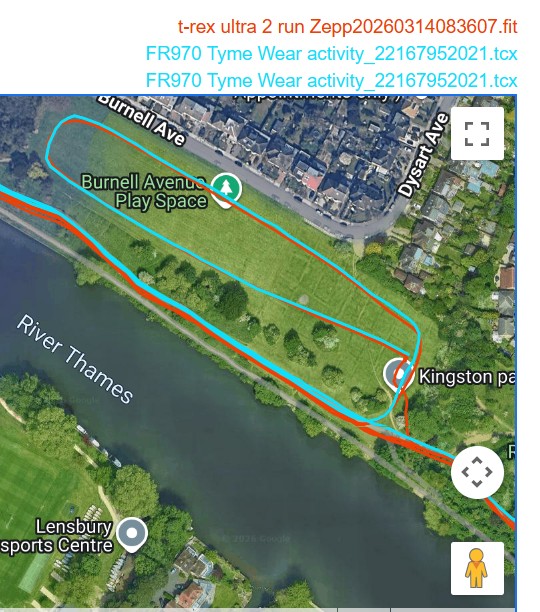
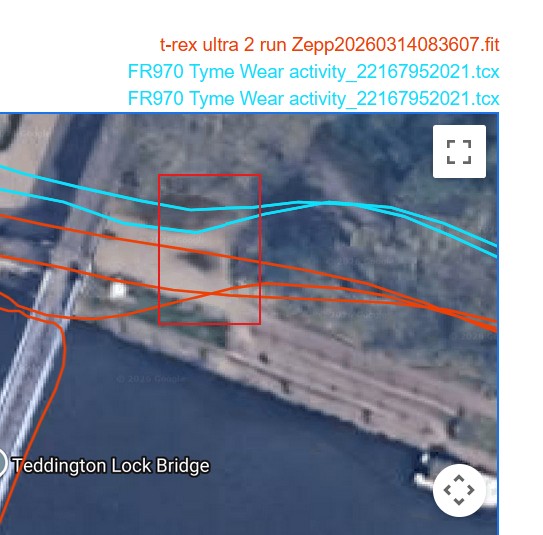
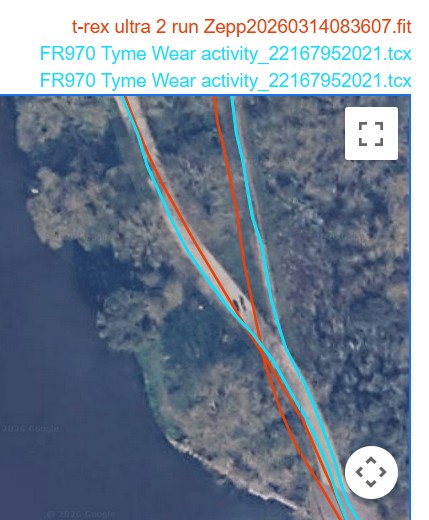
Visual inspection showed a repeated positional offset — at times, the T-Rex track ran parallel to the true route rather than on it, which may explain mild underreporting of distance.
GPS Distance Reporting
To quantify directional tendencies, I compared each watch against the three-device average for each test. The T-Rex Ultra 2 showed a mild tendency to underreport distance, averaging 0.3% below the group mean. The Apple Watch Ultra 3 showed a mild tendency to overreport, averaging 0.5% above. The Garmin FR970 averaged 0.4% below.
| Test | Activity | T-Rex Ultra 2 | Apple Watch Ultra 3 | Garmin FR970 |
|---|---|---|---|---|
| 1 | Run 5.9k | -0.3% | +1.2% | -1.7% |
| 2 | Run 6.4k | -0.6% | +0.9% | -0.3% |
| 3 | Hike 7.2k | -0.7% | -0.1% | +0.7% |
| 4 | Cycle 73k | -0.4% | +0.3% | +0.1% |
| 5 | Run 16.7k | +0.3% | +0.9% | -1.3% |
| 6 | Cycle 59k | -0.2% | -0.0% | +0.2% |
| Mean | -0.3% | +0.5% | -0.4% |
The margins are small enough to be inconsequential for most Ultra 2 owners. The consistent positional offset in the T-Rex may explain the mild underreporting of distance. This pattern held equally across running and cycling tests, suggesting a fixed device characteristic rather than motion-induced error attributable to running.
T-Rex Ultra 2 Battery Test Results
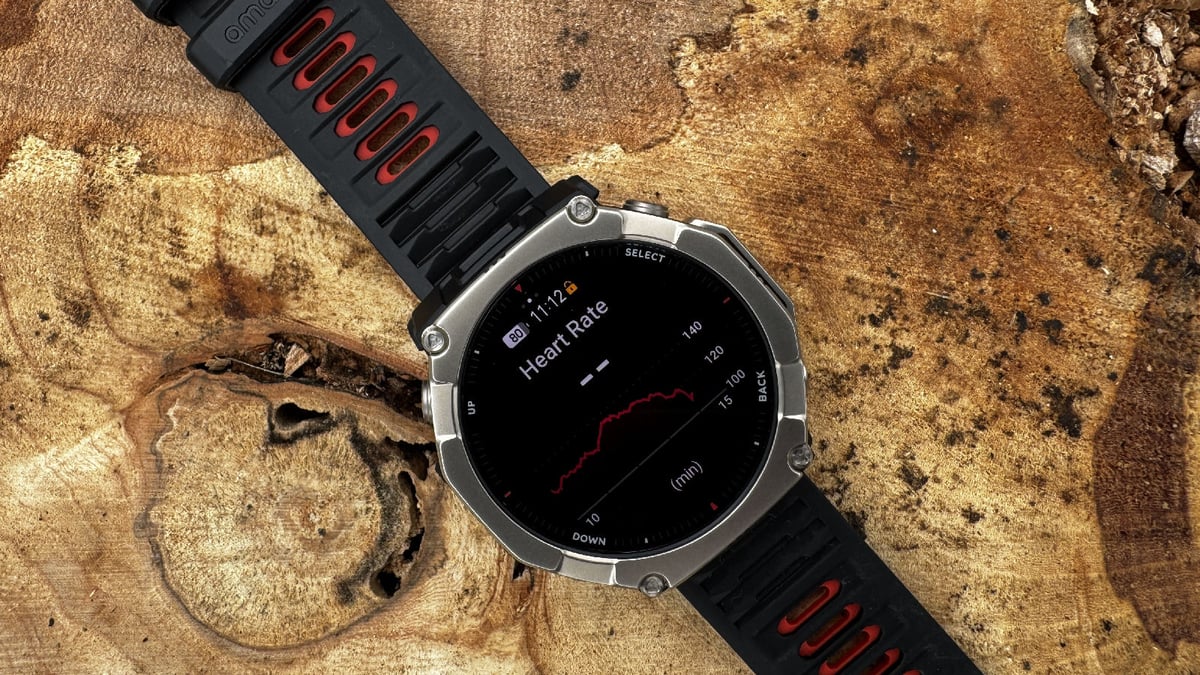
In two weeks of use with 1-2 hours of workouts most days, I only ever charged the watch fully once near the start, and it’s now showing 30%. Battery performance is remarkable, in line with the best. Battery burn is consistently 2-2.5% per hour during workouts, but is significantly lower in normal use.
Real-World Usability
The 24/7 aesthetics of this watch are not for me. But if you love this kind of look on a large format watch, T-Rex Ultra 2 is a winner when it comes to the one key feature that reviews tend to forget, and so subtly favour Garmin. Usability. That’s the feature you use every day.
Wearability
There is no getting away from the fact that this is a large-format watch case. Despite my skinny wrists, I found it comfortable enough to wear even at night, though if you check some forums, you’ll see differing opinions.
Usability
Tested on 3.1.8.3, bugs hopefully fixed when you read this.
On the whole, the watch software and interactions with the buttons, menus and screens are excellent and intuitive. Better than Garmin. If I had to criticise it, I would point out a fractional delay when raising the screen to wake, and that the display doesn’t come with a sensible nightly default off. I had a few embarrassing midnight illuminations…let’s leave it at that.
When using the buttons with bare fingers, I love the presser action, but finding that same button when wearing a glove isn’t super easy – OK though.
On the rare occasions you need to charge it, the small puck magnetically grabs on. The only danger is mislaying the puck, which I have done with previous Amazfit watches, but now have several!
A bone of contention is the new climb-assistance feature, which displays individual climbs from a preloaded route. This just doesn’t work. The climbs are not correctly identified nor presented at the right time. Amazfit seems to have this feature live, but doesn’t actively market it on their website, aside from showing “2/4 Slope Overview” in one image. It must be a difficult feature to implement, as Garmin’s initial attempt was also buggy – as reported on this site at the time, “ClimbPro Bugs Galore“.
When finishing a workout, there is a slightly convoluted process: tap the screen twice, then long-press to save. This is annoying, but it was introduced to stop accidental pausing, saving and discarding of workouts. It’s something you will likely only have to do once a day, so it’s probably worth the mild inconvenience compared to losing one important workout when you least expect it.
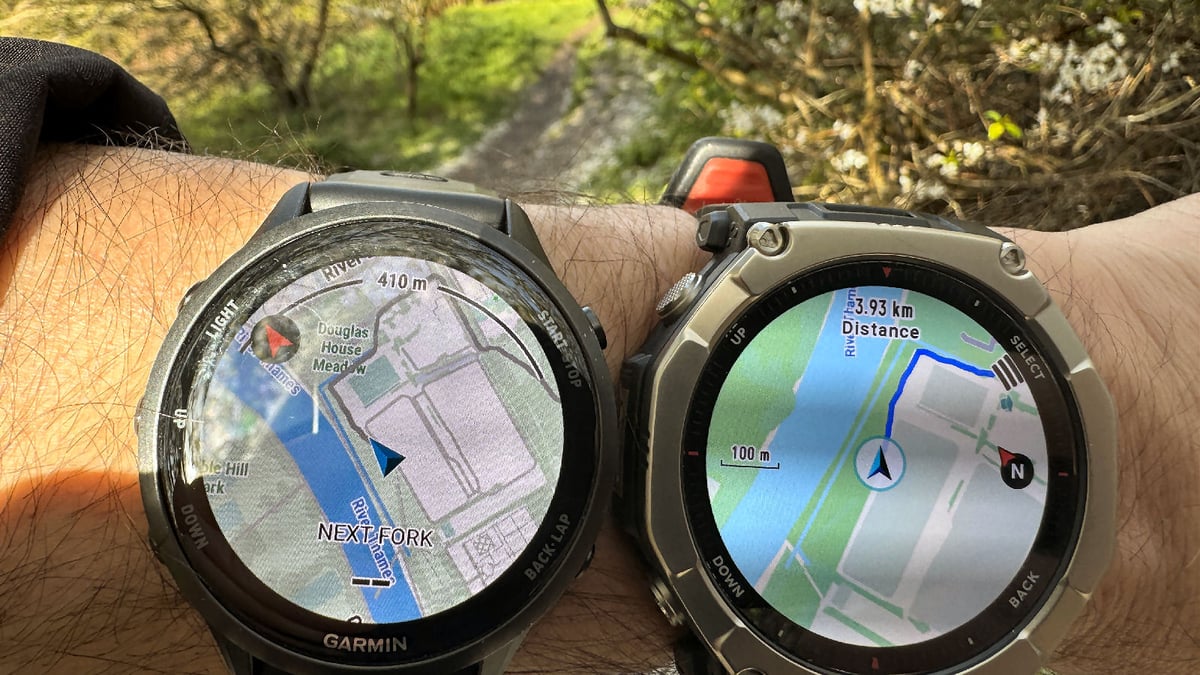
Using the watch to follow a route is pretty good, and I especially liked the subtle alerts for upcoming turns. It’s more than good enough for my meagre routing needs. However, if you’re looking for more detailed maps, you can see in the image below that Garmin offers richer map detail, including more POIs. But where Amazfit excels is the clarity and usability of its maps – it’s pretty easy to get that situational appreciation of where you are and where to go next.
Setting up my UK Curve Mastercard took a little longer than I would have liked. The card capture photo mechanism didn’t work (possibly an iOS issue), and the authentication took minutes longer than it did on my Apple Watch for the same card, and required more button presses. Fine as a one-off, but this is but one example of where Amazfit could tweak usability in many places to slightly improve the user experience.
Bug: I set up the PIN code whilst setting up my Mastercard. A workout was running at the same time, and the watch was not on my wrist. Anyone could have picked up the watch and made a payment, as the PIN code was not prompted. Yikes.
For the flashlight, the default top left button long press turns it on, then there is an on-screen toggle for it – neat!
Amazfit products are certainly not bug-free at launch and are probably comparable in number to Garmin. I’ve not experienced anything else worth noting. Still, elsewhere, there are reports of route calculation crashes, watch lag when navigating, watch freezes during route recalculations, and minor usability issues with the climb assistant. Amazfit is a large company; they will fix them. Just as Garmin do. But perhaps not as quickly as everyone would like.
How It Compares to the Competition
On paper at least, T-Rex Ultra 2 has specifications that hold up very well against the competition. The reality needs to be considered in how the excellent capabilities are used in the real world set of features.
| T-Rex Ultra 2 | Fenix E | Fenix 8 51mm | Instinct 3 50mm | |
|---|---|---|---|---|
| Price (USD) | $549.99 | $799.99 | $999.99 | $499.99 |
| Case | 51mm titanium | 47mm steel | 51mm titanium | 50mm polymer |
| Display | 1.5″ AMOLED 3000 nits | 1.3″ AMOLED | 1.4″ AMOLED | 1.3″ AMOLED |
| Glass | Sapphire | Gorilla | Sapphire | Corning |
| Maps | Offline + contour | TopoActive | TopoActive | None |
| Battery (Watch) | 30 days | 16 days | 29 days | 24 days |
| Battery (GPS) | 50 hours | 42 hours | 28 hours | 40 hours |
| Flashlight | Yes (2 colour) | No | Yes | No |
| Speaker/Mic | Yes | No | Yes | No |
| Water resistance | 10 ATM / 45m dive | 10 ATM | 10 ATM / 40m dive | 10 ATM |
| GPS | Dual-band | Single-band | Dual-band | Dual-band |
| Storage | 64GB | 16GB | 32GB | 8GB |
Q: Is the T-Rex Ultra 2 Good Enough to Replace a Garmin?
Yes. At least it is for most people contemplating the Garmin Instinct 3 ($499.99, 50mm AMOLED). The T-Rex Ultra 2 ($549) matches it on the features that matter for outdoor sport and beats it on display quality. The price difference is smaller than you might expect, and at that crossover point, the Amazfit is the better buy. If the Instinct 3 is on your shortlist, put the T-Rex Ultra 2 on it too.
The Garmin Fenix 8 choice poses a different question. The hardware gap between a $500 rugged smartwatch and a $1000 multisport adventure watch is smaller than the price gap suggests. Still, Garmin’s wider ecosystem — training plans, coach integrations, music, and payments — is more complete and more polished than anything Amazfit currently offers. You are not really paying for a better outdoor GPS watch.
T-Rex Ultra 2 vs Coros and Other Sports Brands
Coros and Amazfit now cover almost everything a serious athlete needs in a multisport adventure watch. Garmin covers more, but the distance between them shrinks with every annual update. Unless you have identified a specific feature gap — certain training plan structures, particular third-party integrations — you are unlikely to notice the difference mid-run or mid-climb.
Where Amazfit Falls Short of Garmin
It is rarely the headline features. Both connect to Strava. Both handle music. Both offer payments. But Garmin’s version of each tends to be more reliable, more deeply integrated, and less likely to need your attention or intervention. The difference shows up not when you are comparing spec sheets but when something quietly fails to work the way you expected, and you find yourself troubleshooting on a rest day.
That said, there are more obvious omissions with Amazfit, like no solar option, only a fledgling 3rd party app ecosystem, and no way to support streaming music services like Spotify.
Q: What about the Apple Watch Ultra 3 and Galaxy Watch Ultra?
These are not sports watches with smart features. They are smart devices that also do sports and a spot of weekend warrioring. If you live inside the Apple or Samsung ecosystem, the integration is genuinely excellent and, in some respects, notably better than Garmin and Amazfit’s. But you will feel the sports-feature gap during longer, more technical activities.
I will add something that does not appear in any spec comparison: I train and go on adventures for 10 to 20 hours most weeks, and I have completed plenty of those sessions on an Apple Watch Ultra 3 without feeling underserved. That says something about how far the top end of the smartwatch market has come. It also says something about how many features on dedicated adventure watches most of us will never actually use.
Who Should Buy It
- Upgrading from a T-Rex 3? I would not bother. The T-Rex 3 is a perfectly decent watch, and there is no compelling reason to spend an extra $250 unless you specifically want the flashlight, the sapphire glass, the larger display, or genuinely need more battery on multi-day efforts. If you have the cash and want the best Amazfit has to offer, go for it — but do not feel you’ll be missing out in a meaningful way.
- Upgrading from a T-Rex 2? Yes, it’s a step up — I’m talking genuine generational improvements, not a leap of faith. You are getting offline maps, AMOLED, dual-band GNSS, titanium-and-sapphire construction, a speaker and microphone, an LED flashlight, NFC payments, more storage, and roughly double the battery life. The T-Rex 2 was a good watch. The Ultra 2 is different.
- Considering a Garmin Instinct 3? Buy the T-Rex instead and keep the $50 for your next adventure. The Instinct 3 has no maps — a significant omission for a watch marketed at outdoor users. If the budget is tight, the T-Rex 3 at under $300 is a better starting point and still beats the Instinct on maps, routing and general navigation.
- Looking at a Fenix 8? You might want the best, but can you afford it? Garmin’s ecosystem is the best in the business — richer, more mature, and more polished than anything else out there. But it costs double. If you can afford it, buy it. If double the price will give you sleepless nights, the Ultra 2 covers the vast majority of what most outdoor athletes actually need.
- Switching from a Fenix 7? No — you will lose too much. You know the Garmin ecosystem intimately: its quirks, your workarounds, your Connect data history. The Zepp experience is simpler and more intuitive, but switching costs are real. Hold on, wait for the Fenix 9 later this year, and pick up a Fenix 8 on sale when deals appear.
- First serious adventure watch? Most sports watch purchases are overkill — including mine. Join the club. Think carefully before spending $550, though. If your adventures are weekend hikes on marked trails, an Apple Watch is probably enough – you have a smartphone as well. If you want maps, a long battery, and genuine ruggedness without committing to Garmin prices, the older T-Rex 3 at under $300 is the smarter starting point. But if you want the best from day one, you already know the answer.
- Coming from a Coros or Suunto? Honestly, why? Moving from a recent Coros, you will gain or lose little of substance. Moving from a current Suunto would feel like a small step backwards. The Zepp ecosystem is mature, and the usability is genuinely strong — arguably better day-to-day than either — but unless you have a specific reason to switch, stay where your data is.
- Switching from an Apple Watch Ultra? Probably not, unless uber-battery life is your problem. The Apple Watch Ultra 3 is an excellent watch, and you already know its one real weakness — mapping and routing — has workarounds. WorkOutDoors handles that better than the native app anyway. If you are spending serious time in the backcountry on multi-day efforts, the T-Rex Ultra 2’s battery and navigation make a compelling case. For everything else, stay put.
Quick answers
Does the Amazfit T-Rex Ultra 2 have offline maps?
Yes. It ships with preloaded global base maps and supports downloadable contour and ski maps via the Zepp app. Maps work without a phone connection and include turn-by-turn navigation, automatic rerouting, and POI search.
How does the T-Rex Ultra 2 compare to the Garmin Instinct 3?
The T-Rex Ultra 2 costs $50 more but delivers full offline maps, a larger 1.5-inch AMOLED display, a built-in speaker and microphone, and an LED flashlight. The Instinct 3 has no maps at any price. For outdoor use, the T-Rex is the better buy.
How long does the battery actually last?
In two weeks of daily use with one to two hours of workouts, the watch dropped to 30% with a single top-up charge. Battery burn rate is consistently 2 to 2.5% per hour during workouts. The 30-day typical use claim appears realistic.
Does the T-Rex Ultra 2 work with Strava?
Yes for workout uploads — completed activities sync automatically to Strava via the Zepp app. Route download is more limited: you cannot pull a Strava route directly to the watch with one tap, as Garmin handles it. Routes need to be exported from Strava as a GPX file and imported via the Zepp app, which adds a step. Once on the watch, the navigation works well. It also syncs with TrainingPeaks and Intervals.icu, Apple Health, Google Fit, Runkeeper, adidas Running, komoot, and Relive.
Is the T-Rex Ultra 2 worth it over the T-Rex 3?
Only if you specifically need the flashlight, sapphire glass, larger display, or more battery on multi-day trips. The T-Rex 3, at under $300, covers most of what most buyers need. The Ultra 2 is for buyers who want the best Amazfit offers and will use it as intended.
Can you make phone calls from the T-Rex Ultra 2?
Yes. The built-in speaker and microphone support Bluetooth calls directly from the watch. You can also use Zepp Flow voice control to reply to messages hands-free on Android.
Does the T-Rex Ultra 2 support music streaming?
No. Spotify and other streaming services cannot be installed directly. Music must be sideloaded to the watch’s 64GB storage via the Zepp app. Garmin’s equivalent watches support Spotify natively.
Where is Amazfit heading, and how does T-Rex fit?
Amazfit (Zepp) occupies a reasonably strong, growing market position — albeit an unprofitable one. Its products, features, and ecosystem are in a good place, though obviously capable of improvement. It is one of the companies doing well at lower price points, but like every other company in that position, it envies the higher margins at higher price tiers that brands like Garmin dominate. The T-Rex Ultra 2 is a clear statement that the company wants to head upmarket.
Amazfit is adept at iterating new models — an ability it can put to good effect by quickly leveraging successful products like the Helio Strap, its Whoop competitor (Helio Strap Gen 2.0 is confirmed for this year)
Zepp-amazfit needs to tread carefully and pick its battles. Helio was a good battle to pick. Trying to take on the Fenix is not one Amazfit would win, but a partial alternative at half the price that tackles niche-case buyers and genuinely gives adventurers credible options. The Garmin Instinct, on the other hand, is ripe for the fight — but that competition requires a watch with a rugged street aesthetic and the right features.
Relatively novel form factors like the Helio Strap are rare. In reality, the most obvious market sectors are already mapped out and understood by every brand, and Amazfit does a solid job in each it targets. The brand perhaps lacks the colour and size options that Garmin’s volumes enable it to develop and sell profitably, hence perhaps why the T-Rex Ultra 2 only comes in one size.
If Amazfit really is heading upmarket — and its CFO said as much recently — it needs excellence in its already solid software platform. That challenge could easily be levelled at competitors pursuing similar strategies, but the Zepp app is genuinely one of the better options in the category outside of Garmin, just as its watches and watch software are generally very good.
Price
The Amazfit T-Rex Ultra 2 is priced at $549.99.

For the complete Garmin Fenix series guide, covering all current models, history and buying advice: Garmin Fenix hub.
For the full Amazfit range, accuracy data and Zepp Health analysis: Amazfit sports watch guide.
Last Updated on 28 June 2026 by the5krunner
My favourite kit and nutrition
- Garmin Fenix 9 Pro — I’ve just bought one.
- Injinji – Runners protect your toes. Avoid discomfort and minor injury. Run more. Run faster. I use them.
- Garmin 90-degree charging adapter — A small keyring adapter you can use anywhere. Essential when away. I use one.
- Garmin charging puck — the fastest and most reliable way to top up your Garmin before a session. I use one.
- Ravemen FR300 — Front light that mounts directly under your Garmin or Wahoo head unit. Keeps your bars clean and your beam pointed where it matters. I use one.
- Body Glide – The blue anti-chafe stick that all swimmers and many runners use. I use it.
- Maurten — The race nutrition trusted by elite athletes. Gels and drink mixes engineered to be easy on the stomach. I use them.
- Garmin Varia RTL515 — A radar rear light that alerts you to vehicles approaching from behind. Pairs with your Edge or Wahoo. I use this model.
- Favero Assioma Pro RS2 — The power-meter pedals most serious cyclists choose. Accurate, easy to move between bikes. I use this model.
- Garmin Forerunner 970 — A serious choice for a pro-grade triathlon watch. I use this.
- Polar H10 — My daily driver for accurate, waking HRV readings.
- Wahoo ELEMNT Roam 3 — The bike computer that has the feature Garmin lacks: usability. I use mine on most rides.
Reader-Powered Content

This content is not sponsored. It’s mostly me behind the labour of love, which is this site, and I appreciate everyone who supports it.
Support the site: Follow (free, fewer ads) · Subscribe (paid, ad-free) · Buy Me A Coffee ❤️
All articles are written by real people, fact-checked, and verified for originality. See the Editorial Policy. FTC: Affiliate Disclosure — some links pay commission. As an Amazon Associate, I earn from qualifying purchases.
tfk is the founder and author of the5krunner, an independent endurance sports technology publication. With 20 years of hands-on testing of GPS watches and wearables, and competing in triathlons at an international age-group level, tfk provides in-depth expert analysis of fitness technology for serious athletes and endurance sport competitors. ID
