Garmin Leaks Trademarks – Two New Products all-but confirmed
Garmin has filed two new trademarks, each corresponding to a significant new product. As part of the filing process, Garmin must state its broad area of use, which provides concrete insight into what the company plans to do.
Garmin Muscle Battery – A New Algorithm and New Hardware
Garmin Body Battery is a modelled HRV proxy for whole-body energy. Muscle Battery is fundamentally different: Garmin’s first direct physiological metric, measuring muscle oxygen saturation (SmO2) via near-infrared spectroscopy (NIRS) at the individual muscle.
SmO2 measures the percentage of haemoglobin saturated with oxygen in the capillaries of a specific muscle. Unlike heart rate or power, which rise predictably with effort, SmO2 does not follow a progressive pattern across zones. The value reflects a dynamic balance between oxygen delivery and oxygen consumption at a specific site. Interpreting it requires knowledge of the absolute level, the direction of travel (replenishment or depletion), and the context of the exercise. It is a fundamentally different class of metric from anything Garmin currently offers.
Further to this, Garmin recently leaked a detailed questionnaire about an advanced strength feature with numerous muscle-related metrics. The questionnaire detailed three tiers of features, with perhaps the most advanced level falling under the Connect+ subscription.
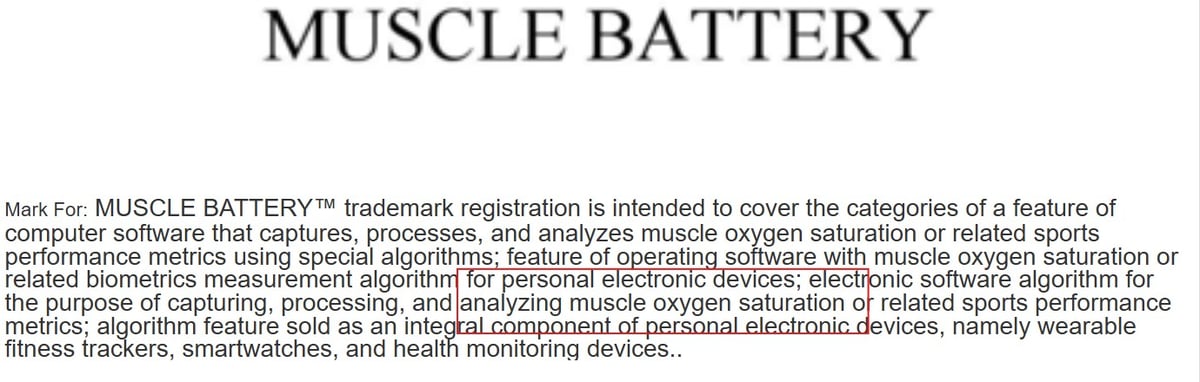
However, the new Muscle Battery trademark pushes the interpretation in a different direction. The trademark application describes an algorithm that processes and analyses muscle oxygen saturation or related sports performance metrics, sold as an integral component of wearable fitness trackers, smartwatches, and health-monitoring devices. That language confirms Garmin’s Muscle Battery will use muscle oxygen, which requires a specialised NIRS sensor.
As used elsewhere in existing optical HR sensor arrays, NIRS works by shining near-infrared light into tissue and measuring the light that returns. SmO2 considers new wavelengths of reflected light. Oxygenated and deoxygenated haemoglobin also absorb infrared wavelengths differently, and the ratio between the two yields SmO2 as a percentage. The technique has been used in laboratory and clinical settings for decades. In the past ten years, a small number of companies have miniaturised the sensors into wearable form factors for athletes.
The Current Muscle Oxygen Sensor Landscape
The muscle oxygen sensor market is small, specialist, and fragmented. Moxy Monitor is the longest-established product and the only device with published scientific validation for measuring SmO2, widely used by elite athletes, including Kristian Blummenfelt.
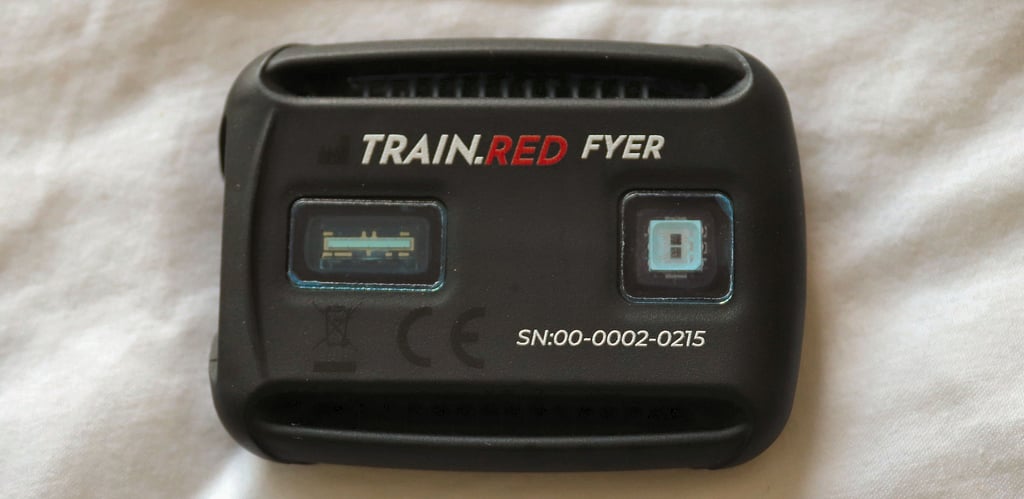
Train.Red FYER, a spin-off from Artinis Medical Systems (the gold standard in laboratory NIRS), packages Artinis sensor technology for consumers and supports ten or more simultaneous sensors for team monitoring. NNOXX One goes further, measuring nitric oxide and local blood flow alongside SmO2, with an independent validation study at Massachusetts General Hospital confirming strong agreement with laboratory-grade NIRS.
What Hardware Will Garmin Need?
Garmin must ship dedicated NIRS hardware. The wrist-mounted Elevate sensor cannot work for muscle oxygen. A muscle oxygen sensor must be placed directly over the target muscle, shielded from ambient light, and worn in a consistent position from one session to the next. A different placement on the same muscle can yield different absolute readings. The sensor also needs to penetrate deep enough into the tissue to reach the muscle beneath the subcutaneous fat, which varies considerably by individual and body site.
The hardware will need to be a separate, movable product, similar in concept to Train.Red FYER or Moxy, able to be strapped or adhered to different muscles and supporting multiple sensors simultaneously. Monitoring both quadriceps during a cycling session, for example, requires two sensors. Elevate 6 on a watch simply cannot do this job.
Types of Training Supported
SmO2 metrics delve deeper into the body’s inner workings than the sports sensors we are used to. Consequently, in the right conditions, they can be highly insightful and will benefit strength and endurance athletes alike.
Endurance
- Threshold identification (VT1, VT2)
- Real-time race pacing
- Interval work/rest tuning
- Inter-interval recovery quality
- Steady-state zone compliance
- Warm-up validation
- Fatmax zone identification
- Limiter identification (cardiac/respiratory/muscular)
Strength and Power
- Intra-set fatigue depth
- Rest period optimisation
- Left/right asymmetry detection
- Hypertrophy metabolic stress confirmation
- VBT data cross-reference
Other
- Post-surgical recovery tracking
- Left/right symmetry monitoring
- Day-to-day readiness testing
- Altitude/heat acclimatisation tracking
- Team sport substitution decisions
Practical Challenges for Muscle Battery
There are no progressive zones. Heart rate has zones. Power has zones. SmO2 does not work that way. A reading of 40 per cent means something entirely different depending on whether it is falling (the muscle is consuming more oxygen than it is receiving) or rising (replenishment is outpacing demand). The same absolute number at the start of a set and at the end of a recovery interval carries opposite implications.
Sensor placement must be consistent. A shift of a centimetre or two on the quadriceps can change the baseline reading enough to invalidate comparisons with a previous session. This is the single most common source of error in field-based SmO2 data collection. Any “battery” metric that compares one workout to the next must account for this, either through calibration routines or through algorithms that normalise for placement variance.
The data is site-specific. A sensor on the right vastus lateralis tells you nothing about the left vastus lateralis, the hamstrings, or the calves. To build a meaningful picture of overall muscular readiness, multiple sensors and some form of modelling will be required. The trademark filing’s reference to wearable fitness trackers in the plural is worth noting.
Subcutaneous tissue thickness affects signal quality. NIRS sensors measure light that has passed through skin, fat, and muscle. In individuals with thicker subcutaneous fat layers, the signal-to-noise ratio degrades. This has been a persistent limitation of consumer NIRS devices, though the NNOXX validation study found relatively little impact from body composition in its cohort.
The existing ANT+ muscle oxygen profile handles transmission of SmO2 percentage data and total haemoglobin. It does not define anything equivalent to a “battery” or readiness score. The modelling that translates raw SmO2 into a consumer-friendly Muscle Battery metric will be entirely Garmin’s own work, built on top of raw sensor data.
Muscle Battery FAQ
Will Muscle Battery work through Elevate on a Garmin watch?
No. Muscle oxygen requires a sensor placed directly on the target muscle, shielded from ambient light. A wrist-mounted watch cannot provide those conditions.
Has Garmin developed its own SmO2 sensor?
Possible but unlikely as a first step. The faster route is to licence proven NIRS optics from an established manufacturer such as Artinis Medical Systems, the parent company of Train.Red.
Will Muscle Battery be a feature or hardware?
A software feature. The trademark describes algorithms, not a device. However, it will require dedicated NIRS sensor hardware to capture SmO2 data.
Could Muscle Battery work with third-party sensors?
Plausible. Both Moxy and Train.Red transmit over the ANT+ muscle oxygen profile. However, Garmin’s commercial incentive is to sell its own hardware, and I strongly suspect the feature will be optimised for a Garmin-branded sensor.
Are there existing standards for muscle oxygen data?
Yes. ANT+ defines a muscle oxygen device profile for SmO2 and total haemoglobin. Garmin devices already display this from third-party sensors. The profile transmits raw readings only. The modelling layer that produces a “battery” score will be proprietary to Garmin.
Will Garmin licence the sensor components for its own hardware?
Yes, that is the most likely route if it wants to be credible. A related option would be to acquire the business from Artinis; the sensor has many uses beyond sports, so Artinis would be unlikely to sell it.
Connecting the Dots
The Muscle Battery trademark should be read alongside the leaked survey of the advanced strength feature from earlier this month. That survey detailed three tiers of muscle-related features, including per-muscle-group recovery modelling, muscle load scores, and readiness indicators. Muscle Battery appears to be the brand name under which the most advanced tier of those features will ship.
If Garmin succeeds, the result will be a genuinely new category of consumer data: localised, objective, physiological readiness at the individual-muscle level. The shift from “How do I feel?” to “What state are my quadriceps in right now?” would be substantial. Whether the data will be accurate and repeatable enough to be genuinely useful, rather than merely interesting, remains an open question until the hardware ships.
Garmin CIRQA
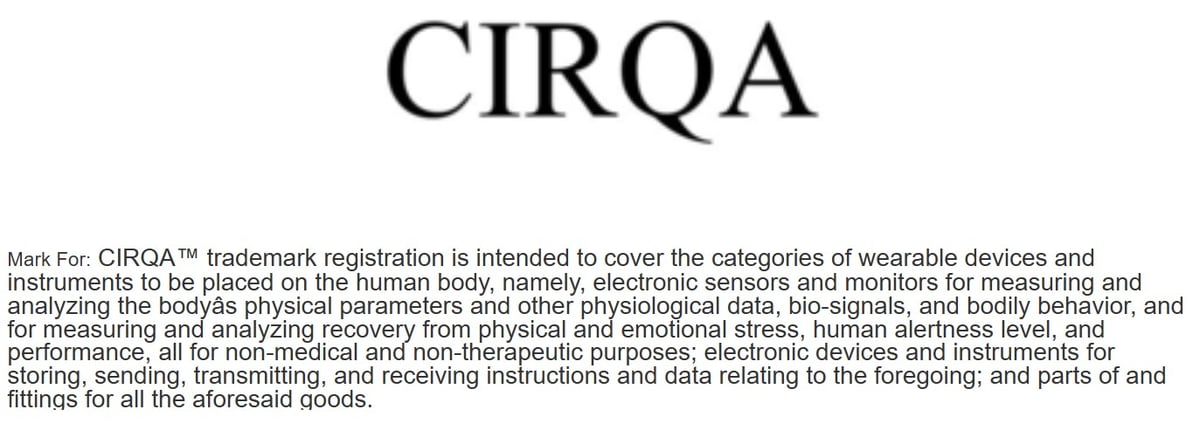
CIRQA has been widely leaked on the company’s regional sites and is known to be a Whoop competitor, expected to launch soon.
I had some doubts that Garmin would use the CIRQA name. To me, the Latin word circa implies “about” or “approximately”. Hardly a name implying precision. However, the latest trademark application confirms that CIRQA will be the name.
Last Updated on 11 April 2026 by the5krunner
Reader-Powered Content

This content is not sponsored. It’s mostly me behind the labour of love, which is this site, and I appreciate everyone who supports it.
Support the site: Follow (free, fewer ads) · Subscribe (paid, ad-free) · Buy Me A Coffee ❤️
All articles are written by real people, fact-checked, and verified for originality. See the Editorial Policy. FTC: Affiliate Disclosure — some links pay commission. As an Amazon Associate, I earn from qualifying purchases.
tfk is the founder and author of the5krunner, an independent endurance sports technology publication. With 20 years of hands-on testing of GPS watches and wearables, and competing in triathlons at an international age-group level, tfk provides in-depth expert analysis of fitness technology for serious athletes and endurance sport competitors.

Hasn’t NNoxx gone bust?