Whoop Patents a Muscle Oxygen Sensor. Here Is What It Means.
Garmin and Whoop both appear to be planning to add new, own-branded sensors to their ranges. We reported on Garmin leaking information through an unusually detailed Trademark application; now, Whoop has slipped even more details with a patent.
Whoop appears to be building a body-worn muscle oxygen sensor. A patent granted on 7 April 2026 describes a wearable NIRS device with a pressure-sensing strap, designed to be placed on the thigh, arm, or chest rather than the wrist. If the company follows through, it would bring real-time SmO2 data to a subscriber base that already tracks strain, recovery, and strength training at a level of detail no competitor matches. For both strength and endurance athletes, that is a significant prospect.
The muscle oxygen sensor market is small and fragile. Two companies, Humon Hex and BSX Insight, have already tried and failed to bring SmO2 to a mainstream audience. The survivors are Moxy Monitor, the only device with published scientific validation for absolute SmO2, and Train.Red FYER, a spin-off from Artinis Medical Systems that packages gold-standard laboratory NIRS optics into a 20-gram consumer sensor with a 24-hour battery and 10Hz sampling, backed by Artinis’s 1,500-plus publications on the PortaMon reference instrument. NNOXX One adds nitric oxide measurement but has not achieved broad adoption. I covered the full competitive landscape here.
Into this picture steps Whoop with a patent, and Garmin with a trademark.
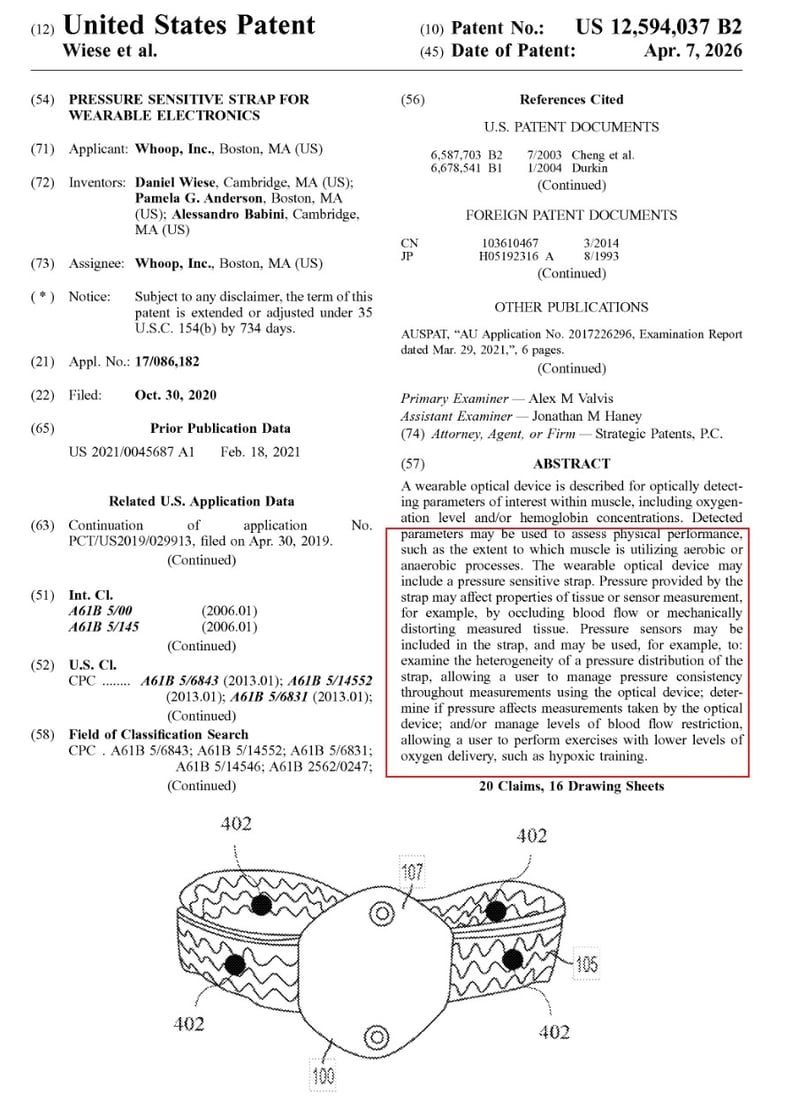
What Whoop Has Patented
US patent 12,594,037 B2 covers a wearable optical device for detecting muscle oxygenation, haemoglobin concentrations, and related tissue parameters. The optical core is standard continuous-wave NIRS: two narrow-band LEDs at approximately 660nm and 855nm, arranged as a point source, with a linear array of three to four photodetectors at graded distances from 5mm to 50mm. Reflectance intensity is fitted against distance to derive SmO2, oxygenated haemoglobin, deoxygenated haemoglobin, and total haemoglobin. This is the same broad technique used by every existing consumer muscle oxygen sensor.
The genuine novelty is the strap. Whoop’s claims centre on pressure and tension sensors embedded in the strap itself, using both solid-state and liquid-state technologies, including PDMS-based electrofluidic circuits. The system detects strap tightness, maps pressure distribution, compares current readings to historical values, and flags when pressure is high enough to restrict blood flow or distort the tissue beneath the sensor. The patent drawings show the device on the upper thigh, with references to placement on the arm, chest, and waist. Wireless charging via Qi and Bluetooth Low Energy communication is specified. No sampling rate, penetration depth, or battery life is stated.
Three practical applications flow from the pressure sensing. The device can detect when strap tension is inconsistent between sessions, a genuine source of error in all body-worn NIRS. It can identify when pressure is high enough to affect blood flow, allowing the system to adjust or flag its optical readings. And it can monitor and guide blood flow restriction during exercise, opening a path to supervised hypoxic training that no existing consumer SmO2 sensor provides.

Why It Fits Whoop’s Athletes
Whoop already supports Any-Wear detection across multiple body positions and ships apparel with sensor pockets. A separate body-worn NIRS device for thigh or arm placement extends the existing ecosystem without replacing the wrist band.
For strength athletes, the case is immediate. Whoop’s strength training features track reps, intensity, and muscular strain using velocity-based training principles and provide a breakdown of cardio and muscular strain across muscle groups. No other mainstream wearable does this to the same level. Adding direct SmO2 measurement would allow athletes to monitor oxygen supply and demand within a working muscle in real time, optimise rest periods between sets based on measured recovery rather than elapsed time, and detect the point at which a muscle shifts from aerobic to anaerobic work. The blood flow restriction application extends the value further for strength-focused buyers.
For endurance athletes, SmO2 has proven applications in pacing, warm-up optimisation, and field-based threshold detection. Research by Bruce Rogers and collaborators has demonstrated that combining NIRS-derived deoxyhemoglobin breakpoints with HRV-based DFA alpha-1 values provides a practical estimate of the respiratory compensation point. That work establishes SmO2 as a complementary metric to heart rate and power, one that measures the cause of performance limitation rather than its effect. The principle applies to any NIRS device with adequate penetration depth and sampling resolution. Whether the Whoop device meets those requirements is unknown.
The patent also describes a distributed multi-sensor architecture, i.e. a system with multiple emitter/detector strips worn simultaneously on different muscle groups, connected to a single controller. This is important because SmO2 is inherently site-specific. A sensor on the right vastus lateralis reveals nothing about the left, the hamstrings, or the upper body. A cyclist investigating bilateral imbalances needs a sensor on each leg. A HYROX athlete transitioning between rowing, running, and sled work would benefit from monitoring both legs and the lateral trunk muscles in one session without stopping to change sensor positions. Train.Red already supports connecting ten or more FYER sensors to a single smartphone for multi-site and team monitoring. Whoop’s patent describes a dedicated control module to coordinate multiple strips locally, but the data still flows to a phone and the Whoop app, just as it does with Train.Red. The practical advantage would lie in integration with Whoop’s existing per-muscle-group strain tracking and Muscle Map visualisation, which already models muscular load across the body.
Consider: Even at a basic level, an SmO2 will detect the exact duration of use of specific muscles and, to a degree, their intensity.
What Garmin Is Assembling
Two Garmin trademark filings surfaced on 11 April 2026. Muscle Battery describes an algorithm built around SmO2 data for consumer wearables. CIRQA is a separate product, a screenless recovery band positioned against Whoop. The two are almost certainly distinct hardware.
If, as this site suspects, Garmin ships a dedicated NIRS sensor alongside Muscle Battery, the result will be more consequential than anything in the Whoop patent. Garmin has the install base, the training load modelling, the Muscle Map recovery visualisation, the Advanced Strength features, and the data infrastructure to do what no previous SmO2 product has managed: translate raw muscle oxygenation into a metric that ordinary athletes can act on without interpreting a single percentage value. The faster route for Garmin’s optics would be to license proven NIRS technology from an established manufacturer such as Artinis, the parent company of Train.Red. That said, these are low-cost sensors to produce, and Garmin has similar competencies in designing other NIRS sensors (Elevate 5).
SmO2 has not failed commercially because the data is irrelevant or the sensors are poor. It has failed because the data is genuinely hard to interpret, and every company that has folded in this space has folded on the software-and-education problem. Garmin is the first company with both the platform and the motivation to solve that.
FAQ
What does Whoop’s muscle oxygen patent cover?
The patent (US 12,594,037 B2) covers a wearable NIRS device with pressure and tension sensors embedded in the strap. The optical core uses two LEDs at 660nm and 855nm with three to four photodetectors at graded distances to measure SmO2, oxygenated haemoglobin, deoxygenated haemoglobin, and total haemoglobin. The strap sensors detect fit consistency, pressure distribution, and blood flow restriction levels. The patent was filed in 2019 and granted on 7 April 2026. No commercial product has been announced.
Can you buy a Whoop SmO2 sensor in 2026?
No. The patent describes a device concept, not a shipping product. As of April 2026, the only consumer SmO2 sensors available are Train.Red FYER 2.0 (from approximately €625), Moxy Monitor, and NNOXX One. Whoop has not announced a release date, price, or product name.
The author would not expect Whoop to launch an SmO2 sensor in 2026. 2027 would be the earliest.
How does Whoop’s patented SmO2 device compare to Train.Red FYER?
Train.Red FYER 2.0 is a shipping product with Artinis laboratory-grade NIRS optics, 10Hz sampling, 24-hour battery life, 20-gram weight, and BLE/ANT+ connectivity. The Whoop patent specifies no sampling rate, penetration depth, or battery life. The Whoop device’s distinguishing feature is pressure sensing in the strap, which could improve measurement consistency and enable blood flow restriction training. The optical architectures use the same underlying NIRS technique.
What This Means for Whoop
The patent is a welcome signal that Whoop is thinking beyond heart rate, HRV, and accelerometry. The pressure-sensing strap is a genuinely novel hardware contribution, and its application to blood flow restriction training could open a use case that no existing SmO2 sensor addresses. Whoop has the brand, subscription revenue, and strength-training features to grow a compelling ecosystem around this technology.
The patent is not, however, a differentiator in itself. The optical architecture is unremarkable. No performance data exists. The device would be entering a market where Train.Red FYER already delivers Artinis-grade NIRS in a compact, validated package, and Moxy provides the only scientifically validated absolute SmO2 measurement in a consumer form factor.
What Garmin appears to be assembling, a purpose-built NIRS sensor integrated with its existing training ecosystem and wrapped in a consumer-friendly abstraction layer, looks more formidable as a competitive proposition. Whoop has the hardware idea. Garmin may have the platform to make muscle oxygen matter to more than a few thousand specialists.
A shipping product with a strong app, deep ecosystem integration, and clear guidance on how to use the data would change that assessment. The patent suggests that Whoop understands the problem’s physics. The test will be whether the company can solve the harder part: making the data useful to the athletes who are already paying for its strap every month.
Last Updated on 13 April 2026 by the5krunner
Reader-Powered Content

This content is not sponsored. It’s mostly me behind the labour of love, which is this site, and I appreciate everyone who supports it.
Support the site: Follow (free, fewer ads) · Subscribe (paid, ad-free) · Buy Me A Coffee ❤️
All articles are written by real people, fact-checked, and verified for originality. See the Editorial Policy. FTC: Affiliate Disclosure — some links pay commission. As an Amazon Associate, I earn from qualifying purchases.
tfk is the founder and author of the5krunner, an independent endurance sports technology publication. With 20 years of hands-on testing of GPS watches and wearables, and competing in triathlons at an international age-group level, tfk provides in-depth expert analysis of fitness technology for serious athletes and endurance sport competitors.
