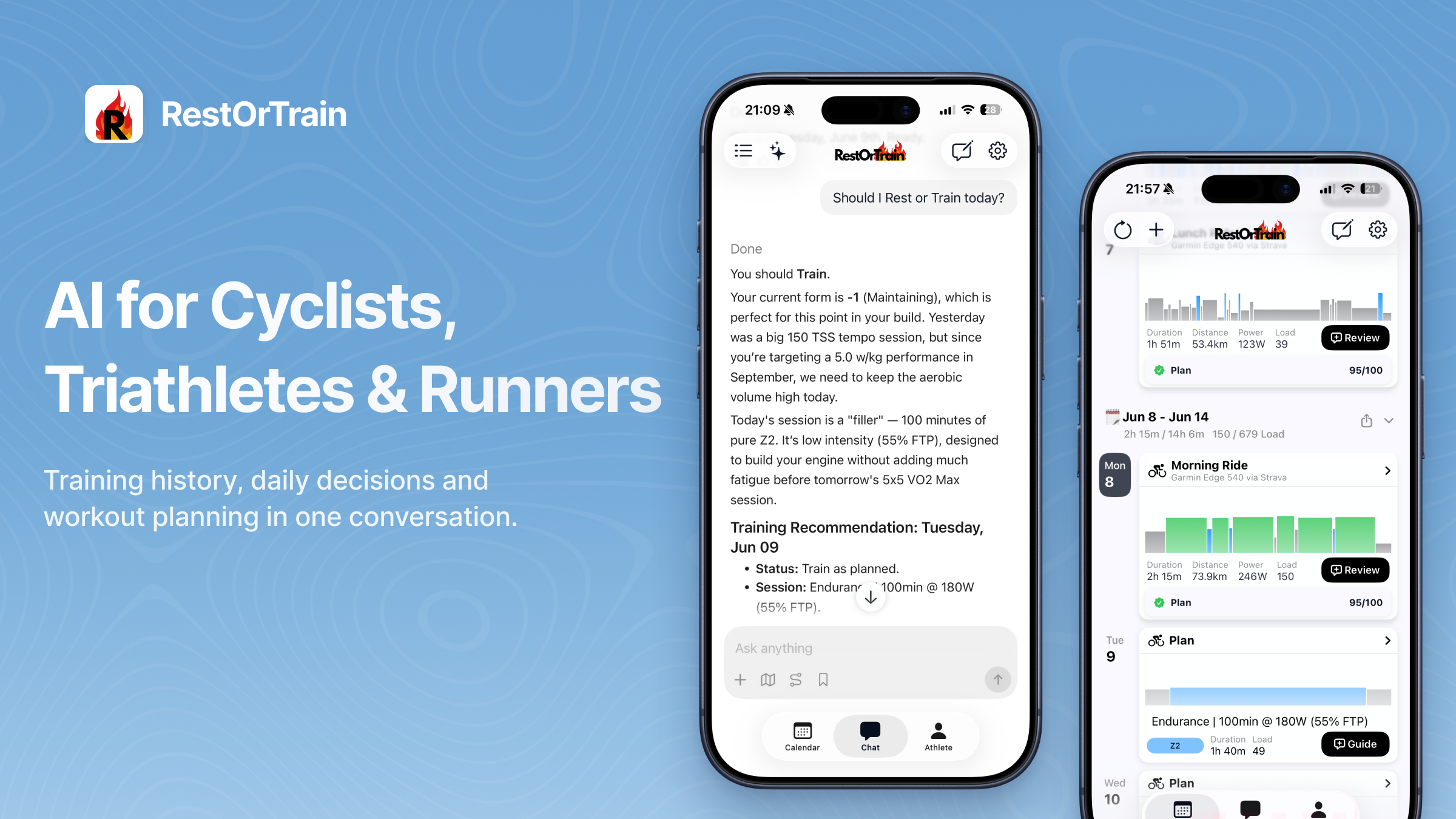
RestOrTrain combines training questions with the athlete’s recorded activities and calendar.
A hard session ends, but the work around training continues. There are numbers to interpret, tomorrow’s workout to choose and a week to rearrange when life changes. For an athlete trying to improve, that can become a second job.
RestOrTrain is an AI app that helps cyclists, triathletes and runners work towards their goals. It brings connected training history, available recovery data and personal context into a conversation that can lead to a revised plan and a structured workout on a supported device.
The ambition: automate endurance coaching
The team behind RestOrTrain wants to fully automate endurance coaching: give every ambitious athlete access to personal training decisions that keep pace with their progress and their life. The athlete sets the direction. The software handles the analysis, planning, and adjustments, leaving more attention for the actual work.
Today, RestOrTrain already connects parts of that process: athletes can analyse sessions, discuss what to do next, revise their calendar and send workouts to supported devices. A training plan is one part of the bigger ambition: support that stays useful as the athlete and their circumstances change.
How RestOrTrain works
TL;DR: RestOrTrain connects training history, available recovery data and the athlete’s own context. Athletes can analyse sessions, discuss their next steps, revise plans through chat and send structured workouts to supported devices.
From a training question to a scheduled workout
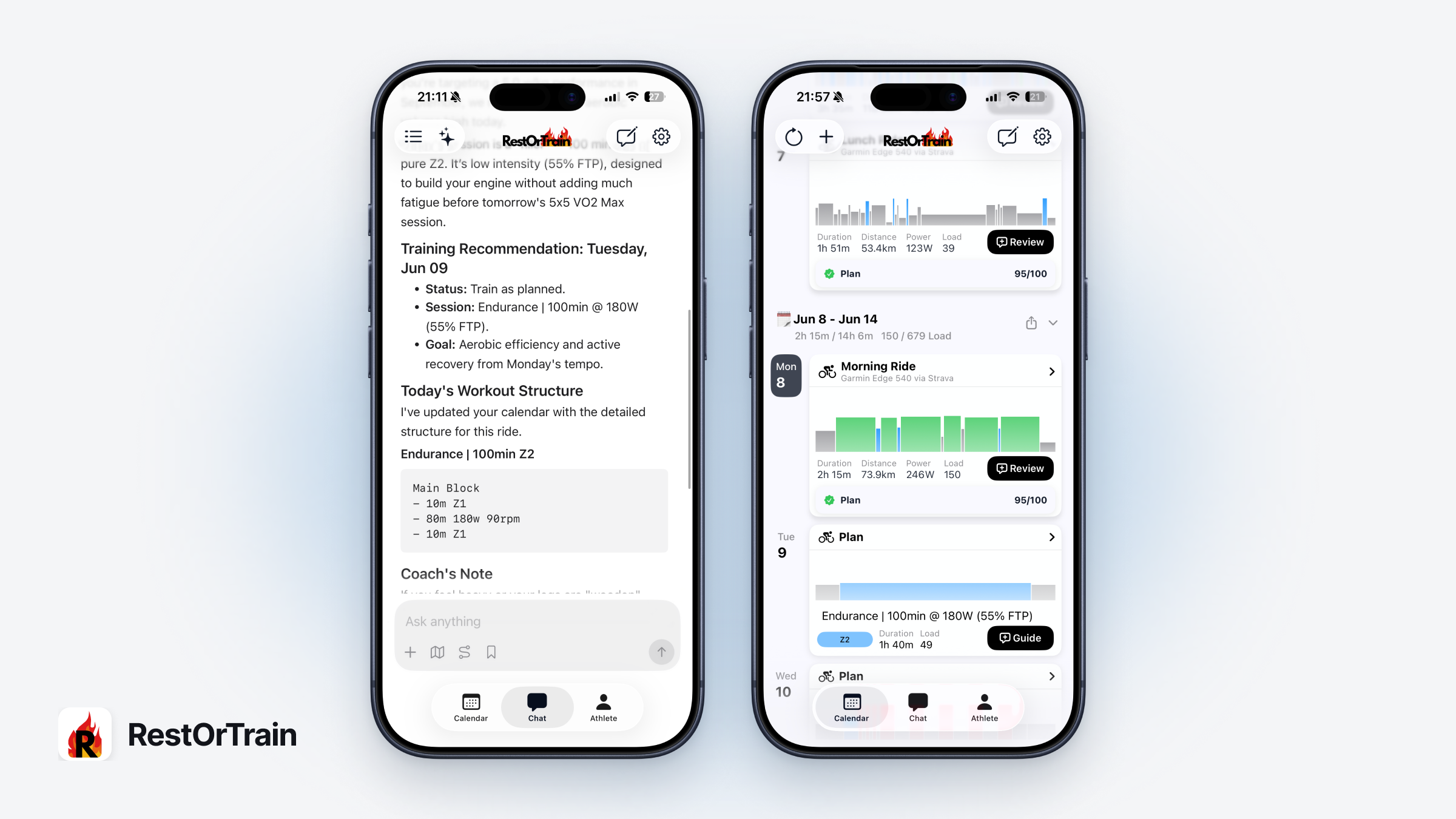
The June example shows the workout structure in chat and a matching calendar entry.
The example question is simple: “Should I Rest or Train today?” The calendar shows a completed ride lasting 2 hours 15 minutes, with a recorded load of 150. The chat mentions harder work planned for the following day.
RestOrTrain recommends a 100-minute session, displayed as 180 watts at 55% of the athlete’s FTP. It explains the session’s intended role between the surrounding efforts and provides its structure: 10 minutes in Z1, 80 minutes at 180 watts and 90 rpm, then 10 minutes in Z1.
The calendar shows the corresponding 1-hour-40-minute workout. The conversation leads to a session the athlete can use, with an explanation of where it fits. The power target is specific to the athlete shown; it is not a recommendation for everyone reading.
Training that can change with the week
A missed workout does not have to become an isolated calendar edit. An athlete can explain what happened, give their remaining availability and ask RestOrTrain to revise the surrounding sessions.
For example, a work meeting may remove the time set aside for a long ride. The athlete can discuss where it might fit, ask why the proposed arrangement makes sense and save the agreed changes. If the suggestion does not fit, the conversation can continue.
Behind the conversation, RestOrTrain brings activities from connected platforms into a shared history, calculates training metrics and retains useful context from earlier conversations. It can retrieve past sessions and write agreed workouts to the calendar. That connection between understanding the athlete and putting a decision into practice is central to what the team is building.
Using recovery data and how the athlete feels
Recorded training describes the work completed. Recovery data and the athlete’s own feedback add context about how that work is being experienced.
RestOrTrain can use available sleep, heart rate variability (HRV) and resting heart rate data when discussing whether to train, ease off or rest. An athlete can also report perceived effort in chat, including when a session felt harder than the file suggests.
Training stress balance (TSB) is calculated from recorded activity stress scores. RestOrTrain combines these across sports to estimate longer-term fitness and shorter-term fatigue, using 42-day and 7-day time constants. TSB is the difference between those estimates.
No fixed percentage formula blends perceived effort, HRV, and TSB. The AI interprets the available information together. Subjective feedback does not itself recalculate TSB, and a combined load number does not mean swimming, cycling and running have identical physical effects.
Connected platforms and data sources
| Connection | Activity import | Recovery data | Workout delivery |
|---|---|---|---|
| Garmin Connect | Yes | Yes | Yes |
| COROS | Yes | Yes | Yes |
| Wahoo | Yes | No | Yes |
| Hammerhead | Yes | No | Yes |
| Intervals.icu | Yes | Yes | Yes |
| Rouvy | Yes | No | Yes |
| Zwift | Yes | No | Yes |
| Apple Health (iOS) | Yes | Yes | No |
| WHOOP | No | Yes | No |
Available history, recovery metrics, supported sports and workout targets vary by source. Manual activity-file uploads and athlete-entered information provide additional inputs. Platforms may also connect indirectly through Apple Health or Intervals.icu where supported.
Strava is not an activity-data source for RestOrTrain. Apple Health supplies data on iOS and is not a destination for planned workouts.
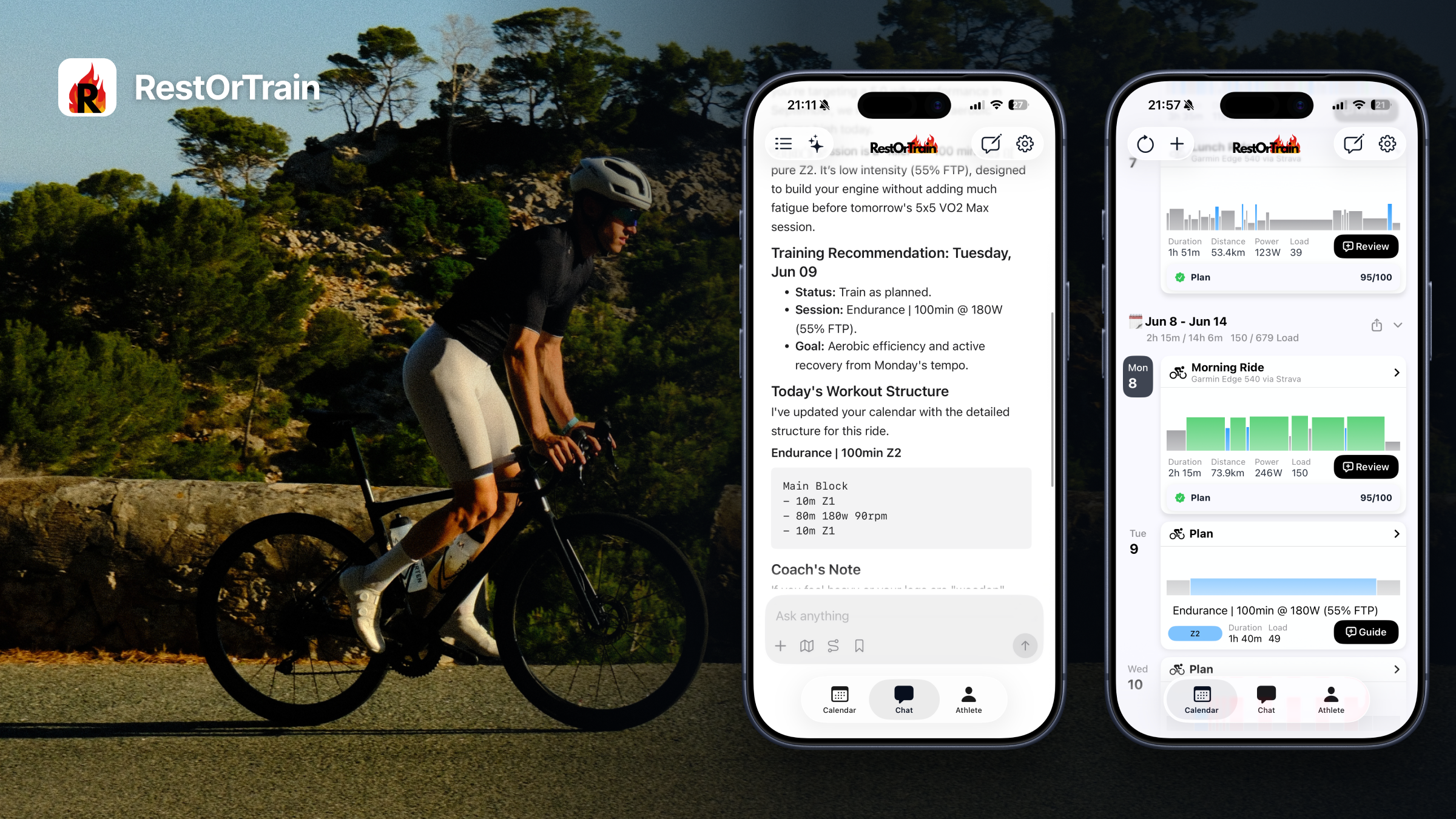
The athlete chooses the goal. RestOrTrain turns training history and conversation into the next practical step.
Getting started
The ambition applies to an athlete preparing for a first event as much as one chasing a personal best. The team wants individual training support to become something anyone with a goal can use throughout their sporting life.
A useful first question is about a recent session. After connecting a training source, an athlete can ask what the session shows and how it fits their goal. Adding realistic availability helps when planning the next workouts.
The app is free to download, with limited free AI use and a paid Pro subscription. The app shows current local prices and subscription terms. Product information and official download links are available at RestOrTrain.
Quick answers
How does RestOrTrain handle load across different sports?
It combines recorded activity stress scores to calculate fitness, fatigue, and TSB. The AI also uses sport-specific activity information and available recovery context, though a combined score does not mean recovery needs are equivalent across sports.
Can RestOrTrain adjust a plan after a missed workout?
An athlete can report the missed session, explain their remaining availability and ask for a revised plan, and RestOrTrain can save the agreed workouts to the calendar.
Can RestOrTrain send structured workouts to Garmin?
RestOrTrain supports structured workout delivery through Garmin Connect and the other destinations listed above, though supported sports and workout details vary by platform.
Last Updated on 20 September 2026 by the5krunner
My favourite kit and nutrition
- Garmin Fenix 9 Pro — I’ve just bought one.
- Injinji – Runners protect your toes. Avoid discomfort and minor injury. Run more. Run faster. I use them.
- Garmin 90-degree charging adapter — A small keyring adapter you can use anywhere. Essential when away. I use one.
- Garmin charging puck — the fastest and most reliable way to top up your Garmin before a session. I use one.
- Ravemen FR300 — Front light that mounts directly under your Garmin or Wahoo head unit. Keeps your bars clean and your beam pointed where it matters. I use one.
- Body Glide – The blue anti-chafe stick that all swimmers and many runners use. I use it.
- Maurten — The race nutrition trusted by elite athletes. Gels and drink mixes engineered to be easy on the stomach. I use them.
- Garmin Varia RTL515 — A radar rear light that alerts you to vehicles approaching from behind. Pairs with your Edge or Wahoo. I use this model.
- Favero Assioma Pro RS2 — The power-meter pedals most serious cyclists choose. Accurate, easy to move between bikes. I use this model.
- Garmin Forerunner 970 — A serious choice for a pro-grade triathlon watch. I use this.
- Polar H10 — My daily driver for accurate, waking HRV readings.
- Wahoo ELEMNT Roam 3 — The bike computer that has the feature Garmin lacks: usability. I use mine on most rides.
Reader-Powered Content

This content is not sponsored. It’s mostly me behind the labour of love, which is this site, and I appreciate everyone who supports it.
Support the site: Follow (free, fewer ads) · Subscribe (paid, ad-free) · Buy Me A Coffee ❤️
All articles are written by real people, fact-checked, and verified for originality. See the Editorial Policy. FTC: Affiliate Disclosure — some links pay commission. As an Amazon Associate, I earn from qualifying purchases.
tfk is the founder and author of the5krunner, an independent endurance sports technology publication. With 20 years of hands-on testing of GPS watches and wearables, and competing in triathlons at an international age-group level, tfk provides in-depth expert analysis of fitness technology for serious athletes and endurance sport competitors. ID
