No study validates the score, and it rests on a VO2 max estimate and the watch’s elevation data
Trail and mountain runners tracking climbing ability over months
Only on flagship and Forerunner 900-series watches, and Garmin does not publish the weighting factors.
Plain English: A rating from 1 to 100 of how well a runner climbs, built from recent runs, walks, and hikes. It splits into hill strength for short, hard climbs and hill endurance for long, steady ones. A higher number means stronger and more practised climbing, and a lower one means little recent hill work or lower aerobic fitness.
In practice: Living in an unhilly area, I’m surprised I can attain a sometimes modest Hill Score, although this comes almost entirely from the Hill Strength constituent factor I build up from hill reps.
Quick answers
What is a good Hill Score on Garmin?
Garmin rates the score in six bands: Recreational 1 to 24, Challenger 25 to 49, Trained 50 to 69, Skilled 70 to 84, Expert 85 to 94 and Elite 95 to 100. The bands are relative to athletes of the same age and gender, so a 60 means something different at 25 and at 55.
How does Garmin calculate Hill Score?
The watch finds every uphill section steeper than 2% in outdoor runs, walks and hikes, and combines how it was climbed with the VO2 max estimate from the last two months. Recent activities count most, but several months are considered. Garmin does not publish the weighting.
Why does my Garmin not show Hill Score?
Hill Score is limited to flagship and Forerunner 900-series watches. Forerunner 570, Forerunner 265, Forerunner 165, Forerunner 70, Forerunner 170, vivoactive 6 and Instinct 3 do not have it. On a supported watch, the score needs outdoor activities with GPS and heart rate, and a current VO2 max estimate.
How do I improve my Garmin Hill Score?
Garmin says hill endurance grows with more climbing time and elevation gain at low intensity, and walking uphill counts. Hill strength needs regular hard, high-intensity uphill efforts with recovery between them. A higher VO2 max also lifts the score.
Hill Score – a deep dive
When Hill Score is actually useful
A potentially great feature for trail runners needing the different muscle recruitment patterns that come from hill work.
Introduction
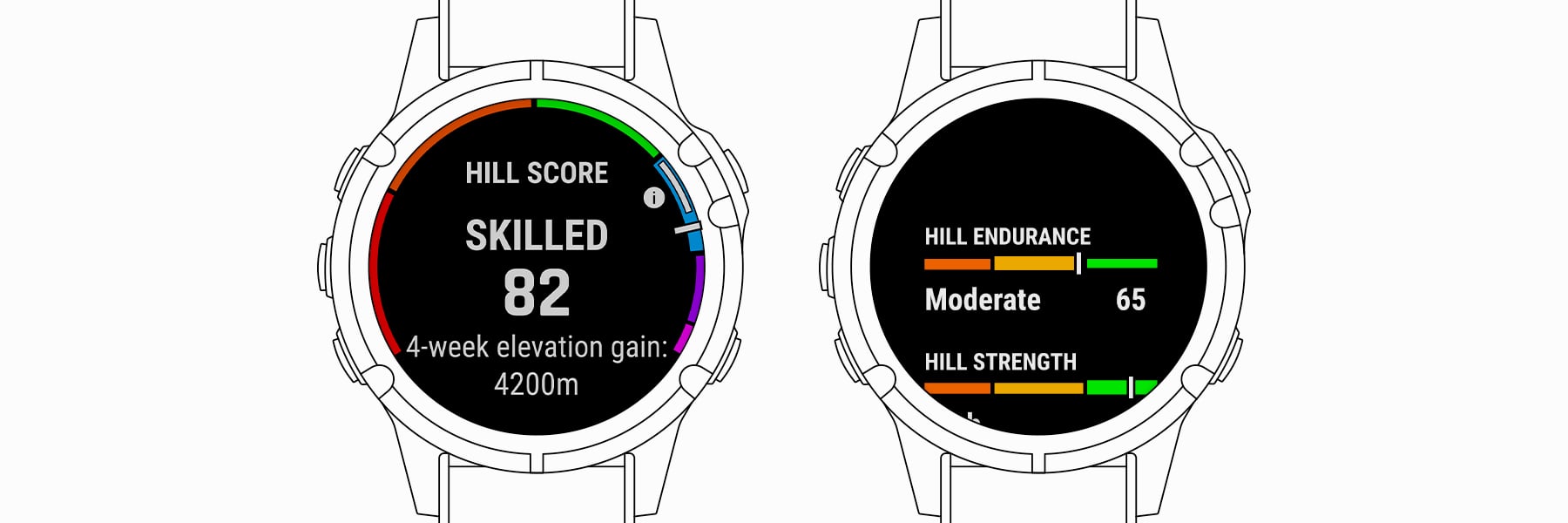
Garmin Hill Score is a rating from 1 to 100 of how well an athlete runs uphill, based on training history and a VO2 max estimate from the last two months. The watch identifies every uphill section with a grade of 2% or more during an outdoor run, walk, or hike, and shows hill endurance, hill strength, and how the score has changed over time.
Garmin launched it in May 2023, alongside Endurance Score. Its main limitation is availability, because only flagship and Forerunner 900-series watches have it, and Garmin does not publish how the score is weighted.
What Hill Score actually means
A higher score means stronger, more practised uphill running, and Garmin rates each score from Recreational to Elite against others of the same age and gender. The watch shows the band as a coloured gauge.
| Rating | Score | Gauge colour |
|---|---|---|
| Elite | 95 to 100 | Pink |
| Expert | 85 to 94 | Purple |
| Skilled | 70 to 84 | Blue |
| Trained | 50 to 69 | Green |
| Challenger | 25 to 49 | Orange |
| Recreational | 1 to 24 | Red |
Source: Garmin owner’s manuals (Forerunner 965, Forerunner 970, Fenix 9). Some third-party guides quote different band edges, such as Trained from 40; Garmin’s manuals do not. Garmin’s technology page gives the range as 0 to 100, but the manual’s bands start at 1.
The two sub-scores explain why a runner sits where they do. Hill endurance reflects the ability to keep climbing over long periods, while hill strength reflects the ability to climb with power on short, hard sections. A runner who does long hilly runs at an easy pace can show high endurance and modest strength, and a runner who only does short hill repeats can show the reverse.
How Garmin calculates Hill Score
Garmin states that the score combines fitness and performance data. The watch automatically detects uphill segments steeper than 2%, and it gives the most recent activities the greatest influence while still considering several months of data. Current VO2 max, which the watch estimates during outdoor runs, also feeds the score. Hill endurance comes from time spent climbing and elevation gain, and hill strength comes from hard, high-intensity uphill efforts.
Garmin does not publish the model or the weight each component carries. The most plausible reading is that the watch compares each climb’s pace and heart rate with its grade, then scales the result by VO2 max, since those are the inputs Garmin lists, but Garmin does not say so. The manuals limit detection to outdoor activities, so treadmill incline sessions do not count, and a watch with no recent VO2 max estimate has less to work with.
What affects the reading
The score can only be as good as the elevation data behind it, because the 2% threshold depends on the watch measuring the grade correctly. Poor GPS in a valley, or an altimeter thrown by a weather front, could move a climb above or below the threshold.
VO2 max enters the score directly, so anything that lowers the VO2 max estimate, such as heat, altitude or poor heart rate data, can pull Hill Score down as well. Garmin points out that VO2 max is expressed per kilogram of body weight, which is why a lighter runner with the same engine climbs faster. Terrain is the other factor: a runner who lives somewhere flat has fewer qualifying climbs, so the score reflects the hills that were available as much as the ability to run them.
How accurate is Garmin Hill Score
No study has tested Hill Score, and Garmin publishes no error figure for it. Its accuracy can be no better than the inputs described above.
The trend is more useful than the number. The same watch, the same hills and the same input errors apply to every reading, so a rising score over weeks of hill work is more trustworthy than a single score compared with a training partner’s.
Competitor equivalents
- Polar, Apple and COROS have no equivalent hill rating.
- Suunto has no equivalent score, and SuuntoPlus Climb instead shows live climb data, including vertical speed and grade-adjusted pace, during a session.
Which Garmin devices support Hill Score
Garmin introduced Hill Score in May 2023 on Fenix 7 Pro and Epix Pro (Gen 2), and the Q3 2023 update added it to Fenix 7, Epix (Gen 2), Forerunner 955 and Forerunner 965. Current owners’ manuals list it for Fenix 9, Fenix 8, Fenix E, Forerunner 970, Venu X1 and Enduro 2. Forerunner 570, Forerunner 265, Forerunner 165, Forerunner 70, Forerunner 170, vivoactive 6 and Instinct 3 do not have it, so the rule is that Hill Score belongs to the flagship and Forerunner 900-series watches.
Where to find Hill Score on Garmin
- Watch glance: the score, a graph, the contributing metrics and a short message about climbing performance. Add it to the glance loop from the watch settings.
- Glance detail: the hill endurance and hill strength gauges, with advice on which to work on.
Common problems and misreadings
A low score on a supported watch usually means too few qualifying climbs or an out-of-date VO2 max estimate. Garmin’s support page says regular outdoor runs with GPS and heart rate are needed for the score to mean anything.
The bands compare a runner with others of the same age and gender, so an Expert rating says nothing about where that runner would finish in a mountain race. A watch outside the flagship and Forerunner 900-series ranges does not have the feature at all.
How to improve Hill Score
Garmin’s advice splits along the two sub-scores. Hill endurance improves with more time climbing and more elevation gain at low intensity, and walking a steep section still builds it. Hill strength improves with regular hard uphill efforts, judged by effort rather than pace, because a slower pace on a steeper hill can take the same work as a faster one on a gentle slope.
The hard sessions need recovery between them. A higher VO2 max gives the score a lift too, but Garmin is clear that the climbing itself is what builds it.
Scientific basis
Minetti AE, Moia C, Roi GS, Susta D, Ferretti G. Journal of Applied Physiology, 2002. PMID 12183501. The energy cost of running rose steeply with gradient on a treadmill tilted up to 45%, which is why uphill running is treated as an ability of its own.
Vernillo G, Giandolini M, Edwards WB, Morin JB, Samozino P, Horvais N, Millet GY. Sports Medicine, 2017. PMID 27501719. Uphill running brings a higher step frequency, a shorter swing phase and more internal mechanical work than level running, the differences Garmin’s technology page uses to explain the score.
How Hill Score connects to other Garmin features
Hill Score draws on VO2 max and arrived on the same watches as Endurance Score, which rates sustained effort rather than climbing. On race day, ClimbPro shows the climbs ahead on a loaded course and PacePro sets pace targets that allow for them. Real-Time Stamina estimates how much an athlete has left during the climb itself.
2026 Seasonal Gifts
- Garmin CIRQA: Garmin’s screenless band, which uses your phone as the display. I tested it.
- HoloSwim 3 Pro: Swim goggles with GPS and your pace in the lens, so you can swim without a watch. Code THE5KRUNNER takes 10% off. I tested them.
- Kineon MOVE+: Red and infrared light for sore knees, Achilles and other joints after hard training. I use it.
Small things I always use
- Garmin 90-degree charging adapter: Charges your Garmin with any USB-C cable. Essential when travelling. I use one.
- Body Glide: The blue anti-chafing stick swimmers and runners carry. I use it.
- Speedo earplugs: Fewer ear infections and no cold-water dizziness. I use them.
- Dryrobe Advance: My winter changing robe for open-water swims. I use one. A cheaper option is the AONYIYI changing robe.
- Maurten: Race fuel that stays easy on the stomach. I use them.
- Beet It Sport nitrate shots: Beetroot shots I take in the days before a race. I use them.
- Garmin charging puck: The quickest way to top up before a session. I use one.
- Injinji: Toe socks that stop rubbing, so you run more. I use them.
- Ultimate toe protectors: Stop black toenails on long runs. They work. I use them.
- Compressport R2 v2 calf sleeves: My calf sleeves of choice. I use them.
- Cellucor C4: My pre-workout before hard sessions.
- TPU tubes: Schwalbe Aerothan, Tubolito and Pirelli SmarTube. Light, tiny spares. I use all three.
- G8 insoles: Adjustable arches, perfect position. I use them.
- Cycplus Cube: A 97g electric pump that gets a road tyre rideable in two minutes. I carry one. 5% off with code THE5KRUNNER.
Health, recovery and sleep
- Fitbit Air: A screenless band for steps, sleep and heart rate, with no subscription needed. It was closest to my hand count in a 9,000-step test. I tested it.
- FreeStyle Libre 3 Plus: Shows how my blood sugar responds to diet. Occasional use.
- hDrop: Measures my sweat loss in summer and indoors. I use it.
- Fourth Frontier Zone: Checks my heart under load in hard sessions.
- Oura Ring 5: My partner’s recovery tracker of choice.
- Eight Sleep: A cooling mattress cover my partner and I use nightly.
- Chilipad 2.0: Cools or heats your side of the bed on a schedule, with no subscription. US only. I am testing it.
Watches and sensors
- Polar H10: My daily driver for waking HRV.
- Polar Verity Sense: My backup arm-worn HR sensor.
- Nomad bedside charger: Charges my iPhone and Apple Watch overnight. I use it, and many of their bands.
- Train.Red: The best muscle oxygen sensor I’ve used. Occasional use.
- Tymewear: Accurate heart rate and reliable ventilatory zones. I use it to pace endurance rides over an hour.
- Garmin Forerunner 970: A pro-grade triathlon watch. I use this.
- Apple Watch Ultra 4: My daily smartwatch. No phone needed on rides.
On the bike
- Continental GP5000 for everyday riding, and Aero 111 on the front for special occasions. I use both.
- Helmets: Specialized S-Works Evade 3 for road riding, and Rudy Project Wing for TT-style races. I use both.
- Ravemen FR300: A front light that mounts under your Garmin or Wahoo. I use one.
- Ravemen FR1000: The light and the computer mount in one unit, so nothing else goes on the bars. Better than mine.
- Ravemen FR1500SE: 1,500 lumens hanging under your Garmin, for proper night rides.
- Ravemen FR1100SE: 1,100 lumens under your Garmin, and up to 46 hours on slow flash.
- Ravemen FR500: A brighter FR300 with the same mount.
- Wahoo TRACKR Radar: I use it on one bike and Varia on the other. They perform the same.
- Garmin Varia RTL515: Radar that warns you of cars from behind. I use this model.
- Wahoo ELEMNT Roam 3: The bike computer that’s easy to use. I use mine on most rides.
- Favero Assioma Pro RS2: Accurate power pedals that swap easily between bikes. I use this model.
Home and indoor training
- NPE Runn: Makes my basic treadmill smart, sending more accurate speed and distance to my watch and Zwift. I use it.
- Google Wifi: Keeps Zwift connected in my pain cave. I use it.
- Apple TV 4K (4th generation): Zwift on the big screen. I use two.
- Google Nest Doorbell (wired, 2nd gen): My video doorbell, running in both Google Home and Apple Home via Starling. I use it.
Reader-Powered Content
This content is not sponsored. It’s mostly me behind the labour of love, which is this site, and I appreciate everyone who supports it.
Support the site: Follow (free, fewer ads) · Subscribe (paid, ad-free) · Buy Me A Coffee
Written by real people, with AI assistance. Fact-checked and verified for originality. See the Editorial Policy. FTC: Affiliate Disclosure — some links pay commission. As an Amazon Associate, I earn from qualifying purchases.
