Garmin Training Effect: How It Works, Accuracy and Device Support
Garmin Training Effect is a post-activity score on a 0 to 5 scale that quantifies the physiological stimulus of a single training session on aerobic and anaerobic fitness. Two separate values are produced for each workout: one for aerobic benefit and one for anaerobic benefit. Together, they tell the athlete how hard the session was and which energy system it developed.
Training Effect is a per-session measure. It resets to zero at the start of each session and represents the impact of that session alone. The accumulated effect of multiple sessions over seven days is represented separately by Training Load.
The principal limitation of Training Effect is its dependence on heart rate accuracy for the aerobic score. Any condition that elevates heart rate relative to actual effort — heat, fatigue, illness, a loose sensor — will inflate the aerobic value, and the score offers no internal signal that this has occurred.
What the Number Actually Means
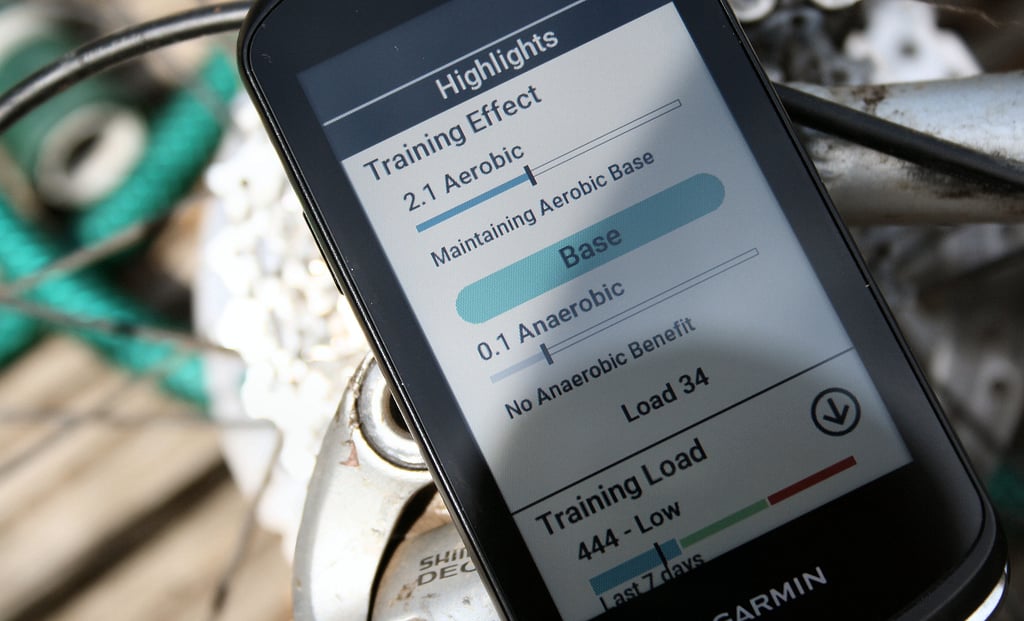
Each of the two Training Effect scores — aerobic and anaerobic — follows the same 0 to 5 scale. A score below 1.0 indicates no meaningful stimulus. Scores in the 2.0 to 2.9 range indicate that the session was sufficient to maintain existing fitness but not to advance it. The improving range begins at 3.0, and the highly improving range begins at 4.0. A score of 5.0 indicates that the session was sufficiently demanding to be classified as overreaching and that appropriate recovery is required before the next hard effort.
Garmin maps each score to a descriptive label displayed in Garmin Connect after the activity. Seven labels cover the aerobic scale, including descriptions such as “Highly Impacting VO2 Max” at the upper end. Each label is colour-coded to align with the three Load Focus categories — low aerobic, high aerobic, and anaerobic — making it straightforward to connect the result of a single session to the weekly training balance the device is tracking.
The aerobic and anaerobic scores are independent. A long tempo run might return an aerobic score of 4.2 and an anaerobic score of 0.3. A session of short, maximal intervals might return an aerobic score of 3.5 alongside an anaerobic score of 3.8. The combination reveals the true nature of the training stimulus more accurately than either score alone or a single, combined aggregate score.
How Garmin Calculates It
Firstbeat Analytics calculates Aerobic Training Effect from the excess post-exercise oxygen consumption (EPOC) accumulated during the session. EPOC is a measure of the disturbance to the body’s homeostasis caused by exercise. Firstbeat’s algorithm estimates EPOC in real time from heart rate data, accounting for the athlete’s fitness level and training history. The peak EPOC value reached during the session — rather than the total accumulated EPOC — determines the aerobic Training Effect score. This design means that a session in which the athlete briefly reaches a high intensity and then recovers scores differently from a session that maintains that intensity continuously. Steady efforts at moderate intensity and intervals exceeding 180 seconds both increase the aerobic score.
Anaerobic Training Effect uses both heart rate and speed or power, rather than heart rate alone, because the anaerobic energy system operates above the threshold where heart rate provides sufficient resolution. Firstbeat’s algorithm identifies high-intensity intervals of 10 to 120 seconds and calculates the anaerobic contribution to EPOC from those efforts. The combination of interval duration, intensity, and recovery determines the anaerobic score. Efforts below 10 seconds contribute little to the score; efforts sustained beyond 120 seconds shift progressively into the aerobic domain. A session of 200-metre or 400-metre repeats with full recovery between each generates the most potent anaerobic Training Effect in running.
Interpretation
| Score range | Label | Meaning |
|---|---|---|
| 0.0 – 0.9 | No benefit | Insufficient stimulus to produce a training effect |
| 1.0 – 1.9 | Minor benefit | Session contributes to recovery or very light maintenance |
| 2.0 – 2.9 | Maintaining | Sufficient to maintain current fitness but not to advance it |
| 3.0 – 3.9 | Improving | Stimulus sufficient to improve fitness with adequate recovery |
| 4.0 – 4.9 | Highly improving | Strong stimulus; recovery required before the next hard session |
| 5.0 | Overreaching | Excessive stimulus; extended recovery required |
What Affects the Reading
Because aerobic Training Effect is derived from heart rate, anything that artificially elevates or suppresses heart rate relative to effort will distort the aerobic score. Heat, altitude, illness, poor sleep, and alcohol all elevate heart rate at a given pace. The aerobic Training Effect will read higher than the actual physiological stimulus in those conditions. Wrist optical heart rate produces larger errors than a chest strap, particularly during high-cadence running and in cold conditions. For athletes who use Training Effect to guide session intensity, a chest strap or upper-arm optical monitor significantly reduces measurement uncertainty.
The anaerobic score is less susceptible to heart rate noise because speed or power anchors its calculation. It does require a reliable pace signal, however. On a treadmill without a footpod, or indoors on a stationary bike without a power meter, the anaerobic score will reflect only a partial picture of short efforts.
A new athlete will find Training Effect scores elevated during the first few sessions, before the device has accumulated sufficient data to calibrate its estimate of the individual’s fitness level. The scores normalise as the algorithm establishes a training baseline over several weeks.
How Accurate Is It
Firstbeat’s validation of the EPOC model underlying the aerobic Training Effect shows a strong correlation with laboratory-measured EPOC under controlled conditions using chest-strap heart rate. Independent studies of the EPOC estimation method found good agreement with direct measurements during steady-state and interval exercise. The aerobic Training Effect score is best understood as a relative measure — useful for comparing sessions of the same type over time — rather than as an absolute physiological value.
Firstbeat’s anaerobic Training Effect white paper, published in 2017, describes field validation using sprint and interval running sessions. Results were generally consistent with external training load measures and biological markers of anaerobic demand. The anaerobic score carries greater inherent uncertainty than the aerobic score because the anaerobic energy contribution is beyond the resolution of any wrist-worn device. Read it as a directional indicator rather than a precise measurement.
Competitor Equivalents
- Polar offers Training Benefit, a text-based feedback label generated from time spent in each heart rate zone. It produces no numerical score. Polar’s platform also shows EPOC estimates directly — the underlying variable that Garmin maps to its 0 to 5 scale — but separates aerobic and anaerobic benefit less explicitly.
- Suunto historically used Firstbeat’s Training Effect on older devices, making the methodology identical to Garmin’s on those models. Current Suunto devices use a workout classification system based on training zones rather than a numeric Training Effect score.
- Coros provides a Training Effect score through its EvoLab platform, using a TRIMP-based training load model rather than Firstbeat’s EPOC approach. The scale is similar in structure, but the underlying calculation differs. Coros also provides a Training Focus label that classifies each session by energy system: Easy, Base, Tempo, Threshold, VO2 Max, or Anaerobic.
- Apple offers no Training Effect equivalent. The Effort Rating introduced in watchOS 11 is a manually adjusted, RPE-based input that feeds Apple’s training load system. It does not automatically distinguish between aerobic and anaerobic stimuli.
- Wahoo provides no Training Effect equivalent on its cycling computers. Training load analysis on the Wahoo platform relies on third-party integrations such as TrainingPeaks.
Which Garmin Devices Support It
Garmin introduced Training Effect in 2012 on the Forerunner 610, as the first Garmin device to carry Firstbeat’s EPOC-based aerobic scoring.
Training Effect is supported across all current Forerunner, Fenix, Enduro, Epix, Tactix, and Edge series. The Forerunner 165 series is the most accessible current model to include the feature. The Forerunner 55 series sits below the threshold at which Training Effect and Training Status become available. The feature is also absent on entry-level Vivoactive and Venu models, which are positioned primarily as lifestyle devices, though this distinction has narrowed across successive generations.
On Edge cycling computers, the anaerobic Training Effect calculation requires a paired power meter. Without power data, the device cannot resolve short, high-intensity efforts with sufficient accuracy. The Edge 500 series and later all support both Training Effect scores when a power meter is paired. Without one, only the aerobic score is produced.
Where to Find It
Both values appear on the activity summary screen at the end of each session. Add the Aerobic Training Effect and Anaerobic Training Effect data fields to a training screen via the activity profile settings to monitor their scores in real time during a workout. Both fields are found in the Heart Rate data field category. A combined Training Effect gauge is also available, displaying both values in a single field.
In Garmin Connect, both scores appear in the activity detail view beneath the performance summary, alongside the seven-label description of the primary benefit. Historical Training Effect data is accessible within individual activity records rather than as a standalone trend chart.
Common Problems and Misreadings
An aerobic Training Effect score that seems too high after an easy run is most often caused by an elevated heart rate due to heat, fatigue, illness, or a loose optical sensor. The score reflects physiological strain, not external pace. Any condition that raises heart rate at a given effort will inflate the aerobic score.
An anaerobic score of 0.0 after a hard session is normal for sustained efforts. The anaerobic score responds specifically to short, maximal intervals. A threshold run at sustained effort will produce a high aerobic score and a near-zero anaerobic score, because no individual interval was both short and intense enough to trigger the anaerobic calculation.
A consistently low aerobic Training Effect despite hard training often points to a maximum heart rate set too high. If the device believes maximum heart rate is higher than the athlete’s true physiological maximum, EPOC estimates will be compressed downward. Confirm that the maximum heart rate value in the athlete’s profile is accurate, ideally established through a maximal field test.
How to Improve It
To raise the aerobic Training Effect, extend session duration or sustain effort at moderate-to-high intensity. Sessions at 70 to 85 per cent of maximum heart rate, held for 30 to 60 minutes, consistently generate scores in the improving-to-highly improving range.
To generate meaningful anaerobic Training Effect, include efforts of 10 to 120 seconds at near-maximal intensity with sufficient recovery between repetitions. A session of 200-metre to 400-metre repeats at close to maximum speed, with two to four minutes of recovery between each, produces the highest anaerobic scores in running. Sessions that are hard but sustained — such as tempo runs — will produce little anaerobic score movement, regardless of how difficult they feel.
Every session does not need to score highly on both scales. The goal is a distribution across sessions over a week that aligns with the Load Focus targets Garmin sets for low aerobic, high aerobic, and anaerobic training.
Frequently Asked Questions
Why is my anaerobic Training Effect always zero? The anaerobic score only responds to efforts of 10 to 120 seconds at near-maximal intensity. If sessions consist of sustained running at threshold pace or below, the anaerobic score will read near zero. Include short sprint intervals to generate an anaerobic Training Effect.
Why does the aerobic score seem too high after an easy run? Check whether the session was completed in heat, after poor sleep, or with a loose sensor. All three elevate heart rate relative to effort and inflate the aerobic score. A chest strap produces a more stable reading in those conditions.
Can I watch Training Effect build during a session? Yes. Add the Aerobic Training Effect and Anaerobic Training Effect data fields to a training screen through the activity profile settings. Both values update in real time as the session progresses.
Should I aim for a score of 5.0? A 5.0 indicates overreaching and carries a warning that recovery is required. Occasional scores at 5.0 are physiologically normal during hard training blocks. A consistent pattern of 5.0 scores without recovery sessions is a signal to reduce load.
Why does Training Effect not appear on my Forerunner 55? The Forerunner 55 series sits below the tier at which Training Effect and Training Status become available. The Forerunner 165 series is the most affordable current Garmin line that includes both scores.
Scientific Basis
Firstbeat Technologies (2015). “EPOC-Based Training Effect Assessment.” Firstbeat White Paper. Describes the heart rate-based EPOC estimation methodology and the mapping of peak EPOC values to the 0–5 aerobic Training Effect scale, with reference to Ross and Jackson’s original activity classification framework.
Firstbeat Technologies (2017). “Aerobic and Anaerobic Training Effect Assessment.” Firstbeat White Paper. Describes the algorithm for detecting high-intensity intervals and estimating anaerobic EPOC contribution, with field validation results from sprint and interval running sessions. The highest anaerobic Training Effect values were consistently achieved with 400–500-metre intervals.
Rusko, H. et al. (2003). “Prediction of EPOC: A tool for monitoring fatigue accumulation during exercise?” ACSM Congress, San Francisco. Early validation of the Firstbeat heart rate–based EPOC model, showing strong correlation between predicted and measured EPOC during cycle ergometer exercise across multiple intensities.
How It Connects to Other Features
Training Load is the sum of EPOC values from all sessions recorded in the past seven days. Each Training Effect score contributes directly: a session generating a high aerobic Training Effect adds to the high-aerobic Load bucket, and sessions with meaningful anaerobic scores drive the anaerobic Load Focus figure.
Training Status uses Training Load alongside VO2 max trends to classify the athlete’s overall training response as Productive, Maintaining, Peaking, Unproductive, or Overreaching. Training Effect is a per-session input to the load that Training Status evaluates each week.
Load Focus distributes training across low-aerobic, high-aerobic, and anaerobic categories using the same EPOC-derived classification. The Training Effect colour coding on the activity summary screen maps directly to these three categories, making it the most immediate link between the result of a single session and the weekly balance the device is monitoring.
VO2 Max is updated by qualifying runs independently of Training Effect. The training sessions that generate the highest aerobic Training Effect scores — sustained high-intensity efforts with accurate heart rate data — are also those most likely to produce upward movement in the VO2 max estimate over time.
