Garmin sells two kinds of dive computer under the Descent name: watches you wear every day, and large-format computers you strap on only to dive. This guide says which Descent suits which diver, whether an older Descent is worth replacing, and when. It covers every Descent from the 2017 Mk1 to the Descent X10 launched on 3 November 2026, and is updated as new models arrive.
Quick choice: which Descent for which diver
| Model | Format | Best for | Launch price |
|---|---|---|---|
| Descent X10 | Large format, 2.1 inch mono | New divers, dive schools and a backup computer. Budget buyers. | £299.99 / $349.99 |
| Descent X30 | Large format, 2.4 inch colour | Regular recreational divers who want a big colour screen and trimix | £649.99 / $749.99 |
| Descent X50i | Large format, 3 inch colour touchscreen | Technical, rebreather and cave divers who want air integration and maps | £1,329.99 / $1,499.99 |
| Descent G1 | Watch, mono MIP, optional solar | Divers who want the longest battery life in a watch | From £479.99 / $549.99 |
| Descent G2 | Watch, AMOLED | Holiday divers who train on land the rest of the year | £589.99 / $699.99 |
| Descent Mk3 and Mk3i | Watch, AMOLED, 43mm or 51mm | Divers who want one device for diving, training and daily wear, with air integration on the Mk3i | From £1,099.99 / $1,199.99 |
Garmin UK now sells the X30 at £559.99 and the X50i at £1,199.99, below their launch prices.
Watch or large-format computer?
A Descent watch stays on your wrist all week, so it tracks your sleep, training and recovery as well as your dives, and it tells you on the boat whether you are rested enough to dive. The trade is a small screen, at 1.2 or 1.4 inches on the AMOLED models, which is harder to read at depth in poor visibility.
The X10, X30 and X50i are built only for the water. Their screens are two to three times wider, the numbers are large enough to read through a fogged mask, and the buttons are big enough to press in thick gloves. You do not wear them between dives, so none of them has wrist heart rate or Garmin’s training and health tracking.
Many divers end up with one of each, because a large-format computer and a Descent watch can share dive settings. The X10’s low price and 50-hour battery make it the obvious backup to a Descent watch.
The Descent range compared
| X10 | X30 | X50i | G2 | Mk3i | |
|---|---|---|---|---|---|
| Dive rating | 100m | 100m | 200m | 100m | 200m |
| Gases | Air and nitrox to 40% | Air, nitrox and trimix | Air, nitrox and trimix | Air, nitrox and trimix | Air, nitrox and trimix |
| Rebreather (CCR) mode | No | No | Yes | Yes | Yes |
| Freediving (apnea) mode | Yes | No | No | Yes | Yes |
| Air integration | No | No | Yes, with Descent T2 | No | Yes, with Descent T2 |
| Built-in GPS | No, uses the phone | Yes | Yes | Yes | Yes, dual-frequency |
| Maps | No | No | Yes, with dive site depth contours | No | Yes, land maps |
| Dive battery | Up to 50 hours | Up to 30 hours | Up to 16 hours | Up to 27 hours | Up to 30 hours (43mm), 66 hours (51mm) |
| Training and health tracking | No | No | No | Yes | Yes |
The plain Mk3 is the 43mm Mk3i without air integration, and the G1 matches the G2 for dive features with a monochrome screen.
If you are new to diving
Buy the Descent X10. It runs the same Bühlmann decompression model as every other Descent, shows how a change in depth affects your no-decompression time, and alarms by sound and vibration. The large monochrome screen is easy to read in murky water, and the 50-hour battery lasts a week-long dive trip on one charge. It also costs less than any other Descent.
It covers air and nitrox up to 40% oxygen, which is everything an Open Water or Advanced course will teach. If you plan to move on to decompression or trimix training, the X30 saves you from buying twice. The Descent X10 launch report covers everything it does and leaves out.
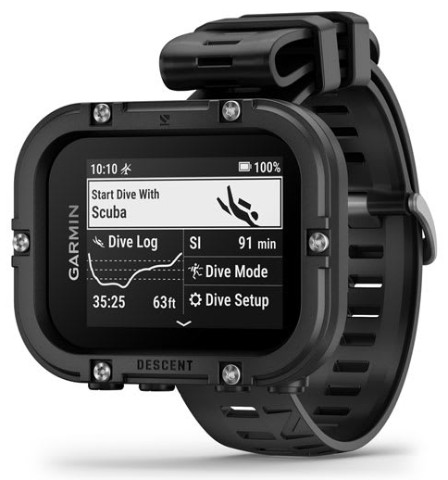
Garmin Descent X10
Big, clear dive computer with a 50-hour battery, ideal as a first computer or a backup.
If you dive a few times a year and train the rest of the time
Buy the Descent G2. It has the full Descent dive software, including trimix, rebreather and freediving modes, inside a watch built on the Instinct platform. Between trips, it works as a capable training watch with Training Readiness, HRV Status, sleep tracking and Garmin Pay, and Dive Readiness uses the same data to tell you whether you have recovered enough to dive. It costs about half the price of a Mk3i.
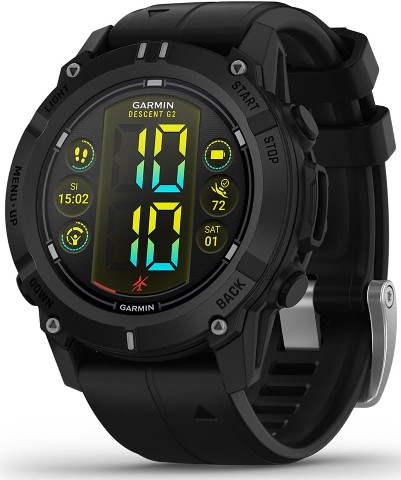
Garmin Descent G2
AMOLED dive computer that doubles as a full multisport smartwatch.
If you dive most weekends
Buy the Descent X30. The 2.4-inch colour screen shows more on each page than the X10, the planner handles multi-gas decompression dives, and the dynamic depth chart shows where you have been during the dive. Built-in GPS marks where you entered and left the water without your phone, and the compass helps with navigation underwater. Battery lasts up to 30 hours of diving at the default brightness.
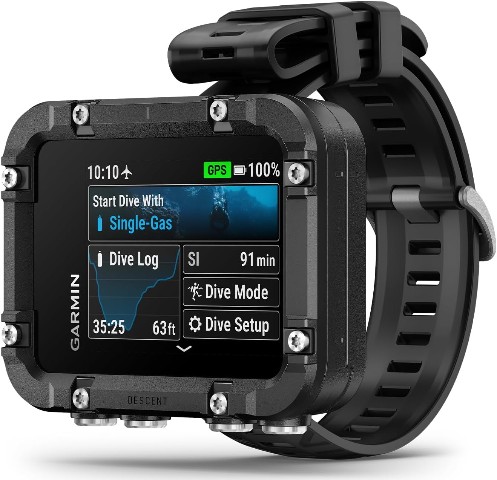
Garmin Descent X30
Colour dive computer with trimix, surface GPS and a compass, at a mid-range price.
If you dive technical, rebreather or cave
Buy the Descent X50i if you want the biggest screen, or the Descent Mk3i if you want the same dive software on your wrist all week. Both read tank pressure and remaining gas from Descent T2 transceivers over Garmin’s SubWave sonar link, and both can send preset messages to other divers using SubWave. The X50i adds DiveView maps with depth contours for more than 4,000 dive sites and a backup dive light. Its battery is the shortest in the range, at up to 16 hours of diving.
Each T2 transceiver costs £429.99 / $499.99, and you need one per tank you want to monitor, so air integration adds a large sum to either computer.
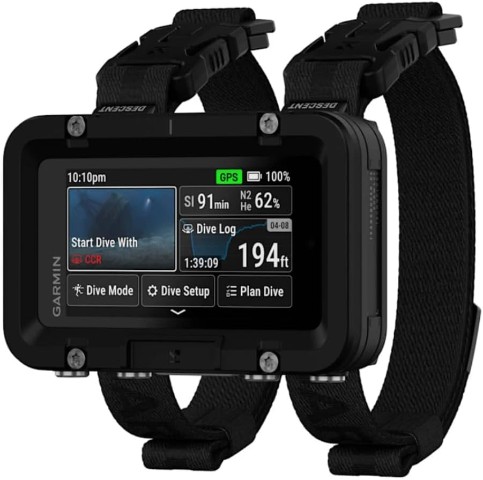
Garmin Descent X50i
Big touchscreen dive computer with air integration, diver messaging, maps and a dive light.
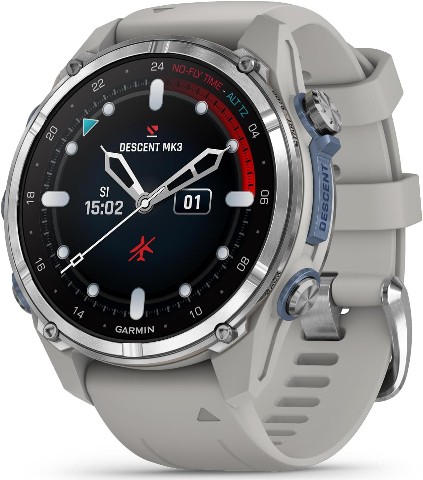
Garmin Descent Mk3
Dive computer and full multisport watch in one, with air integration on the Mk3i.
If you want one device for everything
Buy the Descent Mk3 or Mk3i. It is a Fenix-class multisport watch with a 200 metre dive computer inside, so it brings maps, dual-frequency GPS, music storage and the full Garmin training platform as well as rebreather and freediving modes. The 51mm Mk3i lasts up to 66 hours of diving and adds an LED flashlight. The 43mm models suit smaller wrists and are the lightest way to get air integration.
Upgrade now or stay?
| Current computer | Released | Recommendation |
|---|---|---|
| Descent X50i, X30 or X10 | 2024 to 2026 | Stay |
| Descent Mk3 or Mk3i | 2023 | Stay |
| Descent G2 | 2025 | Stay |
| Descent G1 or G1 Solar | 2022 | Stay, or move to G2 for the screen |
| Descent Mk2, Mk2i or Mk2S | 2020 to 2021 | Upgrade to Mk3i, or add an X-series computer |
| Descent Mk1 | 2017 | Upgrade |
If you have a Descent G1 or G1 Solar
- The G2 runs the same dive software with a colour AMOLED touchscreen in place of the G1’s small monochrome display, and adds Dive Readiness, big-number dive screens and more freediving features.
- The G1 Solar lasts far longer between charges than a G2, which matters on a liveaboard with limited charging.
Verdict: Stay, unless the screen is the problem. Divers who find the G1 hard to read underwater should add an X10 rather than replace the watch.
If you have a Descent Mk2, Mk2i or Mk2S
- The Mk2 and Mk2i launched in October 2020 with a MIP screen, and the Mk2i brought SubWave air integration to Descent with the Descent T1 transmitter.
- The Mk3 generation added an AMOLED screen, a 43mm size, dual-frequency GPS, Training Readiness and HRV Status.
- A Mk2’s battery is five or six years old and will not match its original rating.
Verdict: Upgrade to the Mk3i to stay with a do-everything watch. Divers who mainly want a bigger screen in the water can keep the Mk2 for daily wear and add an X30 or X50i.
If you have a Descent Mk1
Verdict: Upgrade. The Mk1 from 2017 has no air integration, no rebreather mode and none of Garmin’s current health tracking. The G2 replaces it for less money than the Mk1 cost new, and the Mk3 matches its premium build.
The battery question
| Model | Dive mode |
|---|---|
| Descent Mk3i 51mm | Up to 66 hours (40 with air integration) |
| Descent X10 | Up to 50 hours |
| Descent X30 | Up to 30 hours |
| Descent Mk3 and Mk3i 43mm | Up to 30 hours (15 with air integration) |
| Descent G2 | Up to 27 hours |
| Descent G1 and G1 Solar | Up to 25 hours |
| Descent X50i | Up to 16 hours |
A 30-hour computer covers about 30 hour-long dives, so most will see out a week of diving. The X50i needs charging every few days on a busy trip, because its large touchscreen and SubWave radio use more power.
Considering a MARQ or a Suunto instead?
MARQ Gen 3 includes a dive computer in a luxury watch, for divers who want the jewellery more than the dive features. Outside Garmin, Suunto Ocean is the closest rival to a Descent watch, with an AMOLED screen and air integration through Suunto’s Tank POD.
Every other upgrade guide is listed on the buying guides page, and the Garmin specifications database has full figures for every Descent named here. Garmin’s own page for the newest model is the Descent X10 product page.
Quick answers
Which Garmin Descent is best for beginners?
The Descent X10. It costs £299.99 / $349.99, covers air and nitrox diving, uses the same decompression model as the more expensive Descents, and lasts up to 50 hours of diving. Its large screen is easier to read than a watch.
Which Garmin Descent has air integration?
The Descent X50i and the Descent Mk3i, each paired with Descent T2 transceivers on your tanks. The X10, X30, G2, G1 and plain Mk3 do not read tank pressure.
Should I buy a Descent watch or a large-format computer?
Buy a watch if you also want daily training, sleep, and health tracking. Buy a large-format X-series computer if you want the biggest, clearest screen underwater and do not need to wear it between dives.
What is the difference between the Descent X30 and X50i?
The X50i adds a 3-inch touchscreen, a 200 metre rating, air integration, SubWave messaging, rebreather mode, dive site maps and a dive light. The X30 is lighter, cheaper and lasts longer, up to 30 hours of diving against 16.
Should I upgrade from a Descent Mk2?
Yes, if you want a do-everything watch. The Mk3i adds an AMOLED screen, a smaller 43mm option, dual-frequency GPS and Garmin’s newer training features. If you mainly want a bigger screen underwater, keep the Mk2 and add an X30 or X50i.
Small things I always use
- Garmin 90-degree charging adapter: Charges your Garmin from any USB-C cable. Essential when travelling. I use one.
- Body Glide: The blue anti-chafe stick swimmers and runners carry. I use it.
- Speedo earplugs: Fewer ear infections and no cold-water dizziness. I use them.
- Dryrobe Advance: My winter changing robe for open-water swims. I use one. A cheaper option is the AONYIYI changing robe.
- Maurten: Race fuel that stays easy on the stomach. I use them.
- Beet It Sport nitrate shots: Beetroot shots I take in the days before a race. I use them.
- Garmin charging puck: The quickest way to top up before a session. I use one.
- Injinji: Toe socks that stop rubbing, so you run more. I use them.
- Ultimate toe protectors: Stop black toenails on long runs. They work. I use them.
- Compressport R2 v2 calf sleeves: My calf sleeves of choice. I use them.
- Cellucor C4: My pre-workout before hard sessions.
- TPU tubes: Schwalbe Aerothan, Tubolito and Pirelli SmarTube. Light, tiny spares. I use all three.
- G8 insoles: Adjustable insoles that are good. I use them.
- Cycplus Cube: A 97g electric pump that gets a road tyre rideable in two minutes. I carry one. 5% off with code THE5KRUNNER.
Watches and sensors
- Polar H10: My daily driver for waking HRV.
- Polar Verity Sense: My backup arm-worn HR sensor.
- Nomad bedside charger: Charges my iPhone and Apple Watch overnight. I use it, and many of their bands.
- Train.Red: The best muscle oxygen sensor I’ve used.
- Tymewear: Accurate heart rate and reliable ventilatory zones. I use it to pace endurance rides over an hour.
- Garmin Forerunner 970: A pro-grade triathlon watch. I use this.
- Apple Watch Ultra 4: My daily smartwatch. No phone needed on rides.
- Garmin Fenix 9 Pro: I’ve just bought one.
On the bike
- Continental GP5000 for everyday riding, and Aero 111 on the front for special occasions.
- Helmets: Specialized S-Works Evade 3 for road riding, and Rudy Project Wing for TT-style races. I use both.
- Ravemen FR300: A front light that mounts under your Garmin or Wahoo. I use one.
- Ravemen FR1000: The light and the computer mount in one unit, so nothing else goes on the bars. Better than mine.
- Ravemen FR1500SE: 1,500 lumens hanging under your Garmin, for proper night rides.
- Ravemen FR1100SE: 1,100 lumens under your Garmin, and up to 46 hours on slow flash.
- Ravemen FR500: A brighter FR300 with the same mount.
- Wahoo TRACKR Radar: I use it on one bike and Varia on the other. They perform the same.
- Garmin Varia RTL515: Radar that warns you of cars from behind. I use this model.
- Wahoo ELEMNT Roam 3: The bike computer that’s easy to use. I use mine on most rides.
- Favero Assioma Pro RS2: Accurate power pedals that swap easily between bikes. I use this model.
Home and indoor training
- NPE Runn: Makes my basic treadmill smart, sending more accurate speed and distance to my watch and Zwift. I use it.
- Google Wifi: Keeps Zwift connected in my pain cave. I use it.
- Apple TV 4K: Zwift on the big screen. I use two.
- Google Nest Doorbell (wired, 2nd gen): My video doorbell, running in both Google Home and Apple Home. I use it.
Health, recovery and sleep
- FreeStyle Libre 3 Plus: Shows how my blood sugar responds to diet.
- hDrop: Measures my sweat loss in summer and indoors.
- Fourth Frontier Zone: Checks my heart under load in hard sessions.
- Kineon MOVE+: Red and infrared light for sore knees, Achilles and other joints after hard training. I use it.
- Oura Ring 5: My partner’s recovery tracker of choice.
- Eight Sleep: A cooling mattress cover my partner and I use nightly.
Reader-Powered Content

This content is not sponsored. It’s mostly me behind the labour of love, which is this site, and I appreciate everyone who supports it.
Support the site: Follow (free, fewer ads) · Subscribe (paid, ad-free) · Buy Me A Coffee
Written by real people, with AI assistance. Fact-checked and verified for originality. See the Editorial Policy. FTC: Affiliate Disclosure — some links pay commission. As an Amazon Associate, I earn from qualifying purchases.
