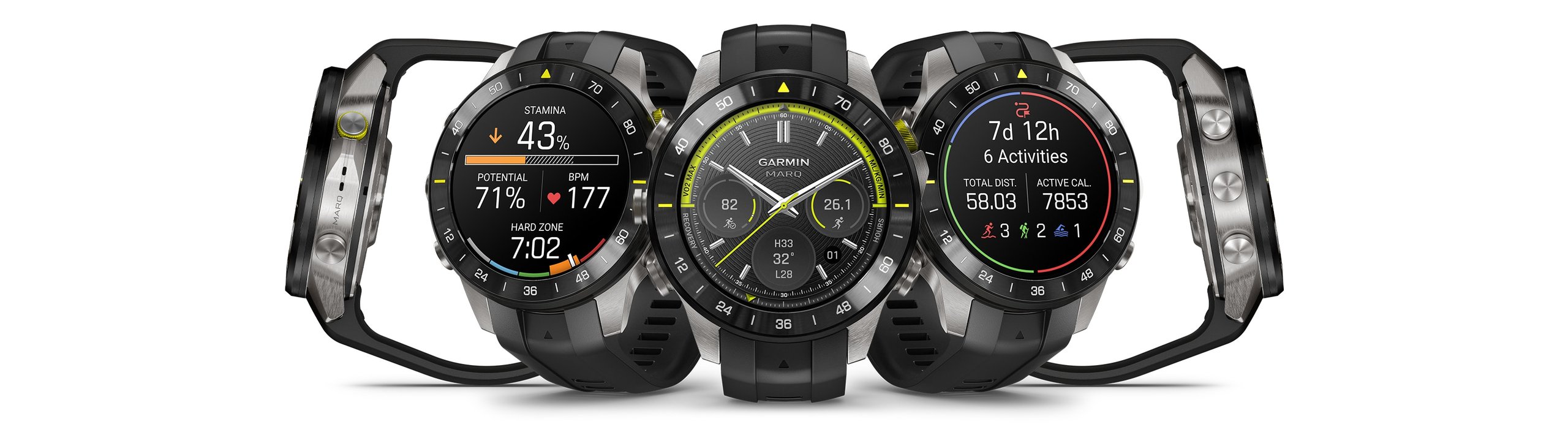
Garmin launched the third-generation MARQ collection on 13 October 2026, days after Garmin’s own Spanish support pages gave it away. There are six editions, priced from $2,500 for the Athlete to $3,100 for the Aviator, Commander and Diver. Every one of them works without a phone through Garmin’s inReach service, making voice calls over LTE and sending messages and SOS over LTE or satellite.
All six share the same watch inside: a 47mm Grade 5 titanium case, a 1.4-inch AMOLED display under sapphire, 128GB of storage, a built-in flashlight, a speaker and microphone, the ECG app and the current Fenix 9 training software. The editions differ in strap and bezel, and four of them add their own tools for flying, tactical use, diving and golf.
Prices and where to buy
At launch, for pre-orders, Garmin sells MARQ only through its own stores, so the links below go straight to Garmin.com. These are US prices at launch.
| Edition | Price | Strap | Shipping at launch |
|---|---|---|---|
| MARQ Athlete (Gen 3) | $2,500 | Silicone rubber | 5 to 8 weeks |
| MARQ Adventurer (Gen 3) | $2,700 | Italian leather and rubber | 5 to 8 weeks |
| MARQ Golfer (Gen 3) | $2,800 | Jacquard-woven | 8 to 12 weeks |
| MARQ Aviator (Gen 3) | $3,100 | Calfskin bracelet, titanium clasp | 8 to 12 weeks |
| MARQ Commander (Gen 3) | $3,100 | Camo nylon weave | 8 to 12 weeks |
| MARQ Diver (Gen 3) | $3,100 | Rubber microadjust bracelet | 5 to 8 weeks |
Euro prices are €2,550 for the Athlete, €2,750 for the Adventurer, €2,850 for the Golfer and €3,150 for the other three.
The phone-free features need an active inReach plan. After a 30-day free trial it costs from $9.99 a month for unlimited LTE use and emergency-only satellite, with satellite messages and check-ins charged extra or on a higher plan. Satellite messaging currently covers most of Europe and North America, and LTE coverage is not available in every region. Garmin lists the limits at garmin.com/marqfeaturerequirements.
What every MARQ Gen 3 does
- Calls to other Garmin Messenger users, voice messages, texts, LiveTrack and weather forecasts over LTE, with no phone on you. Off-grid, it sends texts, location check-ins and weather requests over satellite, and interactive SOS reaches the 24/7 Garmin Response centre over either network.
- Garmin Locate lets chosen contacts see your last location, and Garmin includes free SOS messaging for up to 12 months after the trial period.
- Calls through a paired phone, and voice commands that work offline, through the built-in speaker and microphone.
- Worldwide TopoActive maps preloaded, with address search, perspective view, NextFork, Up Ahead, ClimbPro and round-trip routing. Garmin says the 128GB holds four times as many Outdoor Maps+ maps as before.
- Training Readiness, HRV status, Endurance Score, Hill Score, stamina tracking, Running Tolerance, PacePro, Projected Race Time and rolling grade-adjusted pace. Running Economy and Step Speed Loss work with the HRM 600 strap.
- Garmin Epic, which turns several days of activities into one record, plus rucking workouts with changeable pack weight and indoor rowing VO2 max with a power-equipped rower.
- The ECG app with AFib detection, Pulse Ox, Sleep Coach, morning and evening reports and the jet lag adviser.
- A 40m dive computer on every edition, with single-gas scuba on air or nitrox and apnea modes.
- 43,000 preloaded golf courses, 2,000 ski resort maps, Garmin Pay, music storage and an LED flashlight.
These are the Fenix 9 Pro inReach features, in titanium and ceramic. The Garmin features explained guide covers each one in detail.
What MARQ Gen 3 has that Fenix 9 Pro inReach does not
This time MARQ is clearly more than a Fenix in better materials. Every edition, including the Athlete, adds:
- Worldwide topographic maps preloaded on the 128GB of storage. Fenix 9 ships with maps for your own region and downloads the rest.
- Navigation to a street address typed on the watch, which Fenix 9 cannot do; it navigates to points of interest only. DC Rainmaker reports that the keyboard also offers predictive text.
- ClimbPro without a loaded course, showing the climbs ahead on runs, hikes and rides. Garmin has delayed it, and DC Rainmaker reports it is days rather than months away.
- MARQ-only watch faces. DC Rainmaker also reports a lume mode that mimics a luminous dial at night, and more style and colour options for the faces.
- Grade 5 titanium where Fenix 9 Pro uses Grade 2, a ceramic bezel, a borderless display and sealed inductive buttons with a tactile click. DC Rainmaker adds that the click is mechanical and the bezel’s ceramic is coloured all the way through.
- A magnetic charging cable, braided according to DC Rainmaker, and a spare silicone strap in the box with every edition except the Athlete.
There are no metal bracelets for Gen 3. As on Fenix 9 Pro, metal would interfere with the LTE and satellite antennas.
I’ve looked at which of these could come to Fenix 9 in five MARQ Gen 3 features Fenix 9 doesn’t have yet.
Battery life
Every edition has the same battery figures. Garmin rates the smartwatch mode at 18 days, or 7 days with the display always on.
| Mode | MARQ Gen 3 |
|---|---|
| Smartwatch | Up to 18 days (7 days always-on) |
| Low Power Watch Mode | Up to 24 days |
| Activity Mode (Normal) | Up to 32 hours |
| Activity Mode + Music (Normal) | Up to 13 hours |
| Activity Mode + LTE LiveTrack (Normal) | Up to 16 hours |
| Activity Mode (Max Accuracy) | Up to 26 hours |
| Activity Mode (Extended Battery) | Up to 37 hours |
| Activity Mode (Max Battery) | Up to 87 hours |
| Expedition Mode | Up to 18 days |
LTE LiveTrack halves the recording time, so a long race tracked by family over LTE needs the 16-hour figure, not the 32.
The six editions
MARQ Athlete (Gen 3), $2,500
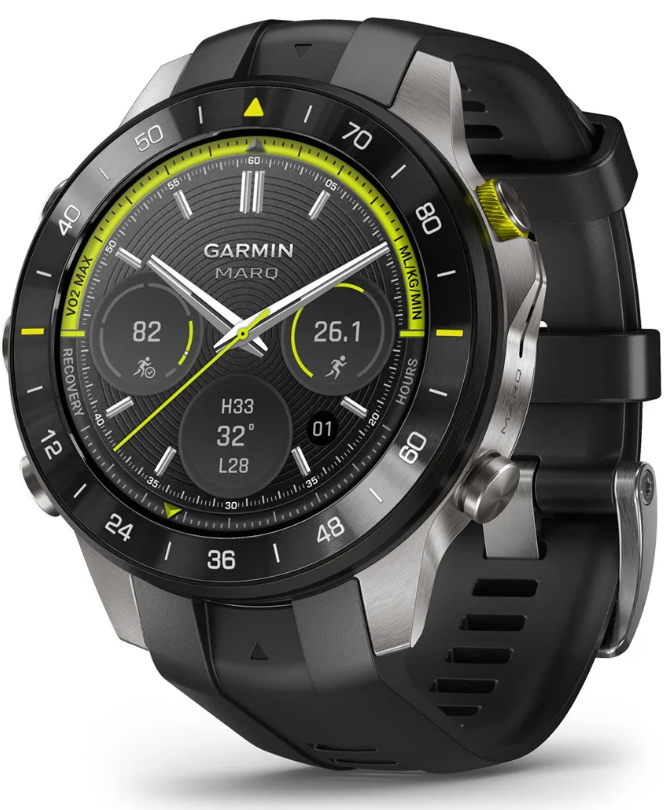
The Athlete has a silicone rubber strap and a ceramic bezel with a VO2 max indicator. Garmin pitches it on running economy and stamina, but those features are on every edition, so the Athlete is simply the cheapest way into MARQ Gen 3. It weighs 86g, or 62g for the case alone.
MARQ Adventurer (Gen 3), $2,700
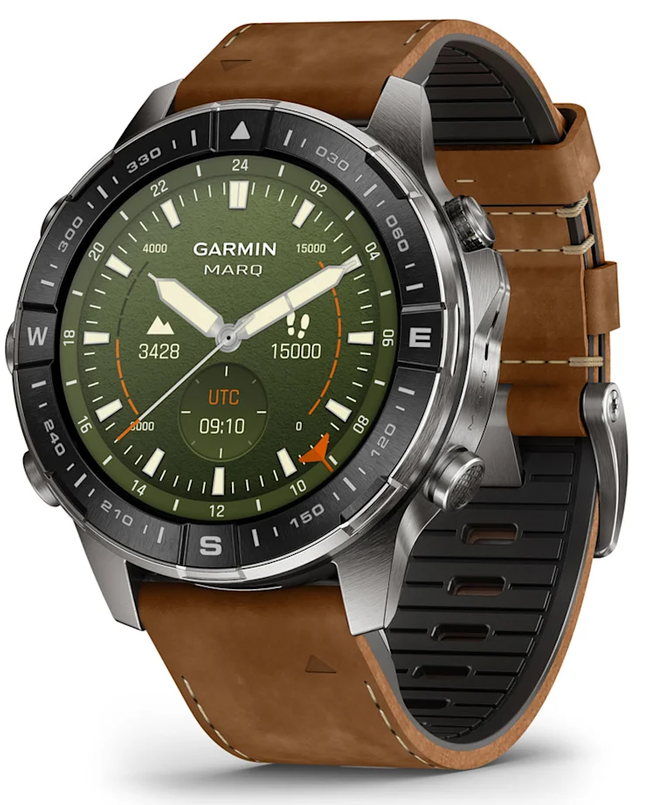
The Adventurer has a full-grain Italian leather strap backed with rubber and a ceramic bezel with 360-degree compass markings. Its feature list matches the Athlete’s, so the extra $200 buys the strap and the bezel. It is the heaviest edition at 96g on the leather strap.
MARQ Aviator (Gen 3), $3,100
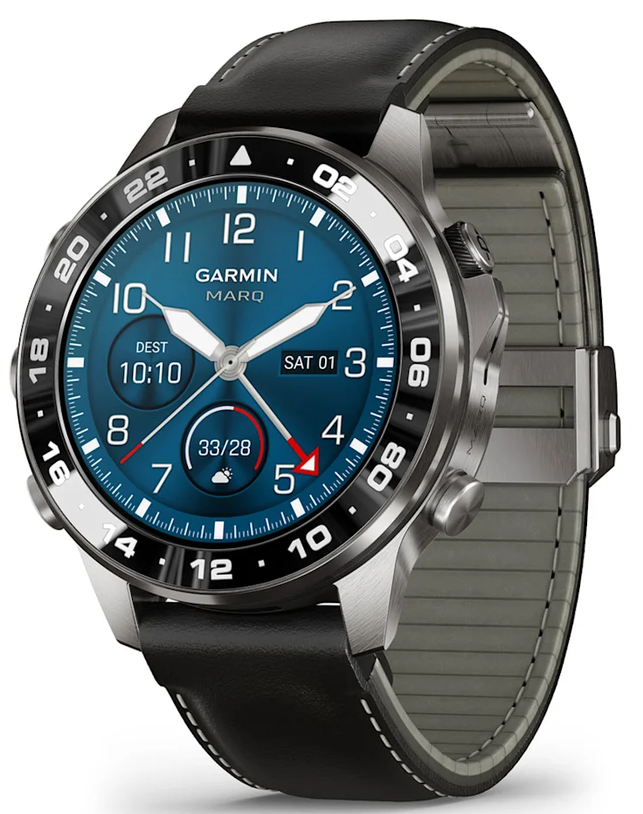
The Aviator comes on a padded calfskin bracelet with an infinitely adjustable titanium clasp, with a polished black ceramic bezel, UTC markings and a dedicated UTC hand. It adds a full flight toolset:
- Flight plans sent from Garmin Pilot, a moving map with airports and navaids, and worldwide airport and navaid databases.
- Voice-commanded direct-to navigation to the nearest airport or any waypoint, with an HSI course needle.
- METAR, TAF, MOS, meteograms and NEXRAD weather, with alerts when conditions break your personal minimums.
- Automatic flight logging to flyGarmin, PlaneSync aircraft status, Connext avionics connectivity, a density altitude calculator and an altitude alert for supplemental oxygen.
MARQ Commander (Gen 3), $3,100
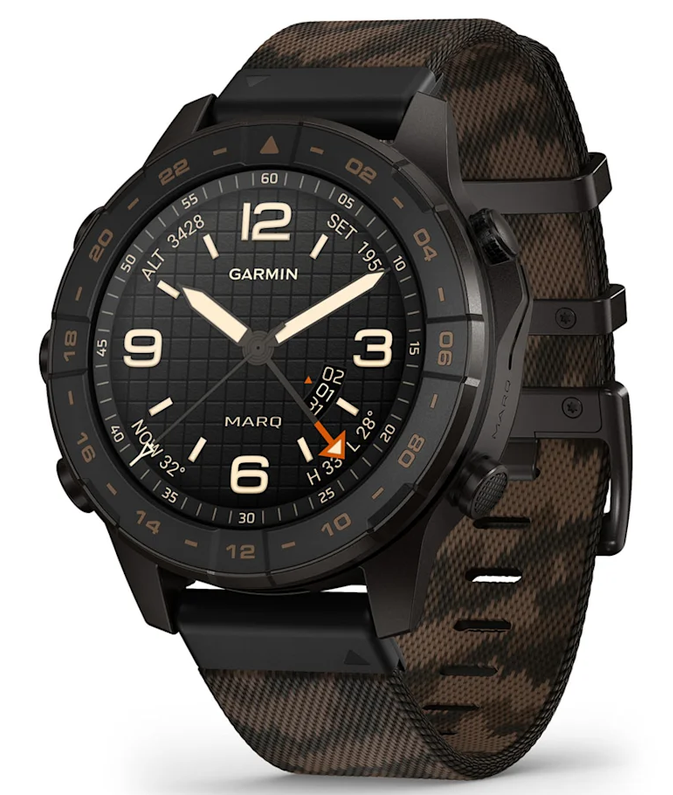
The Commander has a camo jacquard nylon strap, micro-knurled buttons and a matte black ceramic bezel with UTC markings. Its tactical tools are:
- An Applied Ballistics Elite solver, managed from the AB Quantum phone app.
- Night vision mode for use under NVGs, and a flashlight tuned for it.
- Stealth mode, which stops storing and sharing GPS position and turns off wireless connections, and a kill switch that wipes the watch.
- A stage timer, Xero locations and projected waypoints, plus a reduced set of the Aviator’s flight tools.
MARQ Diver (Gen 3), $3,100
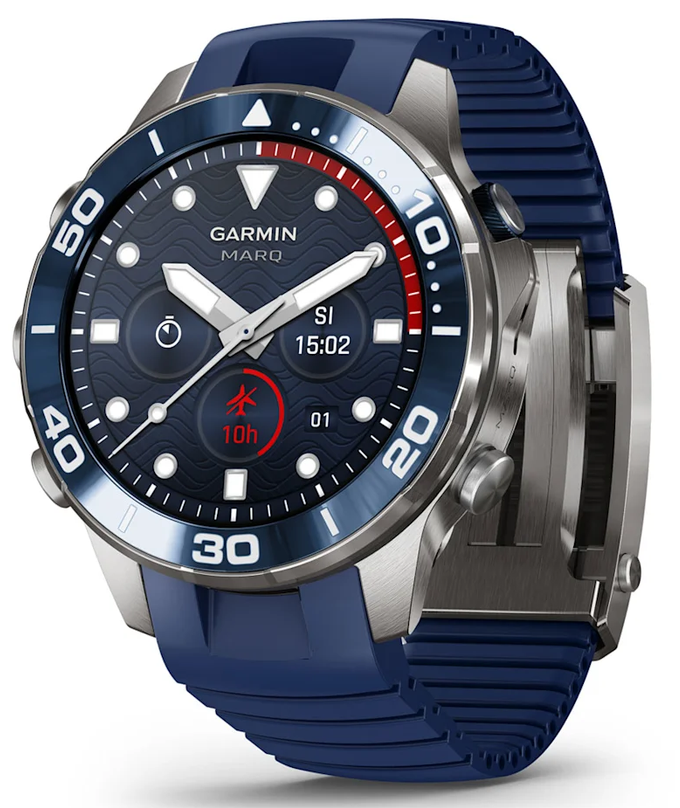
The Diver is the new name in the collection, on a silicone rubber microadjust bracelet with a ceramic quick-timer bezel. Every Gen 3 dives to 40m, and the Diver adds the tools from Garmin’s Descent range:
- NDL Aware depth metrics, which show how a change of depth affects the no-decompression limit, and a Big Numbers dive screen.
- Dive readiness and postdive activity guidance, which warns against training too soon after a dive.
- DiveView maps with depth contours and more than 5,000 dive sites, surface GPS for entry and exit points, and a reference point for finding a site from the surface.
- A variometer for freediving, and setup sharing with a backup Descent computer.
- Boat and sailing tools: autopilot control, chartplotter data on the wrist, an anchor alarm, tack assist, a virtual starting line, BlueChart g3 support and tide tables.
DC Rainmaker reports that it also has a gauge mode, and that it lacks the wireless air integration of the Descent range, an odd omission on a watch called Diver.
The boat tools were the Captain’s job on Gen 2, and according to DC Rainmaker the Diver carries every Quatix boating feature except Boat Mode. Garmin.com lists the MARQ Captain (Gen 2) as permanently out of stock, so the Diver takes its place.
MARQ Golfer (Gen 3), $2,800
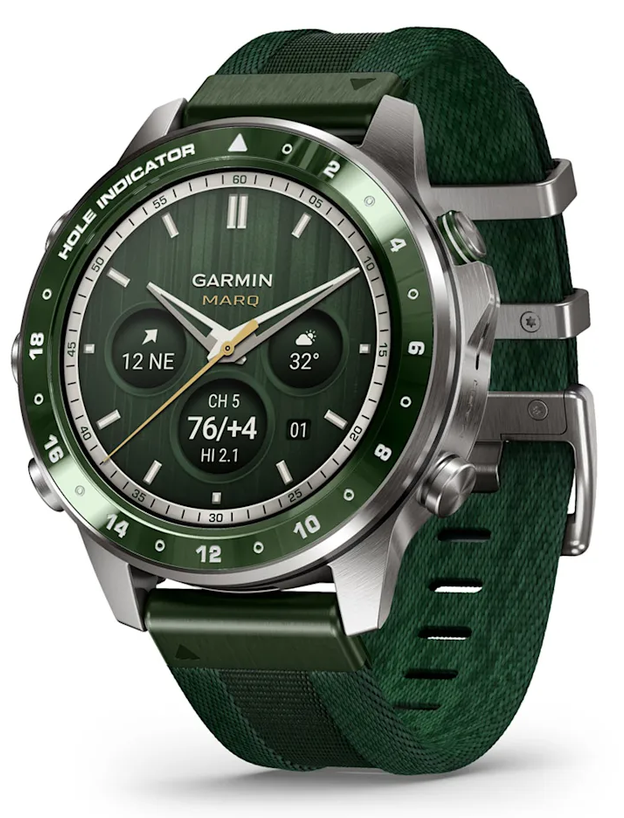
The Golfer has a jacquard-woven strap and a ceramic bezel with an 18-hole indicator. Every edition carries the 43,000 courses, Virtual Caddie and green contours, and the Golfer adds aerial imagery, green reading, putting analysis, scramble mode, a lost ball timer, Stableford and multi-player scorecards, forward tee guidance, next hole navigation, putt tracking and post-round heart rate analysis. Virtual Caddie, green contours, aerial imagery, green reading and putting analysis need a Garmin Golf membership. DC Rainmaker reports that it matches the Approach S72 except for swing metrics and driving range mode, which need extra hardware.
What’s new versus MARQ Gen 2
- inReach LTE and satellite: calls, messages, LiveTrack and SOS without a phone. Gen 2 has none of this.
- A speaker and microphone, an LED flashlight and the ECG app, all missing from Gen 2.
- A 47mm case and a 1.4-inch display, the largest on a MARQ (Gen 2: 46mm and 1.2 inches).
- 128GB of storage for maps and music, four times Gen 2’s 32GB.
- Up to 18 days as a smartwatch (Gen 2: 16 days).
- Fenix 9 software, including Garmin Epic, stamina tracking and rolling grade-adjusted pace, and BeiDou and QZSS satellites alongside GPS, GLONASS and Galileo.
- A new Diver edition, which replaces the Captain.
Battery improves in the long modes, with Max Battery up from 75 to 87 hours and Expedition from 14 to 18 days. Gen 2’s 42-hour figure was for GPS only, so it does not compare directly with the Gen 3 normal mode’s 32 hours. The full specification for every edition is on the Garmin MARQ Gen 3 specifications page, and MARQ Gen 3 vs Gen 2 sets out what the extra $600 buys and which to choose.
My take: a $600 price rise with LTE bundled in
Garmin.com still sells the titanium Gen 2 Athlete at $1,900, and the Gen 3 Athlete costs $600 more at $2,500. I argued in May that Garmin had reached the ceiling of its brand premium, and Garmin has answered by raising the price and adding inReach, which a Fenix buyer pays $200 extra for on Fenix 9 Pro inReach, from $1,299.99.
That makes the MARQ premium over a Fenix 9 Pro inReach about $1,200 for the Athlete. It buys titanium and ceramic, double the storage, worldwide maps, address search and the edition tools. Even the Athlete and Adventurer, which have no edition tools, add a little MARQ-only software, but the biggest addition, ClimbPro without a loaded course, is not on the watch yet. Both come in one size with no solar option. MARQ also inherits the Fenix 9 software, and owners have logged 123 Fenix 9 bugs so far. A buyer paying $2,500 should expect Garmin to have fixed those before the first Gen 3 ships in five weeks.
Three things stand out for me, beyond the price.
- This is the first MARQ with all of Garmin’s current components at launch. The Carbon editions in 2023 and the Damascus edition in 2024 arrived with the older Elevate Gen 4 heart rate sensor, after Garmin had already put Gen 5 in the cheaper Venu 3 and Fenix 8. Gen 3 launches with Elevate Gen 5 and ECG, multi-band GPS, LTE and satellite, the flashlight and the faster Fenix 9 processor.
- The watch faces look professional as a set. Garmin has always had a few good faces among many poor ones, and this is the first time the whole collection looks like it belongs on a luxury watch.
- The braided magnetic charger snaps onto the back of the watch. Garmin’s standard clip cable is awful, and I hope this design spreads across the range. Gen 2 also had its own magnetic cable that never spread, and each case shape needs its own cable, so I would not bet on it.
Two things stand out to me. First, Gen 3 launches with every current Garmin component: the Elevate Gen 5 sensor, multi-band GPS, the flashlight, the speaker and inReach. Gen 2 editions kept arriving with older parts, and the Carbon and Damascus models launched on the Gen 4 sensor after the Fenix 7 Pro had moved to Gen 5. A MARQ buyer is no longer paying more for less.
Second, the watch faces look professional across the whole set, not just one or two, and each has more style and colour options than before. Garmin’s own faces have often been the weakest part of an expensive Garmin.
Garmin has not yet listed UK prices. Garmin.com still sells the titanium Gen 2 Athlete, Adventurer and Golfer at $1,900 to $2,300, and the Carbon and Damascus editions at $2,950 to $3,200. It lists the Gen 2 Aviator and Captain as permanently out of stock. Track the rest of Garmin’s 2026 launches on the Release Radar, and read Garmin’s launch announcement for its own description of the collection.
Quick answers
How much does the Garmin MARQ Gen 3 cost?
MARQ Gen 3 costs $2,500 for the Athlete, $2,700 for the Adventurer, $2,800 for the Golfer and $3,100 for the Aviator, Commander and Diver. Garmin has not yet listed UK prices.
Where can I buy the Garmin MARQ Gen 3?
At launch, for pre-orders, Garmin sells MARQ only directly, through Garmin.com and its own stores. At launch the Athlete, Adventurer and Diver were shipping in 5 to 8 weeks, and the Aviator, Commander and Golfer in 8 to 12 weeks.
What is the difference between the MARQ Gen 3 editions?
All six share the same case, display, battery, storage, inReach connectivity and Fenix 9 software. They differ in strap and bezel, and the Aviator, Commander, Diver and Golfer each add their own flying, tactical, diving and golf tools. The Athlete and Adventurer have the same features.
Is the MARQ Gen 3 just a Fenix 9 Pro in titanium?
No. It shares the Fenix 9 Pro inReach hardware and software, and every edition adds worldwide preloaded maps on 128GB of storage, on-watch address search, MARQ-only watch faces, Grade 5 titanium and a ceramic bezel. ClimbPro without a loaded course is also MARQ-only but has not been released yet.
Does the MARQ Gen 3 need a subscription?
The watch works without one, but calls, messages, LiveTrack, weather and SOS over LTE or satellite need an active Garmin inReach plan. Some golf features need a Garmin Golf membership.
How long does the MARQ Gen 3 battery last?
Garmin rates every edition at up to 18 days as a smartwatch, 32 hours in the normal activity mode and 87 hours in Max Battery mode. Tracking over LTE LiveTrack cuts the activity figure to 16 hours.
Can you dive with the MARQ Gen 3?
Yes. Every edition is a dive computer to 40m with single-gas scuba, nitrox and apnea modes. The Diver adds NDL Aware depth metrics, DiveView maps, a freediving variometer and boat tools.
Should I buy MARQ Gen 2 or Gen 3?
Gen 3 adds phone-free calls and SOS, a flashlight, ECG, a speaker and microphone, a bigger display and the Fenix 9 software. Garmin.com still sells the titanium Gen 2 Athlete at $1,900, $600 less than the Gen 3 Athlete, and the Gen 2 Adventurer and Golfer at $2,100 and $2,300.
Last Updated on 13 October 2026 by tfk the5krunner
Small things I always use
- Garmin 90-degree charging adapter: Charges your Garmin from any USB-C cable. Essential when travelling. I use one.
- Body Glide: The blue anti-chafe stick swimmers and runners carry. I use it.
- Speedo earplugs: Fewer ear infections and no cold-water dizziness. I use them.
- Dryrobe Advance: My winter changing robe for open-water swims. I use one. A cheaper option is the AONYIYI changing robe.
- Maurten: Race fuel that stays easy on the stomach. I use them.
- Garmin charging puck: The quickest way to top up before a session. I use one.
- Injinji: Toe socks that stop rubbing, so you run more. I use them.
- Ultimate toe protectors: Stop black toenails on long runs. They work. I use them.
- Compressport R2 v2 calf sleeves: My calf sleeves of choice. I use them.
- Cellucor C4: My pre-workout before hard sessions.
- TPU tubes: Schwalbe Aerothan, Tubolito and Pirelli SmarTube. Light, tiny spares. I use all three.
- G8 insoles: Adjustable insoles that are good. I use them.
- Cycplus Cube: A 97g electric pump that gets a road tyre rideable in two minutes. I carry one. 5% off with code THE5KRUNNER.
Watches and sensors
- Polar H10: My daily driver for waking HRV.
- Polar Verity Sense: My backup arm-worn HR sensor.
- Nomad bedside charger: Charges my iPhone and Apple Watch overnight. I use it, and many of their bands.
- Train.Red: The best muscle oxygen sensor I’ve used.
- Tymewear: Accurate heart rate and reliable ventilatory zones. I use it to pace endurance rides over an hour.
- Garmin Forerunner 970: A pro-grade triathlon watch. I use this.
- Apple Watch Ultra 4: My daily smartwatch. No phone needed on rides.
- Garmin Fenix 9 Pro: I’ve just bought one.
On the bike
- Continental GP5000 for everyday riding, and Aero 111 on the front for special occasions.
- Helmets: Specialized S-Works Evade 3 for road riding, and Rudy Project Wing for TT-style races. I use both.
- Ravemen FR300: A front light that mounts under your Garmin or Wahoo. I use one.
- Wahoo TRACKR Radar: I use it on one bike and Varia on the other. They perform the same.
- Garmin Varia RTL515: Radar that warns you of cars from behind. I use this model.
- Wahoo ELEMNT Roam 3: The bike computer that’s easy to use. I use mine on most rides.
- Favero Assioma Pro RS2: Accurate power pedals that swap easily between bikes. I use this model.
Home and indoor training
- NPE Runn: Makes my basic treadmill smart, sending more accurate speed and distance to my watch and Zwift. I use it.
- Google Wifi: Keeps Zwift connected in my pain cave. I use it.
- Apple TV 4K: Zwift on the big screen. I use two.
- Google Nest Doorbell (wired, 2nd gen): My video doorbell, running in both Google Home and Apple Home. I use it.
Health, recovery and sleep
- FreeStyle Libre 3 Plus: Shows how my blood sugar responds to diet.
- hDrop: Measures my sweat loss in summer and indoors.
- Fourth Frontier Zone: Checks my heart under load in hard sessions.
- Oura Ring 5: My partner’s recovery tracker of choice.
- Kineon MOVE+: Red light therapy for niggles. It works.
- Eight Sleep: A cooling mattress cover my partner and I use nightly.
Reader-Powered Content

This content is not sponsored. It’s mostly me behind the labour of love, which is this site, and I appreciate everyone who supports it.
Support the site: Follow (free, fewer ads) · Subscribe (paid, ad-free) · Buy Me A Coffee ❤️
Written by real people, with AI assistance. Fact-checked and verified for originality. See the Editorial Policy. FTC: Affiliate Disclosure — some links pay commission. As an Amazon Associate, I earn from qualifying purchases.
tfk is the founder and author of the5krunner, an independent endurance sports technology publication. With 20 years of hands-on testing of GPS watches and wearables, and competing in triathlons at an international age-group level, tfk provides in-depth expert analysis of fitness technology for serious athletes and endurance sport competitors. ID
