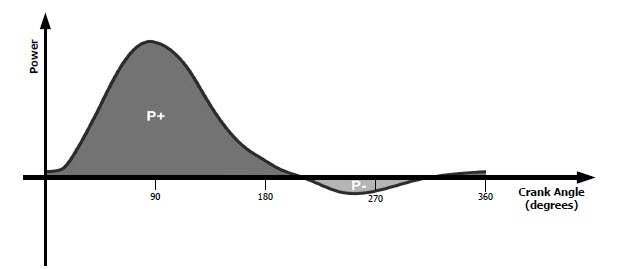
So here is how your downwards power can be effectively applied throughout your pedal stroke. As you may have guessed most of it is when you push down. But look, when your foot is rising you can STILL apply some downwards pressure. If you do that it will reduce the effectiveness of what the other leg is doing.
So in the above diagram, total power applied = P+ minus P-.
If you can de-weight your rising feet then P- will approach zero (good)
I guess if you pull up then P- could be positive. I guess that’s good.
Anyway, with Garmin’s new Vector power meter which is a pedal based solution then this can be measured.
I did just that.
With one legged pedalling it is pretty hard to NOT achieve 100% effectiveness – albeit tiring.
When you pull up (two legs, normal) then 100% can be achieved, initially, for periods of a few minutes – albeit tiring.
For me ‘normal’ pedalling at pretty much any power was in the 80’s %.
Moral of the story: It appears that efficiency might be relatively easily improved by doing one legged drills. But then we knew that anyway 🙂
Related articles
Last Updated on 12 January 2026 by the5krunner
Reader-Powered Content

This content is not sponsored. It’s mostly me behind the labour of love, which is this site, and I appreciate everyone who supports it.
Support the site: Follow (free, fewer ads) · Subscribe (paid, ad-free) · Buy Me A Coffee ❤️
All articles are written by real people, fact-checked, and verified for originality. See the Editorial Policy. FTC: Affiliate Disclosure — some links pay commission. As an Amazon Associate, I earn from qualifying purchases.
tfk is the founder and author of the5krunner, an independent endurance sports technology publication. With 20 years of hands-on testing of GPS watches and wearables, and competing in triathlons at an international age-group level, tfk provides in-depth expert analysis of fitness technology for serious athletes and endurance sport competitors.
