Magene’s latest power meter pedals are the cheapest on the market, claim +/-1% accuracy and come with a Shimano SPD-SL-compatible cleat option. I’ve had a pair for several months of use, and I’m impressed.
TL;DR – Superior price compared to the latest ASSIOMA PRO RS. Great battery life, tempered by slightly prior-gen aesthetics.
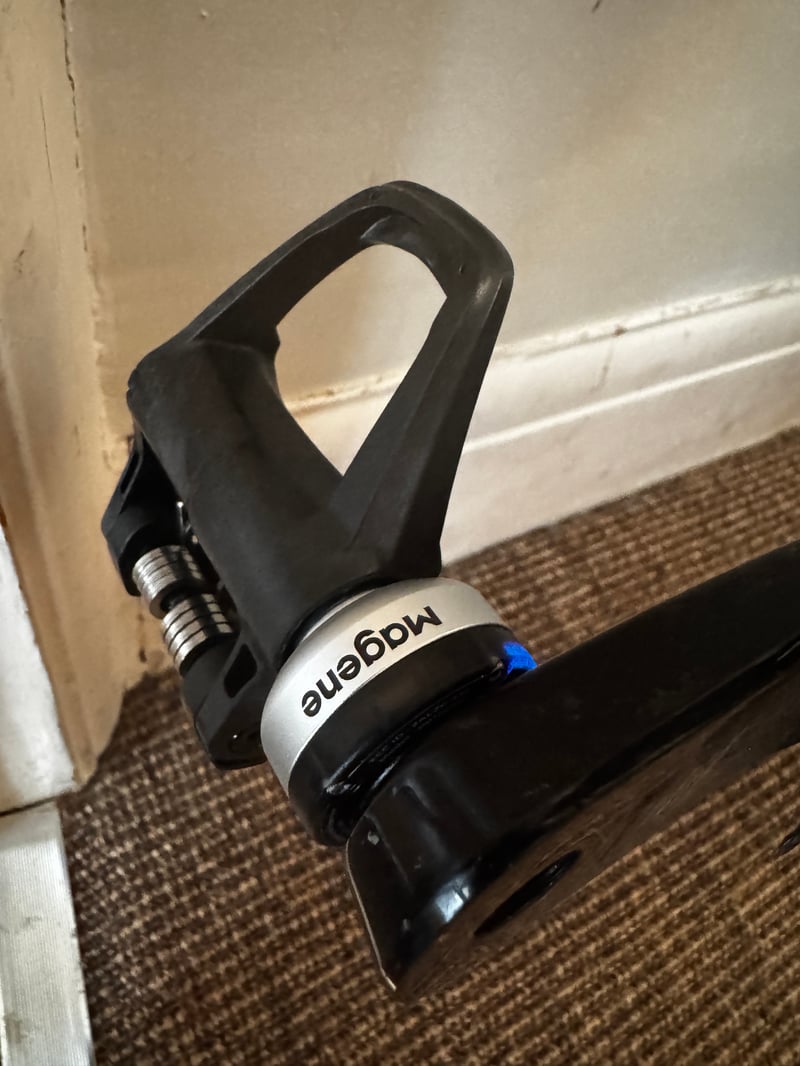
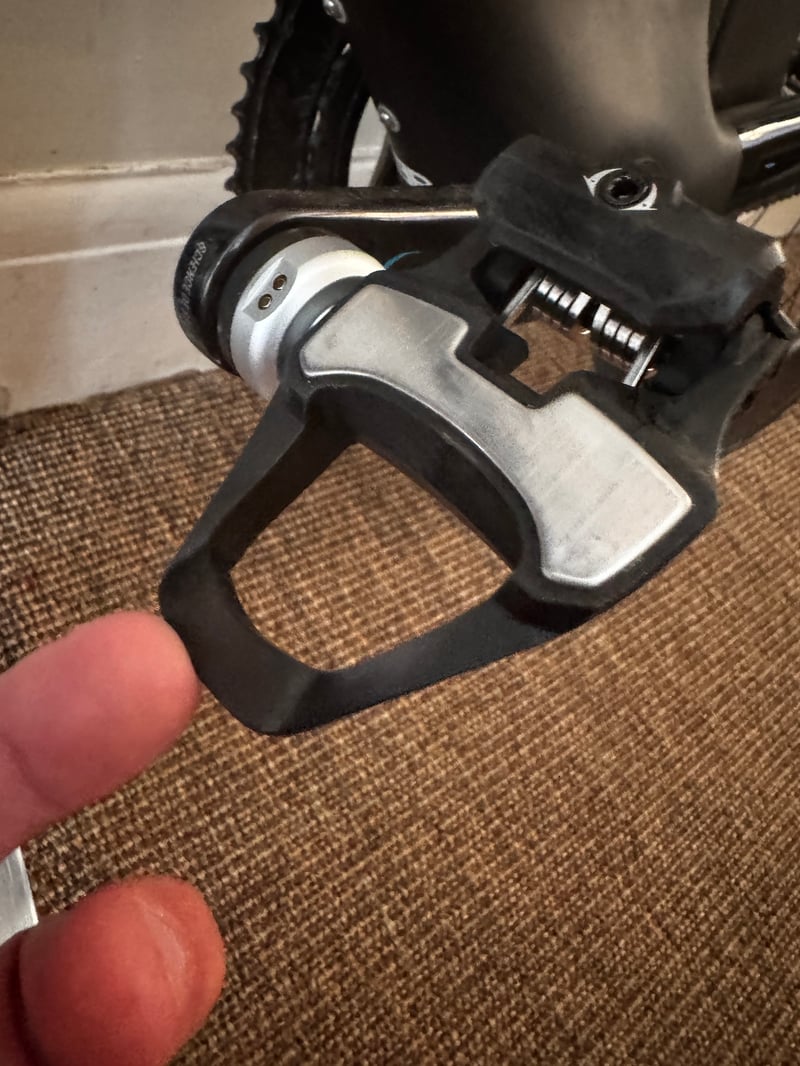
How they look
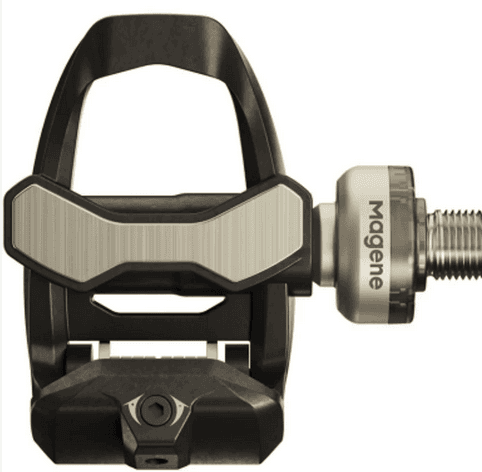
The appearance is very similar to the original Favero Assioma Duo. The issue with the Favero Assioma Duo/Uno was that the pod was slightly too big for some people. This was a slight issue with some of my cycling shoes rubbing, so I worked around it with a cleat spacer. The pod on the Magene has a smaller diameter, and rubbing is not an issue.
The pod is perhaps not the prettiest thing in the world, but it looks OK. Don’t forget the pod contains that battery, which gives you the awesome battery life.
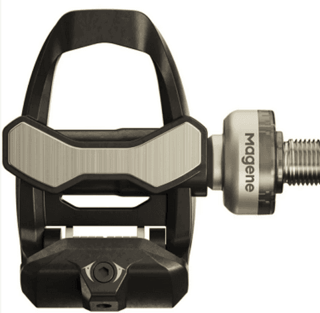
Although a DIY aftermarket solution existed, Assioma didn’t initially have an SPD-SL cleat option. Magene is starting with a Shimano option – the ‘S’ in 715s stands for Shimano. The P715 K model is KEO-cleat compatible.
Set up and first Ride
Installing onto some DuraAce cranks was easy, as I had the right-sized Allen wrench. The pods didn’t wake up from movement, so I put them on the magnetic chargers, and they came to life. The chargers snapped on very positively. First-time setup with the Magene Utility app was also pretty easy.
I prefer using a large Allen wrench to change pedals, as it provides a secure, tight fit with minimal effort. However, the newer Assioma PRO RS opts for a more universally available spanner, which has advantages. Each approach has trade-offs. For instance, the Allen key hole Magene uses takes up internal space that could be used for electronics. This design constraint partly explains why the P715 relies on an external pod. In contrast, Assioma’s use of a spanner for tightening allows for a more compact internal layout, contributing to the pedal’s cleaner, sleeker look. It’s easier to achieve the required 32 Nm of tightening torque with the Magene using a torque wrench than with a spanner on the Assiomas (which my kit can’t measure).
The app isn’t as clean as Assioma’s, but it works. I updated the firmware of each pedal and set the correct crank length. I wanted to calibrate the pedals using the app just for the heck of it, and it was a good job I tried, as I discovered that the crank length hadn’t been saved for some reason. Long story short, after re-opening the app a few times, I sorted everything out.
I initially paired only the P715S with my Forerunner 970. As expected, it doesn’t support a secure connection, but the pairing time did seem inordinately long, as long as a minute. Subsequent pairing via Open-BLE was very quick, but the calibration prompt didn’t always materialise. The sensors ‘About’ details did not show any crank length on the FR970, nor was there any option to set the crank length.
Hmm
I checked the crank length in the app, and it was correct, so I assumed all was good.
Spinning the pedals (not the cranks). There was quite a lot of friction, and the pedals didn’t spin much, like 1-2 revolutions. However, I’m sure this was tightly packed grease in the new bearing, which will be Okay after a few rides.
Setting off for the first time, the shoes super-easily clipped in. It was so easy, almost to the point where I wasn’t sure they had engaged. That was a low default tension setting on the pedals, which I tightened for subsequent rides.
Unclipping and re-clipping were fine during the ride, and the power numbers and cadence looked superficially fine.
Subsequent Rides
It’s all bedded in after the first ride.
As expected, the pedal now spins freely, and pairing and calibration via ANT+ are a breeze.
I tightened the cleat tension spring. Rather than my cleat popping out of the pedal almost of its own accord, a nice little twist is now needed to unclick, as you would expect.
Charging
You get one cable with a USB-A connector for your wall socket adapter; on the other end, it splits into two proprietary Magene magnetic chargers. The magnet is NOT super strong, but it’s good enough to snap on securely and hold in place whilst also being easy to remove if you accidentally spin the pedals. Inbuilt LEDs indicate the various charge states, and most modern bike head units should also warn you of a low-battery state – my Wahoo Bolt 3 does.
Magene App
You probably want to update the firmware and do an initial calibration with the Magene Utility app. There’s not much to the app, and you probably won’t ever use it again.
Magene P715 Accuracy Test Results
I’ve used the P715 over the last month on two bike setups, mostly for outdoor rides and a few rides on my KICKR MOVE with MyWhoosh. The tests lasted between 1 and 5 hours and included at least one additional power source for comparison.
The other equipment used is the Wahoo Fitness KICKR MOVE, KICKR Core with Zwift hub, Magene PES P505, and 4iiii Precision Pro 3+ (Dura Ace). Some of these have been extensively used since new, and I’m no longer entirely confident that they remain as accurate as they once were. All tests had each power meter calibrated at least once, including a factory spin-down calibration of KICKR MOVE.
Ride 1
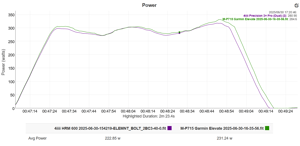
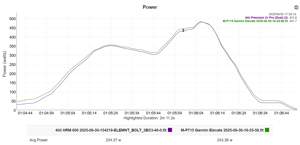
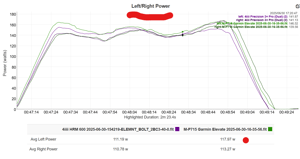
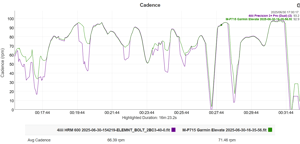
Turning to the ride data on one ride versus another, the power meter (4iiii). The data looks alright and in the right ballpark, but some differences need further investigation – namely, LR Split, cadence, power at low levels, and power after a peak. Of course, these could quite easily be issues with the 4iiii.
Ride 2 – Indoor on MyWhoosh
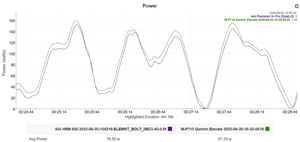
This is the second portion of a longer test. Ideally, KICKR would match at least one of the other sources,s but as you can see, it doesn’t.
I’ve been through all the troubleshooting with Wahoo support, and the only option is to return it, which I probably will. I’m quite happy to accept that this KICKR MOVE is no longer accurate.
Ride 3 – Outdoor ride compared to 4iiii Precision Pro 3
I’ve previously noted that the 4iii is sometimes accurate compared to other sources and sometimes not, at least at the total level. I’ve never been convinced that the LR split is correct.
Unless I have a bad pair of P715 pedals, each pedal should be equally accurate, since the same method is used to determine all metrics.
These tests show that the drive-side values of both meters are closest, but the 4iiii likely has missing cadence data, and a 5% overall difference is more than I would expect. One of the brands is not operating within its stated performance levels.
Ride 4 – Outdoor ride compared to Magene P505 crankset
This seems like a more consistent result between the two Magene power meters.
But the difference between the two is more than I would expect from the stated performance characteristics, and the P505 does seem to underreport and miss some cadence.
Overall, the two perform similarly, but the crank PM is missing some of the higher power levels (or the pedals are overestimating them, depending on how you want to see it).
Ride 5 Second comparison to the P505
This is part of the fifth ride, which pretty much confirms the results of the previous one. The 4% difference between the two sources is too much.
Ride 6 Third comparison to the P505
Same. Perhaps the left pedal has a systemic positive bias. IDK.
Ride 7 Comparison to Kickr Core in ERG mode.
Magene sits nicely in the middle of the watt range between my new KICKR Core and Zwift One (drive train fully oiled and straight to minimise drive chain loss). I don’t know which of the 3 is right!
Key Features & Highlights of the Magene P715
- Power Accuracy: Claims plus/minus 1% accuracy, consistent with industry-leading power meters.
- Battery Life & Charging: Offers a Garmin-equalling 120 hours of battery life with magnetic charging via a USB-A connector.
- Weight & Durability: Each pedal weighs approximately 157g (P715 Keo) or 159g (P715 S), with a composite body and stainless steel spindle. It might be carbon fibre. Either way, it’s light.
- Training Functions: Provides cycling data, including power, cadence, left/right balance, and potentially advanced metrics like Power Phase and Riding Position.
- Compatibility: Supports Look KEO (P715/P715K) and Shimano SPD-SL (P715S) cleat types.
- Connectivity: Utilises Bluetooth and ANT+ dual protocols for seamless device integration.
In-Depth Look at the P715’s Capabilities
The capabilities and specs are good on paper.
Power Accuracy
- Dual-sided Power Meter Spindles: Measures power from both legs with the same method for precise data.
- Embedded Gyroscope: Measures real-time angular velocity to calculate instantaneous power accurately, even with variable pedalling techniques.
- Temperature Compensation: Adjusts algorithms for consistent accuracy across varying conditions, though altitude compensation is not claimed.
Battery Life & Charging
The 120 hours beats the new Garmin Rally 210/110 and is more than double that of the latest Favero Assioma RS2
- 120 Hours of Cycling: Claimed battery life beats Garmin Rally RS210 and exceeds most competitors.
- Magnetic Charging: It uses a proprietary magnetic connector with a USB-A cable, which takes approximately 3 hours to charge at full charge.
Lightweight, Strong, and Safe Design
- The P715 K (Look KEO-compatible) weighs 311g per pair, and the P715 S (Shimano SPD-SL-compatible) weighs 314g per pair.
- Constructed with a composite body (likely carbon fibre, though not explicitly confirmed) and precipitation-hardening stainless steel spindle.
Advanced Training Functions
-
Basic Data: Includes power, cadence, left/right balance, pedalling smoothness, and torque effectiveness.
-
Advanced Insights:
-
- Power Phase: Measures power generation zones and force angles to optimise pedalling efficiency.
- Riding Position: Tracks power output in standing versus seated positions.
- Platform Centre Offset (PCO): Not measured or reported by the P715. Independent testing shows the pedals are influenced by extreme PCO variation, although a normal foot position produces no visible effect on the power numbers. Riders who rely on PCO data for bike fit or asymmetry analysis should look elsewhere.
- Note: These functions are only available on compatible bike computers.
- Note: Full insights are available only when paired via ANT+.
Ease of Installation and Versatility
- Installation: Advertised as a 1-minute setup using an 8mm hex wrench, similar to standard road bike pedals. I’d say it takes 2-3 minutes! Still pretty good.
- Cleat Compatibility: Supports Look KEO and Shimano SPD-SL cleats with the P715K and P715P models, respectively.
Connectivity and Calibration
- Bluetooth & ANT+: Connects to one Bluetooth device and unlimited ANT+ devices simultaneously.
- Calibration: Supports automatic and manual calibration via the Magene Utility App or compatible bike computers.
- Crank Length Adjustment: Customizable via the Magene Utility App or bike computer.
- IPX7 Waterproof: Ensures performance in wet conditions.
- Stack Height: 11mm (P715 K) and 13mm (P715 S).
- Q-Factor: 55mm for both models.
Magene P715S price: where to buy
- United States: $499.00, tax included, United Kingdom: £399.00, VAT included. Free shipping.
- Regional Colour Availability:
- Black model: Available outside the EU/UK
- Silver model: Available outside Germany and Italy.
- Shipping Regions: Confirmed from China to the US, UK, France, Italy, Spain, and Germany.
- Pricing: $499/£399 for dual-sided. Favero has since repositioned the Assioma Duo to the same $499 price point, so the P715 is no longer undercutting it. The P715 remains significantly cheaper than the Garmin Rally RS200 ($1,099/£870) and is the most affordable dual-sided SPD-SL power meter pedal on the market.
For July 2025, you might only be able to get these directly from the brand (see link below). However, PowerMeterCity has confirmed that some are on order.

Who is the Magene P715 For?
With accuracy to be confirmed, the P715 has all-around attractiveness to almost every type of rider.
- Racing/Pro Riders: Benefits from high claimed accuracy and advanced metrics for competitive training.
- Enthusiasts/Fitness Riders: Suitable for improving performance and tracking progress.
- Multi-Bike Users: Easy to transfer between bikes, ideal for riders with multiple setups.
- New Power Meter Users: Competitive pricing and robust features make it accessible for beginners.
Magene P715 vs Competitor Products
The Magene P715 competes with leading power meter pedals such as Favero Assioma RS2, Garmin Rally RS200, Wahoo PowrLink Dual, LOOK KEO Blade Power, and SRM X-Power. Below is a comparison table:
|
Feature |
Magene P715 |
Favero Assioma RS-2 |
Garmin Rally RS200 |
Wahoo Powrlink Dual |
SRM X-Power |
LOOK KEO Blade Power |
|---|---|---|---|---|---|---|
|
Power Error |
plus/minus 1% |
plus/minus 1% |
plus/minus 1% |
plus/minus 1% |
plus/minus 2% |
plus/minus 1% |
|
Battery Life |
120h |
60h |
120h |
75h |
30h |
60h |
|
Charging |
Magnetic (USB-A) |
Magnetic |
Replaceable (LR44/CR1/3N) |
Magnetic (USB-C) |
Magnetic |
Magnetic (USB) |
|
Cleat Type |
KEO & SPD-SL |
SPD-SL |
KEO, SPD-SL, SPD |
Speedplay |
SPD |
KEO |
|
Advanced Data |
Power Phase, Riding Position (Garmin-compatible) |
Basic + IAV Cycling Dynamics (Garmin-compatible) |
Basic + Cycling Dynamics |
Basic |
Basic |
Basic |
|
Weight (Pair) |
311g (K), 314g (S) |
246g |
320g |
276g |
344g |
260g |
Competitive Edge: The P715 matches Garmin Rally’s 120-hour battery life with rechargeable magnetic charging, unlike Garmin’s replaceable batteries, which I dislike. It offers advanced metrics like Power Phase and Riding Position, though these are limited to compatible devices (e.g., Garmin). Its +/-1% accuracy aligns with top competitors. Favero has since repositioned the Assioma Duo to match the P715 at $499, so the pricing advantage against the Duo no longer holds. The P715 remains significantly cheaper than the Garmin Rally RS200 ($1,099/£870) and is the only dual-sided SPD-SL pedal in this price range.
My planned longer-term usage
I recently also bought the Favero Assioma Pro RS 2, intending it to be my go-to power meter for my main road bikes (Cervelo R5, S5). Now I’m not so sure I can be bothered to swap the pedals over, and may well just keep the Magenes permanently on my R5. The point of that is not to brag about being able to have two unnecessary sets of power meter pedals, but rather that there is simply nothing wrong with the Magenes; they are fine to use as your go-to pedal.
I use my TT bike much less (Cervelo P5), so I might swap over the pedals to that when needed. However, it’s taken me years to realise that power meters just don’t work with the oval chainrings I use. They all seem to produce incorrect data (yes, even Favero’s IAV appears wrong despite what the brand adamantly says). Recently I’d used the Assioma’s with a scaling factor (I think setting a 158mm crank rather than the actual 165 worked, I could have used a scaling factor, I know), so I could apply the same scaling factor to the PRO RS, or I could just get a spindle-based solution ie one which measure power holistically and estimates the balance (balance is unimportant). Anyway, I don’t see myself using the P715 pedals for the P5 bike.
I will probably use the P715 on my off-road bikes. On the rare occasions I use them, I tend to do only glorified trail rides that are long but not technical, so they pose little risk of damaging the pedals, and if that happens… so be it. The only factor I see that mitigates against that is that it’s easier to walk with SPD cleats on my MTB shoes than with SPD-SL cleats on my road shoes. Kinda bizarre that my choice of a $500 electronic kit might come down to how easily I can walk in the shoes it’s compatible with, rather than the merits of the device itself. (I can’t justify buying PRO MX pedals for SPD cleats)
Quick answers
Is the Magene P715 accurate enough for serious training?
Yes, independent testing shows total power within roughly one per cent of reference meters during typical pedalling, which is the same accuracy band claimed by Favero, Garmin and Look. Connect the pedals via ANT+ rather than Bluetooth to get the full set of cycling dynamics metrics alongside the power data.
How does the Magene P715 compare to the Favero Assioma Duo?
The two pedals now sit at the same $499 price point after Favero repositioned the Assioma Duo, which removes the P715’s original headline price advantage. The P715 wins on cleat choice for Shimano riders, since it is the only dual-sided SPD-SL pedal at this price. The Assioma uses a more modern spindle-based electronics layout and weighs less. At the same time, the P715 offers longer battery life at 120 hours and Power Phase data when paired with a compatible Garmin head unit.
Does the Magene P715 measure platform centre offset?
No, the P715 neither measures nor reports PCO data. Riders who rely on PCO for bike fit, cleat position analysis or pedalling asymmetry work will need a pedal that supports the metric, such as the Garmin Rally or the Favero Assioma Pro RS.
Conclusion: Compelling but…
It’s a Winner – Only if the accuracy and stats are sound
The Magene P715 combines precision, durability, and advanced features at an appealing price, making it a must-consider choice for everyone from racers to enthusiasts. Its 120-hour battery life, rechargeable magnetic charging, and support for KEO and SPD-SL cleats enhance its appeal in key areas where riders often express preferences.
A minor downside is the pod’s aesthetics and the slightly unusual colour of the silver version. Whilst it’s not important daily, the app needs refinement, as it’s the first thing a buyer experiences.
Priced at $499/£399, the P715 offers strong value. Favero has since matched that price with the Assioma Duo, so the purchase decision now turns on cleat compatibility, battery life and serviceability rather than headline price alone. For Shimano SPD-SL riders, the P715 is the cheapest dual-sided option on the market.
Further Info
- Magene Product Manuals
- GPLama video review
- Magene P715 Product Page
Last Updated on 3 October 2026 by tfk the5krunner
Small things I always use
- Garmin 90-degree charging adapter: Charges your Garmin from any USB-C cable. Essential when travelling. I use one.
- Body Glide: The blue anti-chafe stick swimmers and runners carry. I use it.
- Speedo earplugs: Fewer ear infections and no cold-water dizziness. I use them.
- Dryrobe Advance: My winter changing robe for open-water swims. I use one. A cheaper option is the AONYIYI changing robe.
- Maurten: Race fuel that stays easy on the stomach. I use them.
- Garmin charging puck: The quickest way to top up before a session. I use one.
- Injinji: Toe socks that stop rubbing, so you run more. I use them.
- Ultimate toe protectors: Stop black toenails on long runs. They work. I use them.
- Compressport R2 v2 calf sleeves: My calf sleeves of choice. I use them.
- Cellucor C4: My pre-workout before hard sessions.
- TPU tubes: Schwalbe Aerothan, Tubolito and Pirelli SmarTube. Light, tiny spares. I use all three.
- G8 insoles: Adjustable insoles that are good. I use them.
- Cycplus Cube: A 97g electric pump that gets a road tyre rideable in two minutes. I carry one. 5% off with code THE5KRUNNER.
Watches and sensors
- Polar H10: My daily driver for waking HRV.
- Polar Verity Sense: My backup arm-worn HR sensor.
- Nomad bedside charger: Charges my iPhone and Apple Watch overnight. I use it, and many of their bands.
- Train.Red: The best muscle oxygen sensor I’ve used.
- Tymewear: Accurate heart rate and reliable ventilatory zones. I use it to pace endurance rides over an hour.
- Garmin Forerunner 970: A pro-grade triathlon watch. I use this.
- Apple Watch Ultra 4: My daily smartwatch. No phone needed on rides.
- Garmin Fenix 9 Pro: I’ve just bought one.
On the bike
- Continental GP5000 for everyday riding, and Aero 111 on the front for special occasions.
- Helmets: Specialized S-Works Evade 3 for road riding, and Rudy Project Wing for TT-style races. I use both.
- Ravemen FR300: A front light that mounts under your Garmin or Wahoo. I use one.
- Wahoo TRACKR Radar: I use it on one bike and Varia on the other. They perform the same.
- Garmin Varia RTL515: Radar that warns you of cars from behind. I use this model.
- Wahoo ELEMNT Roam 3: The bike computer that’s easy to use. I use mine on most rides.
- Favero Assioma Pro RS2: Accurate power pedals that swap easily between bikes. I use this model.
Home and indoor training
- NPE Runn: Makes my basic treadmill smart, sending more accurate speed and distance to my watch and Zwift. I use it.
- Google Wifi: Keeps Zwift connected in my pain cave. I use it.
- Apple TV 4K: Zwift on the big screen. I use two.
- Google Nest Doorbell (wired, 2nd gen): My video doorbell, running in both Google Home and Apple Home. I use it.
Health, recovery and sleep
- FreeStyle Libre 3 Plus: Shows how my blood sugar responds to diet.
- hDrop: Measures my sweat loss in summer and indoors.
- Fourth Frontier Zone: Checks my heart under load in hard sessions.
- Oura Ring 5: My partner’s recovery tracker of choice.
- Kineon MOVE+: Red light therapy for niggles. It works.
- Eight Sleep: A cooling mattress cover my partner and I use nightly.
Reader-Powered Content

This content is not sponsored. It’s mostly me behind the labour of love, which is this site, and I appreciate everyone who supports it.
Support the site: Follow (free, fewer ads) · Subscribe (paid, ad-free) · Buy Me A Coffee ❤️
Written by real people, with AI assistance. Fact-checked and verified for originality. See the Editorial Policy. FTC: Affiliate Disclosure — some links pay commission. As an Amazon Associate, I earn from qualifying purchases.

tfk is the founder and author of the5krunner, an independent endurance sports technology publication. With 20 years of hands-on testing of GPS watches and wearables, and competing in triathlons at an international age-group level, tfk provides in-depth expert analysis of fitness technology for serious athletes and endurance sport competitors. ID

So it is a great pedal but noone actually knows what power meter is the correct one. I guess if it is consistent within itself and within 3-5% with other power meters it doesn’t really meter (not for me anyways) and it seemed about right with the kickr a bit more power due to the kickr measuring with drive train losses.
Great review probably going to get this for my new bike.
paired testing will determine accuracy eg kickr+ assioma and then kickr+P715, otherwise a powertap wheel or similar is required
people tend to also ignore drivetrain loss to indoor trainers which can be considerable in some cases.
Also so I understand it works with garmin watches and headunits, and also with whaoo??
yes. and with apps. there might be one exception somewhere but it follows a standard
I just got these pedals also in the Shimano version. I noticed the yellow cleat moves side to side more than in shimano pedals. Have you noticed that too? regardless of tension. It’s different than rotational float. Happens in both sides.