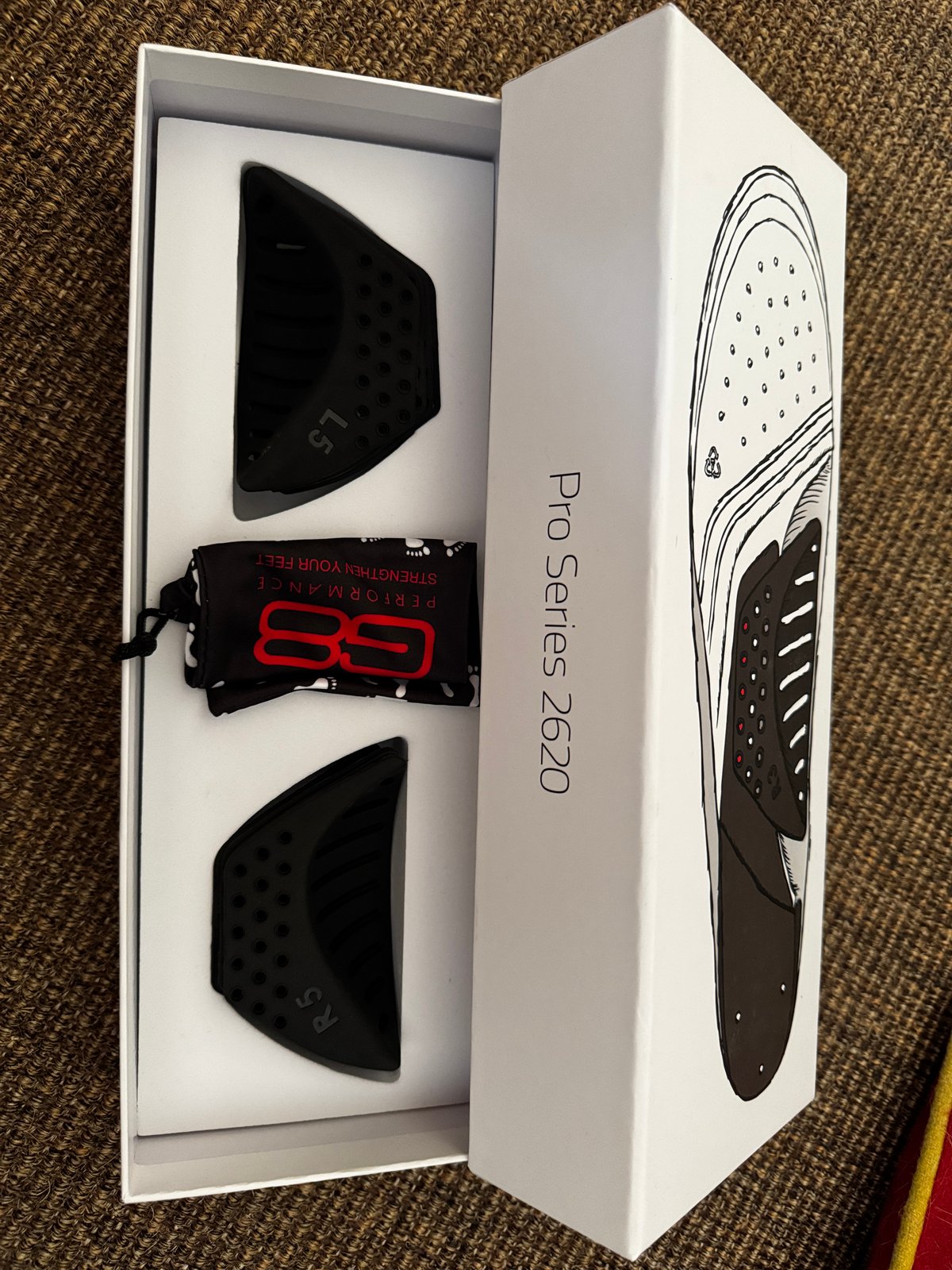
 G8 Pro Series 2620 Detailed Review and Additional Resources – Cycling Orthotics
As part of a long-overdue bike fit, the extra £100 I spent on my first pair of custom cycling orthotics was well worth it.
Despite the ravages of age eating away at my power, this bike fit has delivered me up some notable 1- 2 hour, all-time PBs/PRs on three of my regular local routes. The kit used on my latest rides was similar to previous bests, so these PBs/PRs came from either the bike fit, an unusual number of green lights, or more gym work than normal. Probably a combination of all 3, but I’m convinced the bike fit has delivered greater comfort and more aero.
Note: I bought these myself for my own long-term usage, and I paid for the bike fit myself. I have no connection with G8, but I would say I have a casual friendship with the bike fitter.
G8 insole Review
Verdict: Along with balanced wheels, these insoles have made the biggest positive improvement to my cycling this year. They have rekindled some of the joy and extinguished some of the discomfort.
Recommendation?
A: Yes
The G8 Performance Pro Series 2620 insoles are definitely worth considering by serious cyclists or those engaging in long-distance rides. Basically, anyone looking to improve comfort, enhance power transfer, and promote long-term foot health.
They have good adjustability out of the box, but you may also need the wedges or Metdomes, which do then add to the already high costs of a pair. That said, this is one of the best £100 I’ve spent.
Pros
- Enhanced Comfort/Lower Pain
- Sockless wear during a triathlon
- Increased Power Transfer/Efficiency
- Adaptable/Versatile Design
- Transfer between shoes
Cons
- Cost
- Adjustment Period
- Arch Piece Durability
- Unsure of durability as a running insole
- Supposedly can be used for running but I wouldn’t

My Foot Problem
Here are my old symptoms. Maybe you share some of these.
- My right knee pain seems to stem from the mechanics of my foot. The knee sometimes brushes against the top tube.
- I feel like my foot is almost falling off the side of the pedal, and that I’m riding on the outside of my forefoot.
- I do have an arch, but it could be higher
- The inner ankle of my right foot visibly collapses inwards – a common and sure sign that I need orthotics.
I do have custom running orthotics, but for years I’ve tried to cobble together my own cycling solution on my right foot, which only partly worked. I have some very nice Shimano S-Phyre RC9 road shoes, which offer a choice of arch support as standard. I chose the biggest support. Then I glued a wedge under the ball of my foot so that the inside of my sole made better contact in the shoe. This seemed to kinda work, but not really. To cut a very long story short (below!) I should have stumped up the £100 years ago.
My Bike Fitter
I used (and paid for with my own money) a bike fitter called Richard Melik. Through his company, Freespeed, he probably offers the best triathlon-focused bike fitter service in Richmond, South-West London, UK, also working in surrounding areas like Teddington, where I live. He used to be a RETUL fitter, ran his own Kona team, qualified for Kona himself, and also worked for Zwift for a while. He now works in a fitting space in a custom bike shop in Richmond.
Before working for Zwift, Richard used to be the de facto fitter for all the local triathletes and clubs, but a few local alternatives sprang up, and the £300 for the fit seems decent compared to those other options, many of whom are not triathlon-savvy.
More: Freespeed bike Fit Richmond, Teddington
Why G8 2620?
The insoles are highly adjustable. Having gone through the process with Freespeed, it’s definitely something I could have easily done myself – I’ll explain the process in a minute and link to various videos
You could go for more expensive custom orthotics that are moulded to your foot. However, it’s likely your foot will adapt to the insole and that further tweaks could be required after a few weeks. Unless you plan to get another set of custom orthotics, the G8 insoles offer a far easier and cheaper way to tweak the arch support multiple times.
The insoles are relatively thin, meaning that they shouldn’t take up too much more space inside your shoe. If you have a properly sized cycling shoe, there should be more than enough wriggle room to add G8. If your shoe is already tight, adding further bulk may cause other issues.
More complex fits than mine are catered for with additional heel (sub-talar ‘Met Domes’) wedges or metatarsal support pads, which cost extra.
How do you fit the insoles?
G8’s video, below, differs from what various other bike fitters suggest. Have a look at both.
To generalise:
- Remove your old insole and cut the G8 to the same size (above)
- Whilst sitting with no pressure on your feet and without using the insole, find the biggest arch support that will fit into your arch without protruding. It should be a less-than-snug fit, ie almost a snug fit
- Clip the arch to the insole as far towards the toe as possible. There should be no discomfort at all; if so, move it back. If there is discomfort, use a smaller one.
Neill’s fitting videos are excellent. Here he talks about the G8’s
Before and After Images
Here are the before and after images. I used a Grade 1 left arch and Grade 2 right arch. I’ve not shown an image from above as you can’t see the support – nor should you be able to!
The arches look and feel about right, but I suspect that a heel wedge could also be needed down the line.
Effect on Left-Right balance
This cycling dynamics data looks at two similar punchier rides, one with my old Favero Assioma DUO on the old bike fit and the recent one with my new Favero Assioma RS2 – I think both are using the same physical bike. They are on very similar courses and, coincidentally, at near-identical average power levels. My pedalling efficiency seems to have declined as a result of the bike fit, and the balance remains unchanged.
I don’t quite understand why the right-skewed balance remains, as my left leg is definitely stronger and the balance feels more equal to me. I have 3 crank-based power meters, and they all show a left balance skew – (52:48). However, I believe the Favero data more than any other power tech I have.
So the new insoles and new fit don’t appear to have made me more powerful or more power-efficient. if anything, it’s the opposite. The PB/PRs must be aero-related at least to some degree? That is probably the result of a newer, comfier saddle and better head position, but with otherwise similar reach and saddle height. Perhaps the increased comfort of the fit and the increased comfort in my feet helped maintain better positions for longer?
Effect on speed – Evidence
See…I’m really not making up the speed gains from the bike fit/insoles! These are two charts of my relatively frequent solo routes in the Surrey hills dating back over several years. You can see the number of rides and the definitely faster recent rides.
Comparison with Alternatives
The G8 Pro Series 2620 insoles are a middle-ground solution between mass-produced off-the-shelf insoles and fully custom orthotics, the latter of which cost over £250
While they do not require the precise casting and professional fitting of custom orthotics (which can cost £250-350), they offer a high degree of customisation at a more accessible price point. For individuals with complex medical conditions or highly specific foot issues, custom orthotics provided by a knowledgeable podiatrist may still be the optimal choice. Other popular alternatives include Specialized BodyGeo, Solestar, Superfeet, and Sole Insoles.
Why Cyclists May Need Orthotics: Categorised Breakdown
Custom or semi-custom orthotics, fitted by a podiatrist or bike fit specialist, address biomechanical issues to optimise performance, prevent injury, and enhance comfort in cyclists.
The hypochondriacs amongst you who need to find an excuse to buy some orthotics should consult these tables I curated from a few sources on the web. I would say that if you think you have a problem, you probably do. I wouldn’t look for a problem and buy orthotics hoping for a magical performance gain.
1. Performance Optimisation
Orthotics improve biomechanical efficiency, maximising power transfer and pedalling effectiveness.
| Factor | Symptom | Underlying Cause |
|---|---|---|
| Poor foot alignment (pronation/supination), Pedalling | Pedalling inefficiency, power loss | Misaligned foot causes energy leakage up the kinetic chain, reducing force transfer to the pedals. |
| Excessive foot movement in a shoe | Power loss, poor control | Instability in the shoe reduces force transfer efficiency and compromises bike handling. |
| Uneven leg length / pelvic asymmetry | Imbalanced pedal stroke, saddle shift | Asymmetry disrupts even power distribution, leading to compensatory movements. |
| Poor cleat alignment or float control | Inconsistent cadence or torque patterns | Suboptimal cleat position alters joint mechanics, causing inefficient pedalling dynamics. |
| Weak arch support | Reduced pedalling stability, early fatigue | Insufficient arch support fails to stabilise the foot, leading to energy waste and reduced force output. |
| Foot misalignment amplifies bike fit issues | Reduced power, uneven pedal stroke | Foot misalignment exacerbates improper saddle height or bike fit, disrupting kinetic chain efficiency. |
2. Injury Prevention
Orthotics mitigate biomechanical issues that contribute to acute or chronic cycling injuries.
| Factor | Symptom | Underlying Cause |
|---|---|---|
| Flat feet (pes planus) | Knee or ankle pain, fatigue | Lack of arch support causes overpronation, overloading joints during repetitive pedalling. |
| High arches (pes cavus) | Metatarsalgia, hot spots | Rigid feet concentrate pressure at the forefoot and heel, increasing pain on long rides. |
| Forefoot varus/valgus | Toe numbness, pressure points | Abnormal angles create uneven pressure distribution, compressing nerves or tissues. |
| Knee valgus/varus under load | Medial/lateral knee pain | Foot misalignment causes faulty knee tracking, stressing ligaments. |
| Recurrent Achilles/calf tightness | Calf cramps, heel pain | Improper foot positioning increases Achilles loading during plantarflexion. |
| Uneven leg length | Low back pain, hip discomfort | Asymmetrical load causes muscle imbalances, straining the lower back and hips. |
| Plantar fasciitis | Heel or arch pain during/after rides | Lack of proper arch support or cushioning strains the plantar fascia. |
| Overuse of intrinsic foot muscles | Foot cramps, fatigue | Unsupported foot muscles overwork to stabilise during high-intensity or long-distance rides. |
3. Comfort and Nerve Protection
Orthotics enhance comfort by reducing pressure points and protecting nerves during prolonged cycling.
| Factor | Symptom | Underlying Cause |
|---|---|---|
| Poor metatarsal support | Numb toes, tingling (neuroma) | Nerve compression from inadequate forefoot cushioning. |
| High arches or rigid feet | Arch pain, poor shoe fit | Lack of natural cushioning increases stress on the arch in stiff cycling shoes. |
| Improper shoe-foot interaction | Blisters, hot spots | Micro-movements and lack of stabilisation cause friction and irritation. |
| Cleat misalignment | IT band tightness, hip pain | Rotational force travels up the kinetic chain improperly, straining connective tissues. |
| Inadequate shock absorption | Foot fatigue, joint discomfort | Lack of cushioning amplifies impact from road vibrations, especially on long or gravel rides. |
| Narrow or tight toe box | Toe crowding, discomfort | Insufficient space exacerbates pressure on toes, worsened by misaligned feet. |
4. Long-Term Joint Health
Orthotics support joint health by addressing repetitive stress and improper loading patterns.
| Factor | Symptom | Underlying Cause |
|---|---|---|
| Chronic foot misalignment | Early-onset osteoarthritis in knees/hips | Repetitive improper loading accelerates joint wear over time. |
| Uncorrected leg length discrepancy | Spinal misalignment, chronic back pain | Asymmetrical pedalling forces contribute to pelvic tilt and spinal stress. |
| Excessive pronation/supination | Ankle instability, recurrent sprains | Overcompensation during pedalling weakens ankle ligaments, increasing injury risk. |
sources & Resources
Here are some links to science and various other resources.
- Neill Stanbury Fitting
- DIY Bike Wheel Balancing – XR-One – brilliant, noticeable improvement.
- G8 Fitting Video
- Buy one!
- G8 Performance Website
- Asplund, C., & St. Pierre, P. (2004). Knee pain and bicycling: Fitting concepts for clinicians. The Physician and Sportsmedicine, 32(4), 23–30.
- Callaghan, M. J. (2005). Lower body problems and injury in cycling. Journal of Bodywork and Movement Therapies, 9(3), 226–236.
- Clarsen, B., Krosshaug, T., & Bahr, R. (2010). Overuse injuries in professional road cyclists. American Journal of Sports Medicine, 38(12), 2494–2501.
- Hunt, G. C., & McPoil, T. G. (2004). Footwear and foot orthoses in sports. Physical Therapy in Sport, 5(2), 67–74.
- Schwartz, E. N., & Su, J. (2014). Plantar fasciitis: A concise review. The Permanente Journal, 18(1), e105–e107.
- Chevalier, T. L., & Chockalingam, N. (2012). Effects of foot orthoses on cycling biomechanics. Footwear Science, 4(2), 135–143.
- Yeo, E. D., & Bonanno, D. R. (2014). The effect of foot orthoses on lower limb muscle activity and kinematics during cycling. Journal of Foot and Ankle Research, 7(1), 23.
- Silberman, M. R. (2013). Bicycling injuries. Current Sports Medicine Reports, 12(5), 337–345.
- Wanich, T., et al. (2007). Cycling injuries of the lower extremity. Journal of the American Academy of Orthopaedic Surgeons, 15(12), 748–756.
- Bailey, M. P., et al. (2003). Leg length discrepancy and its effect on cycling performance. Sports Biomechanics, 2(2), 189-199.
- Dinsdale, N. (2012). The effect of foot orthoses on cycling biomechanics. Journal of Science and Cycling, 1(2), 45-50.
- Gregor, R. J., & Wheeler, J. B. (1994). Biomechanical factors associated with shoe/pedal interfaces in cycling. Sports Medicine, 17(2), 117-131.
Take Out
I guess these are expensive for what they are. However, for the benefit and value they have given me, I’m delighted.
Like me, you could check that your fitter will also look at your orthotics (not all do) and then use orthotics as a prompt to get a bike fit update.
While someone else fitted them for me, it was a straightforward process, and you could easily do it yourself.
My overall bike fit makes me feel more comfortable, and it looks a bit more aero—hence the speed increases. My left foot feels unchanged; however, on my right side, I really do feel a noticeable difference with the foot/shoe/pedal interface. My foot feels flatter, I feel contact over the full width, and my right knee pain seems to have miraculously vanished in two weeks.
Last Updated on 29 January 2026 by the5krunner
Reader-Powered Content

This content is not sponsored. It’s mostly me behind the labour of love, which is this site, and I appreciate everyone who supports it.
Support the site: Follow (free, fewer ads) · Subscribe (paid, ad-free) · Buy Me A Coffee ❤️
All articles are written by real people, fact-checked, and verified for originality. See the Editorial Policy. FTC: Affiliate Disclosure — some links pay commission. As an Amazon Associate, I earn from qualifying purchases.
tfk is the founder and author of the5krunner, an independent endurance sports technology publication. With 20 years of hands-on testing of GPS watches and wearables, and competing in triathlons at an international age-group level, tfk provides in-depth expert analysis of fitness technology for serious athletes and endurance sport competitors.

There must be at least a 20 Watt loss from that leg hair!
A couple of thoughts on the left/right balance and pedaling efficiency:
1. L/R balance is very close to 50:50 already and the difference is probably within the margin of error/accuracy limitation of the power meters (especially for crank-based ones, which are notorious for wonky L/R balance). => If it feels as good (you actually say it feels better), I would not worry about it.
2. Pedaling efficiency is a terrible term. I am sure you know the (fairly simple) computations behind Torque Effectiveness and Pedaling Smoothness and while they intituitvely seem ‘interesting’ and potentially useful, I have yet to see studies that show any meaningful correlation between Pedaling efficiency metrics and performance – and some extremely high performing cyclists (including UCI pros) have terrible PE numbers. So I do not pay any attention to PE any longer and I believe most serious coaches do not either (even if Rehook claims otherwise).
Generally, I am quite suspicious of the direct Performance Enhancement considerations from equipment. Take shoe stiffness/power transfer: proper studies indicate that there is no difference in power/power transfer between stiff shoes and softer ones – rather, the benefits seem to be feel (more locked in and controlled feel, more ‘direct’ feel of power). Not that that stops me from using stiff carbon-soled shoes…
I _am_ a big believer in the injury prevention, joint protection, etc. aspects (especially important for cycling – more than running) and the performance benefits from improved comfort – and aero gains, of course.
yes!
interesting on the shoe stiffness comment: my best feelign shoes that i seem to go the fastest with are not the stiffest.
direct performance enhancement: consider shorter cranks. Thus anything that can get a better hip position might impove blood flow in some people and, as you say, anything that imrpoves comfort and aero must be good
Yes, agree on crank length. I still do not get all the (supposed) superior power transfer physics around shorter cranks (not disagreeing, just have not thought through it enough), but in terms of sustained power levels changing to 165mm cranks on my road bike brought significant improvement purely because of the mechanics (like hip angle) before even getting into blood flow etc.
This was an interesting post! How about for running? Any thoughts or recommendations for running orthotics? Would the G8’s be good?
they are supposed to also be for running
however i dont think the plastic supports would last a huge amount of time – that’s me guessing. i suppose you could use them to get your arch to adapt over a few weeks and then get custom orthotics or orthotics that match the level of support. i ahve custom ones