Sudden Cardiac Death Risk Screening: The Next Health Feature for Apple, Garmin, and Google Watches
Chinese smartwatch brand, Honor, has announced a feature that Apple, Google, and Garmin could implement with existing optical sensors, as shown by 2023 tests with Garmin smartwatches.
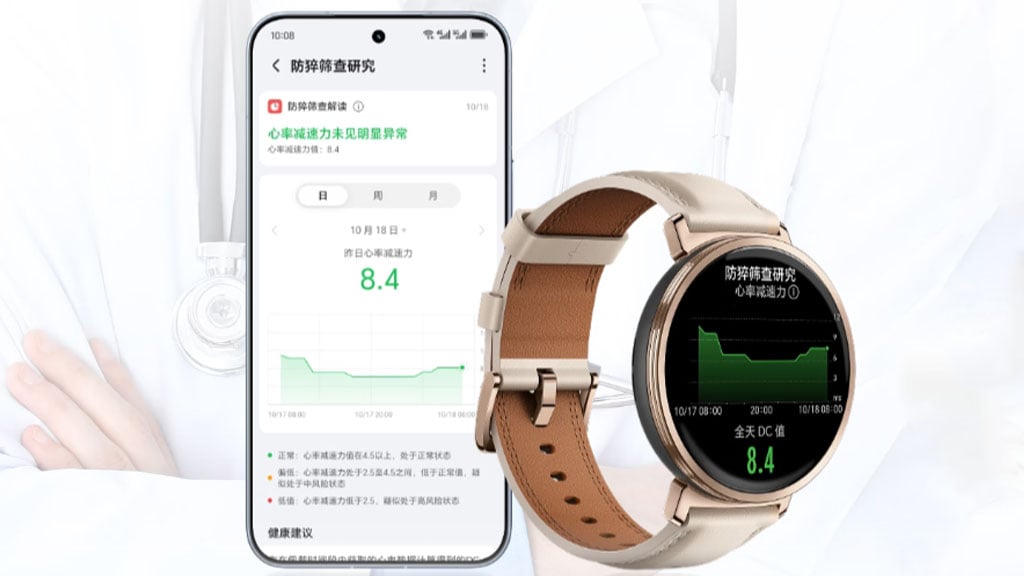
The Honor Watch GS 5 (January 2026) uses an oddly phrased feature that covers “anti-sudden cardiac arrest screening.” Beyond the marketing language, there is a peer-reviewed technique dating back two decades which existing smartwatches from Apple, Garmin, and others already capture sufficient data to implement.
What Honor’s Feature Actually Does
Honor’s “sudden cardiac arrest screening” does not detect cardiac arrest events — it assesses the risk of sudden cardiac death (SCD) by measuring deceleration capacity (DC). Deceleration capacity quantifies vagal modulation of heart rate, i.e. how well your heart can slow down when it needs to. People with poor DC have a significantly higher risk of sudden cardiac death, even when other risk factors appear normal.
The Science
A 2006 study published in The Lancet, covering over 2,700 heart attack survivors across three medical centres, found that deceleration capacity predicts death more accurately than ejection fraction (how well the heart pumps) or standard heart rate variability (HRV) measures. Later research confirmed the findings in other groups: Heart failure patients, Heart attack survivors, People with type 1 diabetes, and Patients on certain medications.
The gold-standard method requires 24 hours of heart rate monitoring with a Holter monitor. However, studies show that shorter recordings of 30-120 minutes (even 5 minutes) can identify high-risk individuals, making it practical for smartwatches.
Current Smartwatches Can Already Do This
A 2023 study in the European Heart Journal – Digital Health tested a Garmin smartwatch against medical-grade ECG equipment in 263 patients, including both ill and healthy control subjects. The researchers specifically measured deceleration capacity and found good agreement between the Garmin and clinical equipment.
Separate research using Apple Watch data found that deceleration capacity was among the most important metrics when analysing heart rate variability, and could be reliably calculated from Apple Watch recordings.
The hardware exists. The data is being collected. What’s missing is the software to analyse it and regulatory approval to launch the feature.
The Regulatory Challenge
The FDA allows wellness features to launch without approval, but diagnostics require clinical trials and regulatory clearance. To stay in the former category, the inevitable option, companies use careful language:
- Apple says “irregular rhythm notification” — not “AFib diagnosis”
- Apple says “signs of chronic high blood pressure” — not “hypertension diagnosis”
- Honor says “cardiac arrest screening” and “risk assessment” — not “prediction”
How It Would Work
The method is broadly this
Data collection: The watch continuously monitors resting heart rate over days or weeks, recording RR intervals (the raw interbeat intervals used in HRV calculations).
Analysis: It determines points where HR decelerates (R-R increases), then averages R-R intervals immediately before and at the deceleration point. A bigger difference (shorter before, longer at the point) means the deceleration is more substantial, and the DC score is better due to a healthier vagal response.
Rather than a raw number, a smartwatch would likely present the DC score as a trend compared to your normal range to give
- A risk category (low/moderate/elevated)
- Trends over time (improving / stable / declining)
- A recommendation to see a doctor if the results are concerning
What it cannot do: Predict when a cardiac event will happen, diagnose a specific condition, or replace a medical evaluation. DC indicates risk, not certainty.
Who Would Benefit Most
The studies mentioned earlier cover people with cardiac risk factors, and it could be argued that they would have medical supervision in any case. Thus, the feature, when used on a smartwatch, is most applicable to older adults, as cardiac risk increases with age. Essentially, it is helpful for people who have no idea that such a condition could be developing or who have no way to monitor it between doctor’s visits.
This Could Arrive More Widely In 2026
I don’t see any obvious barriers to this happening in 2026 for any company sufficiently motivated to release the feature. The data is already there, and companies are well versed in how to market these features and keep the FDA happy. To me, it seems simple: implement another background algorithm, add some code and display the results.
Perhaps the biggest hurdle is the public’s awareness of this issue (low) and demand for it (presumably low but would be higher with raised awareness).
I would not bet that DC is added, as there are several other metrics that indicate heart health, e.g., ST-segment analysis. Those that can be determined by PPG (optical sensors rather than ECG) are easier to add as background measures. There is no reason to think Garmin would implement DC before others.
Likely scenario: Probably attractive to any company desperately seeking a new wellness feature to market to ageing demographics. That sounds like Apple (a Health+ subscription feature), Garmin (a Connect+ subscription feature), and maybe Google, too – a Fitbit subscription feature!
Summary
Despite Honor’s clumsy and proprietary name, “anti-sudden cardiac arrest screening” uses a clinically validated method with nearly 20 years of published evidence. Published studies confirm that Apple Watch, Garmin, and similar devices already have the sensors to produce the same metric.
The feature will not predict cardiac events or diagnose heart conditions. But for people with cardiac risk factors, continuous monitoring of how well their heart can slow down could flag problems early — potentially before symptoms appear for them or other ageing populations.
The technology exists. The science is validated. The sensors are already in use. It is known how to handle the FDA. Implementation is now a matter of commercial priority.
References
- The 2006 Lancet Study (Foundational Science): Schmidt, G., et al. “Heart-rate deceleration capacity as a predictor of mortality after myocardial infarction.” The Lancet, 2006.
- The 2023 Garmin/Medical Comparison Study: Theurl, F., et al. “Smartwatch-derived heart rate variability: a head-to-head comparison with the gold standard in cardiovascular disease.” European Heart Journal – Digital Health, 2023.2
- The Apple Watch ECG/HRV Pilot Study: Velmovitsky, P. E., et al. “Using Apple Watch ECG data for heart rate variability monitoring and stress prediction: A pilot study.” Frontiers in Digital Health, 2022.4
Smartwatch health features are not substitutes for medical care. If you have concerns about your cardiac health, consult a healthcare provider.
Last Updated on 31 January 2026 by the5krunner
Reader-Powered Content

This content is not sponsored. It’s mostly me behind the labour of love, which is this site, and I appreciate everyone who supports it.
Support the site: Follow (free, fewer ads) · Subscribe (paid, ad-free) · Buy Me A Coffee ❤️
All articles are written by real people, fact-checked, and verified for originality. See the Editorial Policy. FTC: Affiliate Disclosure — some links pay commission. As an Amazon Associate, I earn from qualifying purchases.

tfk is the founder and author of the5krunner, an independent endurance sports technology publication. With 20 years of hands-on testing of GPS watches and wearables, and competing in triathlons at an international age-group level, tfk provides in-depth expert analysis of fitness technology for serious athletes and endurance sport competitors.

Check the sentence where’s 9even 5), something wrong there 😃
9=(
and my large fingers
thank you!
thank you FZ
Sadly Google will beg to differ! It’s hard to compete with the Google algorith that favours larger generlist tech sites
Eventhough Garmin could do this on plenty of old watches, they will pack it and sell it for 2k€ in Fenix 9 only 🙂