The Problem With Indoor Pace
Modern GPS watches are genuinely good outdoors. Indoors, without a satellite signal, they fall back on the wrist accelerometer — measuring wrist movement, applying an assumed stride model, and outputting an estimated pace. That estimate degrades quickly when your mechanics shift: interval sessions, incline changes, fatigue-altered form.
The result is familiar to anyone who trains seriously on a treadmill. Watch pace lag during accelerations and drift during steady efforts, producing splits that don’t reflect what actually happened. For structured training, this matters. Pace targets and recovery monitoring become unreliable when the underlying data is wrong.
The established workarounds are a foot pod strapped to the lace, manual treadmill speed entry, or post-run calibration. None of them is seamless.
How RunBridge Works
Many current treadmills broadcast speed, distance, and incline data over Bluetooth using the FTMS (Fitness Machine Service) protocol. The treadmill knows exactly what speed the belt is running at and is advertising that number wirelessly. The problem is that most running watches do not natively consume FTMS data during indoor runs.
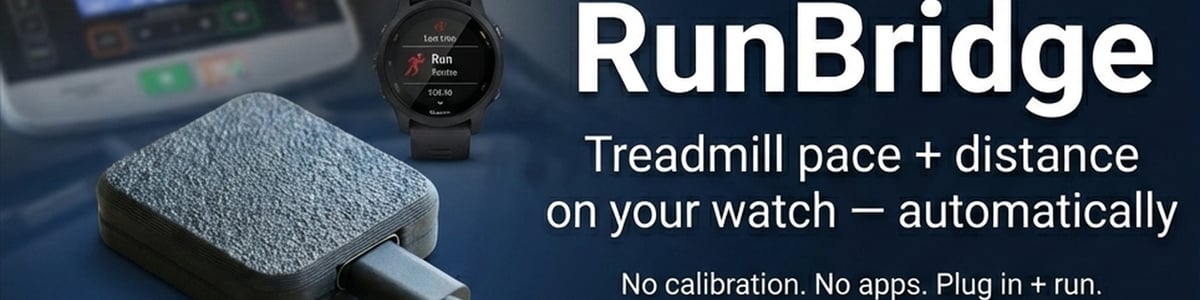
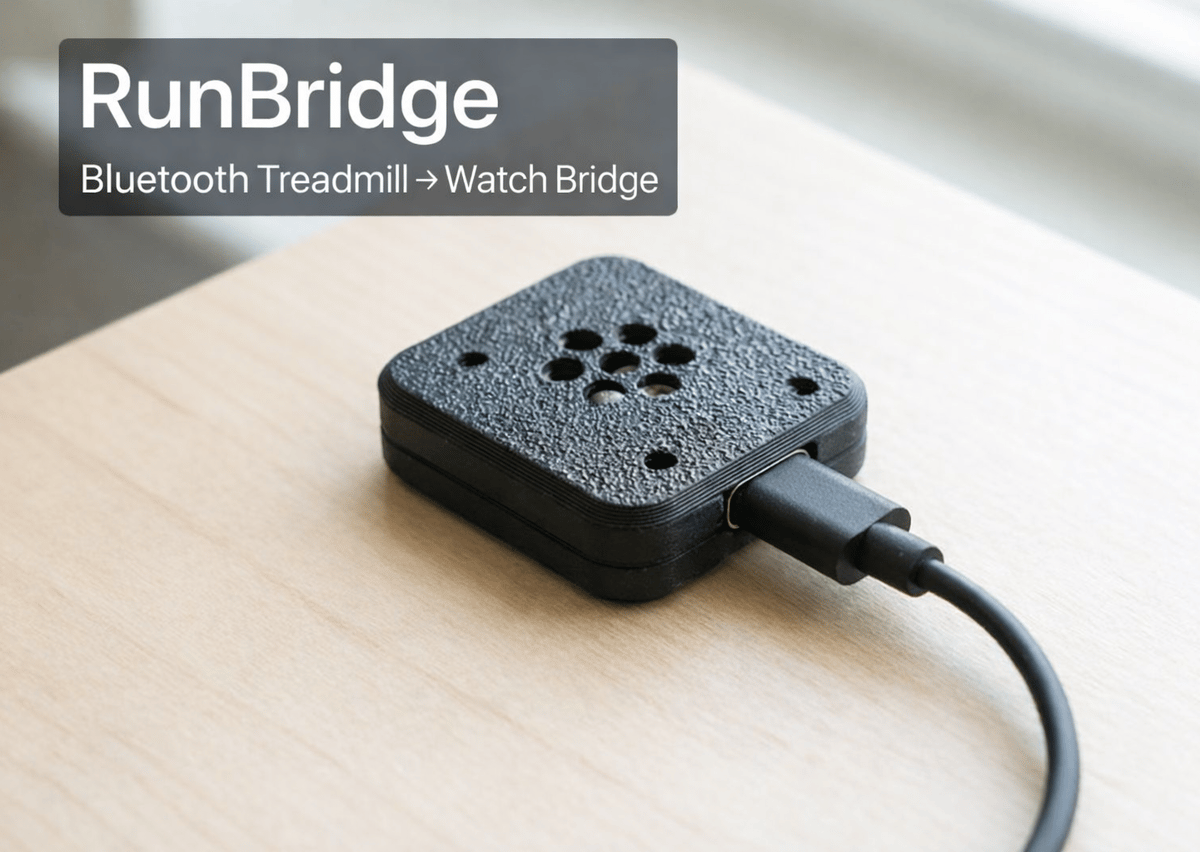
RunBridge is a small USB-powered adapter built around the nRF52840 chip. It sits between the treadmill and the watch and does two things:
- Listens to the treadmill’s FTMS broadcast in real time
- Retransmits that data as a standard BLE Running Speed & Cadence (RSC) profile
To the Garmin, RunBridge looks exactly like a traditional Bluetooth footpod. It pairs in the same menu, appears the same way on the activity screen, and feeds pace data the same way a Stryd or Garmin foot pod would — except the speed value comes from the treadmill’s own computer, not a motion sensor.
There is no app, no cloud sync, and no calibration step.
Setup
The setup process is about as short as it gets:
- Turn the adapter on— plug RunBridge into a stable 5V USB power source. Either a wall adapter or the treadmill’s built-in USB port works well. Most power banks are not suitable as they detect the low current draw and cut power, causing the adapter to drop out mid-run.
- Pair to the watch — open the Sensors & Accessories menu on the Garmin and pair RunBridge as you would any Bluetooth footpod.
- Run — start the indoor run activity as normal. Pace data flows from the treadmill through RunBridge to the watch automatically.
There is nothing to mount on the belt, nothing to align, and no hardware to recalibrate between sessions.
Treadmill Compatibility
RunBridge requires the treadmill to actively broadcast the FTMS protocol over Bluetooth. This is common on mid-range and premium treadmills from the last few years, but it is not universal.
Compatible: Treadmills that broadcast FTMS over Bluetooth — this is common on current NordicTrack, Sole, Horizon, and similar commercial-grade home machines. If the treadmill’s Bluetooth is used for fitness app connectivity (iFit, Kinomap, etc.), it is likely broadcasting the FTMS protocol.
Not compatible: Older treadmills, basic budget treadmills, and closed-ecosystem machines (Peloton, some Life Fitness commercial units) that use proprietary Bluetooth protocols or no Bluetooth at all.
Step-by-step instructions for checking compatibility on your specific treadmill using the nRF Connect app are available at runbridge.dev.
Alternatives
RunBridge only works with smart treadmills that broadcast information.
If you have a more basic treadmill that broadcasts nothing, consider NPE RUNN whihc measures the physical belt speed, incline, and your cadence and broadcasts those.
Things to Note
Accuracy is the treadmill’s accuracy.RunBridge delivers exactly the speed the treadmill computer reports. If the treadmill itself is miscalibrated — a known issue with belt wear on older machines — the watch will faithfully reflect that. RunBridge is a relay, not a correction.
Cadence is estimated, not measured.RunBridge does not capture true step cadence. It uses its own algorithm to estimate a cadence value from treadmill speed data, which populates the cadence field on the watch. It is a calculated estimate rather than a direct measurement.
One treadmill connection at a time.RunBridge connects to a single FTMS source. If multiple FTMS-capable machines are within Bluetooth range it will connect to the first one found. Practical in most home gym setups; worth being aware of in commercial gym environments.
Pricing and Availability
- Complete Unit — Ships to US & Canada: $59.99 — Fully assembled and ready to use. Plug in and pair — nothing else required.
- DIY Kit — Ships Worldwide $25.00 – Includes firmware, full components list, and the 3D-printable case model. Assembly is minimal — the board drops into the printed case and slides shut. No soldering or electronics experience required.
TFK10 at checkout for 10% off either option.RunBridge Information and Purchase
Both options are available through the RunBridge Etsy shop. Full documentation and the list of compatible treadmills are available at runbridge.dev.
Background
RunBridge was developed by a runner-engineer based in the US. It started as a personal fix: winter training blocks on a Bluetooth-capable treadmill were producing pace data that didn’t match the belt speed, and building a solution was faster than accepting the inaccuracy.
After solving it for personal use, the decision was made to make it available to other runners with the same problem. RunBridge is a one-person operation — designed, built, and supported by the same person who still uses it on every indoor run. The firmware is actively developed, with ongoing refinements driven by real-world training rather than a product roadmap.
Summary
For runners using a Bluetooth FTMS treadmill with a Garmin watch, RunBridge directly addresses the indoor pace-accuracy problem. It requires no calibration, no companion app, and no changes to how you set up or run a session. The watch receives accurate speed data from the treadmill’s computer and presents it through the standard footpod interface.
It does not solve every indoor training data problem — cadence is an estimated value derived from speed rather than a direct measurement, and overall accuracy depends on the treadmill’s calibration. But for structured interval work and consistent pace logging through winter, it closes the gap that the accelerometer can’t.
Complete unit $59.99 (US/Canada) · DIY kit $25.00 (worldwide) · Use code TFK10 for 10% off · runbridge.dev
The link and discount code are not affiliated… just a great deal for readers! Enjoy.
Author: Brian, founder of Runbridge, edited by the5krunner
The previous Indie Spotlight covered Pacier Garmin.
Last Updated on 3 October 2026 by tfk the5krunner
Small things I always use
- Garmin 90-degree charging adapter: Charges your Garmin from any USB-C cable. Essential when travelling. I use one.
- Body Glide: The blue anti-chafe stick swimmers and runners carry. I use it.
- Speedo earplugs: Fewer ear infections and no cold-water dizziness. I use them.
- Dryrobe Advance: My winter changing robe for open-water swims. I use one. A cheaper option is the AONYIYI changing robe.
- Maurten: Race fuel that stays easy on the stomach. I use them.
- Garmin charging puck: The quickest way to top up before a session. I use one.
- Injinji: Toe socks that stop rubbing, so you run more. I use them.
- Ultimate toe protectors: Stop black toenails on long runs. They work. I use them.
- Compressport R2 v2 calf sleeves: My calf sleeves of choice. I use them.
- Cellucor C4: My pre-workout before hard sessions.
- TPU tubes: Schwalbe Aerothan, Tubolito and Pirelli SmarTube. Light, tiny spares. I use all three.
- G8 insoles: Adjustable insoles that are good. I use them.
- Cycplus Cube: A 97g electric pump that gets a road tyre rideable in two minutes. I carry one. 5% off with code THE5KRUNNER.
Watches and sensors
- Polar H10: My daily driver for waking HRV.
- Polar Verity Sense: My backup arm-worn HR sensor.
- Nomad bedside charger: Charges my iPhone and Apple Watch overnight. I use it, and many of their bands.
- Train.Red: The best muscle oxygen sensor I’ve used.
- Tymewear: Accurate heart rate and reliable ventilatory zones. I use it to pace endurance rides over an hour.
- Garmin Forerunner 970: A pro-grade triathlon watch. I use this.
- Apple Watch Ultra 4: My daily smartwatch. No phone needed on rides.
- Garmin Fenix 9 Pro: I’ve just bought one.
On the bike
- Continental GP5000 for everyday riding, and Aero 111 on the front for special occasions.
- Helmets: Specialized S-Works Evade 3 for road riding, and Rudy Project Wing for TT-style races. I use both.
- Ravemen FR300: A front light that mounts under your Garmin or Wahoo. I use one.
- Wahoo TRACKR Radar: I use it on one bike and Varia on the other. They perform the same.
- Garmin Varia RTL515: Radar that warns you of cars from behind. I use this model.
- Wahoo ELEMNT Roam 3: The bike computer that’s easy to use. I use mine on most rides.
- Favero Assioma Pro RS2: Accurate power pedals that swap easily between bikes. I use this model.
Home and indoor training
- NPE Runn: Makes my basic treadmill smart, sending more accurate speed and distance to my watch and Zwift. I use it.
- Google Wifi: Keeps Zwift connected in my pain cave. I use it.
- Apple TV 4K: Zwift on the big screen. I use two.
- Google Nest Doorbell (wired, 2nd gen): My video doorbell, running in both Google Home and Apple Home. I use it.
Health, recovery and sleep
- FreeStyle Libre 3 Plus: Shows how my blood sugar responds to diet.
- hDrop: Measures my sweat loss in summer and indoors.
- Fourth Frontier Zone: Checks my heart under load in hard sessions.
- Oura Ring 5: My partner’s recovery tracker of choice.
- Kineon MOVE+: Red light therapy for niggles. It works.
- Eight Sleep: A cooling mattress cover my partner and I use nightly.
Reader-Powered Content

This content is not sponsored. It’s mostly me behind the labour of love, which is this site, and I appreciate everyone who supports it.
Support the site: Follow (free, fewer ads) · Subscribe (paid, ad-free) · Buy Me A Coffee ❤️
Written by real people, with AI assistance. Fact-checked and verified for originality. See the Editorial Policy. FTC: Affiliate Disclosure — some links pay commission. As an Amazon Associate, I earn from qualifying purchases.
tfk is the founder and author of the5krunner, an independent endurance sports technology publication. With 20 years of hands-on testing of GPS watches and wearables, and competing in triathlons at an international age-group level, tfk provides in-depth expert analysis of fitness technology for serious athletes and endurance sport competitors. ID

This is neat – however I already own a NPERunn and a Stryd (which by using Runcline, I can gather pace/power/incline).
Is this device able to be used to gather in incline only to a Garmin watch like the 965? I’m not sure how it would do that if I’m getting pace/speed from the Stryd.
im not sure https://apps.garmin.com/apps/6e90be3d-e880-4ece-aa27-3cd169143e3b
you wont be able to specuify which fields are sent and received but my guess woul dbe that stryd when set as the default speed/distance indoors would overwrite speed/distance from another sensor…leaving incline.
thats my guess
I don’t see how that would work – where would it be getting the incline from in that case? There isn’t a dedicated BT datastream for incline as far as I know on Garmin watches.
idk, sy
Now if only Apple would allow a footpod connection.
they do, albeit via apps like Stryd.
3rd party manufacturers can link any (most?) sports sensors that way – smo2, glasses HUDs, core temp, etc
The biggest problem is treadmill inaccuracy. Only the most expensive and best models reflect the belt’s speed with the actual pace. However, if someone uses a home treadmill, it’s almost certain that they’ll start cheating at lower or higher speeds. That’s why the Footpod doesn’t have any real competition yet, because distance and pace are actual parameters of the legs, not the treadmill itself.
Furthermore, NPE Runn clearly shows the sine wave generated by the treadmill when the runner’s shoe touches it. The heavier the runner, the more pronounced the effect. The stride doesn’t change, but the input data for pace and distance does. Therefore, it’s not worth relying entirely on the belt’s measurements, unless we’re talking about top-of-the-line treadmill models that are proven and have a top-of-the-line motor. However, most people buy cheap treadmills…
Agree. While the data accuracy limitations on watches are very real for indoor runs, many treadmills are even worse (because they are low-end models, poorly calibrated, have wear & tear, etc…).
I get _huge_ (10% or more) discrepancies in pace/distance between my F8 and the treadmill in one condo gym. I am very confident that the numbers from the watch are closer to reality. So unlike for other treadmills, I do _not_ do a calibration based on the treadmill data at the end of runs.
Simply check QZ, it does more than this without any additional hardware! http://qzfitness.com