Whoop Sues Bevel: Bevel Confirms It Is Up for the Fight
Whoop has sued Bevel in a case that looks like David versus Goliath, but Bevel is bigger than it first appears. Whoop has 2.5 million members, a $10.1 billion valuation, and an IPO confirmed as the next step. Bevel has no hardware but over 500,000 monthly active users*, a paid subscription tier, a loyal following, and is up for the fight.
Whoop pioneered the screenless athletic recovery band and is now evolving into a full health platform. It has faced hardware competition from Polar Loop and Amazfit Helio Strap, which has attracted most of the attention because it is a direct product rivalry. Bevel is different and has largely slipped under the radar. It is a software-only platform that pulls data from Apple Health and other sources and presents it in a way that Whoop users would find immediately familiar. for an overview of the full competitive landscape, see our guide to recovery trackers and lifestyle bands.
Whoop is almost certainly clearing the decks ahead of its IPO. Its CEO has confirmed there will be no further private funding rounds. That process means removing obvious hardware copycats, as it did with Lexqi, pursuing competitors like Polar, and now protecting the look and feel of its app.
On the face of it, the case has merits. Bevel looks like Whoop. Many of its users say so openly. I think they look similar. For someone considering whether they need a Whoop band and subscription, discovering a free or low-cost app that delivers a similar experience on hardware they already own is a reason not to buy. That is a real commercial threat, even if the two products are not direct substitutes.
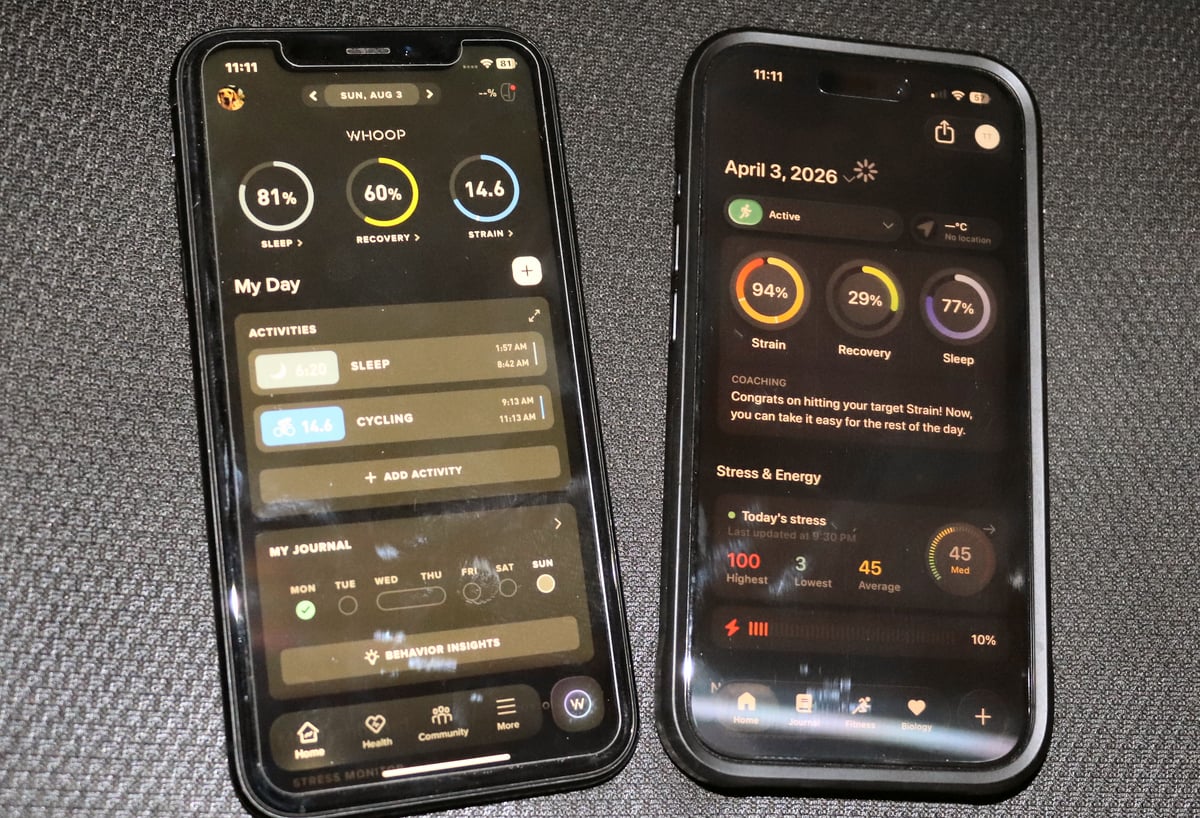
That is the nub of it. Here are some more facts, some you may already know, and some new.
What Whoop is claiming
Whoop claims Bevel copied its app: the look, the feel, the way health data is presented.
- The interface so closely resembles Whoop’s that a user could confuse the two.
- Bevel’s UI reproduces elements of Whoop’s underlying code.
- Four patents are cited, covering biometric data processing and recovery scoring.
The core legal question is “trade dress”, or “passing off” in the UK, i.e. would a reasonable person encountering Bevel confuse it with Whoop? Given that Bevel integrates with Garmin, Apple Watch, and Oura and is widely described by its own users as a Whoop experience for those devices, that association is not difficult to make.
The apps do look similar.
Place both home screens side by side as we did in the earlier image, and the visual similarity is clear. Three circular dials: strain, recovery, sleep. A coaching panel beneath. The same hierarchy. Whoop has spent a decade building an identity around those circular dials. The argument that a lookalike app in the same market dilutes is not unreasonable, particularly with a public listing ahead.
Bevel’s counter-argument
Bevel points to a timestamped post on X from December 29, 2023, showing its three-circle layout displaying strain, recovery, and sleep. Whoop introduced its three-ring home screen with the launch of Whoop 5.0 on May 8, 2025, seventeen months later.
What happens next
A source close to Bevel told this site that the company is “financially secure to see this case through to the end“*. Expect nothing to change in the short term. Various procedural delays make a temporary injunction unlikely, so this one should go straight to trial, which could take over a year.
As for where this case ends up, it is hard to say without seeing the precise patent claims. On the trade dress argument, and with the timeline as it stands, Whoop’s case looks superficially strong on the home screen layout.
* Source: this site.
Quick answers
What is trade dress, and why does it apply here?
It is the legal protection for a product’s overall look and feel. Whoop argues that Bevel’s app is visually similar enough to its own that a user would associate the two.
Is Whoop claiming to own the words 'strain' and 'recovery'?
No. The case is about the cumulative visual presentation, not individual metric labels.
Does it matter that Bevel has no hardware?
It complicates Whoop’s case. Bevel does not sell directly against Whoop, but users cite it as a reason not to buy a Whoop band. That is the commercial harm that Whoop is arguing.
Who introduced the three-circle home screen first?
Bevel published a screenshot showing that layout on December 29, 2023. Whoop introduced its three-ring screen with Whoop 5.0 on May 8, 2025, seventeen months later.
Why does Whoop's complaint show Bevel in dark mode?
Bevel’s default is light mode. Whoop’s screenshots use dark mode, which makes the two apps look more similar than they do out of the box.
Can Bevel be forced to change its app while the case runs?
Unlikely. Whoop went silent for nearly a year before filing. Courts weigh that delay when deciding whether to grant a temporary injunction.
How long will this take?
Cases of this kind typically run over a year before reaching trial.
What would a Whoop win mean for the industry?
It would establish that a health app’s visual presentation can be protected as trade dress, with implications for every third-party platform sitting above wearable hardware.
Is Bevel still available to use?
Yes. No ruling has been made, and nothing has been ordered to change. The app is live and unchanged.
Does Bevel actually call its metric strain the same word Whoop uses?
Yes. Bevel uses strain and recovery as primary metric labels. Whoop cannot trademark those words, but the choice to use the same terminology contributes to the overall similarity argument.
Why did Whoop approach Bevel about collaboration before suing?
In June 2024, a Whoop corporate development employee contacted Bevel proposing a partnership. Bevel was six months old and declined. Five months later, Whoop sent a cease-and-desist letter. Bevel’s founder has described the sequence as shocking.
Did Whoop try to settle before filing?
Lawyers exchanged correspondence for several months after the cease-and-desist. Whoop stopped responding around May 2025 and filed suit in March 2026 without advance notice.
Has Whoop won similar cases before?
Yes. In February 2026, a federal court granted Whoop a preliminary injunction against Lexqi, a Chinese manufacturer whose screenless tracker the court found almost identical to Whoop’s hardware. That case concerned physical design rather than the app interface.
Is there anyone else involved beyond Whoop and Bevel?
Two of Bevel’s publicly announced advisers resigned in the months following August 2024. One cited his institution’s relationship with Whoop. The Whoop 5.0 press release credits Dr Eric Verdin, chief executive of the Buck Institute for Research on Ageing, as a named development partner. Verdin had been announced as a Bevel adviser nine months earlier.
For full context on WHOOP hardware, accuracy, and competitive position, see the WHOOP hub.
For full context on WHOOP hardware, accuracy, and competitive position, see the WHOOP hub.
Last Updated on 3 October 2026 by tfk the5krunner
Small things I always use
- Garmin 90-degree charging adapter: Charges your Garmin from any USB-C cable. Essential when travelling. I use one.
- Body Glide: The blue anti-chafe stick swimmers and runners carry. I use it.
- Speedo earplugs: Fewer ear infections and no cold-water dizziness. I use them.
- Dryrobe Advance: My winter changing robe for open-water swims. I use one. A cheaper option is the AONYIYI changing robe.
- Maurten: Race fuel that stays easy on the stomach. I use them.
- Garmin charging puck: The quickest way to top up before a session. I use one.
- Injinji: Toe socks that stop rubbing, so you run more. I use them.
- Ultimate toe protectors: Stop black toenails on long runs. They work. I use them.
- Compressport R2 v2 calf sleeves: My calf sleeves of choice. I use them.
- Cellucor C4: My pre-workout before hard sessions.
- TPU tubes: Schwalbe Aerothan, Tubolito and Pirelli SmarTube. Light, tiny spares. I use all three.
- G8 insoles: Adjustable insoles that are good. I use them.
- Cycplus Cube: A 97g electric pump that gets a road tyre rideable in two minutes. I carry one. 5% off with code THE5KRUNNER.
Watches and sensors
- Polar H10: My daily driver for waking HRV.
- Polar Verity Sense: My backup arm-worn HR sensor.
- Nomad bedside charger: Charges my iPhone and Apple Watch overnight. I use it, and many of their bands.
- Train.Red: The best muscle oxygen sensor I’ve used.
- Tymewear: Accurate heart rate and reliable ventilatory zones. I use it to pace endurance rides over an hour.
- Garmin Forerunner 970: A pro-grade triathlon watch. I use this.
- Apple Watch Ultra 4: My daily smartwatch. No phone needed on rides.
- Garmin Fenix 9 Pro: I’ve just bought one.
On the bike
- Continental GP5000 for everyday riding, and Aero 111 on the front for special occasions.
- Helmets: Specialized S-Works Evade 3 for road riding, and Rudy Project Wing for TT-style races. I use both.
- Ravemen FR300: A front light that mounts under your Garmin or Wahoo. I use one.
- Wahoo TRACKR Radar: I use it on one bike and Varia on the other. They perform the same.
- Garmin Varia RTL515: Radar that warns you of cars from behind. I use this model.
- Wahoo ELEMNT Roam 3: The bike computer that’s easy to use. I use mine on most rides.
- Favero Assioma Pro RS2: Accurate power pedals that swap easily between bikes. I use this model.
Home and indoor training
- NPE Runn: Makes my basic treadmill smart, sending more accurate speed and distance to my watch and Zwift. I use it.
- Google Wifi: Keeps Zwift connected in my pain cave. I use it.
- Apple TV 4K: Zwift on the big screen. I use two.
- Google Nest Doorbell (wired, 2nd gen): My video doorbell, running in both Google Home and Apple Home. I use it.
Health, recovery and sleep
- FreeStyle Libre 3 Plus: Shows how my blood sugar responds to diet.
- hDrop: Measures my sweat loss in summer and indoors.
- Fourth Frontier Zone: Checks my heart under load in hard sessions.
- Oura Ring 5: My partner’s recovery tracker of choice.
- Kineon MOVE+: Red light therapy for niggles. It works.
- Eight Sleep: A cooling mattress cover my partner and I use nightly.
Reader-Powered Content

This content is not sponsored. It’s mostly me behind the labour of love, which is this site, and I appreciate everyone who supports it.
Support the site: Follow (free, fewer ads) · Subscribe (paid, ad-free) · Buy Me A Coffee ❤️
Written by real people, with AI assistance. Fact-checked and verified for originality. See the Editorial Policy. FTC: Affiliate Disclosure — some links pay commission. As an Amazon Associate, I earn from qualifying purchases.
tfk is the founder and author of the5krunner, an independent endurance sports technology publication. With 20 years of hands-on testing of GPS watches and wearables, and competing in triathlons at an international age-group level, tfk provides in-depth expert analysis of fitness technology for serious athletes and endurance sport competitors. ID

I find Whoop to be an extremely unlikable company. Personally, I also think it’s way overpriced.
I wish Bevel the best of luck; hopefully they’ll win.
This lawsuit actually made me switch from Whoop to Bevel instead. So I’d say they are not handling this great, especially after last years subscription changes.
Super predatory move from Whoop. If this is how they plan to deploy fresh capital, by lawyering up and going after competitors that are software players, not hardware, it’s a desperate look.
Garmin Cirqa and Google Fitbit are coming in full force to eat their lunch which is going to expose just how fragile Whoop’s overpriced, influencer-driven subscription model really is.
Go Bevel!