Forma: Garmin Recovery Data to Structured Strength Workouts
Garmin watches collect recovery data every night. HRV status, Body Battery, sleep score, training load ratio. The numbers are there every morning. For runners and cyclists, Garmin translates this data into Daily Suggested Workouts and Training Readiness scores. For strength training, the translation stops. The watch can tell you your Body Battery is 35, but it has no opinion on what that means for your gym session.
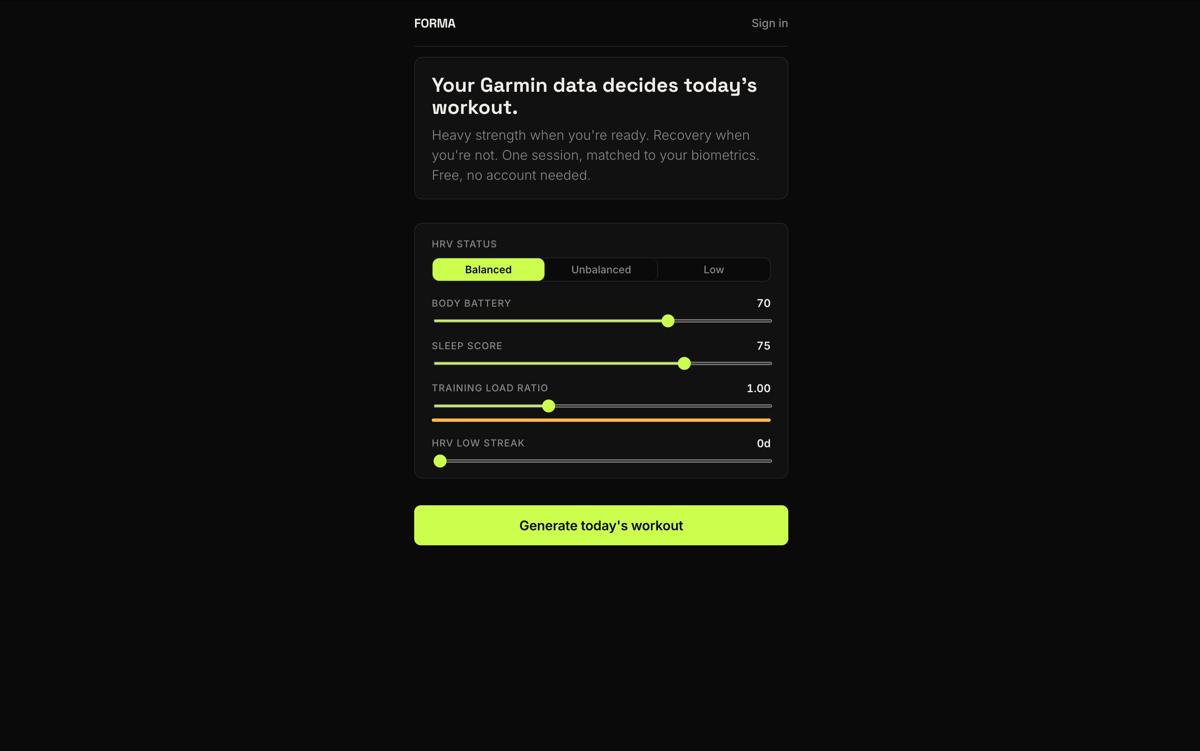
Forma is a free web-based tool that attempts to close that gap. It takes four Garmin recovery metrics as input and generates a structured strength workout matched to the user’s recovery state that day. No account required, no app to install, and no AI involved. The engine is entirely deterministic.
What Problem Does It Solve?
Most Garmin users who lift weights are in one of two camps: they either ignore their recovery data entirely when planning gym sessions, or they look at it, draw some vague conclusion about how recovered they are, and then do whatever they were planning to do anyway.
The second group is the interesting one. They already believe the data has value. The friction is in the translation. Going from “my Body Battery is 52 and my HRV is unbalanced” to “today should be a moderate hypertrophy session, not a heavy day” requires a set of rules that Garmin does not provide for strength training.
Forma provides those rules. Enter the numbers, and the tool returns a complete workout: session type, exercises, sets, reps, rest periods, and coaching cues. The same inputs will always produce the same output. There is no randomisation, no machine learning, and no subjective override.
How the Readiness Engine Works
The engine takes four inputs: HRV status (balanced, unbalanced, or low), Body Battery (0 to 100), sleep score (0 to 100), and training load ratio (acute-to-chronic). Each is normalised and weighted into a composite readiness score:
- HRV status carries the highest weight (40%), reflecting its established role as a recovery indicator
- Body Battery contributes 25%, capturing overnight autonomic recovery
- Sleep score accounts for 20%
- Training load ratio carries 15%, flagging overreaching before it becomes a problem.
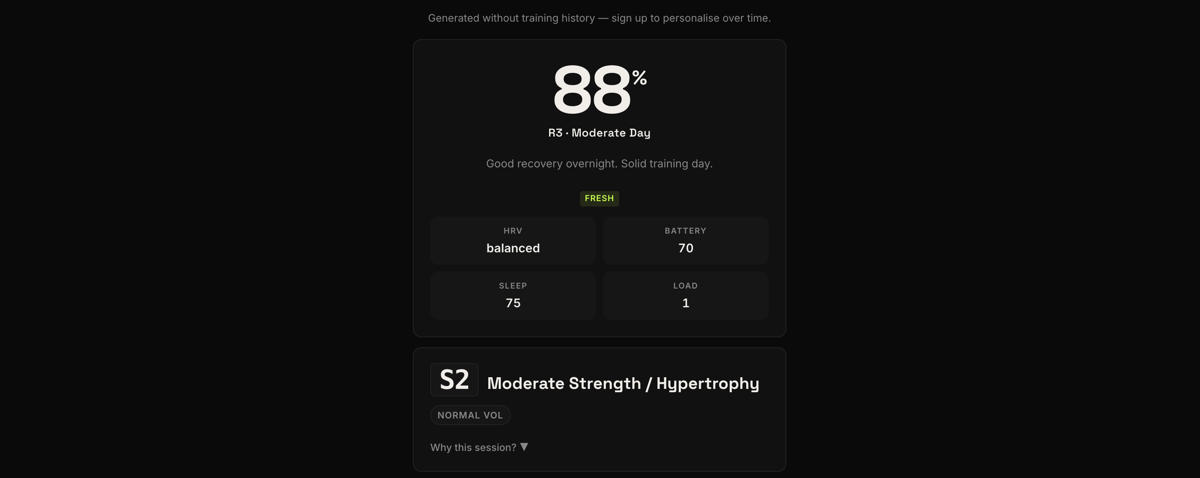
The composite score maps to one of four readiness tiers:
- R4 (Train Hard): All systems are recovered. Heavy compound work is available.
- R3 (Moderate): Moderate strength and conditioning. The most common tier, with roughly half of all user sessions landing here.
- R2 (Easy): Conditioning or low-intensity only. The body is managing accumulated load.
- R1 (Recover): Active recovery. The engine will not prescribe any demanding work.
Hard overrides exist for edge cases: two consecutive days of low HRV force R1 regardless of other metrics. Body Battery below 30 caps the tier at R2. A training load ratio above 1.5 forces R1.
What a Workout Looks Like
Each readiness tier unlocks a set of session types. R4 allows heavy strength (S1), moderate strength (S2), or conditioning (S3). R3 allows S2 and S3 only. R2 is limited to conditioning and zone 2 work. R1 prescribes active recovery.
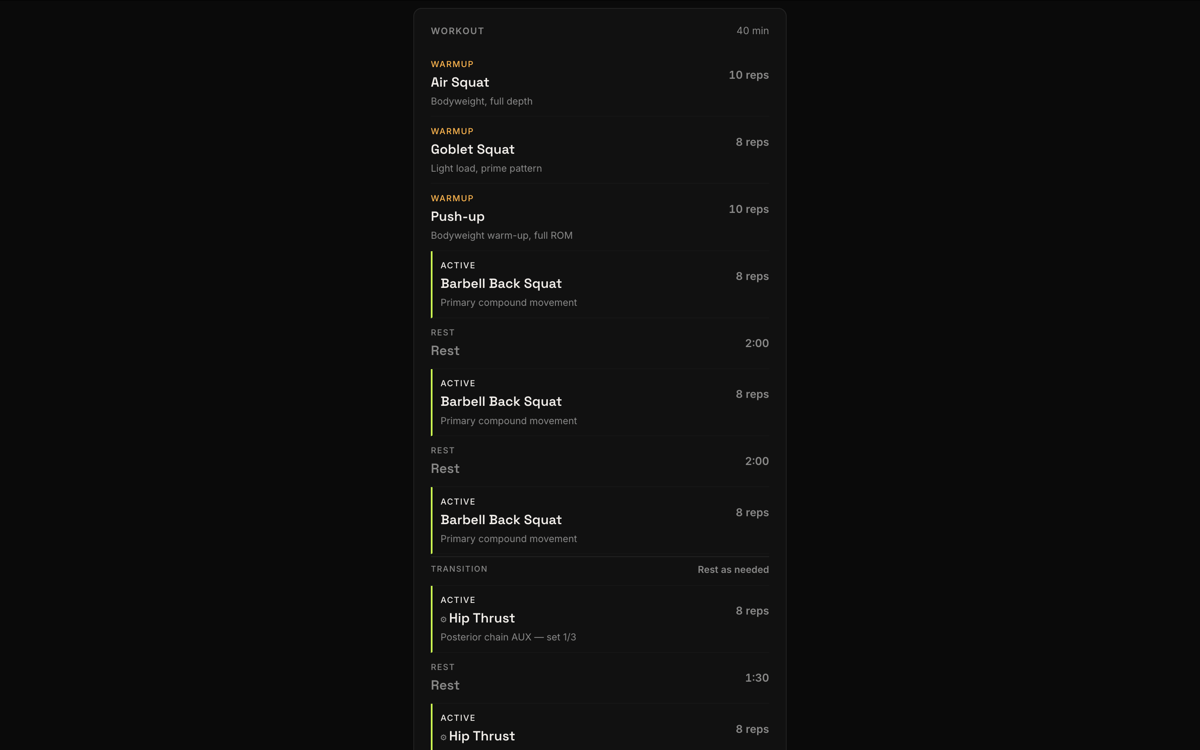
Once the session type is selected, the engine builds the workout from block templates. An S1 Heavy Strength session, for example, includes a primary hinge or squat pattern at low reps and high intensity, a secondary push or pull pattern at moderate reps, and auxiliary core work. An S2 Moderate Strength session shifts toward hypertrophy ranges, with higher reps, greater volume, and broader movement-pattern coverage.
For users who create a free account, exercises rotate between sessions using a deterministic pattern rotation system. If the user trained a hinge pattern yesterday, the engine deprioritises hinge-dominant sessions today and promotes squat- or push-dominant sessions instead. This serves two purposes: it prevents repetitive sessions. It ensures weekly muscle group coverage and serves as a basic form of muscular fatigue management by avoiding the same movement patterns on consecutive days. The user does not need to think about any of this.
Every workout includes a warm-up, main working blocks with specific sets, reps, and rest periods, and a cool-down. Coaching cues are attached to exercises, covering topics such as bracing, tempo, and eccentric control.
Device Compatibility
Forma currently works with any Garmin watch that reports Body Battery, HRV, sleep score, and training load. This covers most of the Forerunner, Fenix, Enduro, and Venu lines. Mid-range watches like the Forerunner 255 lack Training Readiness, but the Forma does not. It works directly from the raw metrics.
Some watches lack a training load ratio or sleep score. The tool handles this with default values. The training load ratio defaults to 1.0 (balanced), and users without a sleep score can leave it at the default. The engine still functions, though with slightly less precision.
This is worth noting: Forma is not a Garmin app. It is a web tool (app.forma.coach) that currently requires manual input of metrics. The user checks their Garmin, enters the numbers, and receives the workout. Garmin API integration for automatic data ingestion is in development.
What It Does Not Do
Forma does not yet track what happens during the workout. The current version does not log sets, count reps, or measure bar speed. Weight tracking and progressive overload are on the development roadmap. Still, today the tool focuses exclusively on the pre-workout decision: what type of session to do, and exactly what that session should contain.
It also does not fully account for muscular fatigue. Garmin’s recovery metrics are biased toward cardiovascular and autonomic recovery. HRV, Body Battery, and sleep score reflect the central nervous system and cardiac readiness. They say nothing directly about whether your quads have recovered from Tuesday’s squat session. The pattern rotation system described above partially mitigates this by avoiding repeated loading of the same muscle groups, but it tracks movement patterns rather than actual tissue recovery. This is a limitation that no wearable currently addresses well for strength training.
Forma does not run a multi-week periodisation programme. Each day’s workout is prescribed independently based on that morning’s recovery state. There is no mesocycle structure, no planned deload week, and no progressive overload curve. In practice, the engine produces a natural autoregulation pattern. Users report roughly one easier week every three to four weeks, driven by recovery signals rather than a calendar. This is emergent, not programmed.
Current State and Roadmap
Forma launched in early access in April 2026 as a free, no-login tool. In its first week, over 150 unique users generated nearly 300 workout decisions, entirely through organic word of mouth. The readiness tier distribution across all users follows a natural bell curve centred on R3 (Moderate), which suggests users are entering real data rather than gaming the inputs.
The next phase adds automatic Garmin data ingestion via OAuth2, removing the need for manual input. After that, the plan is push-to-watch: generating the structured workout and sending it directly to the Garmin device so it is waiting on the user’s wrist when they arrive at the gym.
The tool is built and maintained by a solo developer training on a Forerunner 255.
Summary
Forma is a free tool that turns Garmin recovery metrics into structured strength workouts. It fills a specific gap: the missing link between Garmin’s recovery data and a concrete decision about what to do in the gym. The engine is deterministic, the workouts are specific, and the limitations (particularly around direct muscular fatigue measurement and periodisation) are openly acknowledged.
For Garmin users who already check their recovery data each morning and then wonder what to do with it, Forma provides the answer. Try it at app.forma.coach. No sign-up required.
Forma is an independent project. It is not affiliated with or endorsed by Garmin or the5krunner. The tool is currently free during early access.
FAQ
Which Garmin watches work with Forma?
Any Garmin watch that reports Body Battery, HRV status, sleep score, and training load is fully compatible. This includes most models in the Forerunner, Fenix, Enduro, and Venu lines. Watches that lack a training load ratio or sleep score still work. The engine substitutes default values for missing metrics, so the workout output remains functional with slightly reduced precision.
Does Forma replace a strength training programme?
It replaces the daily session selection, not the long-term programme. Forma prescribes each day’s workout independently based on that morning’s recovery data. It does not manage multi-week periodisation, planned deload weeks, or progressive overload targets. Owners following a structured programme from a coach can use the readiness tier as a guide to session intensity, while relying on their programme for exercise selection and progression.
How does Forma handle back-to-back gym days?
Registered users benefit from a pattern rotation system that tracks which movement patterns were trained in recent sessions. If a hinge pattern was loaded yesterday, the engine deprioritises hinge-dominant work today and promotes squat or push patterns instead. This reduces the risk of loading the same muscle groups on consecutive days. The rotation is deterministic and requires no manual input beyond entering recovery metrics each morning.
Last Updated on 13 April 2026 by the5krunner
Reader-Powered Content

This content is not sponsored. It’s mostly me behind the labour of love, which is this site, and I appreciate everyone who supports it.
Support the site: Follow (free, fewer ads) · Subscribe (paid, ad-free) · Buy Me A Coffee ❤️
All articles are written by real people, fact-checked, and verified for originality. See the Editorial Policy. FTC: Affiliate Disclosure — some links pay commission. As an Amazon Associate, I earn from qualifying purchases.
tfk is the founder and author of the5krunner, an independent endurance sports technology publication. With 20 years of hands-on testing of GPS watches and wearables, and competing in triathlons at an international age-group level, tfk provides in-depth expert analysis of fitness technology for serious athletes and endurance sport competitors.
