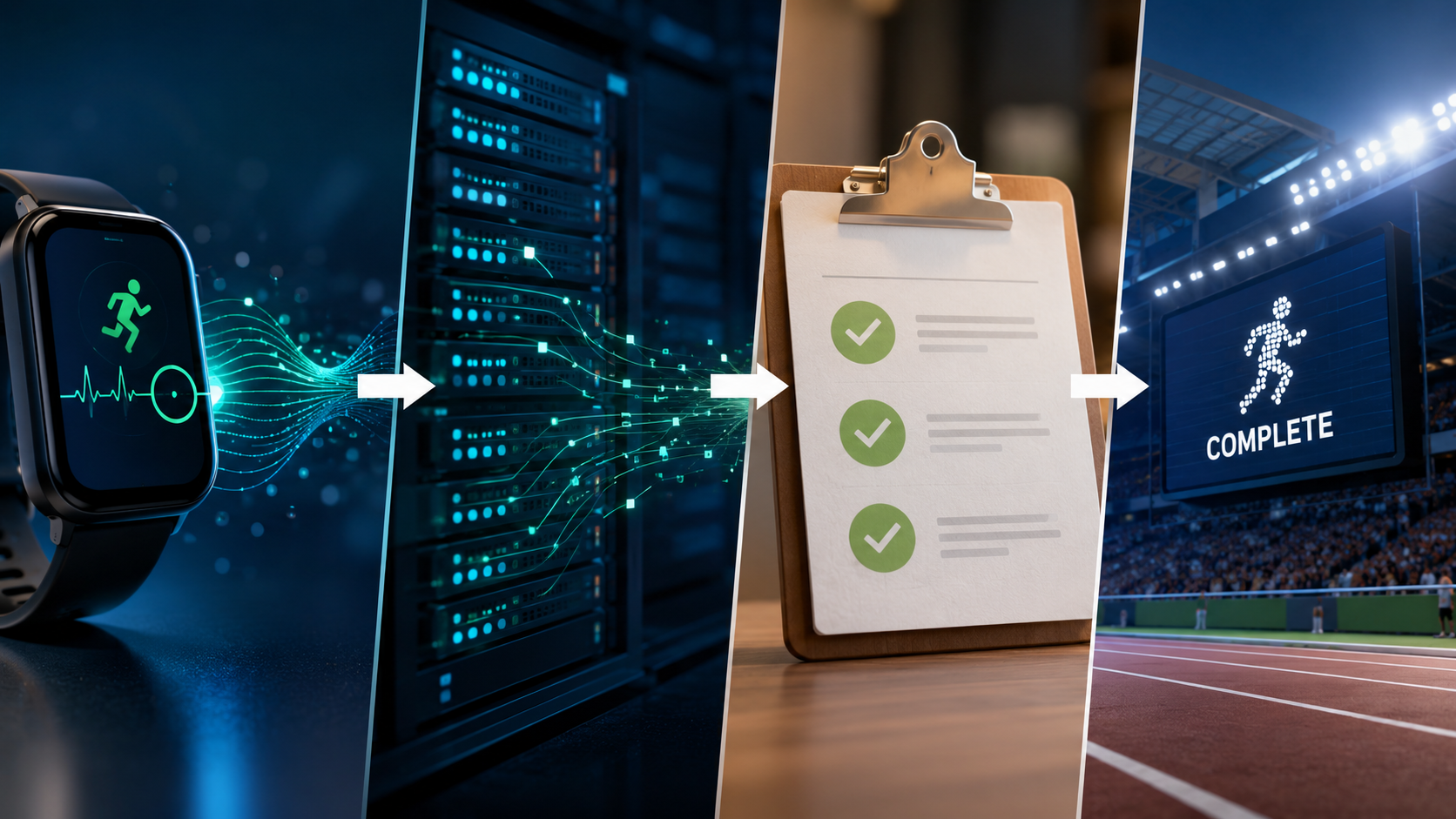
Two devices can record the same run and still disagree on your distance, pace, or heart rate. A training platform may produce a third value after you upload the data, while an event service publishes yet another result. When you read a metric, trace it through four stages: capture, interpretation, validation, and distribution. Each stage answers a different question about where the number came from and what it is fit to represent.
A wearable device does not begin with a finished sporting metric. It records signals such as reflected light, acceleration, or changing positions, and then software converts them into familiar values. A Frontiers review of wearable technology and analytics distinguishes variables collected by sensors from the analytical work used to translate them for athletes and practitioners. That separation explains why two systems can begin with similar observations, yet display different results. Filtering, model assumptions, and treatment of missing readings can all affect the interpreted value.
The same data can be perfectly adequate for one purpose and incomplete for another. A number shown during training may only need to indicate a useful pattern, while a competition record may require precise timing, clear attribution, and confirmation against an accepted event state. The receiving system determines which details matter, which checks are necessary, and how much uncertainty can be tolerated.
Once a record has been interpreted, its useful form depends on what the receiving system needs to decide. A coach may accept a smoothed heart-rate trace because the aim is to see an effort pattern. Race timing needs an identified participant, a checkpoint, and a timestamp. A broadcast graphic may combine an event with positional information to explain where an action occurred.
Time-sensitive competitive activities require another structured form. Information gathered for esports betting usually relies on recognized fixtures, match states, and outcomes, rather than a feed of raw keystrokes or every movement made by a player. A completed round or confirmed match result performs a different job from telemetry used to study how players reached it.
Esports illustrates the same pipeline under different physical constraints. Player movement is confined to a keyboard and mouse rather than a track or a road, so the sensors that produce pace, cadence, or heart rate have no equivalent role to play. Rankings and match states arrive instead from the game client and the tournament system, then pass through the same interpretation and validation questions as a GPS trace: what does this number mean, and what is it fit to confirm.
Capture and interpretation create different errors
Capture concerns the first observation in traditional sports. Optical sensors measure changes in reflected light, accelerometers record movement, and positioning systems calculate location from timed signals. Other sporting records begin with timing mats, cameras, human observation, or game servers. The source determines what can be recovered later. A short gap in a continuous trace may be estimated from neighboring samples, but a missing discrete event is much harder to deal with.
The raw data is then often processed in some way. Values may be put through a smoothing function to hide random noise and make actual trends easier to spot, and measurements from multiple different systems may be combined.
Validation changes the status of a record
Validation asks whether interpreted information is plausible and suitable for its intended use. A training service might remove an outlier, especially if it seems to indicate an error in recording, rather than a noticeable moment. The system may also match identities, reconcile timestamps, or check a result against another record. The required standard rises with the consequence of the decision. An athlete reviewing an easy run can tolerate uncertainty that would be unacceptable in a published placing or competition record.
Validation also has limits. It can identify known faults, apply agreed rules, and produce an accepted version, but it cannot recreate information that was never captured. Nor does an accepted result make every underlying stream equally accurate. A corrected finish time, cleaned GPS trace, and analyzed power file can each be valid for different purposes without becoming interchangeable.
Distribution can hide the earlier stages
Distribution decides which version gets displayed to the end user. Each destination may receive a different level of detail because each has a different task. The athlete may see rolling pace during a run, the coach may inspect the full file later, and an event page may publish only accepted checkpoints and finishing times.
Combining streams introduces another problem: alignment. A Scientific Data study integrating football event and positional data describes event records with timestamps and labels, alongside coordinates for players and the ball. Because the streams were generated through separate processes, simple timestamp matching could produce errors, so the researchers applied a synchronization method. More data does not automatically create one coherent account. Definitions, identifiers, and timing must also agree.
When two numbers conflict, start with the chain rather than the screen. Identify the original observation, the calculation applied, the validation performed, and the purpose of the displayed version. That sequence shows whether the disagreement began during measurement, interpretation, checking, or delivery. The right number is not always the one with the cleanest presentation or greatest precision. It is the one produced by a process that fits the decision being made.
Last Updated on 5 August 2026 by the5krunner

theparkrunner is a contributing writer covering road races, endurance events and the travel side of racing life. Reports focus on upcoming events, race destinations and what athletes need to know before they arrive.
