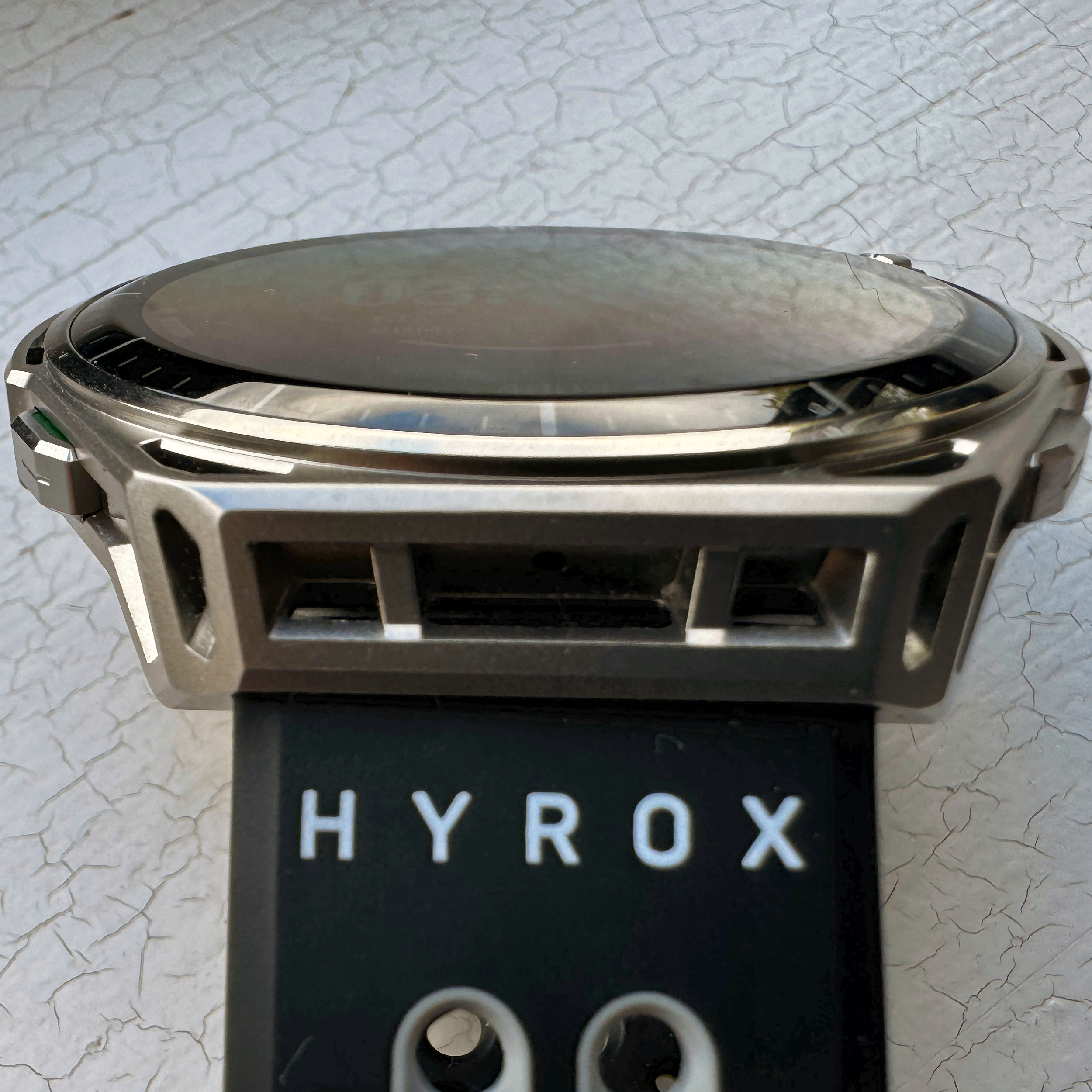
Amazfit Balance 3 review: the HYROX watch tested
The Amazfit Balance 3 is the first dedicated HYROX sports watch, and that is the reason to buy it over its predecessor. Balance 3 gives HYROX athletes dedicated race modes, hybrid recovery scoring and a HYROX training platform that no Garmin, Coros or Suunto matches.
At £369.90 for stainless steel and £449.90 for titanium, the new model is £70 more expensive than the Balance 2, which, when on sale, is a good buy if hybrid training is not your thing. For the extra money you’ll also get full maps and the HYROX coaching platform that Garmin lacks, but the key word of caution is ‘size’: this is a big watch and unsuited for small wrists.
Heads up: this is a media loaner, and the brand does not pay for the review. If you want to support the independent work here, please buy through one of the affiliate links or become a supporter. I have been a GB age-group multisport athlete for over 15 years and am currently training for a HYROX, so this watch arrived at a useful time. For me, sports tech makes the sport more interesting, which is why this site exists.
Amazfit Balance 3
Amazfit Balance 3
Amazfit is the only smartwatch brand with dedicated HYROX features, including a Race Mode that automatically tracks the 8 stations and runs. The battery lasts up to 21 days (7-10 in real-world use), and HybridCharge combines recovery, training load, and lifestyle factors into a broader readiness score than most rivals. Zepp Coach adds adaptive training plans across 180+ sports modes, plus Bluetooth calls and Zepp Pay. GPS accuracy lags behind the class leaders.
Pros
- Only watch with official HYROX race modes, PFT benchmarking and a dedicated training library
- Button-free tracking over all 8 HYROX stations plus the 1km runs on race day
- HybridCharge combines objective and subjective recovery data, for potentially the most complete recovery picture
- Stryd support for accurate indoor pace in the HYROX arena
- Durable, premium build: stainless steel or titanium case, sapphire lens, four buttons plus a rotating crown
- Bright display, readable in direct sunlight
- Strong heart rate accuracy in the gym and on the bike
- 180+ sports modes, including 25 auto-recognised strength exercises
- Full offline maps and turn-by-turn navigation
- Long battery life claimed: 21 days or 41 hours in GPS mode
- Bluetooth calling, Zepp Pay contactless payments and a dual-colour LED flashlight
- Mature Zepp Coach ecosystem, syncing to TrainingPeaks, Strava, Runna and Intervals.icu
Cons
- GNSS/GPS accuracy average by 2026 standards
- Heart rate drifts on some outdoor runs, with occasional dropouts
- Large 51.4mm case unsuited to small wrists
- Map rerouting doesn’t update reliably after a wrong turn
- Garmin’s app store is far larger: roughly 4,000 apps against Zepp’s 500, plus extras like Spotify
- Muscular strain needs the separately sold Helio Strap Pro, not yet widely available, and only works during a HYROX race
User Review
( votes)What’s new? Balance 3 vs Balance 2
The Balance 3 keeps the Balance 2’s optical sensor and its dual-band GPS, and changes the case from aluminium and polymer to the more durable stainless steel or grade 5 titanium. The display is brighter, and the lens uses tough sapphire glass.
There are four buttons now rather than two, and the top right one is a rotating crown, which all work together nicely with the touchscreen to give a highly usable experience.
Storage doubles to 64GB, and the watch gains the HYROX modes and HybridCharge that the Balance 2 never had. The full Amazfit Balance 3 specifications are set out separately for those wanting more detail, and a detailed comparison of Balance 3, Balance Ultra and Balance 2 is here.
The changes are in materials, screen and software, rather than the internal components. Hence, any difference in tracking accuracy (HR/GPS) comes from the new case material, antenna placement, and firmware rather than a new sensor. More on that later.
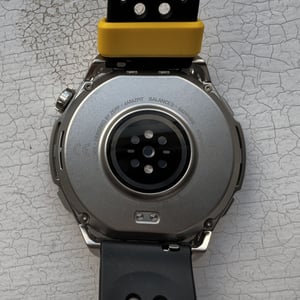
Build, screen and wearability.
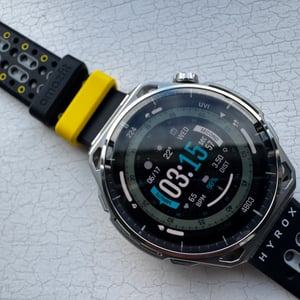
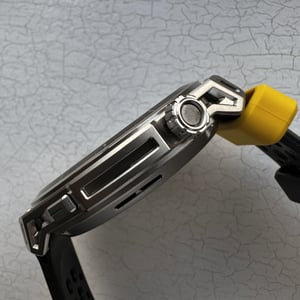
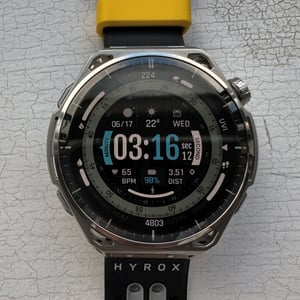
The 51.4mm Balance 3 is a big watch that will not suit everyone. To me, it seems to look OK on average wrists like mine as its thinness helps avoid the impression of the case towering over the wrist. A big screen, or even an oversized one, is great for sport in my opinion, but this Amazfit looks good the rest of the day too. Consider if an oversized screen works for you outside of sport.
The screen is bright enough to read even in direct sunlight. The supplied strap is perfectly fine but nothing special. The separately sold HYROX-edition strap is my favourite branded accessory from the company; it’s comfortable and worth getting, though the yellow band might be an acquired taste for some!
How I tested
I tested the Balance 3 against a Garmin Forerunner 970, a Garmin HRM 600 chest strap, a Polar Verity Sense, a Fourth Frontier Zone ECG strap, a WHOOP MG and used the DCR Analyser tool. Four of my write-ups on the accuracy tests are shown below; representative ones I included were a HYROX sim, long hilly bike ride, long tempo run and a pool swim.
HYROX and hybrid training
Amazfit’s HYROX features are impressive. You get most of what you need out of the box except a full, personalised plan targeted towards your race day and the ability to create on-the-fly workouts. Specifically, the full feature set currently covers benchmark tests, pre-built workouts, structured training modes, race simulations, race day mode and post-workout analyses.
- HYROX P’F”T mode: Official Physical Fitness Test template for benchmarking
- HYROX Workout Library & training templates (sync from Zepp app)
- HYROX Training Mode: Free training + structured options (AMRAP, EMOM, Tabata)
- Race simulation options (full course, half course, etc.)
- Dedicated HYROX Race Mode: automatically tracks all 8 stations + the 1 km runs in between (no manual lap button needed for the full race structure)
- HYROX Virtual Pace: real-time pacing guidance against target times
- Supports Single, Doubles, and Team Relay formats
- Post-workout analysis with station-by-station times, heart rate, and recovery data in the Zepp app
- Available on multiple models including Balance series, T-Rex 3/Pro, Active series, Cheetah models, and others
Tests and thoughts on the HYROX Features
The standard P’F”T assessment is challenging and can be completed in most gyms or even at home if you happen to have a wall ball and rowing erg lying around. Like many of the other HYROX modes and workouts, there are few station-specific metrics on the PFT screens, and even if there were, you probably wouldn’t look at them. So you’re using the watch as a logging tool and perhaps for the timer, heart rate and indication of the next station.
At the time of writing, there are 33 HYROX-specific workouts on the Zepp app which are organised nicely so you can easily choose one based on your goal (e.g. strength boost or lactate threshold), available time, or focus on a particular station. They can be executed on the app or synced to the watch’s training library. I particularly like the 40-minute AMRAP erg (1km Ski, 1km Rowing, 2km Assault Bike). Again, the metrics on display are functional (HR, Time, workout overview). All that’s missing from a data logging perspective (i.e. for analysis rather than viewing live) are some station metrics such as power on the Ski Erg, pauses to rest, and reps.
I’ve used the structured training option with the timers for TABATA (20+10) and AMRAP. It’s handy having a reminder on the wrist, but I’ve managed to get by in the past by looking at the gym clock, so these are a nice-to-have for me. I only tried the EMOM once and got a bit confused setting it up, but eventually managed to fumble my way through it. The 5-second countdown to the end of the minute is clear and audible, but it might annoy others (it can be turned down or disabled).
I’ve used the race simulation options over 10 times and like them. I’m not entirely sure what the difference between the Half- and full-hyrox modes is, as on the watch they appear to work the same way and so are perhaps just labels for the completed workout in the app.
The following image gallery shows my example of the post-workout screens from a simulation. The stats are pretty good overall, with each station broken down clearly, a continuous HR chart with each segment highlighted, and details on the training load. The main issue I found was forgetting to press the button when transitioning from one station to the next; the formal race mode (not tested) automatically advances as it detects changes in motion patterns.
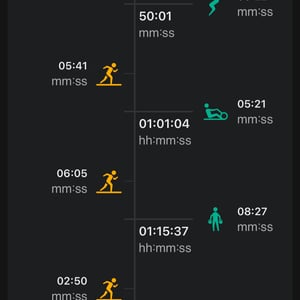
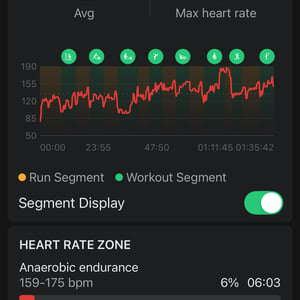
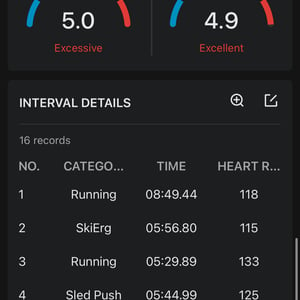
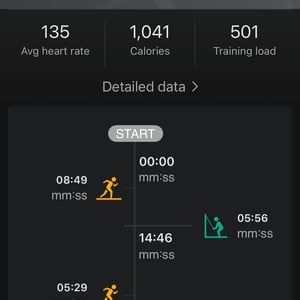
One view of performance data I couldn’t find was how I progressed on individual stations over time. This would be hard for Amazfit to meaningfully implement, though, as I sometimes forget to press the button and sometimes cut distances short or vary the weights so the data probably wouldn’t be truly comparable over time.
Other HYROX-specific Issues
Strength-based workouts such as those in HYROX present readiness and recovery algorithms with a unique problem. The muscular strain component of your training load cannot be determined from heart rate. Most brands either ignore it, guess it, or pretend that heart rate measures it in some way.
Amazfit’s new Helio Strap Pro turns the Balance 3 into a 3-sensor system (watch + wrist strap + belt sensor pod). This combination is claimed to uniquely measure movement dynamics and then apply the standard distances and loads in a HYROX race to calculate muscular load. In theory, the maths could work to calculate load properly; in practice I’m not sure what you’d do with the data once your A race has finished (the calculations would only work in the race, not in training). It’s probably a tool for the pros and serious amateurs, and I plan to test one later this year.
Amazfit HybridCharge
Amazfit recently updated and expanded its HybridCharge metric to include objective measures (sleep, HR, HRV), training load (including muscular strain), and subjective LifeLoad logging (alcohol, stress, mood, nutrition). In theory, this is the most comprehensive ‘body battery’ from any sports watch vendor; in practice, there is no science behind assessing ‘Body Battery’ or readiness in this way. So no one can test it as there is no standard; you might find Amazfit’s HybridCharge useful or perhaps even more useful than Garmin’s popular Body Battery – it’s your call.
GPS Accuracy
Test #1 Standard 10-mile Test Route
The Balance 3 scored 77% on my standardised 10-mile test, against 85% for the Balance 2 on the same route, and 77% ranks as average against 2026 watches. A breakdown of the test showed easy conditions scoring 75%, medium 88%, and hard 69%. The worst section was open suburban roadside running, where the track drifted up to 5 metres to the other side of the road; the underpass and the sections close to buildings were, counterintuitively, relatively good.
The other devices on the same route that day all tracked better.
The newer, larger metal case is the most likely explanation, since the antenna will likely have been redesigned and the full-metal construction will also impact reception differently from the Balance 2. That said, the Dartmoor and Stockholm tests both returned better results.
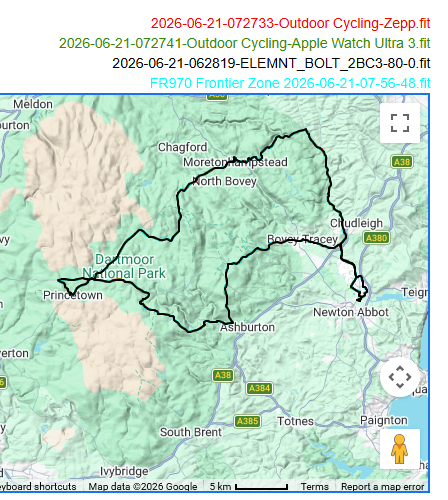
Test #2 cycling on Dartmoor
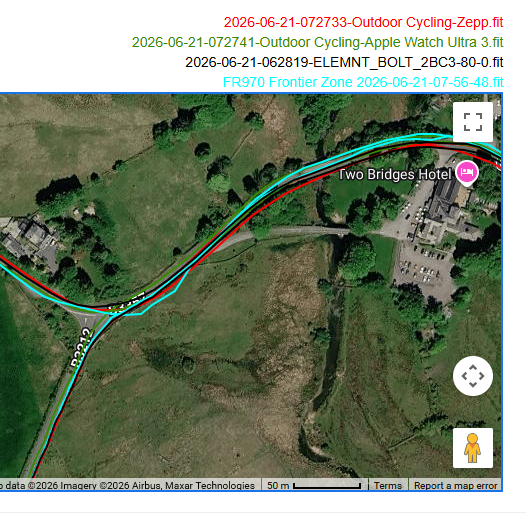
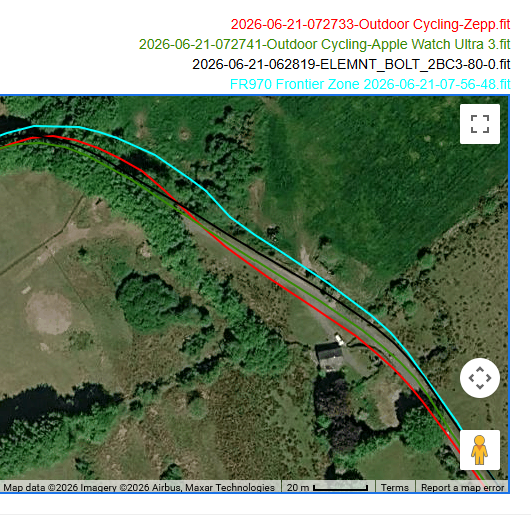
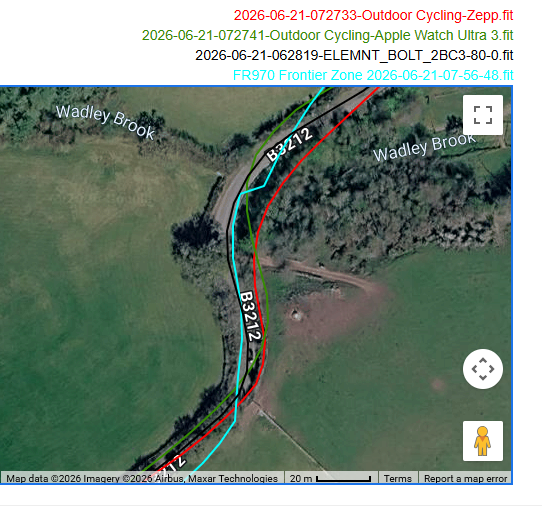
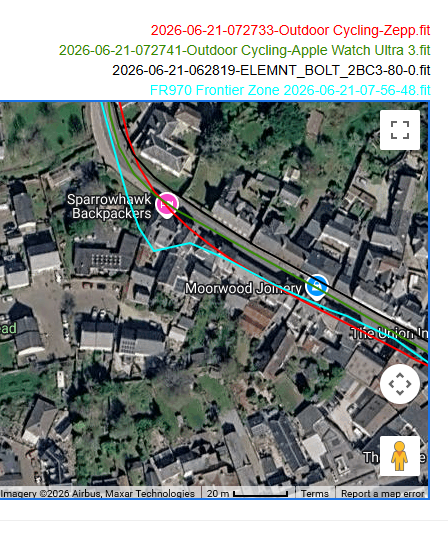
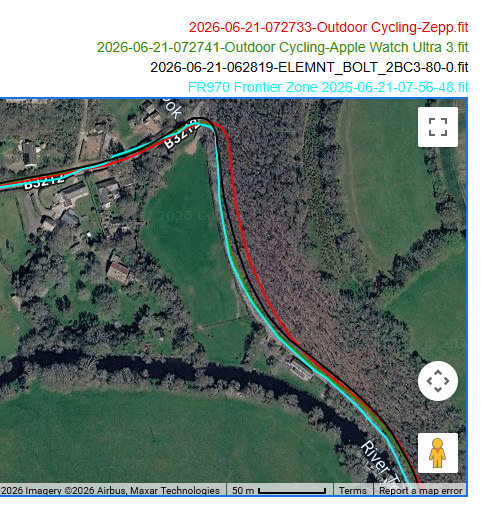
Overall, GPS accuracy was fairly good for both the Bolt and the Amazfit Balance 3, but the Apple Watch Ultra 3 was probably the best. The Amazfit wasn’t far behind, but you can see the Forerunner 970 struggled because the battery was low and I switched to GPS-only reception.
The Balance 3 deviated slightly off route by a few more metres than I would like on some corners, and on some of the faster, winding descents with tree cover, its track drifts off the road. The result was just about acceptable, but it could be better. On the numerous open moorland sections, the Balance 3 and all devices performed well. Where the Amazfit’s GPS track did differ, it seemed skewed to the South or West, which could be a timing issue with some of the received satellite signals.
GPS Test #3 – Running In Stockholm
I ran with the Balance 3, a Garmin Forerunner 970, and an Apple Watch Ultra 3.
The route was a similar distance to my standard 10-mile GPS test but lumpier and on uneven ground. There were also urban canyon sections near tall buildings, tree cover, lakesides, and a short underpass. These were test conditions that separated the good from the bad and ugly!
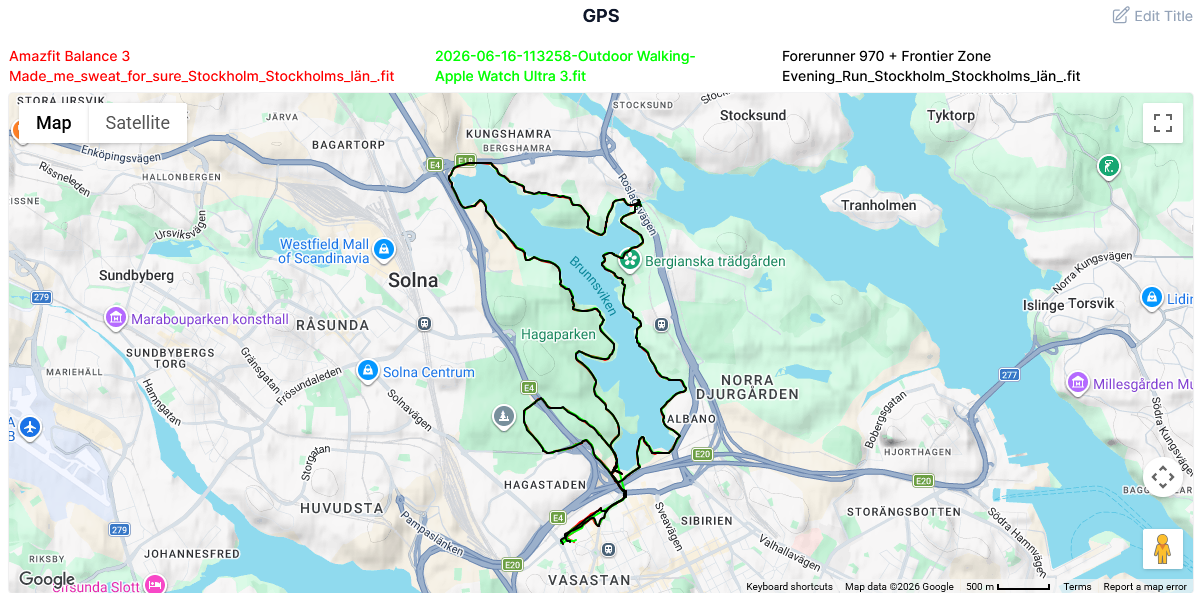
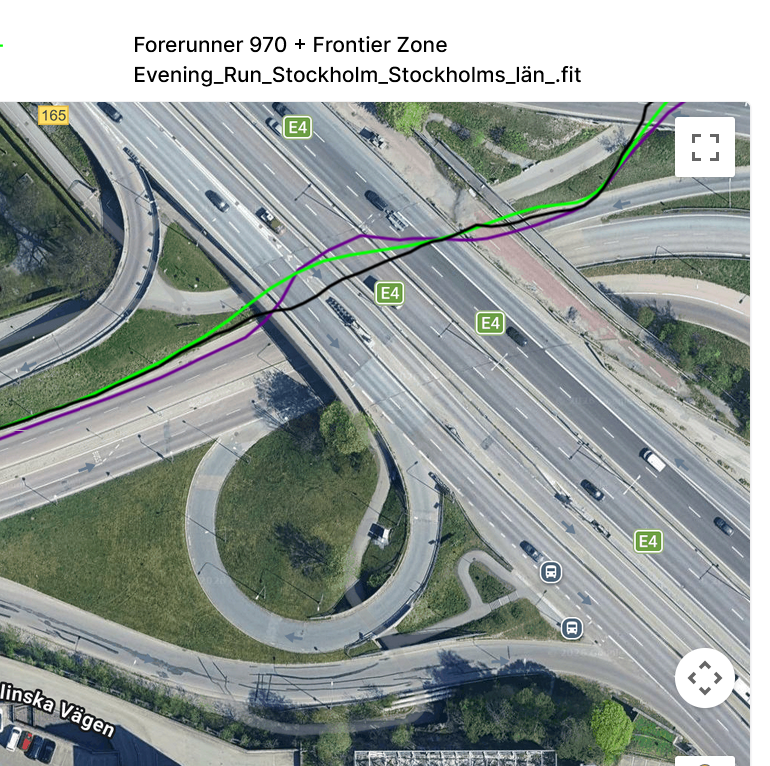
Under the underpass, the Forerunner 970 was the best performer, with the Balance 3 ahead of the Apple Watch Ultra 3. All three handled it quite well, indicating that the watches do a decent job of combining GPS and accelerometer measurements when the former is unreliable.
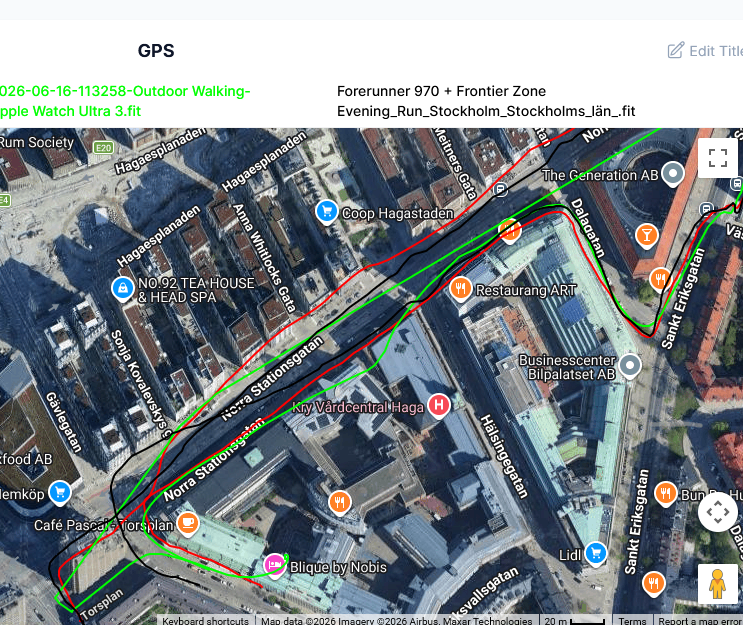
Near tall buildings, where multipath errors are inevitable, the Balance 3 (red) and Forerunner 970 (black) were clearly the strongest two watches even though both had good and bad moments.
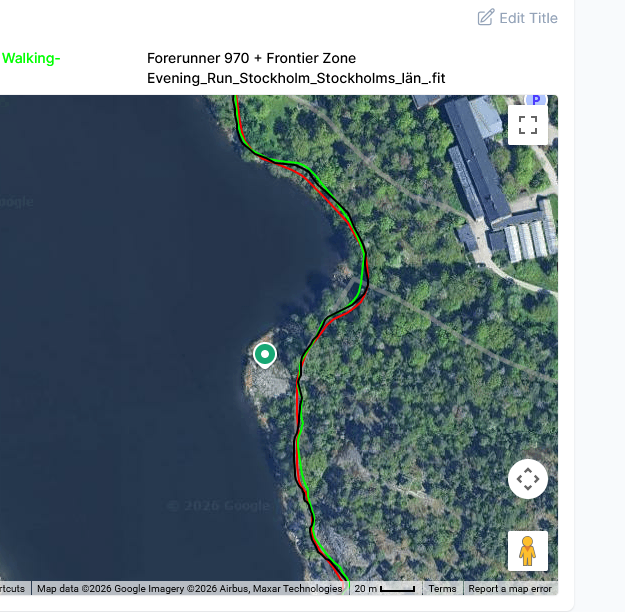
Through the sections of tree cover, all three devices again had good and bad moments, but there was no clear winner.
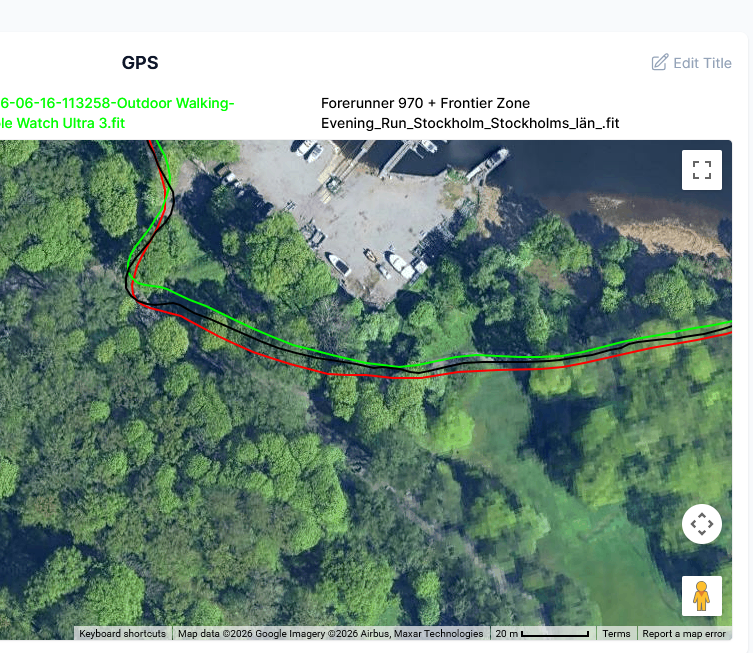
Overall, none of the watches failed here, and the FR970 probably was the most accurate. The Apple Watch Ultra 3 was weakest in the urban canyon sections. Between the Balance 3 and the Forerunner 970, performance was closely matched across the run as a whole. See our GPS accuracy guide for full context on how we assess these kinds of results.
Heart rate accuracy
Test #1 HYROX Sim – moderate effort
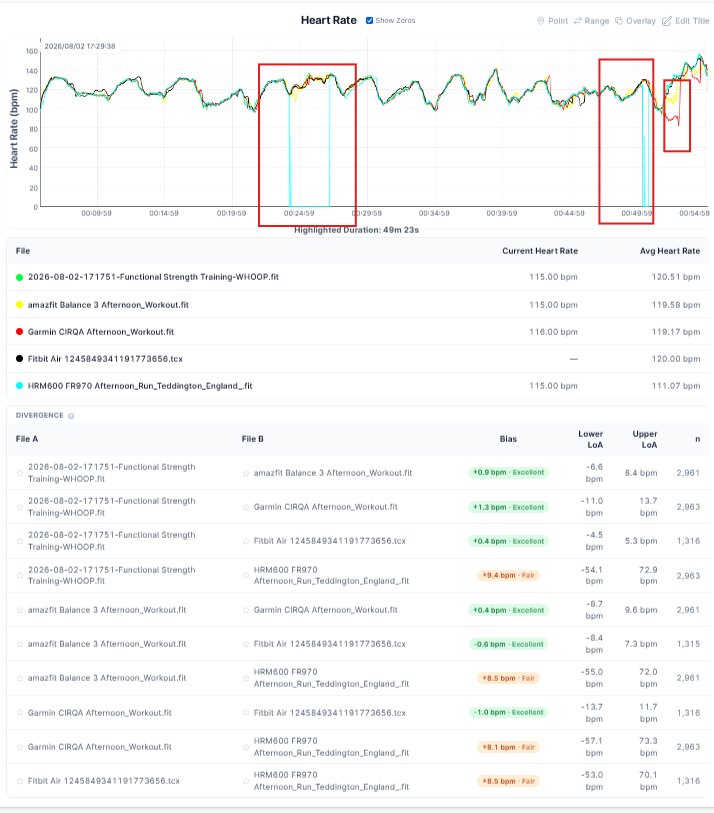
In this test, the Amazfit Balance 3 matched the other optical devices closely, as these summarised results show
- vs WHOOP: +0.9 bpm bias, Excellent (LoA –6.6 to +8.4 bpm)
- vs Garmin CIRQA: +0.4 bpm bias, Excellent (LoA –8.7 to +9.6 bpm)
- vs Fitbit Air: –0.6 bpm bias, Excellent (LoA –8.4 to +7.3 bpm)
Like the others, it diverged substantially from the HRM 600, whose results were skewed by two significant dropouts (+8.5 bpm bias, Fair rating with very wide limits of agreement).
Overall, it performed on par with WHOOP and CIRQA across a Hyrox simulation, with tight agreement and only one notable period of slight under-reporting at the start of the wall balls.
Test #2 Moderate pool swim
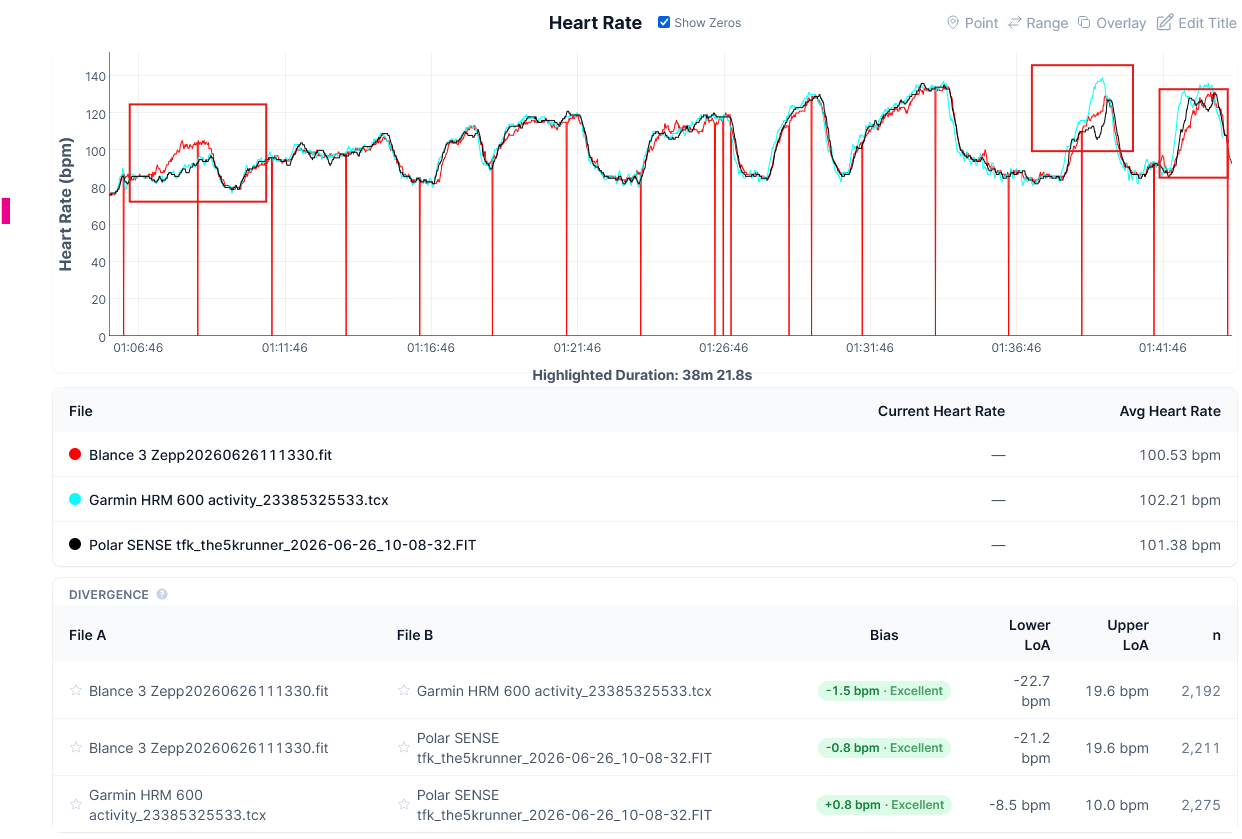
Garmin HRM 600 and Polar SENSE are the most accurate here with the tightest agreement (bias: +0.8 bpm; LoA: -8.5 to 10.0 bpm). The Balance 3 has larger spreads than both (LoA approximately 40 bpm wide, biases of -1.5 and -0.8 bpm). This indicates lower accuracy, but unusual and slight overreporting at the start plus short dropouts caused this as it was good enough for the rest of the time.
The more interesting finding is the HRM 600. It likely overestimated the two harder efforts toward the end. It did not overestimate by much, but overestimating heart rate means the effort is classified in a higher zone, with a disproportionate physiological impact on Garmin’s load metrics. The overestimation in Zone 1 by the Balance 3, in some respects, is irrelevant as the levels are so low, although almost 20 dropouts are a cause for concern.
Test #3: bumpy, hilly roads on a hot day over 100km
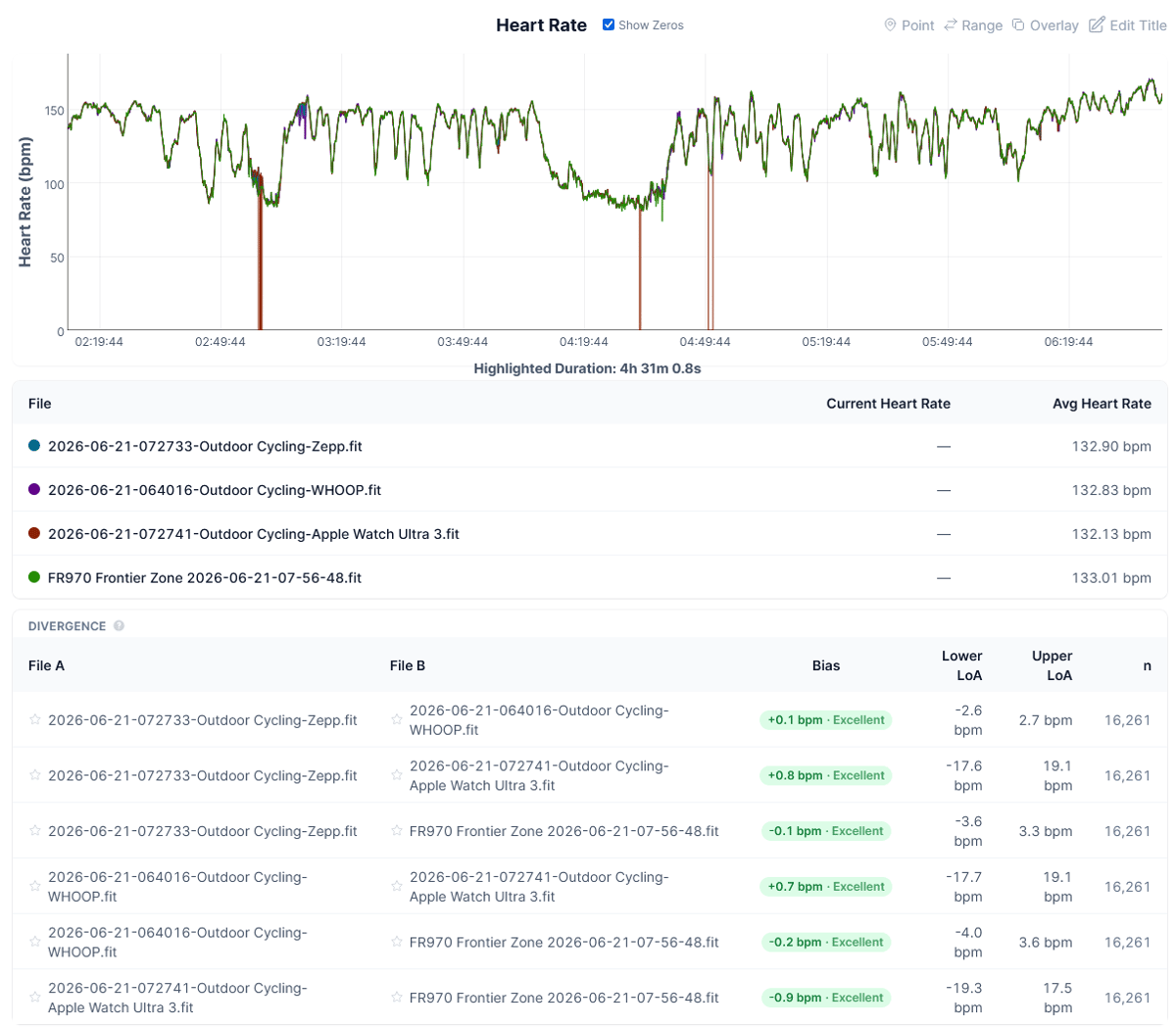
All devices showed excellent heart rate accuracy compared to the chest strap (Frontier Zone).
- Amazfit Balance 3: Bias -0.1 bpm, tight LoA (-3.6 to 3.4).
- WHOOP: Bias -0.2 bpm, tight LoA (-4.0 to 3.6).
- Apple Watch Ultra 3: Bias -0.8 bpm, wider LoA (~±18 bpm).
Averages: Frontier Zone 132.5, Zepp 132.4, WHOOP 132.3, Apple 131.7 bpm.
Apart from the very occasional AWU3 dropout, there is nothing at all to report here. I didn’t expect the results to be quite this good. The Amazfit Balance 3 and the Frontier Zone chest strap produced near-identical readings and tracked closely over an extended period. As you can see from the chart below, there appears to be surprisingly good visual agreement, supporting the LoA stats.
 Test #4 Tempo run
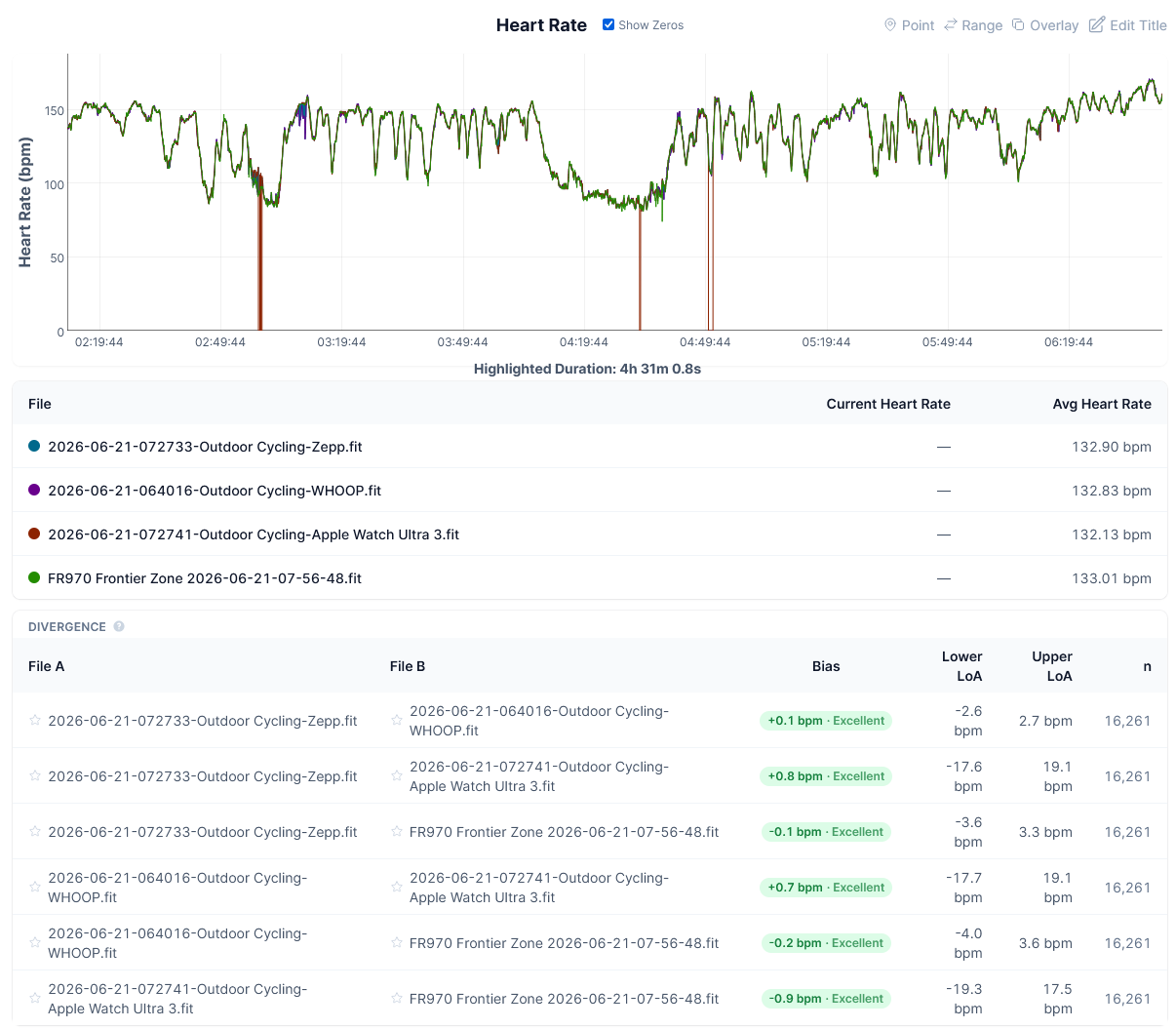
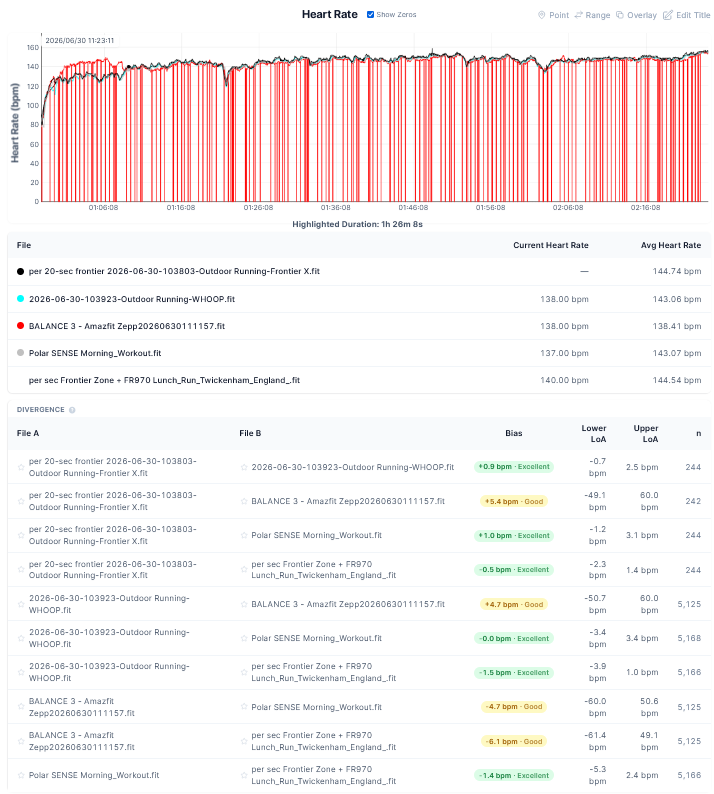
Amazfit Balance 3 showed more issues than the other devices in this outdoor run.
- vs WHOOP: +4.7 bpm bias, Good (LoA –50.7 to +60.0 bpm)
- vs Polar Sense: –4.7 bpm bias, Good (LoA –60.0 to +50.6 bpm)
- vs Frontier X: +5.4 bpm bias, Good (LoA –49.1 to +60.0 bpm)
- vs FR970: –6.1 bpm bias, Good (LoA –61.4 to +49.1 bpm)
The other devices (WHOOP, Polar Sense, Frontier X, FR970) all agreed tightly with one another (Excellent ratings, biases near zero, narrow LoA).
This matches the visual notes: slight over-reporting at the start plus numerous dropouts produced the wider limits of agreement and “Good” (rather than Excellent) ratings, even though the overall trace still largely followed the reference strap when the signal was present.
Test #5 Easy flat trail half marathon
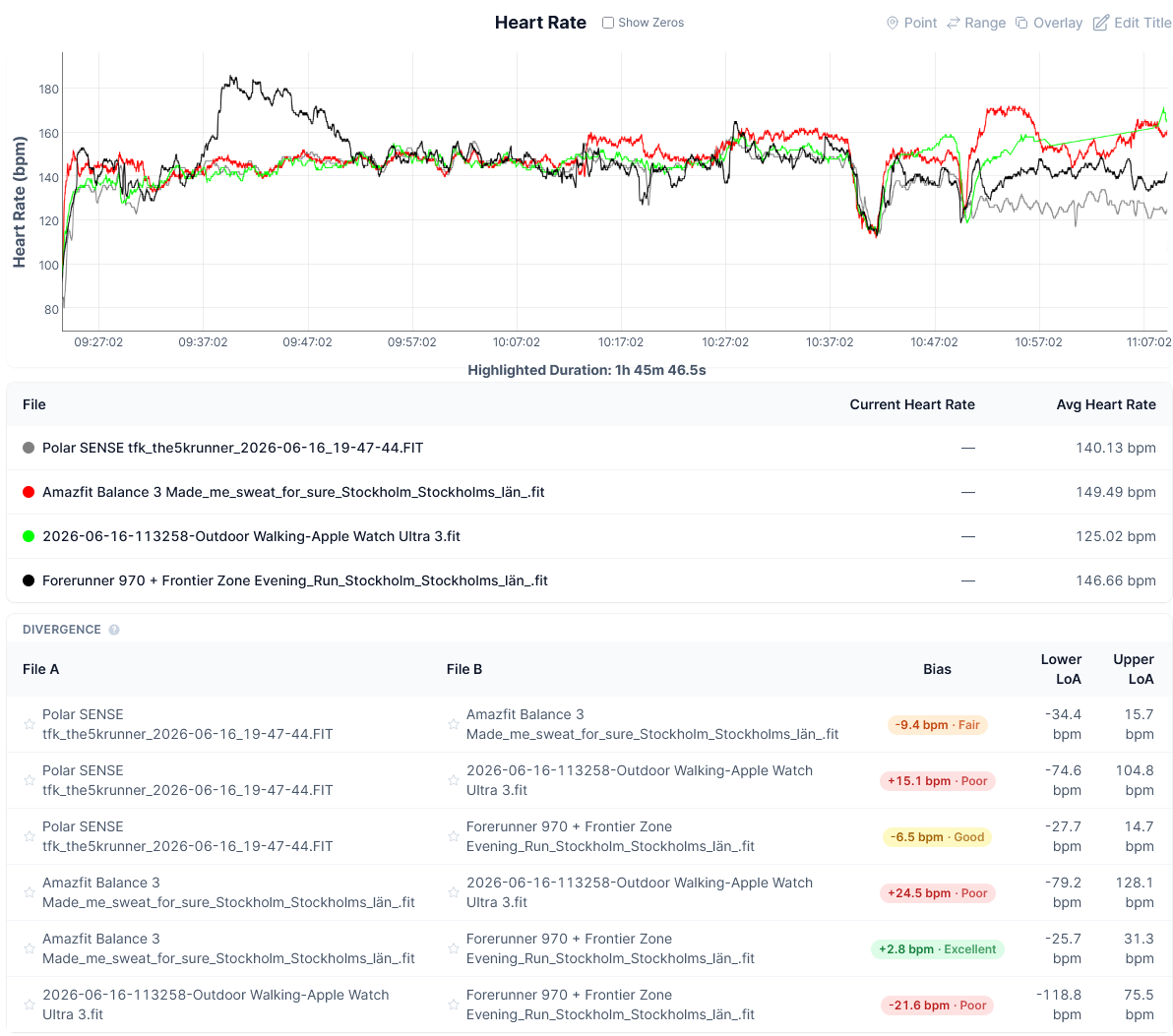
The Amazfit Balance 3 was compared against the Polar Verity Sense, the effective reference for this run, as follows:
- vs Polar Sense: –9.4 bpm bias, Fair (LoA –34.4 to +15.7 bpm, n=6,347)
- vs FR970 + ZONE combo: +2.8 bpm bias, Excellent (LoA –25.7 to +31.3 bpm)
It tracked closely with the Frontier Zone chest strap for much of the run, but read high in sections, also producing the Fair overall rating against the Sense. On this lumpy, unfamiliar trail run, the Balance 3 performed reasonably well despite the elevated readings in places and unexplained, significant divergences by all devices at times; the Frontier Zone (on the Garmin 970) was perhaps the worst.
Swim accuracy
I only did front crawl in test #2 (above), and both watches identified that correctly. Both were 100% accurate on length and distance counting, with a custom pool length of 36m set for Hampton Outdoor Pool. That is a better result than many watches deliver, and the FR970 has historically been a reliable length tracker for me.
Elevation Accuracy
On the one test I set aside to measure significant elevations (the ride covered above), there was no elevation data stored in the manually exported FIT file. Yet when running, elevation data is stored. I didn’t investigate any further than that.
Battery life
I’ve used the Balance 3 extensively for six weeks and charge it less than once a week, even with brightness set higher than default. Amazfit claims up to 21 days in typical use and up to 41 hours in accurate GPS mode. I have no reason to doubt those figures, though increasing brightness, screen on-time, GPS recording, and audio playback will all reduce them.
In practice, with brightness raised and regular GPS use, expect something closer to 7 to 10 days rather than the full 21.
Training metrics: threshold, running power, VO2max
The Balance 3 carries the Zepp training-metrics suite: lactate threshold, running power, ground contact time, vertical oscillation, stride length, VO2max and race-time predictors, from Zepp Coach. These are the same metrics and algorithms Amazfit uses for all its watches.
My Lactate threshold presumably carried over from my previous Amazfit device rather than needing fresh qualifying runs to recalculate; thus, at 161bpm it was ‘about right’, and I didn’t notice it change much through the test period.
A VO2max calculation requires a qualifying effort where your distance and heart rate are known when running on a hard surface. Amazfit supports cycling power meters but does not use that info to calculate a cycling VO2max.
Currently my Amazfit metrics are broadly in line with Garmin. VO2max is at least 5 points too low, LTHR/LT2 matches, and my race times in Achievement Predictor are about right (a bit slow).
Recovery time reads higher on the Balance 3 than on Garmin. Both are EPOC-based calculations built around HRmax, and my HRmax is not set correctly in the Zepp app: there is no obvious way to enter a manual value when zones are configured around LTHR.
The HybridCharge readiness percentage feels lower than the old Biocharge metric did, though a direct comparison and understanding is difficult given how many additional inputs the new metric factors in.
Zepp Coach, training plans and software
The software is the mature Zepp platform. Zepp Coach builds adaptive plans from 5K to marathon and adjusts to fitness and schedule. Sync to TrainingPeaks, Runna, Intervals.icu and Strava is in place. The Zepp app is a credible ecosystem for athletes whose data lives on Strava or Runna, if not as deep as Garmin Connect and is perhaps easier for us. However, the non-core settings and features could be organised better. Zepp Pay handles contactless payments.
Maps and navigation
The Balance 3 has offline maps, route import and turn-by-turn directions, with 64GB of storage behind them. Rendering and the on-watch interface are responsive. As on recent Amazfit watches, voice prompts respond to wrong turns, but visual rerouting on the map does not update reliably, so do not depend on it for an unfamiliar route until firmware improves it.
The competition
- The Amazfit Balance 2 at £299.90 is the most sensible comparison from the same brand. It is £70 cheaper and shares the same coaching platform, but lacks the HYROX modes, HybridCharge, the quality case and the superior display. For anyone who does not train for HYROX, the Balance 2 is the value pick.
- The Amazfit Balance Ultra at £599.90 is the brand’s flagship model. Software, display and sensors are identical to the Balance 3, and the only real difference is battery: 30 days typical use and 50 hours of GPS against 21 days and 41 hours on the Balance 3, in a slightly larger titanium case. Buy the Ultra if battery life is worth the extra £150 for you.
- A feature-comparable option in build is the Garmin Fenix 8 (51mm, AMOLED, Sapphire, titanium) at £859.99, which pairs full-colour mapping and multisport tracking with a genuinely metal case of a similar size. It brings a deeper coaching ecosystem with hybrid training but no dedicated HYROX mode. For HYROX-specific features, you’d need a 3rd-party Connect IQ app like Roxfit.
- A Coros Pace Pro or Apex brings strong battery life and a recently added hybrid training platform.
- The Suunto Race 2 at £499 is a premium alternative for buyers who want a well-made sports watch. They will have to compromise with working around strength and CrossFit features rather than a dedicated HYROX alternative.
Verdict
For HYROX and hybrid athletes wanting dedicated features out of the box, the Balance 3 is the only choice, although good 3rd party apps like Roxfit exist for other brands. The screen is excellent, and the ecosystem is mature and feature-packed, not too far behind Garmin.
Accuracy is a mixed picture. GPS trails the Balance 2 on my standardised route, and heart rate reads well in the gym and on the bike but drifts on some outdoor runs. Buyers chasing best-in-class tracking numbers should look elsewhere. Buyers who want the HYROX modes and the Zepp coaching platform get accuracy that’s good enough for training.
- Buy it if you train or race HYROX or hybrid events, you want a bright screen with full maps and a coaching platform, and you want a cheaper alternative to Garmin under £400.
- Do not buy it if you do not do HYROX and want the best value, where the cheaper Balance 2 is the pick, or if you have small wrists, or if best-in-class GPS accuracy matters more to you than the HYROX features.
Quick answers
Is the Amazfit Balance 3 good for HYROX?
It is the best HYROX watch you can buy, because Amazfit is the only maker currently building for the event. The watch ships the official HYROX workout modes, the Zepp app carries HYROX Training templates, and each session is broken down station by station with a HybridCharge recovery score that accounts for muscular strain. No current Garmin or Coros platform matches this.
Should I buy the Amazfit Balance 3 or the cheaper Balance 2?
Buy the Balance 3 if you train for HYROX or hybrid events, because the HYROX modes, HybridCharge, metal build and brighter screen are the reasons it costs £70 more. Buy the Balance 2 if you do not, because it is cheaper and runs the same coaching platform.
How does the Amazfit Balance 3 compare to Garmin?
A feature-comparable Garmin Fenix 8 has a deeper coaching ecosystem and years of software behind it. The Balance 3’s advantage is HYROX: it is the only watch with official HYROX modes and a hybrid recovery score. If proven all-round performance decides it, choose Garmin. If you race HYROX, choose the Balance 3.
Is the HYROX strap included with the Amazfit Balance 3?
No. The HYROX-edition strap is a separate purchase. The watch ships with a standard silicone strap.
The Amazfit sports watch guide covers the full range, accuracy data and Zepp analysis.
Last Updated on 5 August 2026 by the5krunner
My favourite kit and nutrition
- Garmin Fenix 9 Pro — I’ve just bought one.
- Injinji – Runners protect your toes. Avoid discomfort and minor injury. Run more. Run faster. I use them.
- Garmin 90-degree charging adapter — A small keyring adapter you can use anywhere. Essential when away. I use one.
- Garmin charging puck — the fastest and most reliable way to top up your Garmin before a session. I use one.
- Ravemen FR300 — Front light that mounts directly under your Garmin or Wahoo head unit. Keeps your bars clean and your beam pointed where it matters. I use one.
- Body Glide – The blue anti-chafe stick that all swimmers and many runners use. I use it.
- Maurten — The race nutrition trusted by elite athletes. Gels and drink mixes engineered to be easy on the stomach. I use them.
- Garmin Varia RTL515 — A radar rear light that alerts you to vehicles approaching from behind. Pairs with your Edge or Wahoo. I use this model.
- Favero Assioma Pro RS2 — The power-meter pedals most serious cyclists choose. Accurate, easy to move between bikes. I use this model.
- Garmin Forerunner 970 — A serious choice for a pro-grade triathlon watch. I use this.
- Polar H10 — My daily driver for accurate, waking HRV readings.
- Wahoo ELEMNT Roam 3 — The bike computer that has the feature Garmin lacks: usability. I use mine on most rides.
Reader-Powered Content

This content is not sponsored. It’s mostly me behind the labour of love, which is this site, and I appreciate everyone who supports it.
Support the site: Follow (free, fewer ads) · Subscribe (paid, ad-free) · Buy Me A Coffee ❤️
All articles are written by real people, fact-checked, and verified for originality. See the Editorial Policy. FTC: Affiliate Disclosure — some links pay commission. As an Amazon Associate, I earn from qualifying purchases.

tfk is the founder and author of the5krunner, an independent endurance sports technology publication. With 20 years of hands-on testing of GPS watches and wearables, and competing in triathlons at an international age-group level, tfk provides in-depth expert analysis of fitness technology for serious athletes and endurance sport competitors. ID

How is the map view looking when compared to Garmin on Fenix 8 or the 8 Pro or even the Venu X1? I see the map view very detailed and clear when compared to Amazfit view. Even with my sunglasses, the garmin map view is bright and clear but with Amazfit, it is not so much. I tested it with Cheetah 2 Ultra. I don’t have the. Cheetah 2 Ultra anymore. Can you please compare the map view between Garmin and Balance 3 and post the pictures here?
I always compare in Day mode and not in Night (dark) mode.