Accuracy
Reasonably consistent with itself from run to run; not comparable with any other brand’s watts
Best for
Holding an even effort over hills and capping surges early in a race
Weakness
The wind factor comes from a weather forecast, isn’t measured, and doesn’t reflect the air dynamics around the runner.
Plain English: Running power is a number in watts that shows how hard a runner is pushing against the ground, hills and air at that moment. It rises straight away on a climb or a surge, long before heart rate catches up, so a steady number means a steady effort whatever the terrain. A higher number means more work; it is personal, so one runner’s 250 watts says nothing about another’s.
In practice: I no longer use Garmin’s running power. I use a Stryd pod instead, because its numbers feel repeatably right on the road and it measures the wind rather than taking it from a forecast. Power is now my main check during every effort longer than about two minutes, and after the run, power curves quantify my strengths, progress and how hard the session really was.
Quick answers
What does running power mean on a Garmin?
Garmin running power is an estimate, in watts, of the power a runner applies to the road. Garmin builds it from five parts: the work of speeding up, climbing, bouncing up and down, braking and re-accelerating on each step, and pushing through the air.
What is a good running power on Garmin?
There is no good number to aim for, because running power scales with body weight, pace and running economy. Divide by weight to compare runs over time, and judge the number against the runner’s own threshold power, which Garmin estimates from lactate threshold and uses to set five power zones.
How accurate is Garmin running power?
No study has validated Garmin’s wrist-based power, and no agreed reference for running power exists. The only lab comparison that included Garmin’s sensor-based version found it less repeatable than Stryd.
Why is Garmin running power higher than Stryd?
The two use different definitions of running power. Garmin sums the mechanical work of several movements, while Stryd scales its number to track metabolic demand, so Garmin reads higher; in tfk’s 2022 tests, Garmin and Polar read about 30 per cent higher than Stryd, Coros and Apple.
Can I use Stryd instead of Garmin running power?
Yes. Garmin’s Running Power settings include a Status switch that turns off Garmin’s own power for athletes who prefer third-party power, and Stryd then supplies the watts through its own app on the watch. Never mix the two in one training history, because their scales differ.
Running Power – a deep dive
When Running Power Is Actually Useful
- Holding the planned effort on any interval or block longer than about two minutes, where power responds straight away and is not fooled by hills or wind the way pace is.
- Tracking improvement after the run through power-duration figures, which show the best power held for each length of effort over time.
- Measuring training load afterwards, so a hilly or windy session counts for the work it took rather than the pace it produced.
Introduction
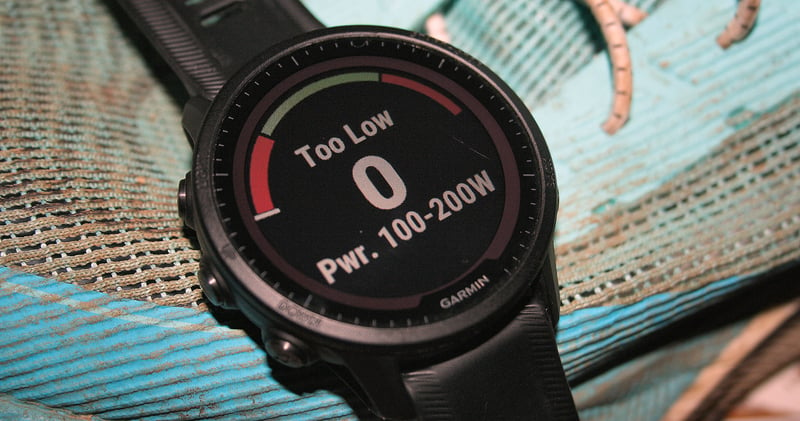
Garmin Running Power estimates the power a runner applies to the road surface and shows it in watts. Garmin calculates it from “measured running dynamics information, user mass, environmental data, and other sensor data,” according to its owner’s manuals, and says it responds to effort faster than heart rate and accounts for hills and wind, which pace cannot.
Running power began as a Connect IQ app in December 2017 and has been calculated on the wrist, without an accessory, since late 2022. The main limitation is that running power has no agreed definition: Garmin, Stryd, Polar, Coros, Suunto and Apple each calculate it differently, so their watts cannot be compared.
What Running Power Actually Means
A higher number means more work per second. On the flat it rises with pace; at the same pace it rises on a climb and falls on a descent, though by less than it rose on the way up. Because it is calculated with body weight, a heavier runner produces more watts at the same pace, so power divided by weight is the fairer comparison over time. Garmin publishes no population norms or colour gauge for running power. Instead, the watch estimates threshold power from the runner’s lactate threshold and builds five zones from it; Garmin says the default zones use “gender, weight, and average ability” and may not match the individual, and they can be changed on the watch or in Garmin Connect.
How Garmin Calculates Running Power
Stated: Garmin describes its model as determining “the propulsive power applied to the road” from five components. Kinetic power is the cost of changing pace, from watch speed. Potential power is the cost of climbing or descending, from barometric elevation. Vertical oscillation power is the cost of the bounce on each step, and horizontal oscillation power is the cost of braking at footstrike and re-accelerating, both from running dynamics measured by a Garmin chest strap, the Running Dynamics Pod or the watch itself. Wind or air power is the cost of air resistance, from speed, heading, wind reported by weather services for the area and the watch barometer. The equations also use constants for the runner’s weight, gravity and air density. When a Garmin accessory is paired, the Source setting’s Smart mode uses it; otherwise the watch uses its own sensors.
Inferred: Garmin does not publish its equations. The component list matches a summation of mechanical work, which is one of the two broad ways to estimate running power; the other, used by Stryd, scales the number to track metabolic demand. On the Vivoactive 6, which has no barometric altimeter, elevation must come from satellite positioning instead. Unknown: how Garmin weights the components, how wrist and chest strap inputs are reconciled, and whether running power feeds any Firstbeat metric such as training load.
Wind is on by default. Garmin says the watch needs to have been connected to the paired phone for at least ten minutes in the hour before the run to have current weather data; without it, the wind component cannot reflect the day’s conditions. Wind can be switched off under Running Power, Account for Wind.
What Affects the Reading
Wind is Garmin’s weakest input. A forecast describes the wind across an area, not the gust between buildings or the shelter of a tree line, so a run in a sheltered park on a windy day can carry a wind correction the runner never felt. Speed feeds several of the components, so poor satellite reception under trees or between tall buildings makes power noisier; multi-band positioning, or a calibrated foot pod set as the speed source, reduces that. On a treadmill there is no air resistance and Garmin does not account for belt incline, so indoor and outdoor power are not directly comparable.
Body weight is an input, so a change to the weight in Garmin Connect changes the watts at the same pace. The source of the running dynamics matters too: a chest strap, the waist-worn pod and the wrist measure from different points on the body and produce different oscillation values, so switching source part way through a training block creates a step in the data that reflects the sensor, not the runner. Steep descents are handled less consistently than climbs, as tfk’s comparison runs in Cornwall in 2022 found when Garmin and Polar, which track each other on the flat, diverged on downhill sections.
How Accurate Is Garmin Running Power
No independent study has validated Garmin’s wrist-based running power, and there is no reference standard against which any running power figure can be proved correct. The one laboratory study to include Garmin, Cerezuela-Espejo et al. (2021), tested the earlier accessory-based version against oxygen uptake on a treadmill and track. Stryd was the most repeatable device, with a coefficient of variation of 4.3 per cent or less and the closest relationship to oxygen uptake; Garmin, Polar and RunScribe kept some relationship with oxygen uptake, but the authors said their low repeatability questioned their suitability.
On trails, Berzosa et al. (2024) had runners wear two Garmin and two Stryd devices at once. Each brand agreed closely with its own second unit, but Garmin and Stryd disagreed on power uphill. Garmin running power is therefore useful as a trend within one athlete’s history, on the same watch and source, and not as an absolute figure. Stryd has the strongest case for absolute accuracy among current options, because it measures more of its inputs directly at the foot, including the air speed the runner meets, which no wrist-based system does; Stryd’s own testing reported relative air speed within about 2.5 mph of the applied wind in wind tunnels. That case rests on input quality rather than a measured error.
Competitor Equivalents
- Stryd: a foot pod that calculates power in the pod and broadcasts it to most watches; it measures air speed directly to add the cost of wind and reads lower than Garmin.
- Polar: wrist-based Running Power on current Grit X, Pacer Pro and Vantage watches, calculated from speed and gradient only, with no gait data or wind; it feeds Polar’s Muscle Load.
- Apple: Running Power on Series 6, SE and later in Outdoor Run, which Apple describes as the rate of work needed to maintain speed; Apple does not publish its inputs.
- Coros: wrist-based running power on all current watches outdoors, with no wrist power indoors; full native Stryd support adds Form Power and Air Power.
- Amazfit: wrist-based running power on the Cheetah 2 Pro and other current models, reading much higher than Suunto, Apple and Stryd in the Cheetah 2 Pro review, which suggests a method closer to Garmin’s; Stryd pairs natively with the Balance 2, Cheetah 2 Pro, Cheetah 2 Ultra, T-Rex 3 and Active Max.
- Suunto: wrist-based running power on Suunto 9 Peak Pro and later from GPS and barometric data, with Stryd supported as a power sensor.
Which Garmin Devices Support Running Power
Every current Garmin running, outdoor, dive, aviation and marine watch calculates running power from the wrist without an accessory, from the Forerunner 70 to the Fenix 9, according to Garmin’s running power compatibility list. The Venu 3 series and Vivoactive 6 are wrist-only, and the Forerunner 165 manual describes measurement from the watch sensors alone; all other native watches can also take running dynamics from the HRM 600, HRM-Fit, HRM-Pro, HRM-Pro Plus, HRM-Run, HRM-Tri or Running Dynamics Pod, with the HRM-Fit, HRM-Pro and HRM-Pro Plus straps paired over ANT+. Older watches with a barometer, including the Fenix 5 and 6 series, Forerunner 645, 745, 935 and 945 and the first MARQ, need one of those accessories and Garmin’s Running Power apps from the Connect IQ Store, which come as five separate data fields: current power, lap power, last lap power, average power and a Combo field that shows several of these at once. The feature launched as that app in December 2017 on the Fenix 5, Forerunner 935 and Chronos, became native on the Forerunner 255 and 955 in June 2022, and moved to the wrist from late 2022.
Where to Find Running Power on Garmin
- Data fields during a run: current power, 3, 10 and 30 second averages, lap and last lap power, average and maximum power, power zone and a power gauge. Watches that use the Connect IQ apps have a smaller set of fields: current, lap, last lap and average power, plus the Combo field.
- Alerts and workouts: high and low power alerts by zone or value, and power targets in structured workouts from Garmin Connect, TrainingPeaks or Final Surge.
- Settings: Activities and Apps, Run, Run Settings, Running Power, for Status, Source and Account for Wind; zones under User Profile, Heart Rate and Power Zones.
- Garmin Connect app and web: the activity’s Stats show average power and whether wind data was used, and Charts show power through the run; watches with native running power also show maximum power and a time in power zones chart. No Connect Plus subscription is needed.
- Not available as a glance, watch face complication or Morning Report item.
Common Problems and Misreadings
A Garmin figure that differs from a partner’s Stryd, Coros or Apple number is normal; Quick answers above explains why. The same applies to a runner who switches from a Stryd to Garmin power, or the reverse: zones, threshold power and any power-duration history must be rebuilt, because the two scales differ.
Power that looks high on a calm day, or that jumps with a change of direction on a sheltered route, usually comes from the forecast wind correction. Checking whether wind data was used in the activity’s Stats in Garmin Connect confirms it; turning Account for Wind off removes the effect for runners who mostly train in shelter.
A sudden change in typical watts after a new chest strap, a firmware update or a weight update in Garmin Connect reflects a change of input rather than of fitness. Comparing runs only within one setup avoids reading a sensor change as a fitness change.
How to Improve Running Power
Running power is not trainable as a number in its own right, because more watts at the same pace can mean more weight or worse economy rather than more fitness. The useful aims are more power at threshold, measured over a fixed effort or a time trial on a known course, and more speed for the same power, which is better running economy. Threshold work, such as sustained intervals at or just below threshold power, raises the first; strength work and steady volume, which improve economy, raise the second.
Power is most useful for pacing. Holding it even on hills stops the overspend that pace targets cause on climbs, and a power cap in the first kilometres of a race stops the early surge that heart rate is too slow to catch.
Scientific Basis
Cerezuela-Espejo, V., Hernández-Belmonte, A., Courel-Ibáñez, J., Conesa-Ros, E., Mora-Rodríguez, R. and Pallarés, J.G. (2021). Are we ready to measure running power? Repeatability and concurrent validity of five commercial technologies. European Journal of Sport Science, 21(3), 341 to 350. PMID 32212955. Twelve trained runners tested five power systems against oxygen uptake indoors and outdoors; Stryd was the most repeatable and best related to oxygen uptake, and Garmin’s accessory-based power was among the less repeatable systems.
Berzosa, C., Comeras-Chueca, C., Bascuas, P.J., Gutiérrez, H. and Bataller-Cervero, A.V. (2024). Assessing trail running biomechanics: a comparative analysis of the reliability of Stryd and Garmin RP wearable devices. Sensors, 24(11), 3570. PMID 38894361. Two Garmin and two Stryd devices worn together on trails were each highly consistent within brand but disagreed on uphill power, which is why the page treats Garmin power as a within-athlete trend.
How Running Power Connects to Other Garmin Features
Running power is built from the same running dynamics that drive Vertical Oscillation, Ground Contact Time and Cadence, and from the speed behind Stride Length, so a change of dynamics source affects all of them together. Default power zones come from threshold power, which the watch estimates from Lactate Threshold. Real-Time Stamina gives a related live read on how long an effort can be held. For setting up zones and a longer history of Garmin’s power, see the Garmin running power explainer, and for the Stryd alternative, the Stryd 5.0 specifications.
Small things I always use
- Garmin 90-degree charging adapter: Charges your Garmin from any USB-C cable. Essential when travelling. I use one.
- Body Glide: The blue anti-chafe stick swimmers and runners carry. I use it.
- Speedo earplugs: Fewer ear infections and no cold-water dizziness. I use them.
- Dryrobe Advance: My winter changing robe for open-water swims. I use one. A cheaper option is the AONYIYI changing robe.
- Maurten: Race fuel that stays easy on the stomach. I use them.
- Beet It Sport nitrate shots: Beetroot shots I take in the days before a race. I use them.
- Garmin charging puck: The quickest way to top up before a session. I use one.
- Injinji: Toe socks that stop rubbing, so you run more. I use them.
- Ultimate toe protectors: Stop black toenails on long runs. They work. I use them.
- Compressport R2 v2 calf sleeves: My calf sleeves of choice. I use them.
- Cellucor C4: My pre-workout before hard sessions.
- TPU tubes: Schwalbe Aerothan, Tubolito and Pirelli SmarTube. Light, tiny spares. I use all three.
- G8 insoles: Adjustable insoles that are good. I use them.
- Cycplus Cube: A 97g electric pump that gets a road tyre rideable in two minutes. I carry one. 5% off with code THE5KRUNNER.
Watches and sensors
- Polar H10: My daily driver for waking HRV.
- Polar Verity Sense: My backup arm-worn HR sensor.
- Nomad bedside charger: Charges my iPhone and Apple Watch overnight. I use it, and many of their bands.
- Train.Red: The best muscle oxygen sensor I’ve used.
- Tymewear: Accurate heart rate and reliable ventilatory zones. I use it to pace endurance rides over an hour.
- Garmin Forerunner 970: A pro-grade triathlon watch. I use this.
- Apple Watch Ultra 4: My daily smartwatch. No phone needed on rides.
- Garmin Fenix 9 Pro: I’ve just bought one.
On the bike
- Continental GP5000 for everyday riding, and Aero 111 on the front for special occasions.
- Helmets: Specialized S-Works Evade 3 for road riding, and Rudy Project Wing for TT-style races. I use both.
- Ravemen FR300: A front light that mounts under your Garmin or Wahoo. I use one.
- Wahoo TRACKR Radar: I use it on one bike and Varia on the other. They perform the same.
- Garmin Varia RTL515: Radar that warns you of cars from behind. I use this model.
- Wahoo ELEMNT Roam 3: The bike computer that’s easy to use. I use mine on most rides.
- Favero Assioma Pro RS2: Accurate power pedals that swap easily between bikes. I use this model.
Home and indoor training
- NPE Runn: Makes my basic treadmill smart, sending more accurate speed and distance to my watch and Zwift. I use it.
- Google Wifi: Keeps Zwift connected in my pain cave. I use it.
- Apple TV 4K: Zwift on the big screen. I use two.
- Google Nest Doorbell (wired, 2nd gen): My video doorbell, running in both Google Home and Apple Home. I use it.
Health, recovery and sleep
- FreeStyle Libre 3 Plus: Shows how my blood sugar responds to diet.
- hDrop: Measures my sweat loss in summer and indoors.
- Fourth Frontier Zone: Checks my heart under load in hard sessions.
- Oura Ring 5: My partner’s recovery tracker of choice.
- Eight Sleep: A cooling mattress cover my partner and I use nightly.
Reader-Powered Content

This content is not sponsored. It’s mostly me behind the labour of love, which is this site, and I appreciate everyone who supports it.
Support the site: Follow (free, fewer ads) · Subscribe (paid, ad-free) · Buy Me A Coffee
Written by real people, with AI assistance. Fact-checked and verified for originality. See the Editorial Policy. FTC: Affiliate Disclosure — some links pay commission. As an Amazon Associate, I earn from qualifying purchases.
