Amazfit Cheetah 2 Pro Review: Marathon Watch Tested
The watch was worth the wait: 3 years. But is it worth the money: $449? Let’s see.
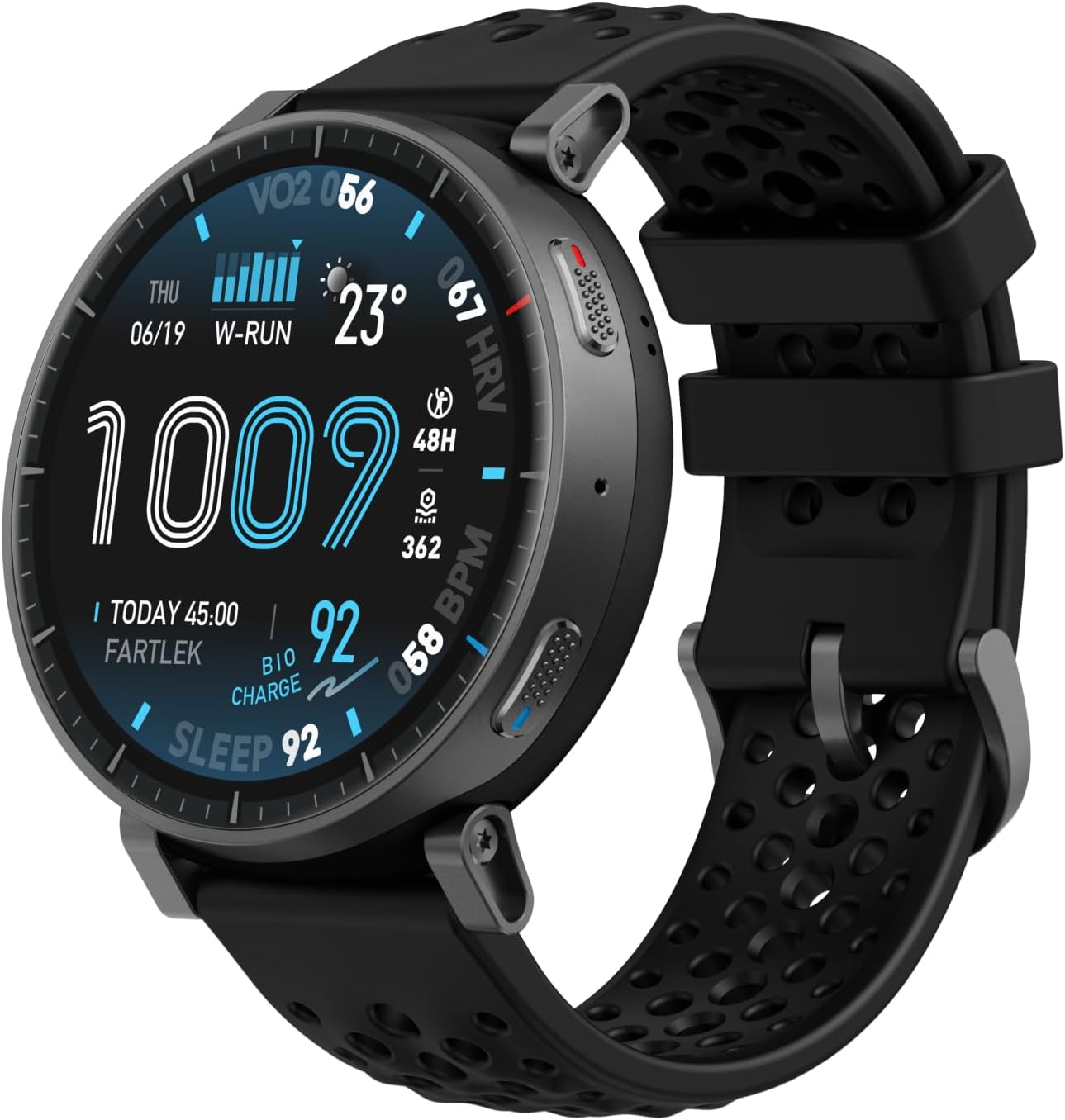
Amazfit waited three years to refresh its dedicated road running watch. April 2026 came, as did a fifty per cent price increase, a titanium case, a sapphire lens, and an explicit pitch towards marathon runners. The Cheetah 2 Pro is the most serious watch the brand has built. Even better, its case looks good in a slightly unusual way. Kudos to the brand for trying something different.
Whether it earns the £449.90/$449.00 ask depends less on the hardware, which is genuinely (mostly) great, than on the software running on top, where Amazfit has historically conceded ground to Garmin while matching the likes of Coros. This review covers what holds up after highly detailed testing, and what does not.
Heads up: this is a media loaner, and the brand does not pay for the review in any way. If you want to support the truly independent work here, please buy from one of the affiliated links or become a supporter. I appreciate the time taken to write nice comments and ask questions as well.
Listen to the discussion
Amazfit Cheetah 2 Pro Review
Marathon Watch Tested
Amazfit’s first proper running watch in three years arrives with a titanium case, sapphire glass, and a fifty per cent price hike. The Cheetah 2 Pro is the most serious watch the brand has built.
After over two weeks of testing across running, cycling, and swimming against Garmin HRM 600, Polar Sense, Forerunner 970, and Stryd references, the hardware lives up to the price, but the software is still half a step behind Garmin.
It’s best for 5K-to-marathon runners who want premium materials without paying Garmin Fenix money. Pair with a chest strap and Stryd footpod for supreme accuracy during interval training and cycling.
Pros
- Titanium frame and case with sapphire glass at sub-£500
- Full offline maps with turn-by-turn directions
- Zepp Coach adaptive training plans for 5K to marathon
- TrainingPeaks, Runna, and Intervals.icu sync
- HYROX mode and triathlon support
- Strong steady-state running HR accuracy
- Market-leading 3,000-nit brightness AMOLED display
- Contactless payments via Zepp Pay
- Voice-Captured Workout Notes at launch
- LED torch
Cons
- HR accuracy drops on the bike and during intervals
- GPS edged by best-in-class dual-frequency rivals in urban conditions
- On-watch re-routing not working in testing.
- The strap looks mediocre, given the rest of the build
- Zepp ecosystem is still behind Garmin Connect
- The display is slightly small for the case size
User Review
( votes)Who the Cheetah 2 Pro is for, and the buying decision
The watch is marketed towards marathon and half-marathon runners. Of course, the reality is that it’s fine for any distance runner. Similarly, it supports many sports and multi-sports, such as triathlon and HYROX. Indeed, Amazfit is the official and only watch sponsor of HYROX.
In that category, I would put the ultra crowd and the serious triathlon crowd, both of whom would probably err on the side of a top-end Garmin. Similarly, if your sports-data geekery reaches stratospheric levels, then Garmin is the only place for you. But those categories, when combined, represent a small number of people.
The marathon-like features touted for the Cheetah 2 Pro are found on cheaper Amazfit models and on competitors’ watches. The question you should ask is how well the features are implemented. Some brands like Coros have a history of offering box-ticking features rather than deep features (improving). Amazfit was guilty of not updating its features and fixing bugs in the past, but that’s mostly (though not entirely) a thing of the past. All watches have bugs, just check the Garmin forums.
If you love insights from sports metrics, then Amazfit’s Zepp has matured into a decent app and ecosystem that integrates with TrainingPeaks, Runna, Intervals.icu, and more.
Perhaps you are a switcher, looking to ditch a brand that’s let you down? If you rely on your data in your existing app, it will be hard to leave that behind. Still, if you only care about a continuous record on platforms like Strava or Runna, you will find they are largely device-agnostic, meaning you can switch without worrying about losing your data. Amazfit is a good brand to switch to. Not the best in every respect, but good.
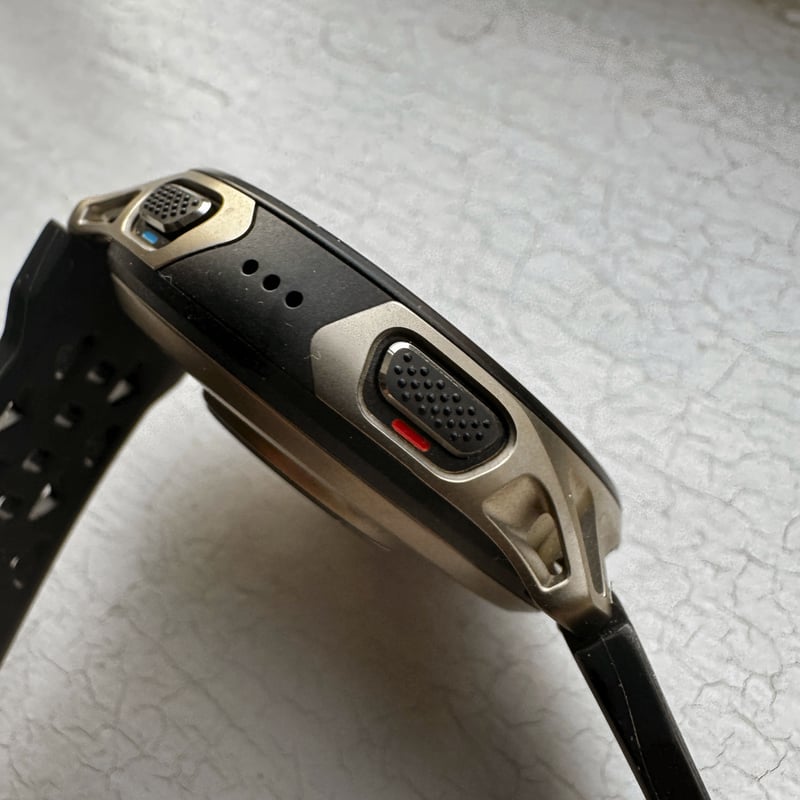
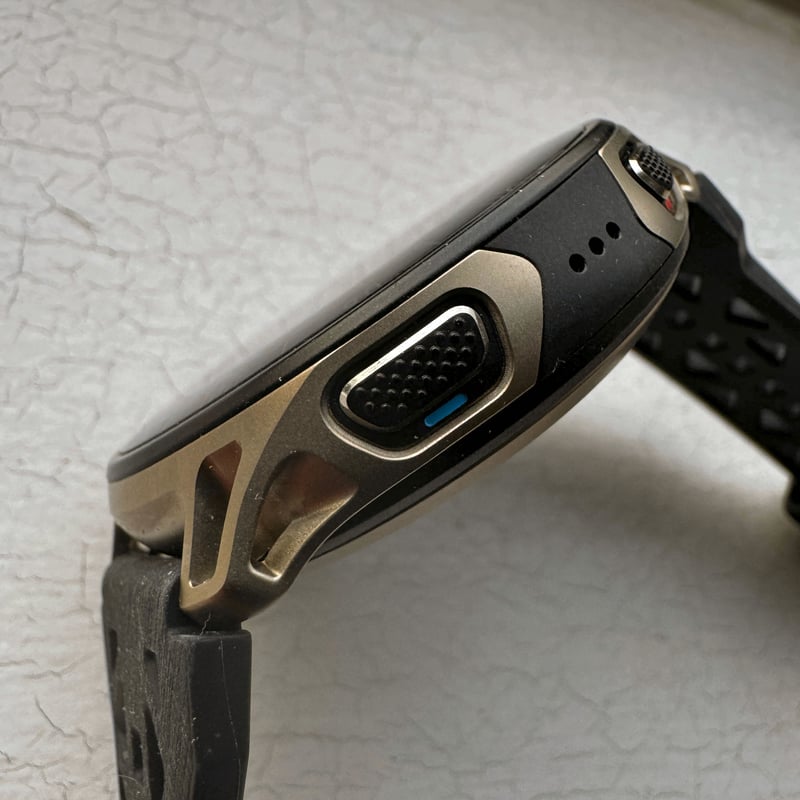
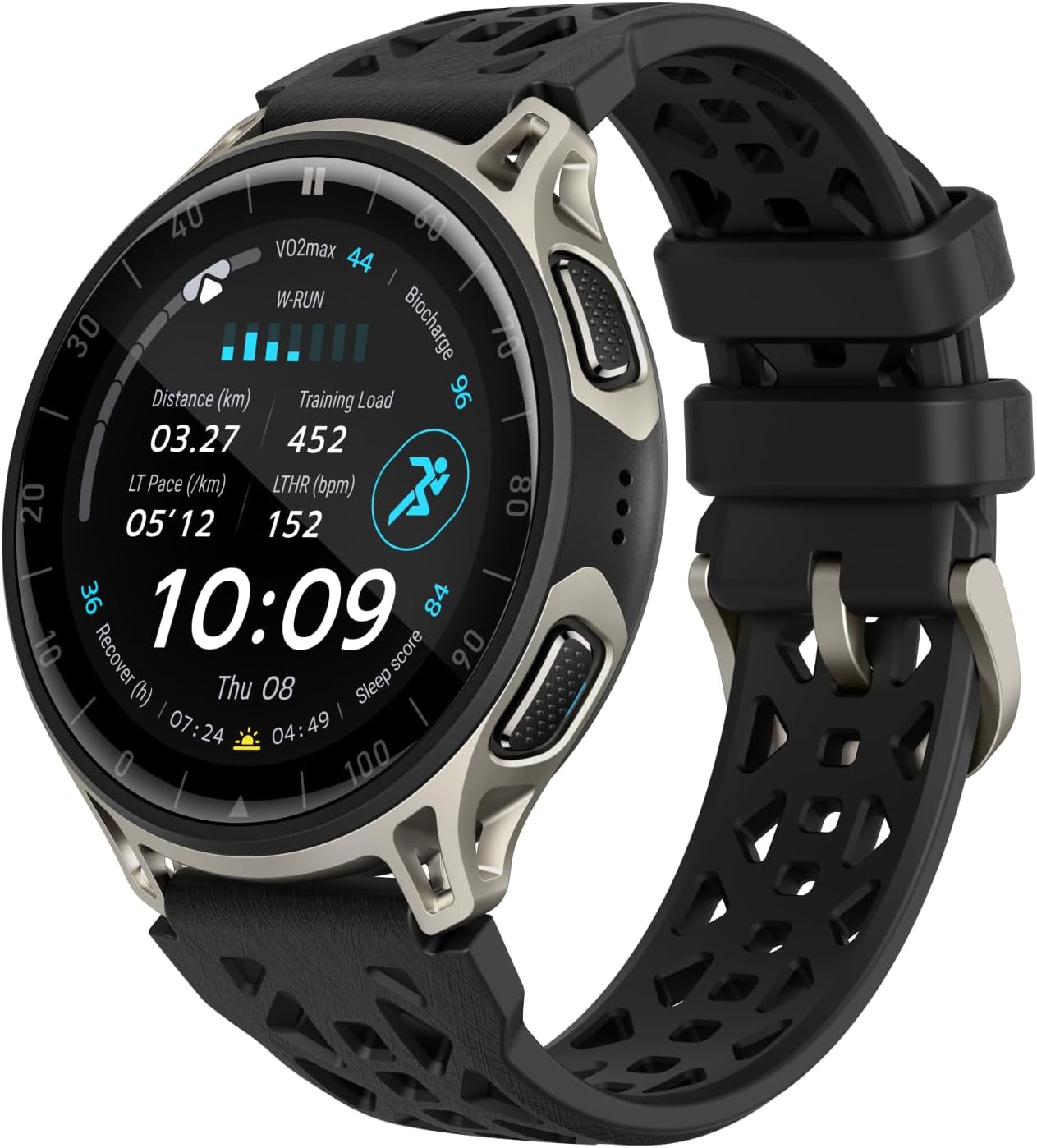
The penultimate consideration is one that’s often overlooked. How does that watch look on your wrist, and are you proud to show it off? In my opinion, it’s a great-looking watch with only a couple of reservations (the bezel size and the strap; you can change the latter, of course). Even better, Amazfit has pulled off some unusual design decisions on the case, blending two materials, adding superb buttons, and adding some industrial-looking lugs that also work (IMHO).
Finally. Price. Amazfit has grown to a large market share because it offers such great value for money. I wouldn’t class the Cheetah 2 Pro as excellent value. I’d say it’s fair value at the list price. There’s a but. Amazfit has tended to add new hardware models and discount slightly older models relatively quickly. If the Cheetah 2 Pro were to drop to $299, it would enter the great-value bracket.
What is new versus the original Cheetah Pro
The case design and quality have improved, and the features have improved greatly since 2023. I reviewed the original Cheetah Pro here in 2023. The biggest change is covered in these two bullet points.
- Original Cheetah Pro (2023): $299
- 2 Pro (2026): $449.99 and £449.90
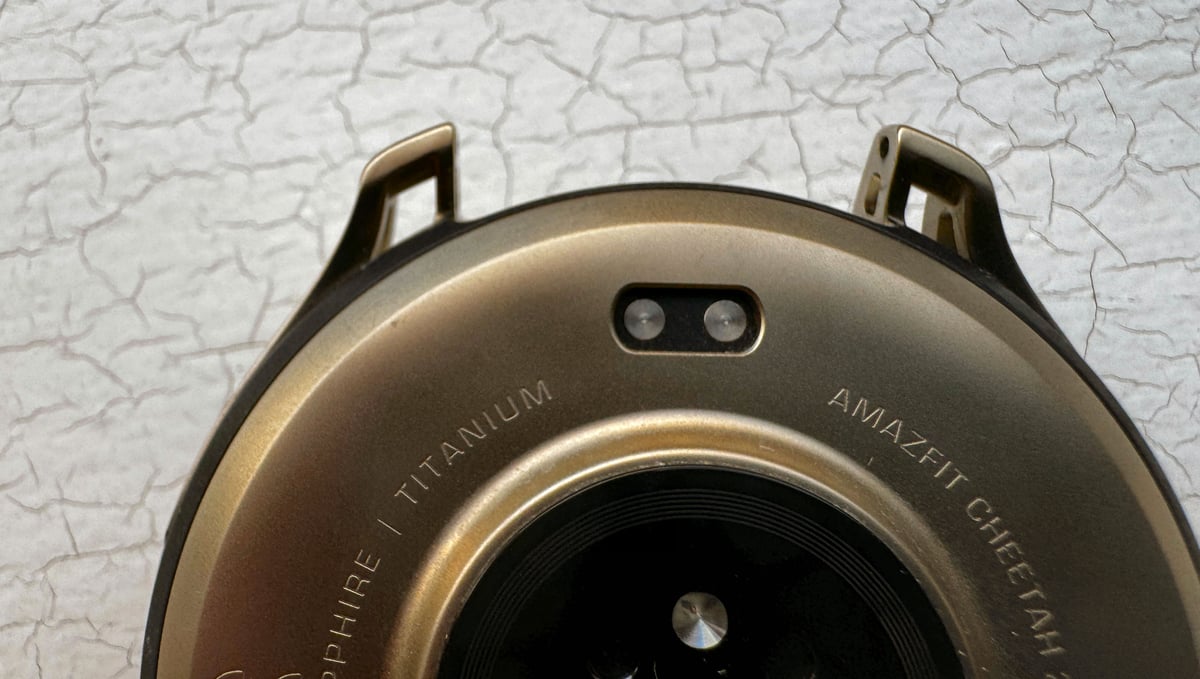
That’s a fifty per cent jump, rare by the standards of any sports watch brand. That said, the new build is top quality, now with a full titanium frame and case, where the original used a polymer body with just a titanium bezel. Add sapphire glass and a 3,000-nit display. One oddity is the smaller display, 1.32″ against 1.45″. That’s probably one of the few bad calls Amazfit has made, but they just get away with it. The bezel area isn’t too big, the lens is well-designed around it, and the display is flashlight-bright and super readable. There’s also a real LED torch.
As I’ve already touched on, the consequential change is ergonomic. The rotating crown of the original is gone (good riddance) and replaced by four physical buttons. That’s great, but five would have been marginally better for runners. Garmin figured that out a decade ago.
Also new are several key spec elements that read as boring on paper but make a positive difference in the usability, reliability, and accuracy of your experience: dual-frequency, six-constellation GNSS and Amazfit’s next-gen optical sensor package (BioTracker 6.0 with five photodiodes and two LEDs). These sound great, but many brands get new sensors, and they’re still inaccurate. I’ll cover these in the test results further on.
Per-second GPS battery life gets a modest boost from 26 to 31 hours, while Power Saving mode gets a more notable uplift from 54 to 69 hours. There’s also a new Extended mode rated for 99 hours, though it’s confined to outdoor walking and hiking, so it’s of limited use to a runner.
Oh, and storage rises to 32GB. Plenty of space for maps and music. That’s all that number means.
The full Amazfit Cheetah 2 Pro specifications are set out separately.
Build, screen, and ergonomics.
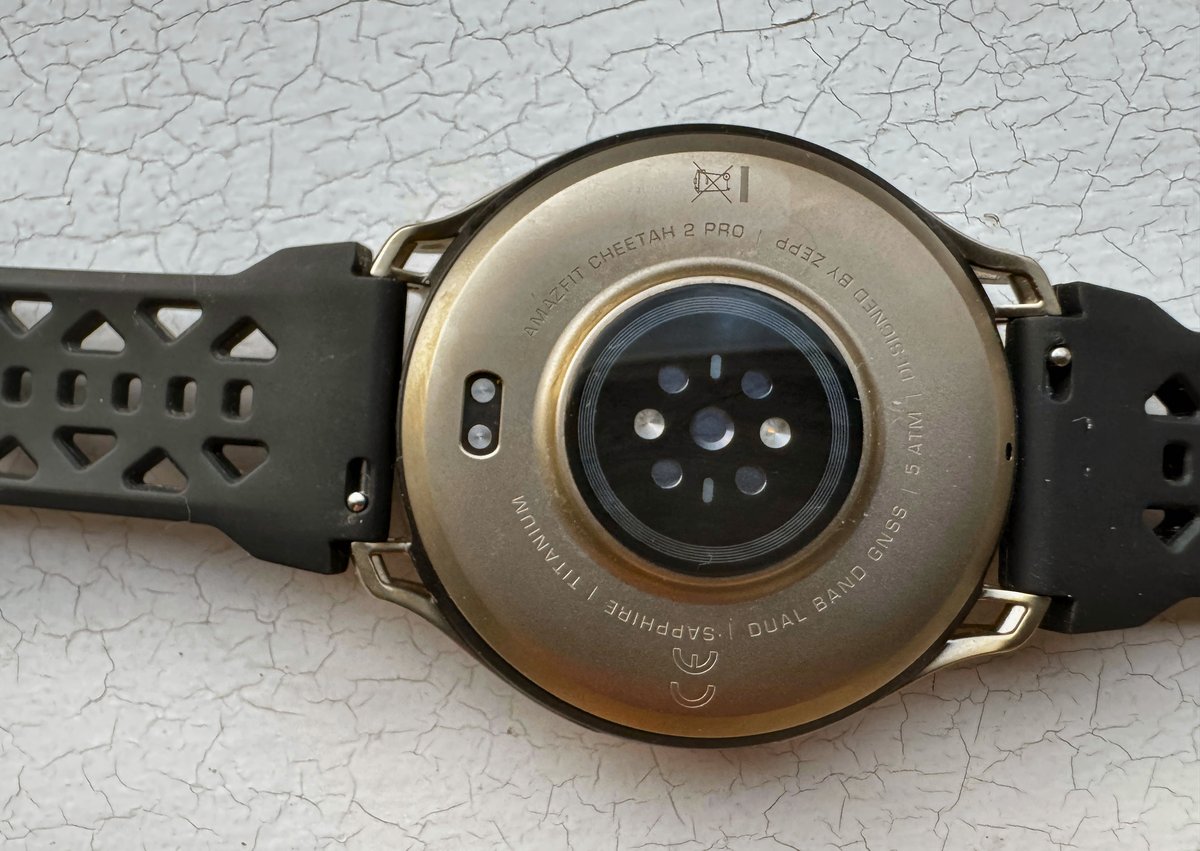
The 2 Pro looks like a standard medium case. At 48mm, it is slightly wider than the norm, but not in a way you notice on the wrist. The 45.6g overall weight feels lighter than you would expect, 8g lighter than the Forerunner 970, despite both having a titanium case.
It feels light, even during my two-hour runs. My wear problem is generally avoiding slippage down towards the wrist bone, which leads to poorer OHR readings. The Cheetah’s strap is a tad stretchier than usual, so it can be adjusted to provide a bit of grip. It doesn’t slip. The strap does look a bit cheap, though, which is my one aesthetic reservation.
The 3,000-nit screen, when cranked up to the max, will just about sear through your retina. Well, not quite, but it is bright. The AOD mode is OK and configurable with various max-brightness levels, on-time settings, and customisations for sport or watch modes. I eventually landed on the AOD plus raise-to-wake combo, meaning it was dulled but always on, then brightened up when you turn your wrist. The brightness takes at least a second to crank up to 3,000 nits here. There are perhaps some situations when that will be annoying, but I didn’t find them.
One display-related annoyance is the 5-6mm bezel around the display. Amazfit’s own Active Max, at a third of the price, fits a 1.5-inch display into a 48.5mm case, half a millimetre wider than the Cheetah’s. The £450 Cheetah has roughly 2mm more bezel on each side than the £170 Active Max. The case effectively disguises the black bezel, lens curvature, and other features, but the design decision for the smaller display is unusual (the reasons are that it is cheaper to buy and uses less power)
The buttons are almost flush with the case. Their knobbled texture makes them easier to find and press than I would expect, but in the end, protruding buttons are more functional. These certainly look fantastic. Where I keep getting caught is the missing fifth button.
The touchscreen works well most of the time and, like many modern sportswatches, can be selectively disabled during times (sports) when you want to avoid accidental presses. It worked less well when wet (e.g., while swimming).
The haptics are muted but sufficient. The whole watch gives a little judder, which is quite pleasant in a tingly kind of way.
Some nice touches
Sports watches have come a long way in the two decades I’ve been testing them, to the point now where even a watch discounted to $150 can be an amazing piece of tech. Reviews tend to cover the bigger features. Rightly so. Here are a few unusual snippets that represent the breadth of the designers’ scope.
- The watchface has a runner icon (more correctly called a complication). Tap it, and the run profile opens up. A great shortcut.
- Other complications include Training Load. Tap that to see your acute (7-day) training load with swipes to other key metrics like VO2max.
- Voice-Captured Workout Notes, the press-and-hold voice memo feature Amazfit rolled out in January, is present on the Cheetah 2 Pro at launch. I covered the feature on the T-Rex Ultra 2, where transcription accuracy ran at around 98 per cent. Useful for capturing context mid-run.
- Oh. Did I mention the LED torch? Yes, I think I did.
I did not test every feature. It’s simply impossible as there are so many of them.
How I tested
My standard testing methodology for sports watches is set out in full here. I have applied the relevant subset to the Cheetah 2 Pro and report my findings below. Where a test in the standard protocol is not covered in this review, I have either judged it not material to this kind of running watch or have not yet run it. I will update this review as further data comes in.
The Cheetah 2 Pro was worn as the sole device on the left wrist (some photos are posed showing the opposite), with reference devices worn elsewhere: Garmin HRM 600, Polar Sense, Garmin Forerunner 970, Suunto Race 2, Apple Watch Ultra 3, and Stryd 4. Tests were typically under one hour, up to two. Coverage skewed strongly toward steady aerobic running, threshold sessions, and long runs. Conditions were generally warm to hot.
GPS accuracy
At the macro level, the Cheetah 2 Pro tracks accurately and is broadly comparable to the Garmin Forerunner 970 across the conditions tested. It falls short of the near-reference Huawei GT Runner 2 and produces occasional 5m-plus errors that detail-oriented readers will spot. For the vast majority of runs, the Cheetah’s GPS is good enough.
The Cheetah 2 Pro has a seemingly excellent GNSS chipset with dual-frequency support and coverage across six constellations. However, that doesn’t guarantee a good position fix. The chipset, its power, the antenna it uses, and other factors matter just as much. The following detailed tests are what most reviewers leave out when they call a watch “good” or “accurate” after one or two modest tests.
GPS Accuracy: Standard 10-Mile Test
The standard 10-mile test is the anchor comparison across all sports watches tested at the5krunner, using the same route run with +/- 1m precision and the same reference devices. The full methodology is documented at the5krunner.com/testing-methodology.
Huawei’s GT Runner 2 is a near-reference-grade watch in this test, and the Cheetah 2 Pro did not match it, but came in with a creditable 73% overall score against the Runner 2’s 90%. GPS performance across the board had some unusual moments on the day. The Suunto Race 2, also tested on the same day, produced unexpectedly average results.
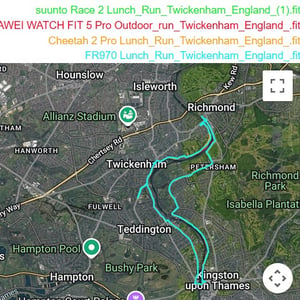
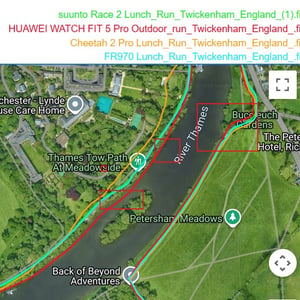
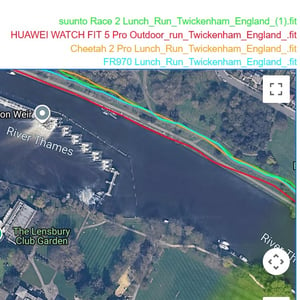
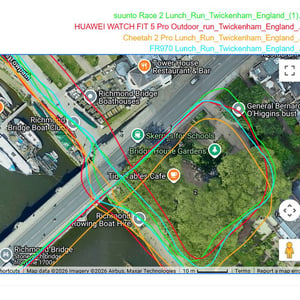
In the overview chart, the Amazfit yellow line is hidden by the blue track of the Forerunner 970, indicating the trace is roughly correct at the macro level. The devil is in the details, and most readers and casual reviewers will not look for it. The Cheetah was generally pretty accurate until it wasn’t; when it wasn’t, it was 5 or more metres off, as shown in the 2nd, 3rd, and 5th images below. Elsewhere, it was on track, whether in the open, under trees, or near buildings. These rare but significant errors are the sort that people will spot even when wearing a single watch. Generic reviews of this watch describe the GPS as “good” or “similar to other test devices,” without conducting rigorous comparisons. The standard 10-mile test reveals the details those reviews miss. To explore the results in more detail, see the DCR Analyser files at this link.
The 73% score places the Cheetah 2 Pro in the middle of the pack against all the watches I’ve tested, perhaps a little lower than others using dual-frequency GPS. For a recreational runner or first-time racer, the accuracy is good enough for pace and a pretty track afterwards on Strava. If you want precision for Strava segments or pace in urban canyons, you need something else.
GPS Accuracy: Tunnel and Tall Buildings
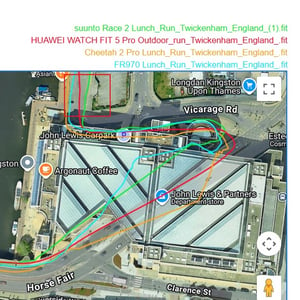
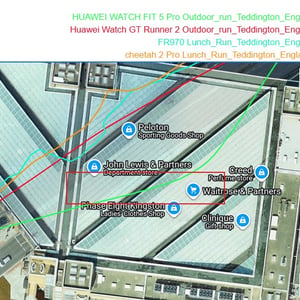
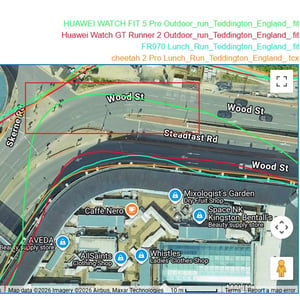
The tunnel and tall-building tests exposed the competing Huawei Runner 2 as the most accurate GPS watch I have tested under difficult conditions, and its track can serve as a near-reference in the images below. The Cheetah’s overall tall-building performance was OK and broadly comparable to that of the Forerunner 970. The Huawei GT Runner 2, by contrast, was clearly accurate and clearly the best on test. Its novel antenna architecture and tri-frequency GNSS chipset make a difference, a noticeable one – at least to me. But does it matter? It probably matters if you are running a city marathon. Otherwise, the Cheetah is good enough.
If you train or race regularly in large city centres, you are best advised to get a footpod like Stryd to boost the pace and distance accuracy of your Amazfit.
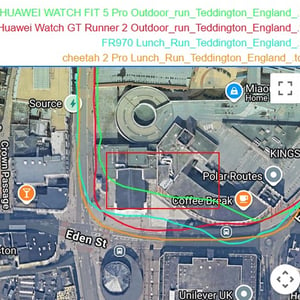
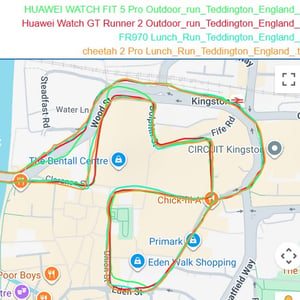
GPS Accuracy: Suburban Grid
In a residential grid layout of semi-detached and detached houses, the Huawei GT Runner 2, Forerunner 970, and Amazfit Cheetah 2 Pro performed similarly. The Runner 2 was again clearly the best device on test, with the other three each having good moments and less good moments. Those three were broadly equal to each other overall.
For everyday running under relatively benign GPS reception conditions in suburbia, there is no meaningful difference between the Cheetah 2 Pro and top-end watches like the Forerunner 970. Tip: Save yourself $300.
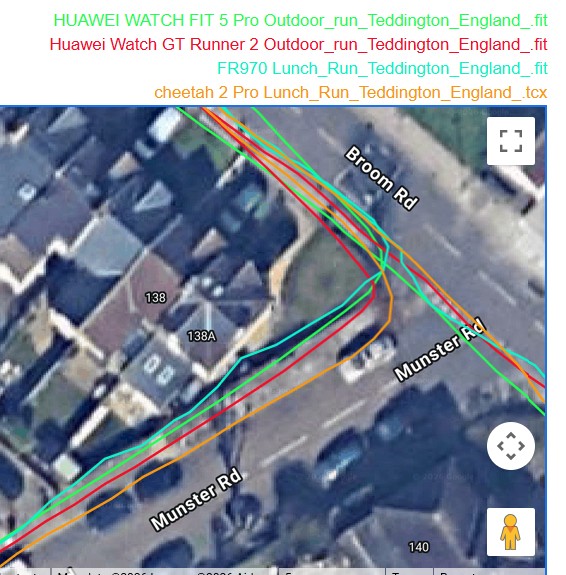
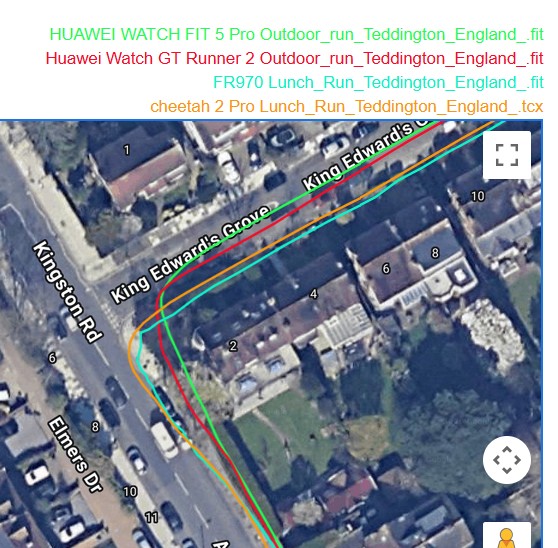
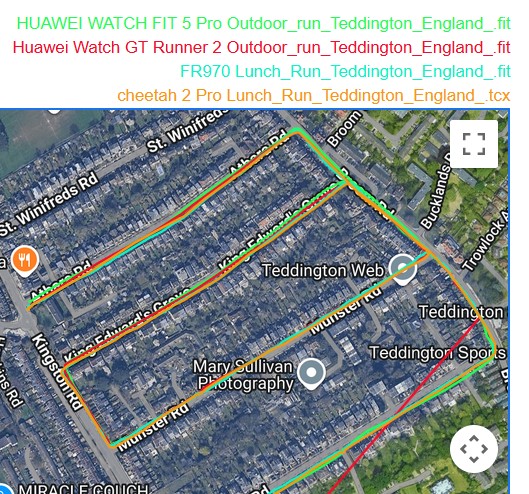
Note: Runner 2 was accidentally paused at the start, resulting in a straight red line.
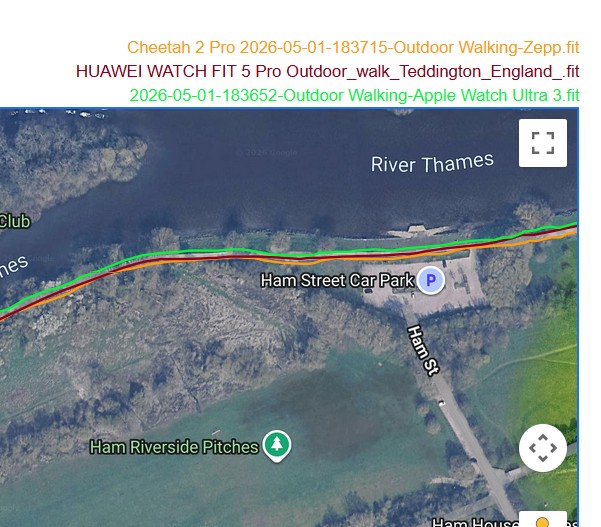
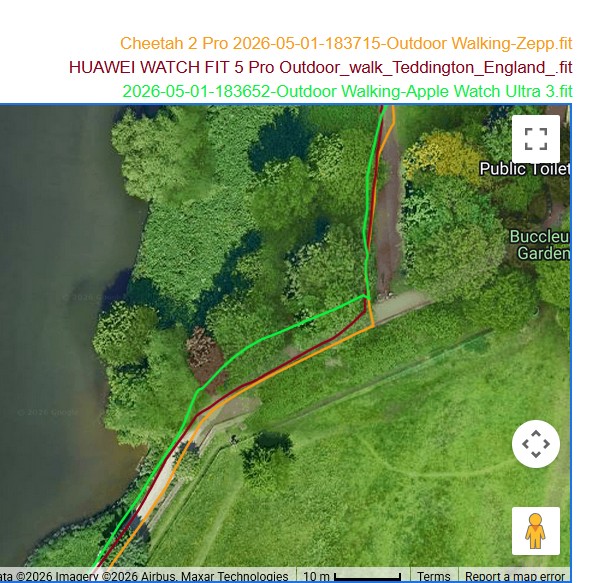
A walk under the riverside trees showed excellent performance by the Cheetah, which maintained the correct position at slow speeds throughout. Even the normally good Watch Ultra 3 had a bad moment here, drifting 3m off track. Not so the Amazfit.
On easy trails under tree canopies, the Cheetah 2 Pro was surprisingly and unexpectedly very good in this test, but might suffer in more demanding tree-related scenarios.
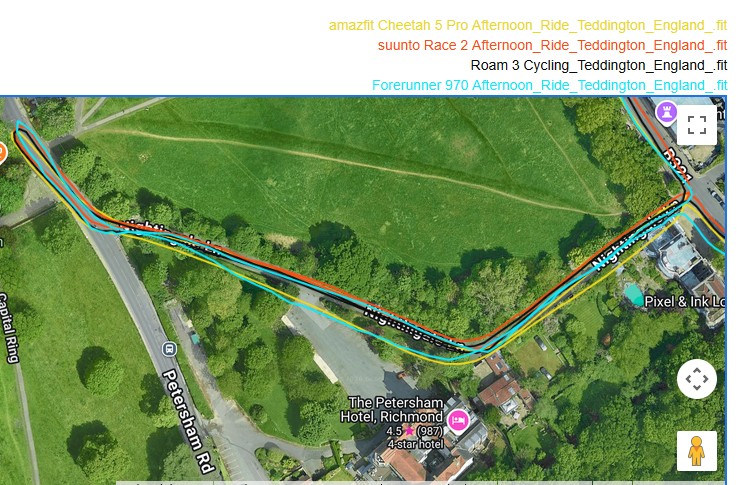
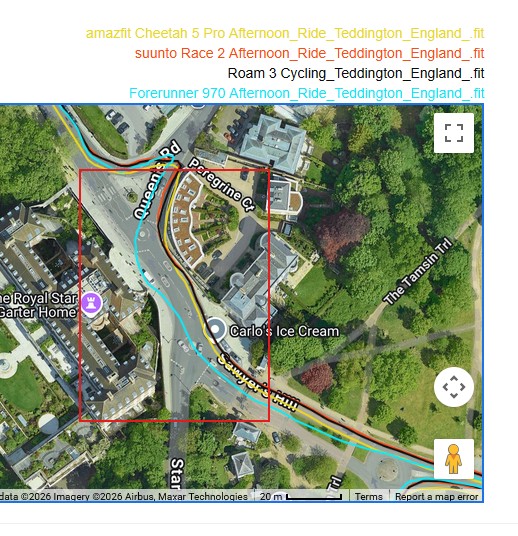
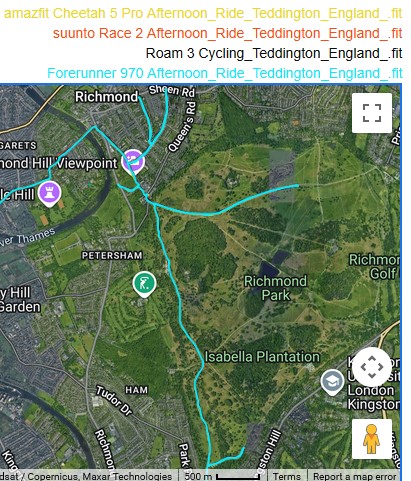
Next, a suburban road bike test. The Richmond Octopus is my self-curated route of eight hills in Richmond. One of them, Nightingale Lane, is probably the steepest within many miles of my house, and thankfully short. Roadworks and heavy car traffic spoiled the test, but that did not stop the devices from being generally spot on. Good cycling GPS performance is, after all, easy to achieve on most roads. The worst on test was the Garmin Forerunner 970, which had one bad moment of over 5m inaccuracy. Other than that, every device was within 2m of the others. The Cheetah did a little corner-cutting on one section, but it stayed within 3m or so of the actual line, so it was acceptable.
A watch is never a replacement for a bike computer for a serious cyclist, but the Cheetah 2 Pro is perfectly fine for the occasional ride.
I ran several other tests, but they showed nothing unusual, apart from the next one.
The Cheetah 2 Pro claims GNSS dead reckoning, meaning it uses the watch’s sensors to estimate its position when the satellite signal is lost. I had effectively tested that already in two of the tunnel results above. However, I wanted to see what would happen with no GPS and no wrist movement. Handily, I was on a canal boat holiday in Northamptonshire, which just so happened to have a 20-minute, 1,300m tunnel, complete with bats and stalactites. I digress. The watches were placed on a pole on the boat’s roof to keep them still. There was no wrist motion, no GPS signal in the tunnel, and not even any reflected signal once the entry and exit were a few tens of metres away. Perhaps unsurprisingly in hindsight, each device drew a straight line from its determined entry point to its determined exit point. This is clearly different behaviour from the proper tunnel tests above, where other adjustments are made either through arm movement or through bounced GPS signals. The Pixel Watch 4’s tracking differs from that of the Cheetah 2 Pro and Suunto Race 2 because it uses different entry and exit points.
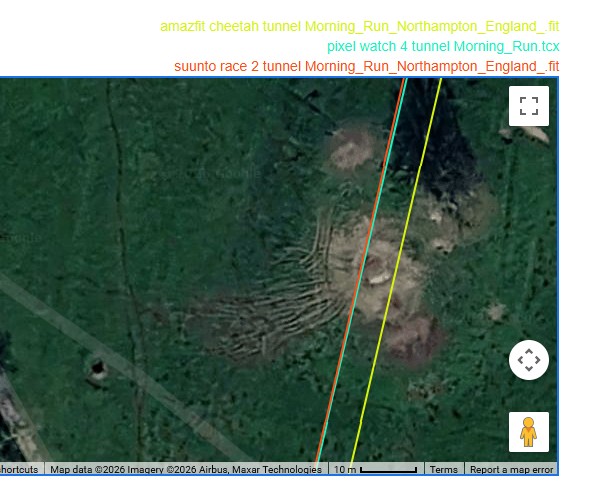
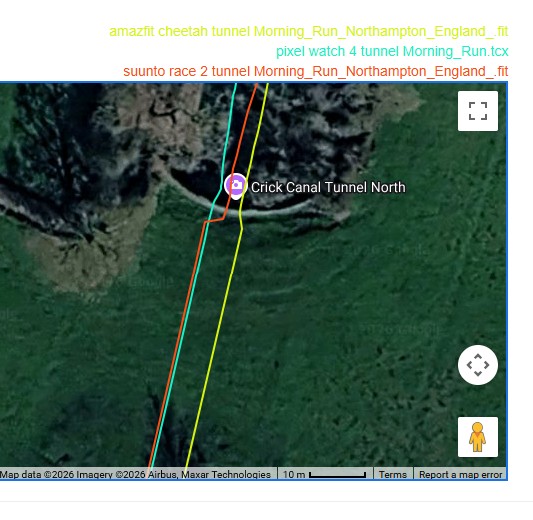
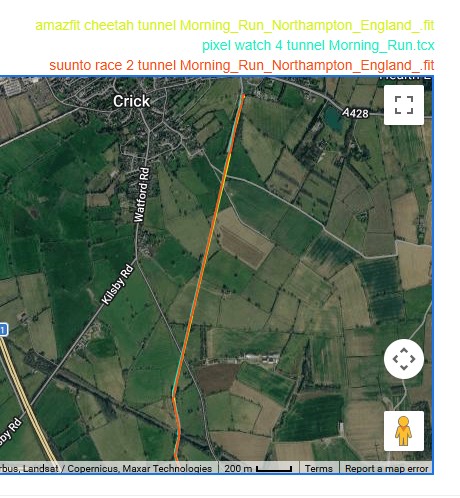
I was genuinely surprised by this extreme-conditions test. I expected each device to make poor attempts at correction. As it turned out, none of them did. i.e., they really DO use accelerometer data when you run in a tunnel.
Amazfit makes claims about its new dead-reckoning GPS feature for tunnels. It does perform better than many in tunnels, where it must use arm movements to determine direction and pace. Where there is no GPS or movement, its dead-reckoning algorithm correctly keeps quiet until a signal is reacquired.
Distance accuracy
GPS accuracy and distance accuracy are linked, and overall run distance tends to average out the over- and under-estimation across the activity. With autolap set to 1km on four reference devices and all watches started and stopped at the same point, the Cheetah 2 Pro was accurate. All five were subjectively accurate too; they beeped together at each 1km marker.
Against a 7.81km reference from the Garmin Forerunner 970 paired with the Stryd footpod, the Cheetah 2 Pro recorded 7.80km, an error of 10 metres or 0.13 per cent. That placed it ahead of the Apple Watch Ultra 3 (0.26 per cent low), Pixel Watch 4 (0.64 per cent high) and Suunto Race 2 (1.41 per cent low) on this run. The route was moderately difficult from a GPS perspective, with buildings and trees, typical of my training routes, but perhaps not yours.
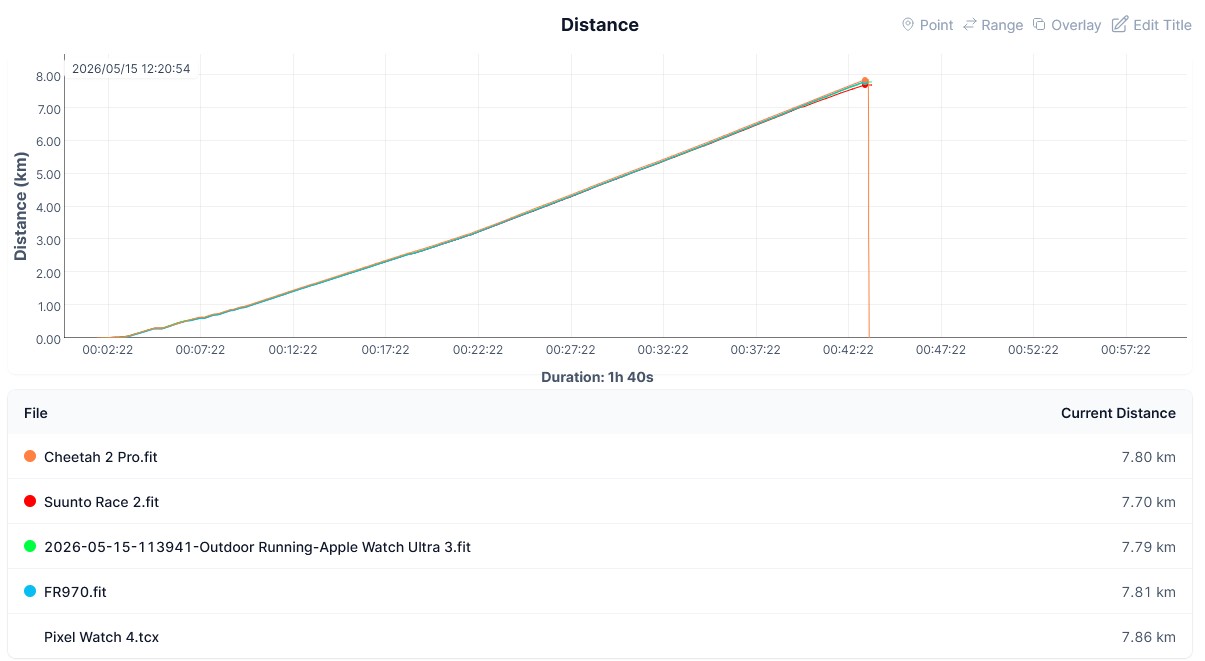
Note: Suunto Race 2 entered power-save mode, likely explaining its slight underreporting.
When to trust the Cheetah’s GPS
You can trust the Cheetah 2 Pro to deliver a decent running track, distance, and pace in middling difficulty scenarios like suburbia, river paths, parks, trails, and road cycling. I wouldn’t trust it for accurate distance and pace readings in urban areas, despite its dual-frequency claims.
What was not tested: Track Run mode. I will update this review once I cover it, but my experience with recent Amazfit watches has been decent with this feature.
One caveat: GPS accuracy varies by conditions and day. Your experience will vary.
At a glance:
- Standard 10-mile test: creditable 73% against the GT Runner 2’s 90%
- Tunnel and tall buildings: acceptable, broadly equal to the Forerunner 970, well short of the GT Runner 2
- Suburban grid: equal to the Forerunner 970
- Riverside trees, walking pace: excellent, held the line where the Apple Watch Ultra 3 did not
- Suburban road bike: within 2m to 3m of the reference line, minor corner-cutting on one section
- Canal tunnel dead reckoning: straight-line, no correction attempted, behaviour correct and matched the other watches on test
Optical heart rate accuracy
The Cheetah 2 Pro’s wrist optical heart rate is excellent during steady runs, good in the pool, and fair on the bike. Session-average accuracy is consistently strong, but moment-to-moment readings can drift substantially in any activity. A chest strap remains the recommendation for any session above threshold and for cycling.
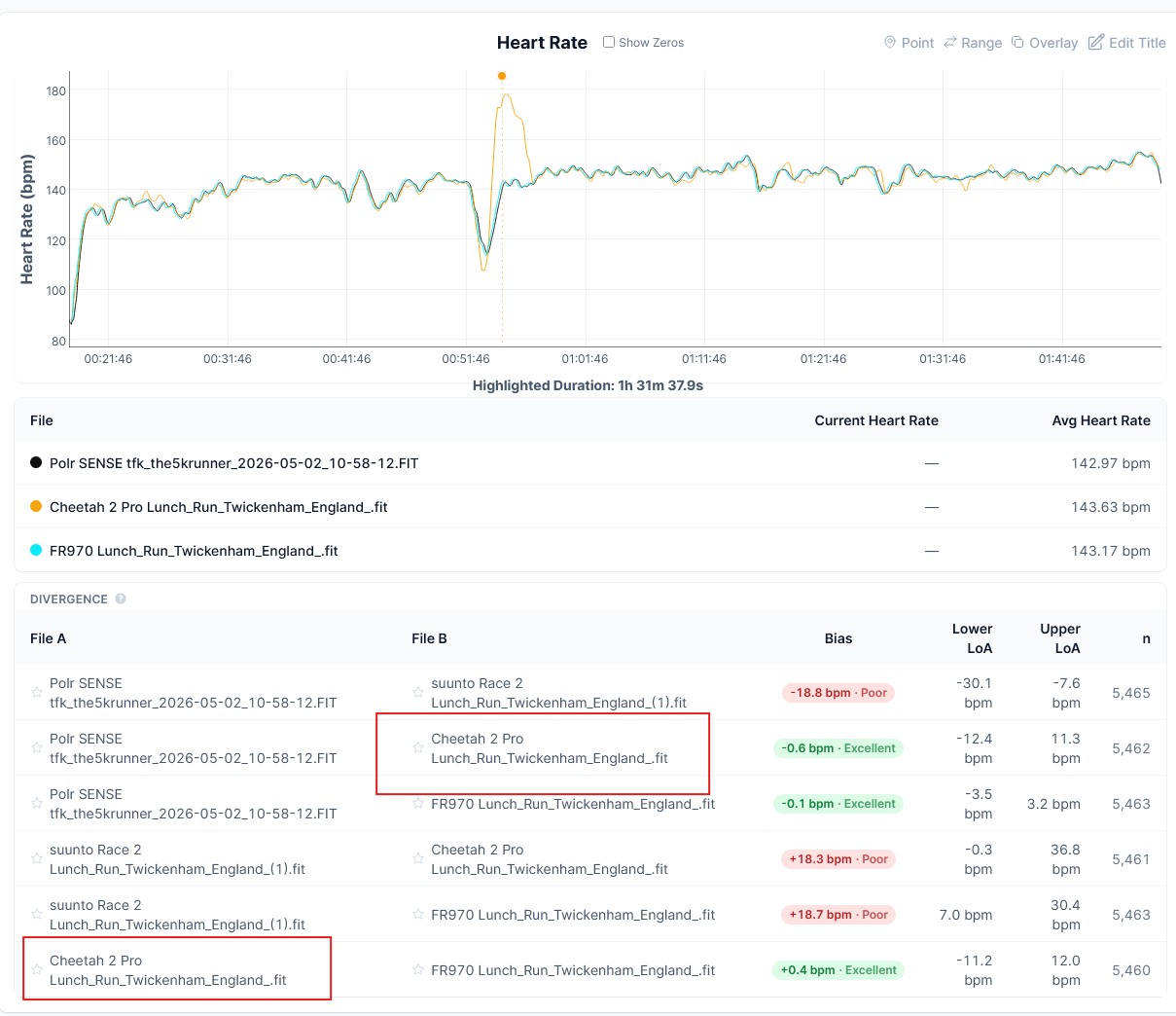
Over a single steady aerobic run in the London borough of Richmond, the Cheetah 2 Pro’s optical heart rate averaged within one beat per minute of both reference straps. Bias against the Polar SENSE was -0.6 bpm. Bias against the Garmin HRM 600, recorded via the Forerunner 970, was +0.4 bpm. During the session, the Cheetah matches the chest straps. The limits of agreement told a different story, spanning ±12 bpm relative to both references. In any given second, the Cheetah could sit 12 bpm higher or lower than the chest strap, with the errors cancelling out across the run rather than disappearing. The chart shows one specific event that caused the peak, linked to a pause in the test. For steady aerobic running, this is about as good as a wrist sensor needs to be, but it’s not perfect.
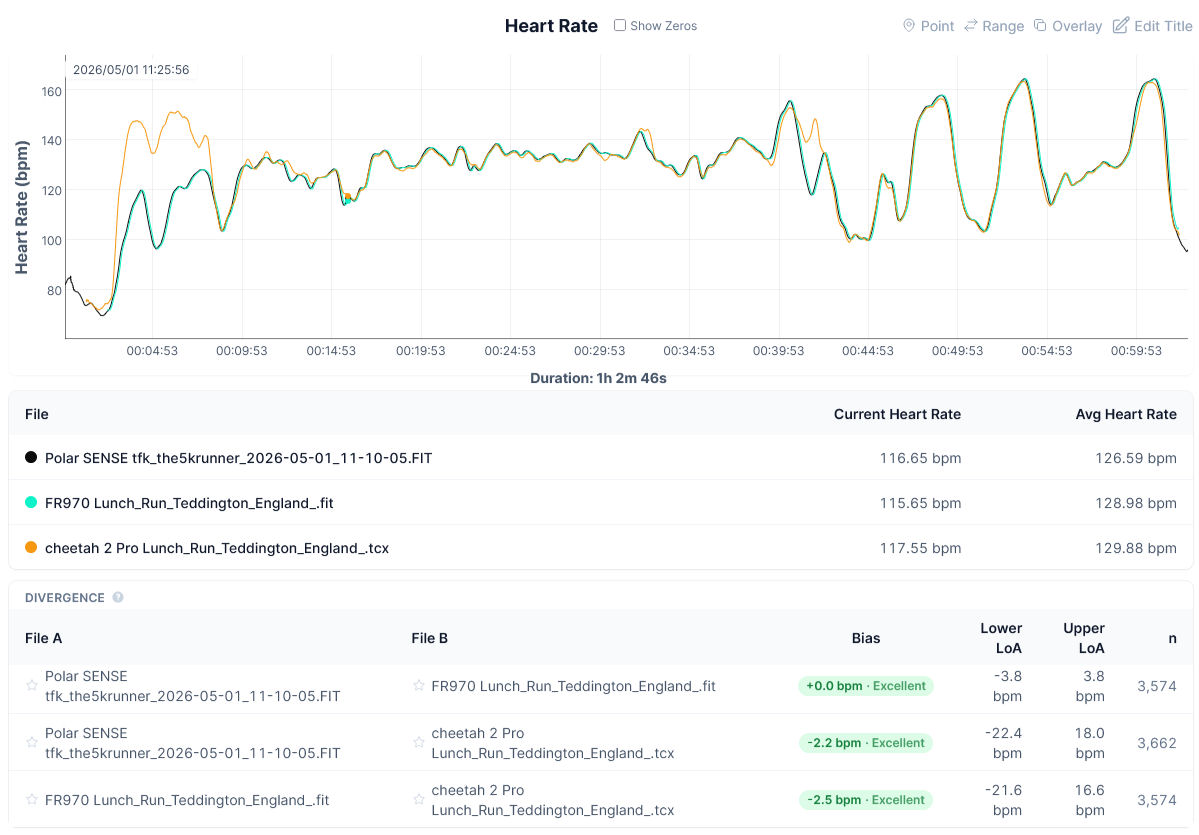
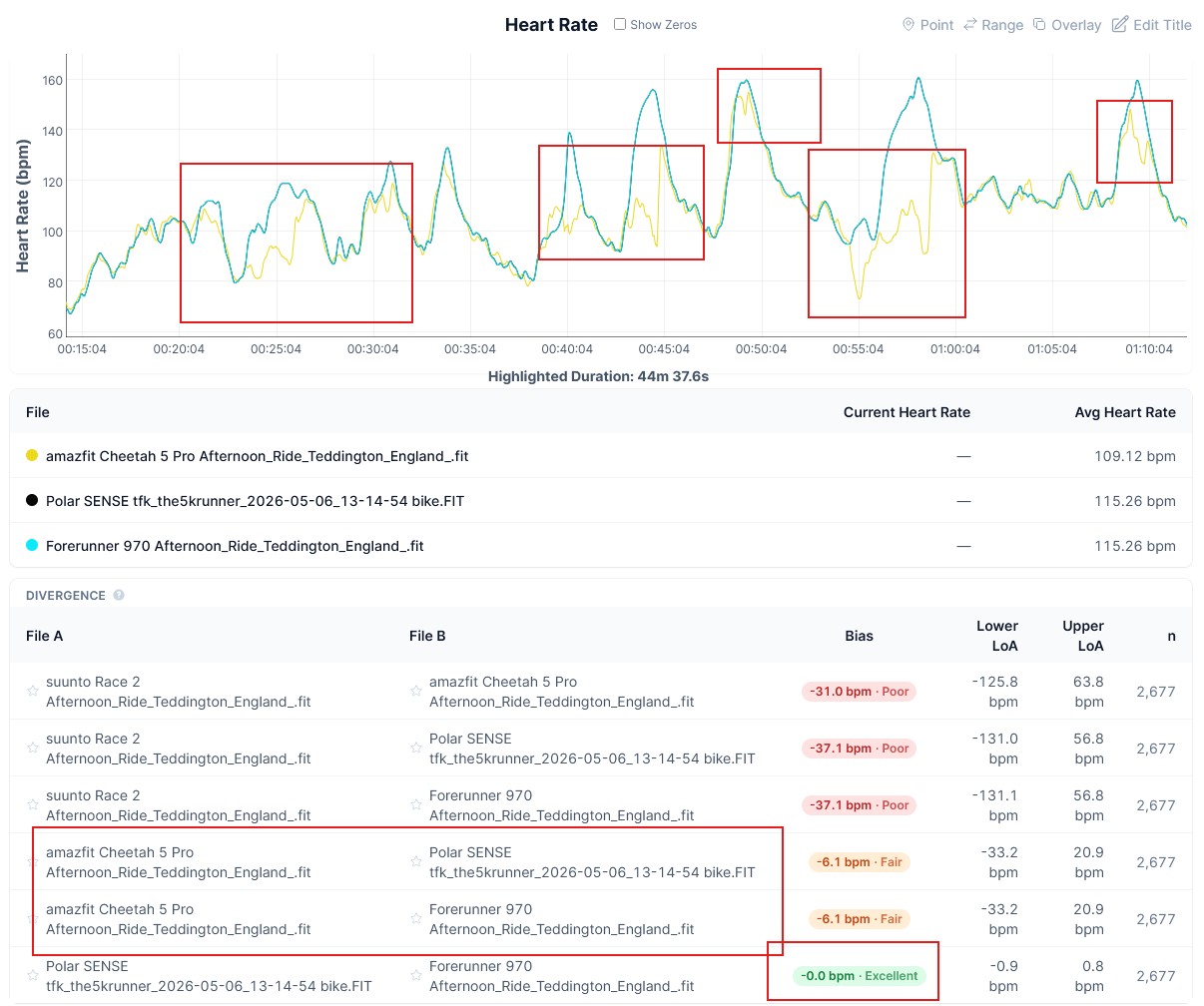
On a ride in Richmond, the Cheetah 2 Pro’s wrist optical heart rate underread both chest straps by 6 bpm on average. The Polar SENSE and the Garmin HRM 600 recorded via the Forerunner 970 agreed to within a single beat per minute, which means the reference baseline is solid and the 6 bpm bias is on the Cheetah. You can see this visually in the chart below. The limits of agreement were wide. At any given moment, the Cheetah could sit 33 bpm below or 21 bpm above the chest straps, a 54 bpm spread. The DCR Analyser stats (beta) rate this as Fair. On a bike, the wrist sits in a relatively static position on the handlebars under steady pressure, with cooler air across the sensor, and those are conditions where wrist optical typically struggles. Some of my tests were in quite aggressive riding positions (drops) with some wrist movements. If you ride seriously, treat the Cheetah as more of a bike logging device than a high-end training tool, and pair it with a chest strap.
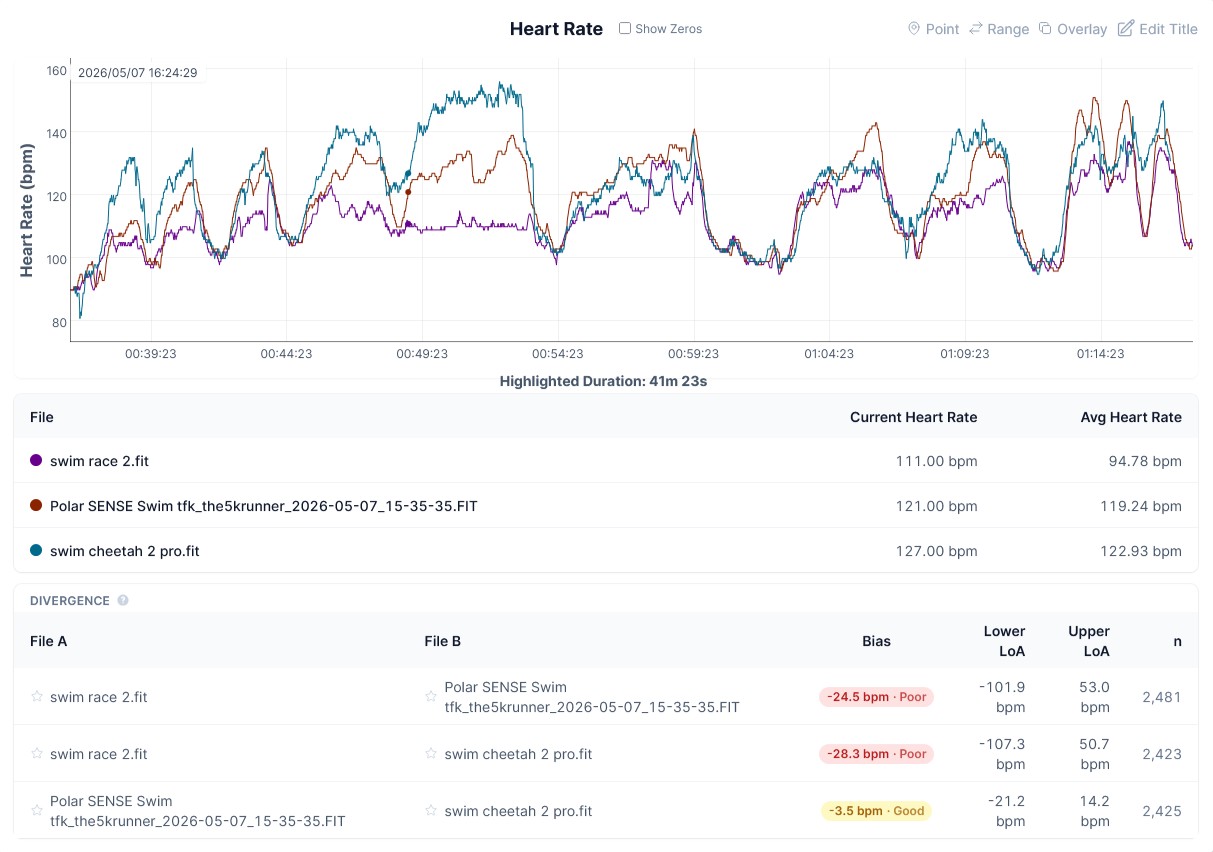
In this first swim test, the caching strap (Garmin HRM 600) failed to record because of an error on my part. Usually, a single missing reference would not matter, since the others could corroborate it, but on this swim, the devices disagreed. The Polar Sense armband, which uses optical sensing at the upper arm, was therefore the only practical reference. The Cheetah 2 Pro’s wrist optical heart rate averaged 3.5 bpm higher than the Sense, with limits of agreement of -21 to +14 bpm. The analyser (beta) rated this Good. The chart visually says otherwise, and therein lies the problem with other review sites (not DC Rainmaker) that quote summary statistics without a visual comparison. The summary result is unintentionally misleading.
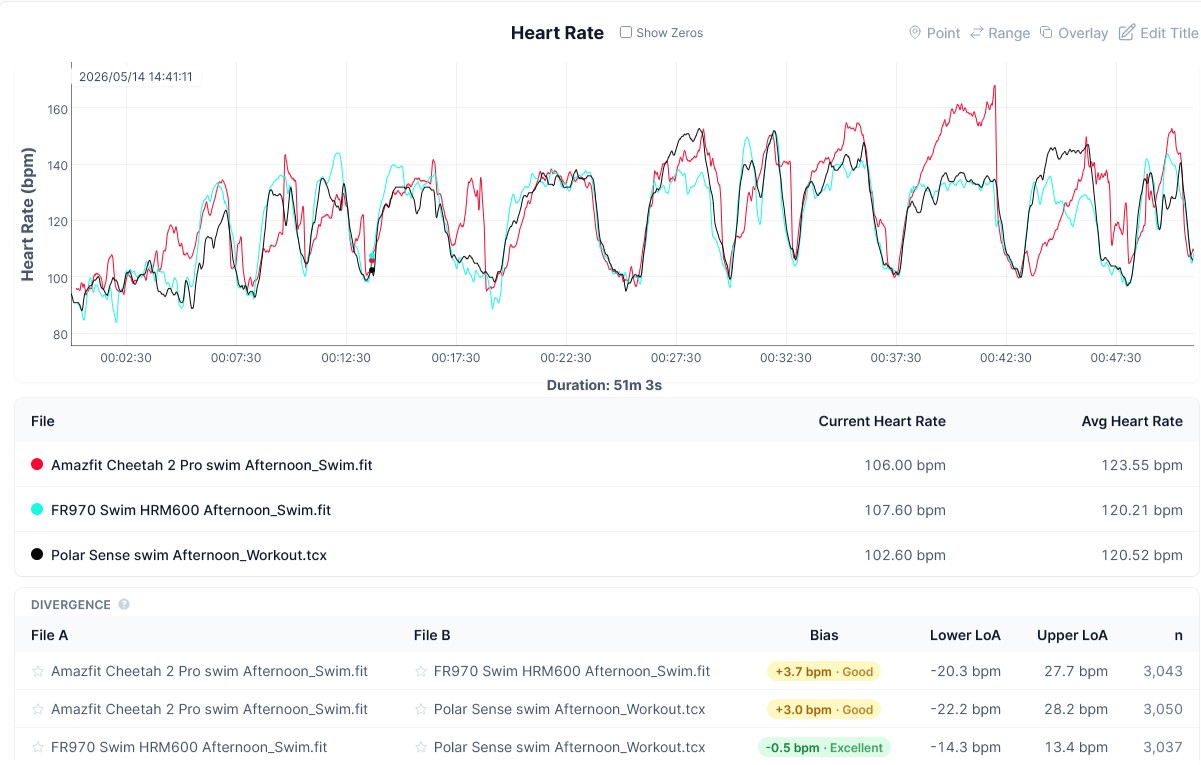
On the second swim test, all three devices recorded properly. Yay! The Garmin HRM 600 chest strap was worn under a trisuit, which kept it in place against the skin. In water, both the chest strap and the Polar Sense armband can slip and misread, but the trisuit removed that variable for the HRM 600. The two references agreed to within half a beat per minute, with limits of agreement of -14 to +13 bpm. That spread is wider than on dry land and reflects the known limitations of both sensor types in water, but it is tight enough to treat as a paired reference. By that paired reference, the Cheetah 2 Pro averaged 3 bpm high, with limits of agreement ranging from -20 to +28 bpm. The analyser rated this Good. The session average is creditable. Moment-to-moment readings can drift a long way from the actual value. As the chart shows, the Cheetah is significantly wrong in places. My view is that it is just about accurate enough for recreational logging. A swimmer using the Cheetah alone would likely not even notice the error.
When to trust the Cheetah’s heart rate
Trust the Cheetah’s optical heart rate for any steady aerobic effort on foot. Be mindful during intervals, threshold work, cycling, and anything involving sharp changes in effort. The session average could look fine in either case, but mask errors in the details.
What was not tested: strength work and cold-weather running. I will update the review as that data comes in.
One caveat. These are single-session results under dry-land, warm-Spring conditions. Wrist optical accuracy varies by individual, skin tone, tattoo coverage, ambient temperature, and how tightly the watch is worn. The pattern here is more reliable than the precise numbers.
At a glance, optical heart rate accuracy:
- Steady run: bias within 1 bpm against both Polar Sense and Garmin HRM 600 (n 5,460). Limits of agreement plus or minus 12 bpm. Rated Excellent.
- Bike ride: 6 bpm low against both references (n 2,677). Limits of agreement: -33 to +21 bpm. Rated Fair.
- Swim 1, Polar Sense reference only: 3.5 bpm high. Limits of agreement: -21 to +14 bpm. Rated Good.
- Swim 2, paired Polar Sense and HRM 600 references: 3 bpm high against both. Limits of agreement: -20 to +28 bpm. Rated Good.
This is in line with other tests. Other test results are not included, as this review is already way too long.
Elevation accuracy
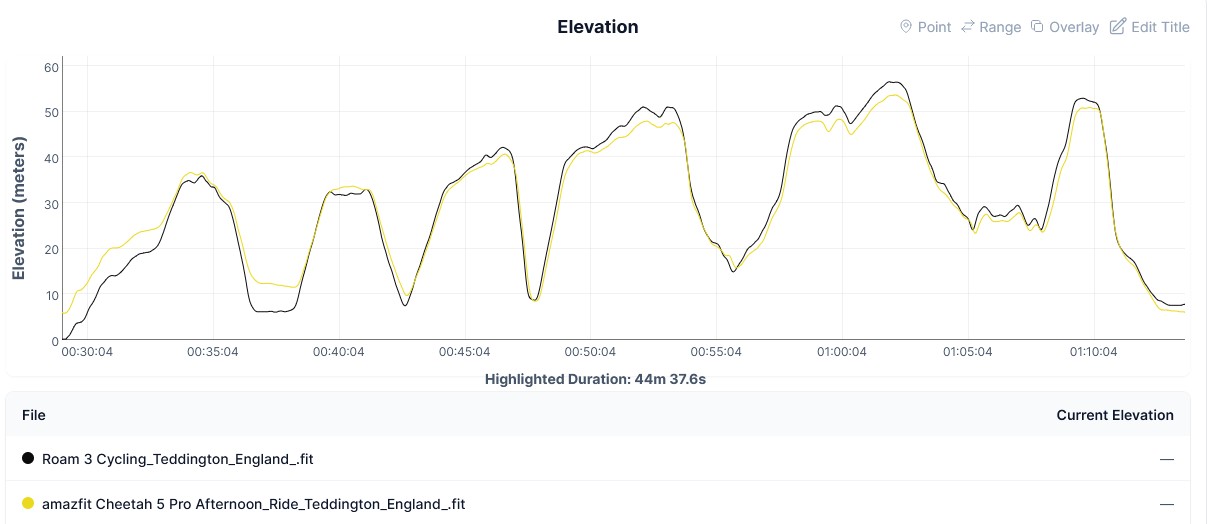
The bike ride showed a few metres of discrepancy in the recorded elevation. It’s not as good as some other devices, but it’s probably OK for recreational purposes. In any case, other tools like Strava may well write their own elevation figures.
Swimming pool metrics
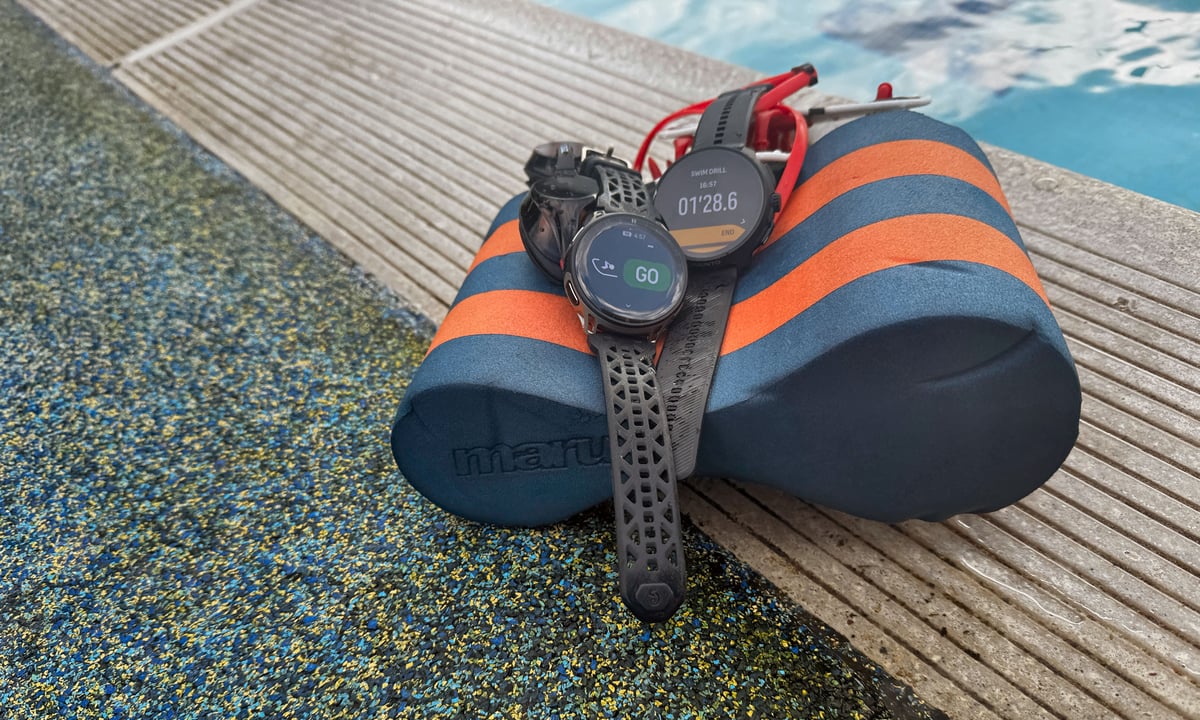
I tested the Cheetah 2 Pro in the pool against the Suunto Race 2, Forerunner 970 and Form LT Goggles. This is primarily a running watch, so I don’t want to dwell too much on the swim metrics. The app correctly detected my main style as Freestyle on two occasions. The stats on the app are sometimes useful and sometimes not. The summary stats include rest time in the averages and SWOLF score, so that is clearly wrong. The charts are decent, with the stroke rate and individual lap pace being correct. These stats essentially come from accurate turn identification and manual lane-length measurements, which the watch got right, unlike other devices on test, which missed a length on two uncrowded days. Stroke cadence also looked correct.
Training metrics: power, threshold, VO2max, recovery
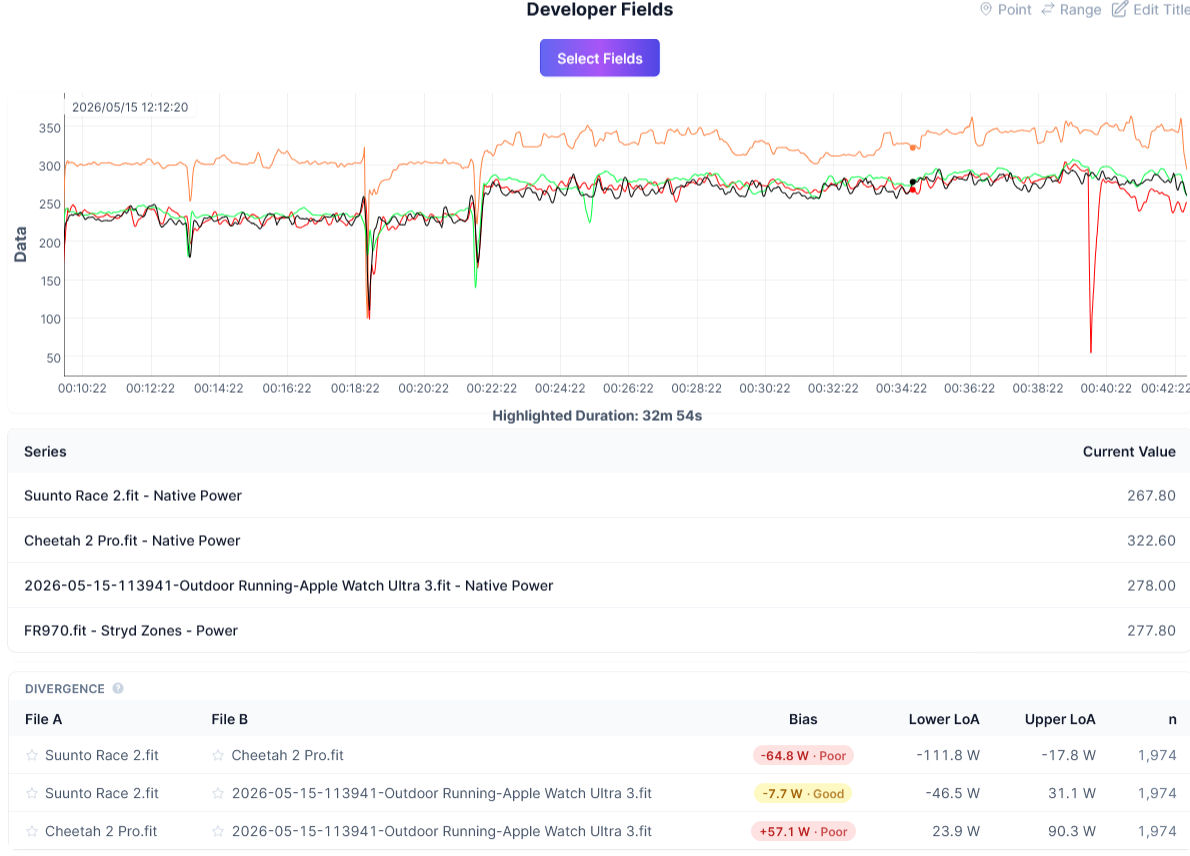
There is no accepted definition of running power, and indeed, there are two methods for calculating it that yield entirely different results. As the following chart shows, Amazfit clearly uses a different calculation from that used by Suunto, Apple, and Stryd (FR 970). In fact, it’s likely the same method as Garmin (which yields much higher results, like Amazfit). The general trend of the lines appears similar, but a closer look shows that only two lines track each other closely. The Cheetah seems not to track a similar trend either. Nothing can be drawn from this whatsoever. If the Cheetah’s running power is useful to you, use it.
Heart rate zones and lactate threshold
Heart rate training zones appear to be calculated by default based on age and sex, using 220-Age (or a similar formula). This general method yields inaccurate zones based on HR Reserve, and thus, low-grade efforts are overstated. Possibly the VO2max comes out lower than it actually is as a result.
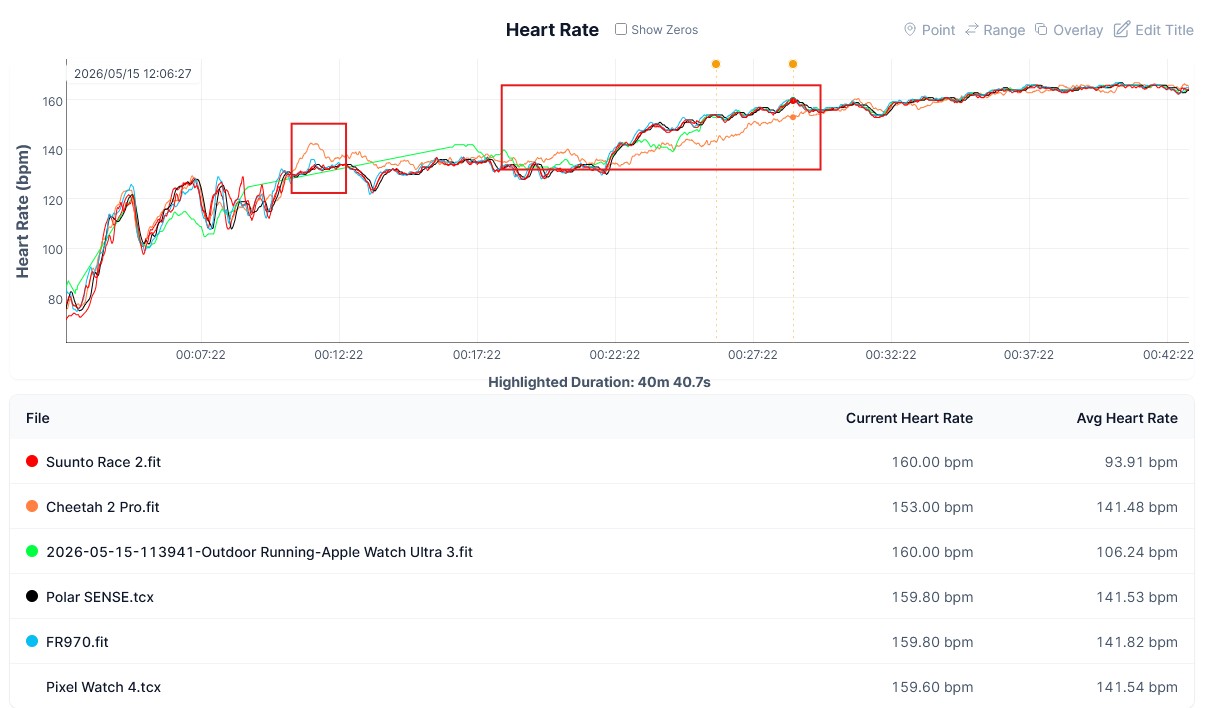
There are two manual overrides you can set. I would recommend the Lactate Threshold method. Amazfit automatically adjusts this over time. For me, it started at a value that was at least 10 bpm too low (probably about 13-14 bpm). To get a good approximation of your LTHR, run a maximal 10km, and the average HR for the last 20 minutes is your LTHR. Simple to calculate, hard to execute.
Amazfit also has an LTHR test, but I didn’t do that. Instead, I performed my own threshold run and was pleasantly surprised. The Cheetah picked it up as a qualifying effort, but it assigned an LTHR of 153 bpm, even though my LTHR is probably 162. I was very fatigued on the day, which could account for some of the suppression. However, look at the following chart. I’ve marked the point where the LTHR was supposedly hit, and this is where the Cheetah was underreporting the actual LTHR. Had it been reporting the correct HR at this point, that would likely have matched my real LTHR.
VO2max
After several qualifying runs, my VO2max was calculated to be at least 5 ml/kg/min too low (probably 7 or 8). This could be linked to the sometimes inaccurate heart rate during faster workouts. I have been running slower over the last few weeks, which might be one reason Amazfit scored me the way it did.
Recovery time
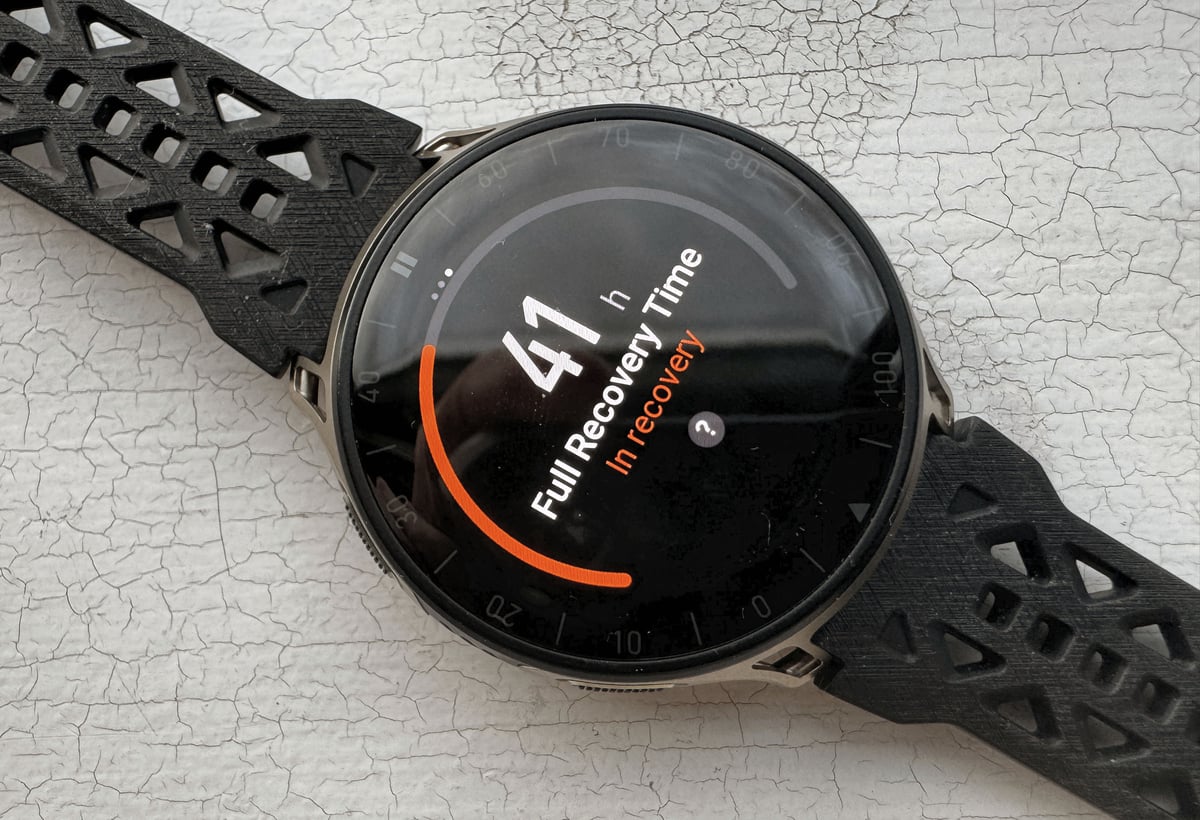
After one particularly hard run, Amazfit’s recovery time was 43 hours, compared with 66 hours on Garmin. Throughout testing, Amazfit was typically lower than Garmin, even though its heart rate and LTHR were lower as well. I don’t know if either was right. Still, Amazfit’s time matched what we would have seen from Garmin several years ago, until they updated their algorithm to the current, more conservative calculation.
Race time predictors
Zepp’s race-time prediction on the app was accurate. It was 30-45 seconds above my 5K time this year, and the HM time was 90 seconds over a race earlier in the year. However, I’m probably a bit less fit than I was on those two race days so Zepp could be very close.
Battery life in real use
Just checking my watch as I write this, wait, I see I have the AOD brightness set to max. Oops. I’ve been charging it every 5 days or so and completing 1-2 hours of outdoor workouts per day. I’ll need to revisit the claimed battery performance once, but even the performance I got was very good. Based on my experience with other Amazfit watches, the Cheetah 2 Pro’s claims of up to 31 hours in Accurate GPS mode, 69 hours in Power Saving mode, and 99 hours in Extended mode (for outdoor walking and hiking) are plausible. Typical use is rated at 20 days.
The 540 mAh cell is charged via a magnetic puck. The box ships with the standard Amazfit charging head – it’s a good one and very magnetic; you will need your own USB-C cable.
Zepp Coach, training plans, and software
The software is where Amazfit has historically conceded ground to others. However, in recent times, it has caught up and is now at a higher level. Whoop-like presentations and activity report details nicely cover the basics and more. There are still several minor annoyances that haven’t been fixed in a long time, and this irks me, especially when features like the Marathon plans and HYROX mode are added, even though they still need tweaks.
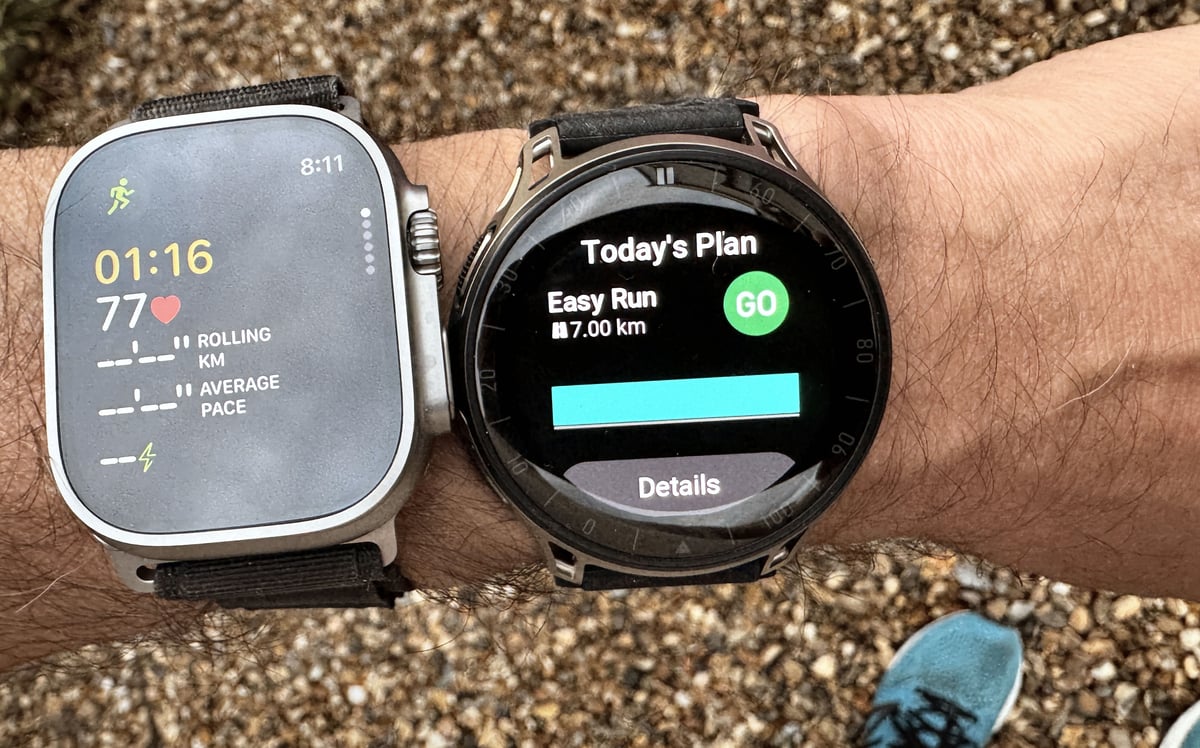
Garmin is often cited as a better app. It certainly has its usability issues, but more along the lines of presentational errors in fine detail rather than annoyances from missing sets of features.
I set up a training plan for a 5K based on my current ability level. The plan setup was clear. The plan itself gave the correct training speeds. However, there were some oddities, such as my 9KM Sunday long run, which is a low distance for me and probably should be 100% more. In one week, I had 5 available training days, but at the start of the period, the plan included only one fast session, comprising 30-second intervals. Beyond about 10 days in the future, planned workouts are not set and cannot be seen. I didn’t test how well the intensities and durations adapted, as my testing spanned over 2 weeks. However, a slower recovery day was built in when I significantly overachieved.
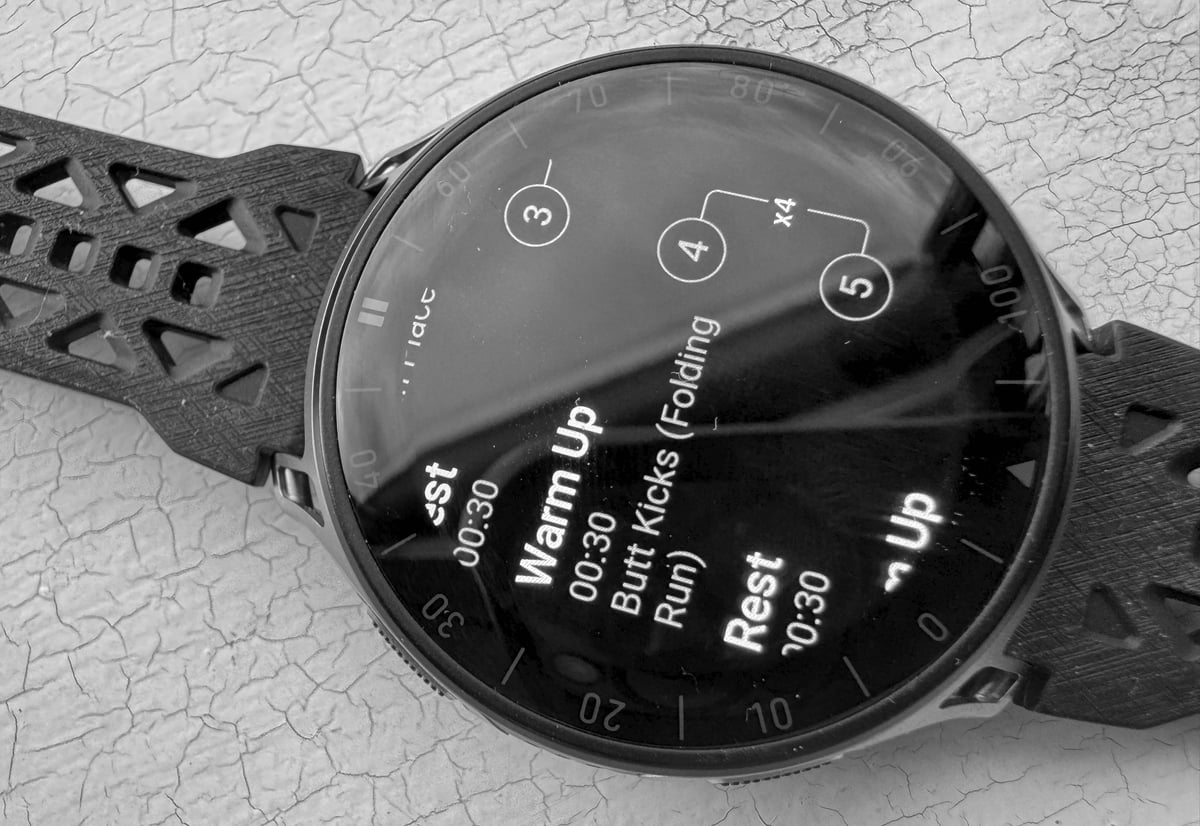
Workout sync is supported with plans you create on TrainingPeaks, Runna, Intervals.icu, and Strava. (Not tested.) Completed activities synced back to Strava correctly; indeed, all the test data here was manually re-exported from Strava (don’t ask!).
The app is certainly clear enough for daily use. Certain features may not be located where you expect them to be, but that’s true of all the training apps, in my opinion. Zepp is probably better than normal in usability.
Maps and navigation
The full offline maps, turn-by-turn directions, course deviation, and round-trip route generation are pretty good. The map display is very clear, and the directions are prompt and clear.
A surprise at this price point was on-watch re-routing. Another surprise was that it didn’t work! I only got the older functionality, where, after 50m, I received an off-course alert for about 5 seconds. After that, the only thing you can do to get back on track is to visually assess your position against the correct position on the red line.
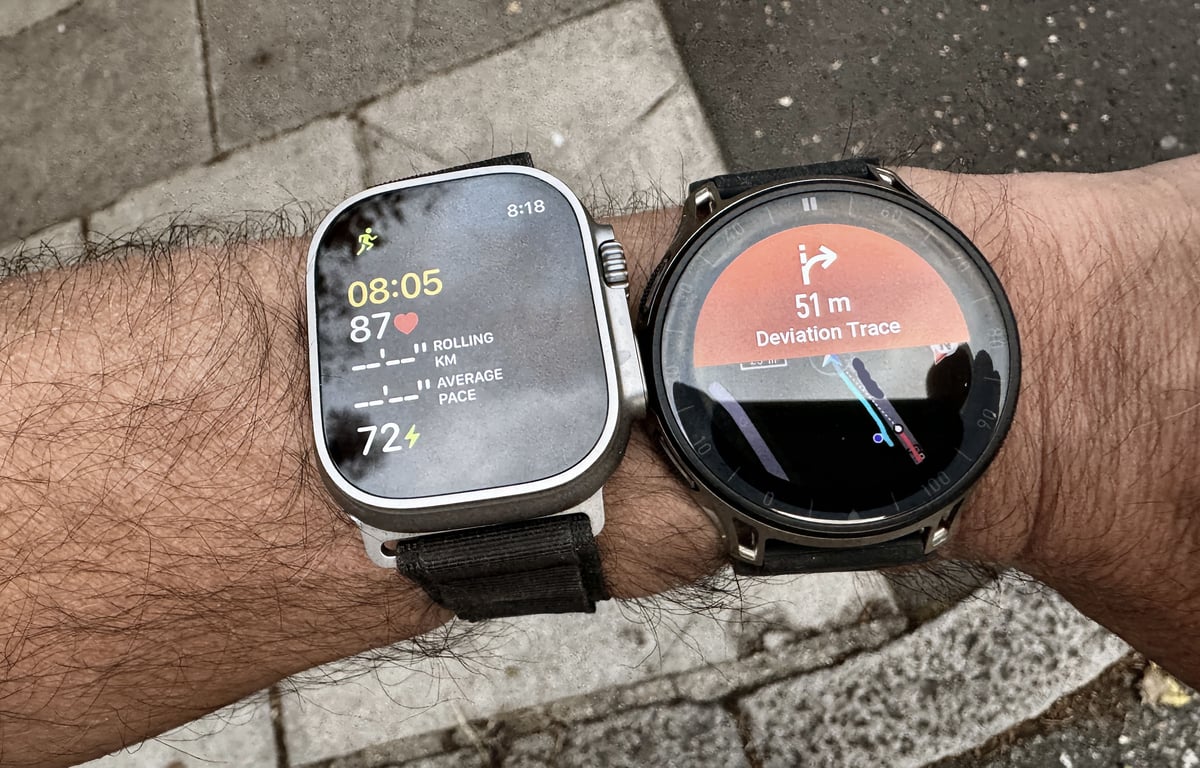
The 32GB of onboard storage is enough for substantial map regions alongside music. I had to manually download the UK map and the contours layer, which took a minute or so over WiFi, and was mildly annoying but a one-off task.
When navigating, the 1.32″ panel is probably a tad on the small side if you are thinking of regularly relying on maps on the wrist or handlebars. Still, it’s perfectly fine for occasional use. And when you are on course, I found the TBT direction clear and well signed ahead of the turn.
The Competition
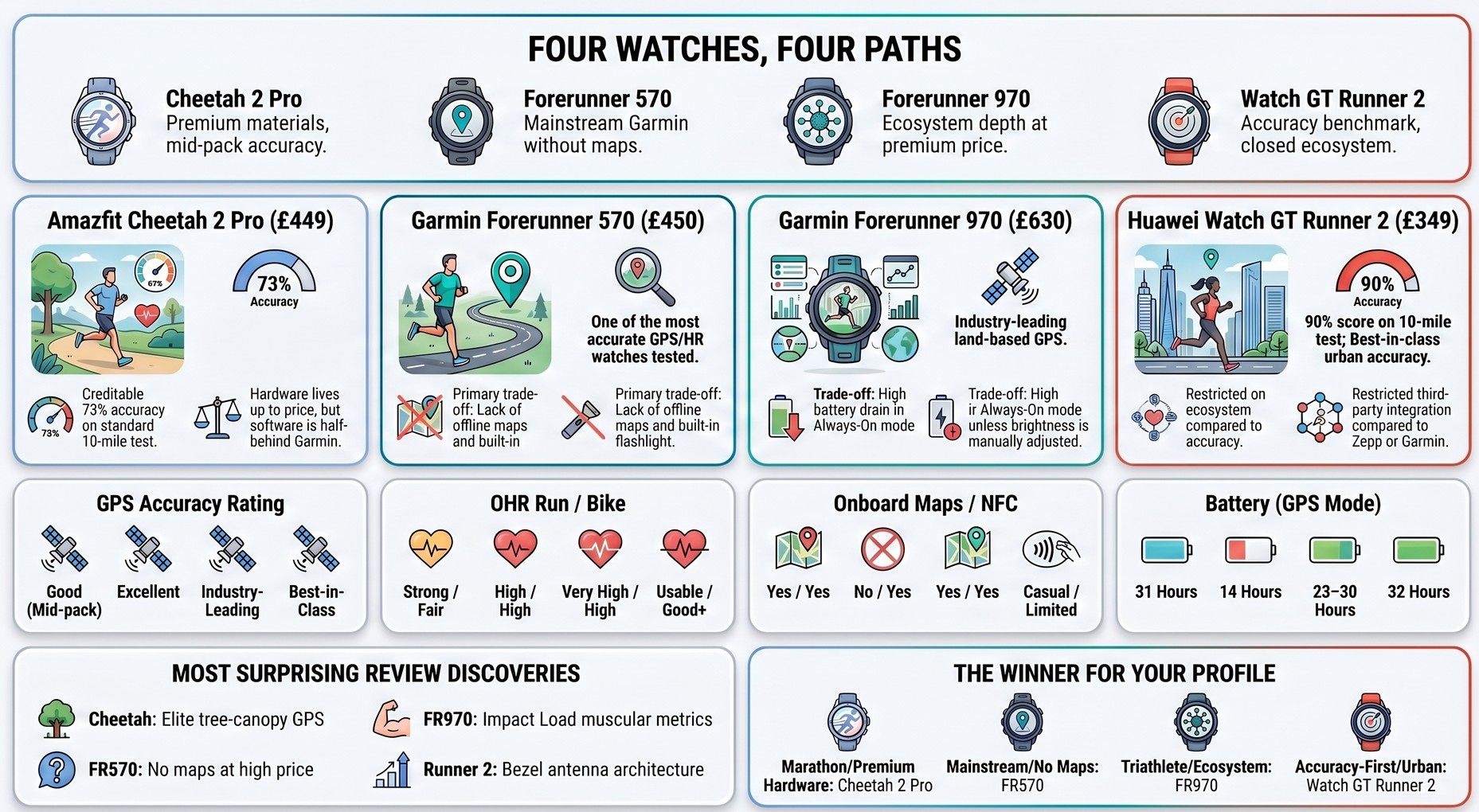
FR570 (~£460). These are initially at similar prices, but Amazfit will inevitably discount to a very attractive level when the case for the Cheetah 2 Pro becomes clearer. Garmin’s prices will remain stickier. The standard line is that Garmin has the best sports ecosystem, which it does, but Amazfit is getting much closer with each passing month. The Cheetah has better-quality exterior hardware but poorer internal components, such as the GPS. Perhaps the Cheetah’s major win is the onboard maps, which the FR570 surprisingly omits. So the calculus might be: plastic and no maps (FR570) versus maps, titanium and a lower price.
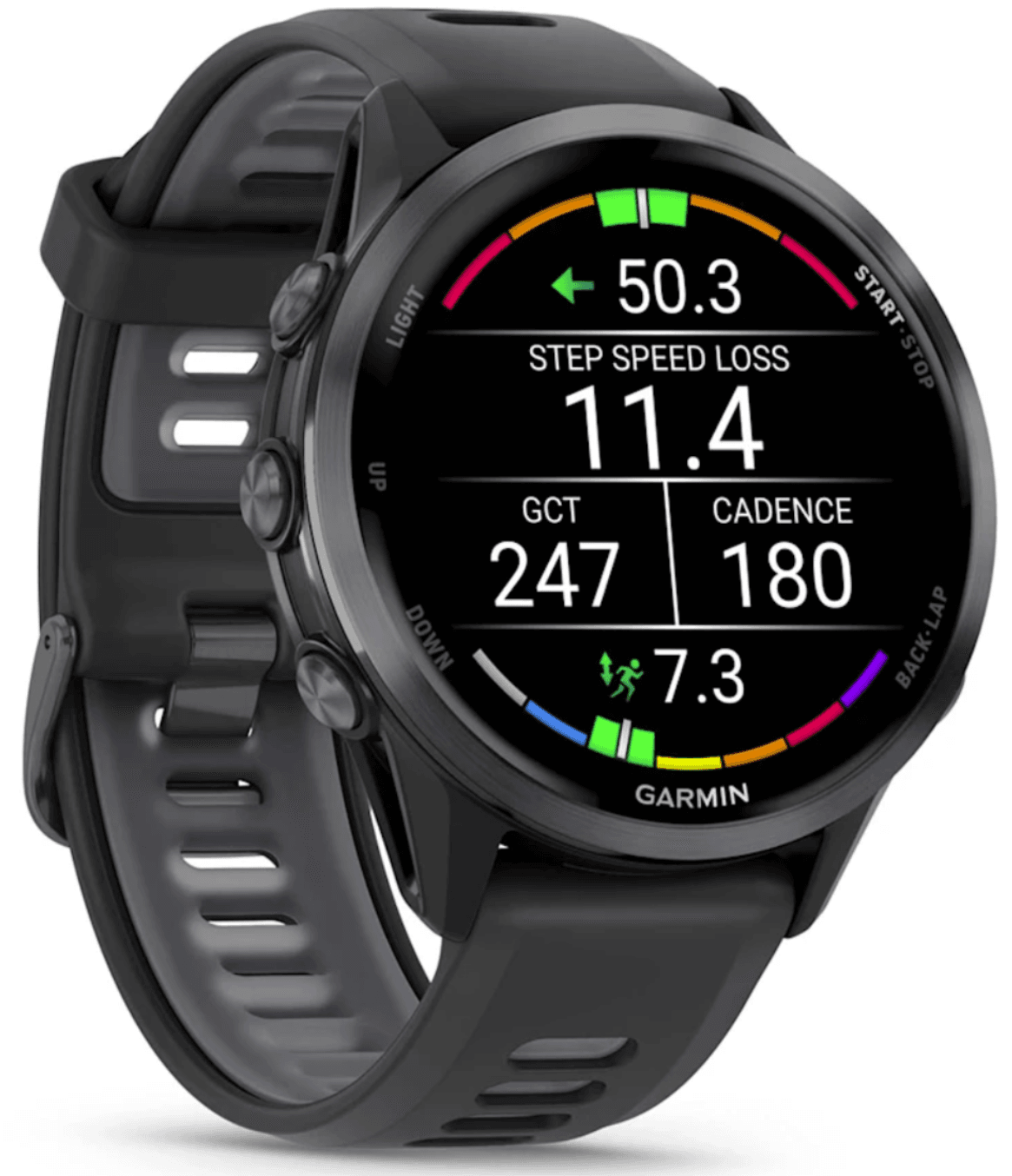
Garmin Forerunner 970 (~£630, premium step-up). The FR970 is superior to the Cheetah 2 Pro in many respects. The Cheetah’s wins are on HYROX mode, design details, and price. The FR970 is also titanium, so the materials are on the same level – FR970 just looks like it’s made of plastic.
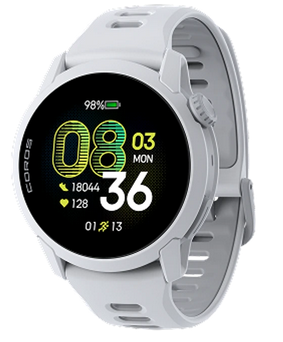
Coros Pace Pro (~£349, cheaper). Coros is not a smartwatch in reality, so you would choose it if you are looking for a “cheap”, light sports watch with better battery life. Coros lacks smart features such as a microphone, speakers, and contactless payments. The Cheetah 2 Pro is a watch you can wear all day; the Pace Pro isn’t.
Huawei Watch GT Runner 2 (~£400). The apps and on-watch menus are similar in style and comprehensiveness. Design is good on both. Huawei edges out the Runner 2 in visual appearance (personal preference) and is more accurate on GPS and HR, where the Runner 2 is best in class. The Cheetah’s advantage is third-party platform integration, since Huawei Health is more closed than Zepp.
Quick buyer steer:
- If you already live inside Garmin Connect, stick with Garmin. I would not recommend you leave.
- If you are brand-agnostic and value premium hardware for the money, the Cheetah is a strong case.
- If you want a focused runner’s tool with no smartwatch noise, choose the Pace Pro.
- If you can switch to Huawei, the Watch GT Runner 2 has better sensors.
Verdict
The Cheetah 2 Pro is a good watch. It looks good. It has quality materials – titanium & sapphire.
Pretty much all the features you need are there, with many of the detailed nuances baked in that brands like Coros sometimes gloss over. The Cheetah looks and feels fantastic, and is very well specified throughout, even down to some decent watchfaces, mic and speaker, a real LED torch, contactless payments, HYROX mode, and marathon training plans.
On accuracy, GPS is broadly accurate, and the heart rate is excellent on steady running, fair on the bike, but less so in the pool. Good enough for the vast majority of training and racing for runners over any distance. Not class-leading.
I like the Amazfit watches overall. I prefer the Active Max mostly because its larger 1.5-inch display fits in an essentially the same-sized case. Most of the features are similar. The Cheetah pulls ahead on sensors, dual-band GPS, and premium materials.
Over the years, Amazfit has continually improved its ecosystem features to a very good level, a level too many reviewers overlook, having not visited the brand for a while or stayed in touch with its developments. So you might read mixed messages on this point.
Who should buy it? Marathon and half-marathon runners who want premium hardware at a sub-Garmin-Fenix price point are not locked into Garmin Connect and value third-party platform integration with TrainingPeaks and Runna.
Why not buy it? Huawei and Coros are more accurate, and Garmin has a better ecosystem. Simple.
As a hypothetical, if you and I had to train together for marathons, HYROX and triathlons for a year with the Cheetah 2 Pro, I would be happy enough, but would definitely miss my top-end Forerunner. The Zepp ecosystem is still clearly not as good as Garmin’s. If I were Amazfit, I would pause new feature development for a while and perfect the existing ones. That’s the main missing cog that would make the company a better contender in this crowded marketplace.
The Cheetah 2 Pro is a little overpriced for what it is at launch. Perversely, its problem is the superb quality of its materials, which drives up the price, making it compete with better-featured watches made with lower-quality materials.
Amazfit has a high cadence of new products (there is already an adventure-leaning Cheetah 2 Ultra in my in-tray that I have not even started to look at), and you can be sure that its retail price will fall progressively over the next 18 months, like other brands, but probably a bit faster. Thus, by Christmas or Black Friday 2026, this good watch could be priced very attractively – if you need it now, buy it.
Price and comparators
Garmin Forerunner 970
Premium GPS triathlon smartwatch. Features a bright AMOLED touch screen and a built-in LED flashlight.

Quick answers
Is the Amazfit Cheetah 2 Pro good for marathon training?
Yes. The Cheetah 2 Pro is the first Amazfit running watch built explicitly for marathon preparation, with adaptive Zepp Coach plans for distances up to the full marathon, structured workout sync from TrainingPeaks and Runna, lactate threshold estimation, running power at the wrist, and 31 hours of accurate GPS battery life. The main caveat is the optical heart rate sensor, which warrants a chest strap for intervals.
How accurate is the Amazfit Cheetah 2 Pro GPS?
The Cheetah 2 Pro’s GPS is broadly accurate for everyday running and cycling, and matches the Garmin Forerunner 970 on suburban routes, but is edged by the best dual-frequency watches like the Huawei GT Runner 2 in tight urban conditions. Adequate for the vast majority of runs, less suited to city-centre marathons.
How accurate is the Amazfit Cheetah 2 Pro heart rate?
Excellent on steady running (bias within 1 bpm of chest strap reference), good in the pool (3 bpm high), and fair on the bike (6 bpm low with a wide spread). Session averages are consistently strong, but moment-to-moment readings can drift by up to 30 bpm during sharp changes in effort. Pair with a chest strap for interval and cycling training.
Amazfit Cheetah 2 Pro vs Garmin Forerunner 970: which is better?
The Forerunner 970 has a deeper Garmin ecosystem and more refined training software. The Cheetah 2 Pro matches it on premium materials, onboard maps, microphone, and flashlight, at roughly 70 per cent of the price. Choose the Garmin for years of Connect history and ecosystem depth; choose the Cheetah for premium hardware value.
Amazfit Cheetah 2 Pro vs original Cheetah Pro: what is new?
The 2 Pro arrives three years after the original at a fifty per cent higher price. It adds a full titanium frame (the original used polymer with a titanium bezel), sapphire glass, a brighter 3,000-nit display, dual-band six-constellation GNSS with Point Dead Reckoning, the BioTracker 6.0 sensor, longer battery life across all GPS modes, and 32GB of onboard storage. Four physical buttons replace the original’s rotating crown.
Amazfit Cheetah 2 Pro vs Coros Pace Pro: which is better?
The Pace Pro is roughly £100 cheaper, lighter, and has roughly twice the battery life on a charge, but it has no mic, no speaker, and no contactless payments. Choose the Pace Pro for a focused running tool. Choose the Cheetah 2 Pro for premium materials and full daily-watch features.
Does the Amazfit Cheetah 2 Pro have onboard maps?
Yes. The Cheetah 2 Pro offers full offline topographic maps, turn-by-turn directions, course deviation alerts, and round-trip route generation. The Forerunner 570, at a similar price, omits maps. The 32GB onboard storage is enough for substantial map regions alongside music.
Does the Amazfit Cheetah 2 Pro support contactless payments?
Yes. The Cheetah 2 Pro has NFC and supports Zepp Pay for contactless payments. Up to eight bank cards can be stored on the watch and used without a phone.
Does the Amazfit Cheetah 2 Pro have a flashlight?
Yes. The Cheetah 2 Pro has a dual-mode LED flashlight with white and red light options. Boost and SOS modes are included. Useful for early-morning and late-evening runs.
Is the Amazfit Cheetah 2 Pro waterproof?
Yes. The Cheetah 2 Pro is rated to 5 ATM (50 metres) under the ISO 22810:2010 standard. That covers pool swimming, open-water swimming, and surface-water sports. It is not rated for diving or high-impact water sports.
Can the Amazfit Cheetah 2 Pro be used for a triathlon?
Yes. The Cheetah 2 Pro has a dedicated triathlon mode and supports multi-sport transitions. The watch is rated to 5 ATM for swim, has dual-band GPS for the bike and run legs, and pairs with cycling power, speed, and cadence sensors over Bluetooth.
Does the Amazfit Cheetah 2 Pro work with an iPhone?
Yes. The Cheetah 2 Pro pairs with iPhones running iOS 14 or later via the Zepp app. Activities sync to Apple Health automatically. Android users get a slightly fuller feature set, including speech-to-text replies and call quick-reply, but the core experience works on both platforms.
Does the Amazfit Cheetah 2 Pro work with TrainingPeaks and Runna?
Yes. The Zepp app syncs structured workouts from TrainingPeaks, Runna, Intervals.icu, and Final Surge to the Cheetah 2 Pro. Completed activities push to Strava and to Apple Health on iOS or Google Fit on Android. The sync is two-way for workouts, which means a coach-built session lands cleanly on the watch.
How long does the Cheetah 2 Pro battery last in GPS?
The Cheetah 2 Pro is rated at 31 hours in Accurate GPS mode, 69 hours in Power Saving GPS mode, and 99 hours in Extended mode (walking and hiking only). In typical use, with around 1 hour of daily GPS activity, I got close to a week between charges with the always-on display set to a bright setting.
For the full Amazfit range, accuracy data and Zepp Health analysis: Amazfit sports watch guide.
Last Updated on 2 August 2026 by the5krunner
My favourite kit and nutrition
- Garmin Fenix 9 Pro — I’ve just bought one.
- Injinji – Runners protect your toes. Avoid discomfort and minor injury. Run more. Run faster. I use them.
- Garmin 90-degree charging adapter — A small keyring adapter you can use anywhere. Essential when away. I use one.
- Garmin charging puck — the fastest and most reliable way to top up your Garmin before a session. I use one.
- Ravemen FR300 — Front light that mounts directly under your Garmin or Wahoo head unit. Keeps your bars clean and your beam pointed where it matters. I use one.
- Body Glide – The blue anti-chafe stick that all swimmers and many runners use. I use it.
- Maurten — The race nutrition trusted by elite athletes. Gels and drink mixes engineered to be easy on the stomach. I use them.
- Garmin Varia RTL515 — A radar rear light that alerts you to vehicles approaching from behind. Pairs with your Edge or Wahoo. I use this model.
- Favero Assioma Pro RS2 — The power-meter pedals most serious cyclists choose. Accurate, easy to move between bikes. I use this model.
- Garmin Forerunner 970 — A serious choice for a pro-grade triathlon watch. I use this.
- Polar H10 — My daily driver for accurate, waking HRV readings.
- Wahoo ELEMNT Roam 3 — The bike computer that has the feature Garmin lacks: usability. I use mine on most rides.
Reader-Powered Content

This content is not sponsored. It’s mostly me behind the labour of love, which is this site, and I appreciate everyone who supports it.
Support the site: Follow (free, fewer ads) · Subscribe (paid, ad-free) · Buy Me A Coffee ❤️
All articles are written by real people, fact-checked, and verified for originality. See the Editorial Policy. FTC: Affiliate Disclosure — some links pay commission. As an Amazon Associate, I earn from qualifying purchases.
tfk is the founder and author of the5krunner, an independent endurance sports technology publication. With 20 years of hands-on testing of GPS watches and wearables, and competing in triathlons at an international age-group level, tfk provides in-depth expert analysis of fitness technology for serious athletes and endurance sport competitors. ID

Great breakdown! Any plans to take the Cheetah 2 Pro out for another test run? It looks like the recent July update helped with GPS accuracy, but I’d love to see how much of a real-world difference it actually made overall.
probably not , although supporter-requested tests often get actioned if I feel guilty!