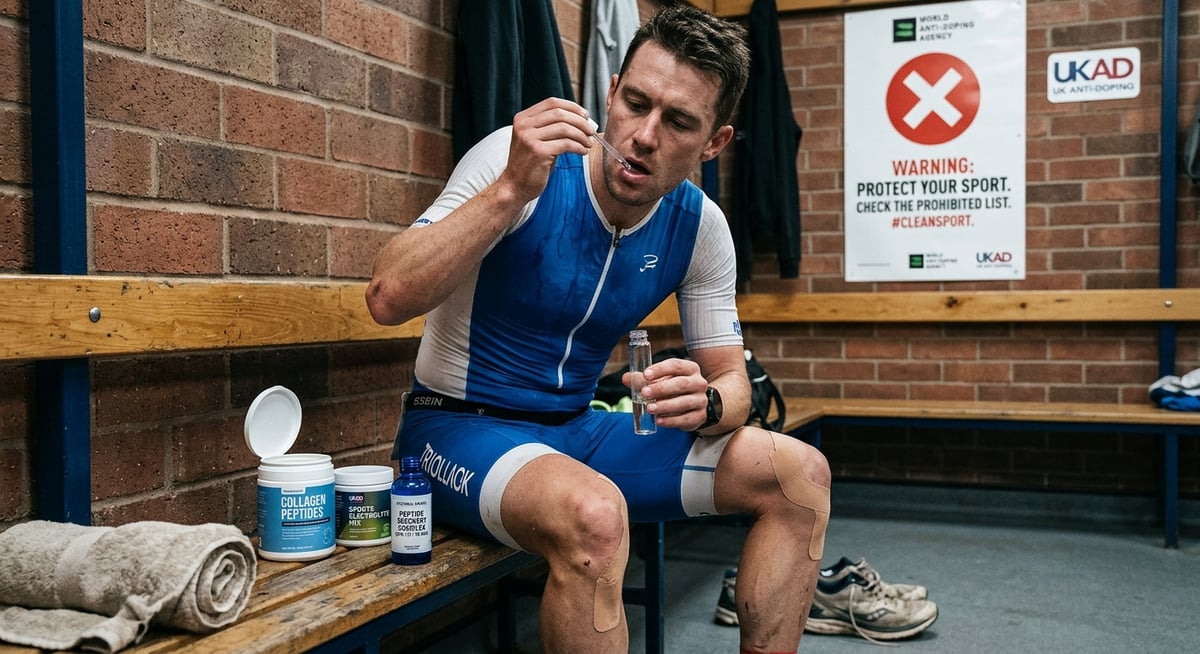
Walk through almost any gym forum and sooner or later someone brings up BPC-157. The name travels fast, usually with big promises attached and very little context. This article skips the promises. It explains what the compound is, where the name comes from, why it sits in the laboratory research category, and why anyone who competes under anti-doping rules should regard it as off limits.
Is BPC-157 allowed in sport?
No, BPC-157 is prohibited at all times under the World Anti-Doping Agency (WADA) Prohibited List. The 2026 list, in force since 1 January 2026, names BPC-157 in section S0, non-approved substances. Everything in S0 is banned both in and out of competition, so the offseason, a training block and a travel week all carry the same rule as race day.
S0 exists to catch pharmacologically active substances that no government regulator has approved for human use. A compound that lives only as a laboratory material, with no regulatory approval behind it, lands in that bucket almost by definition. That is why athletes do not need to wait for a ruling on one specific peptide: if a substance is not approved and not named elsewhere on the list, S0 covers it.
Anti-doping also runs on strict liability. Whatever is found in an athlete’s sample is the athlete’s responsibility, whether it came from a friend’s recommendation, an unfamiliar label or a forum thread. Not knowing is not a defense.
Here is the short version in one place:
| Question | Answer for BPC-157 |
|---|---|
| Which list section names it? | S0, non-approved substances |
| When is it prohibited? | At all times, in and out of competition |
| Which list applies right now? | The 2026 list, in force since 1 January 2026 |
| Does a purity certificate change its status? | No |
What is BPC-157 and where did it come from?
BPC-157 is a 15-amino-acid fragment of a larger protein found in human gastric juice. Predrag Sikiric and colleagues at the University of Zagreb characterized it in the early 1990s and published foundational papers in 1993 and 1994 describing the fragment. Those papers are the origin of the name and of nearly everything said about it since.
Good research literacy means separating three ideas that gym talk blurs together. A molecule described in a laboratory paper is one thing. A molecule studied in laboratory settings is another. A product approved for people is a third. BPC-157 belongs to the first two categories. It has no approval as a medicine, and nothing in its early literature changes that.
It also helps to confirm that everyone is talking about the same molecule. PubChem, the open chemistry database run by the US National Center for Biotechnology Information (NCBI), indexes BPC-157 under CAS registry number 137525-51-0, the same number that appears on product pages. A CAS number works like a serial number for a substance. It tells you what the molecule is. It tells you nothing about whether the molecule is permitted in sport.
Why is BPC-157 a research material and not an approved product?
Because no regulator has approved it as a medicine, it exists in the market only as a material for laboratory work.
Vive Peptides, a US-based supplier of research-grade peptides, is a useful example of how this category is labeled. Its peptides are compounded at a US-based lab that adheres to cGMP standards and carry a purity specification of 99% or higher by HPLC. Everything it sells is strictly for laboratory and research use only and is not approved for human consumption.
Read that last sentence slowly, because it is the whole product definition rather than fine print. A research-use label means the material is meant for bench work, such as analytical and in-vitro studies. It is not a hint that the compound is a gray-area option for athletes, and it is never a sports clearance. If anything, the label is a signal to stay away.
What does a certificate of analysis actually prove?
A certificate of analysis proves what is in one specific lot, not whether anyone is allowed to use that lot. Those are separate questions, and mixing them up is a common mistake in gym circles.
The BPC-157 page at vivepeptides.com/product/bpc-157 is an example of documentation that covers the compound’s identity and its lot-level testing. Vive Peptides sells the compound strictly for laboratory and research use only, not for human consumption, and that documentation does not alter the list status described above.
The Vive Peptides COA library listed 126 certificates across 25 peptides on 16 October 2026. Each lot is analyzed by an independent USA-based laboratory using HPLC with UV detection coupled to mass spectrometry, and each certificate shows the purity result, mass confirmation and chromatogram. In plain terms, the purity result says how much of the lot is the target molecule, the mass confirmation checks that the measured mass matches the expected molecule, and the chromatogram is the picture of how the sample separated.
This is why identity documents matter: a sequence, a CAS number and a lot certificate let a researcher confirm that the vial on the bench is the molecule on the label. For an athlete, the same documents answer only the identity question. They cannot answer the eligibility question, because eligibility is set by the Prohibited List, not by a laboratory.
What are the real stakes for a tested athlete?
An adverse analytical finding can bring a period of ineligibility and the loss of results, and the exact outcome depends on the rules of the sport and the facts of the case. For a serious competitor, that outweighs any online rumor about a research peptide. A career built over many seasons can be undone by a single sample, and no forum post will be there to explain it to a hearing panel.
There is a second stake that gets less attention. Research-use labeling means nobody has qualified the material for human use. There is no human-use specification, no approved labeling and no regulator behind it. An athlete who steps outside that boundary is making a decision with no safety net, and anti-doping rules will not accept a laboratory certificate as an excuse.
What should a tested athlete do instead?
Keep it simple and put the burden of proof on the list, not on the label:
- Read the current Prohibited List directly, not a forum summary of it.
- Ask your national anti-doping organization or sport federation about any unfamiliar name before anything else.
- Read a research-use label as a reason to stay away, never as a loophole.
- Bring questions to your team physician, who can check an ingredient against the list for the current year.
- Re-check the list each year, because it is revised and republished.
Why research literacy matters in the gym
Research literacy is a training skill, like reading a program or tracking progress. It means asking what a source is actually describing, whether a molecule, a laboratory observation or an approved product, and refusing to let one slide into another. For BPC-157, the facts are plain: it is a documented research molecule with a CAS number and a laboratory history, and for tested athletes it is prohibited at all times.
Anyone who trains seriously deserves clear information, and clear information here is short. Check the list, ask your anti-doping organization, and leave laboratory materials in the laboratory.
Last Updated on 9 November 2026 by tfk the5krunner
Small things I always use
- Garmin 90-degree charging adapter: Charges your Garmin from any USB-C cable. Essential when travelling. I use one.
- Body Glide: The blue anti-chafe stick swimmers and runners carry. I use it.
- Speedo earplugs: Fewer ear infections and no cold-water dizziness. I use them.
- Dryrobe Advance: My winter changing robe for open-water swims. I use one. A cheaper option is the AONYIYI changing robe.
- Maurten: Race fuel that stays easy on the stomach. I use them.
- Beet It Sport nitrate shots: Beetroot shots I take in the days before a race. I use them.
- Garmin charging puck: The quickest way to top up before a session. I use one.
- Injinji: Toe socks that stop rubbing, so you run more. I use them.
- Ultimate toe protectors: Stop black toenails on long runs. They work. I use them.
- Compressport R2 v2 calf sleeves: My calf sleeves of choice. I use them.
- Cellucor C4: My pre-workout before hard sessions.
- TPU tubes: Schwalbe Aerothan, Tubolito and Pirelli SmarTube. Light, tiny spares. I use all three.
- G8 insoles: Adjustable insoles that are good. I use them.
- Cycplus Cube: A 97g electric pump that gets a road tyre rideable in two minutes. I carry one. 5% off with code THE5KRUNNER.
Watches and sensors
- Polar H10: My daily driver for waking HRV.
- Polar Verity Sense: My backup arm-worn HR sensor.
- Nomad bedside charger: Charges my iPhone and Apple Watch overnight. I use it, and many of their bands.
- Train.Red: The best muscle oxygen sensor I’ve used.
- Tymewear: Accurate heart rate and reliable ventilatory zones. I use it to pace endurance rides over an hour.
- Garmin Forerunner 970: A pro-grade triathlon watch. I use this.
- Apple Watch Ultra 4: My daily smartwatch. No phone needed on rides.
- Garmin Fenix 9 Pro: I’ve just bought one.
On the bike
- Continental GP5000 for everyday riding, and Aero 111 on the front for special occasions.
- Helmets: Specialized S-Works Evade 3 for road riding, and Rudy Project Wing for TT-style races. I use both.
- Ravemen FR300: A front light that mounts under your Garmin or Wahoo. I use one.
- Ravemen FR1000: The light and the computer mount in one unit, so nothing else goes on the bars. Better than mine.
- Ravemen FR1500SE: 1,500 lumens hanging under your Garmin, for proper night rides.
- Ravemen FR1100SE: 1,100 lumens under your Garmin, and up to 46 hours on slow flash.
- Ravemen FR500: A brighter FR300 with the same mount.
- Wahoo TRACKR Radar: I use it on one bike and Varia on the other. They perform the same.
- Garmin Varia RTL515: Radar that warns you of cars from behind. I use this model.
- Wahoo ELEMNT Roam 3: The bike computer that’s easy to use. I use mine on most rides.
- Favero Assioma Pro RS2: Accurate power pedals that swap easily between bikes. I use this model.
Home and indoor training
- NPE Runn: Makes my basic treadmill smart, sending more accurate speed and distance to my watch and Zwift. I use it.
- Google Wifi: Keeps Zwift connected in my pain cave. I use it.
- Apple TV 4K: Zwift on the big screen. I use two.
- Google Nest Doorbell (wired, 2nd gen): My video doorbell, running in both Google Home and Apple Home. I use it.
Health, recovery and sleep
- FreeStyle Libre 3 Plus: Shows how my blood sugar responds to diet.
- hDrop: Measures my sweat loss in summer and indoors.
- Fourth Frontier Zone: Checks my heart under load in hard sessions.
- Kineon MOVE+: Red and infrared light for sore knees, Achilles and other joints after hard training. I use it.
- Oura Ring 5: My partner’s recovery tracker of choice.
- Eight Sleep: A cooling mattress cover my partner and I use nightly.
Reader-Powered Content

This content is not sponsored. It’s mostly me behind the labour of love, which is this site, and I appreciate everyone who supports it.
Support the site: Follow (free, fewer ads) · Subscribe (paid, ad-free) · Buy Me A Coffee
Written by real people, with AI assistance. Fact-checked and verified for originality. See the Editorial Policy. FTC: Affiliate Disclosure — some links pay commission. As an Amazon Associate, I earn from qualifying purchases.
tfk is the founder and author of the5krunner, an independent endurance sports technology publication. With 20 years of hands-on testing of GPS watches and wearables, and competing in triathlons at an international age-group level, tfk provides in-depth expert analysis of fitness technology for serious athletes and endurance sport competitors. See the gear tfk uses. ID
