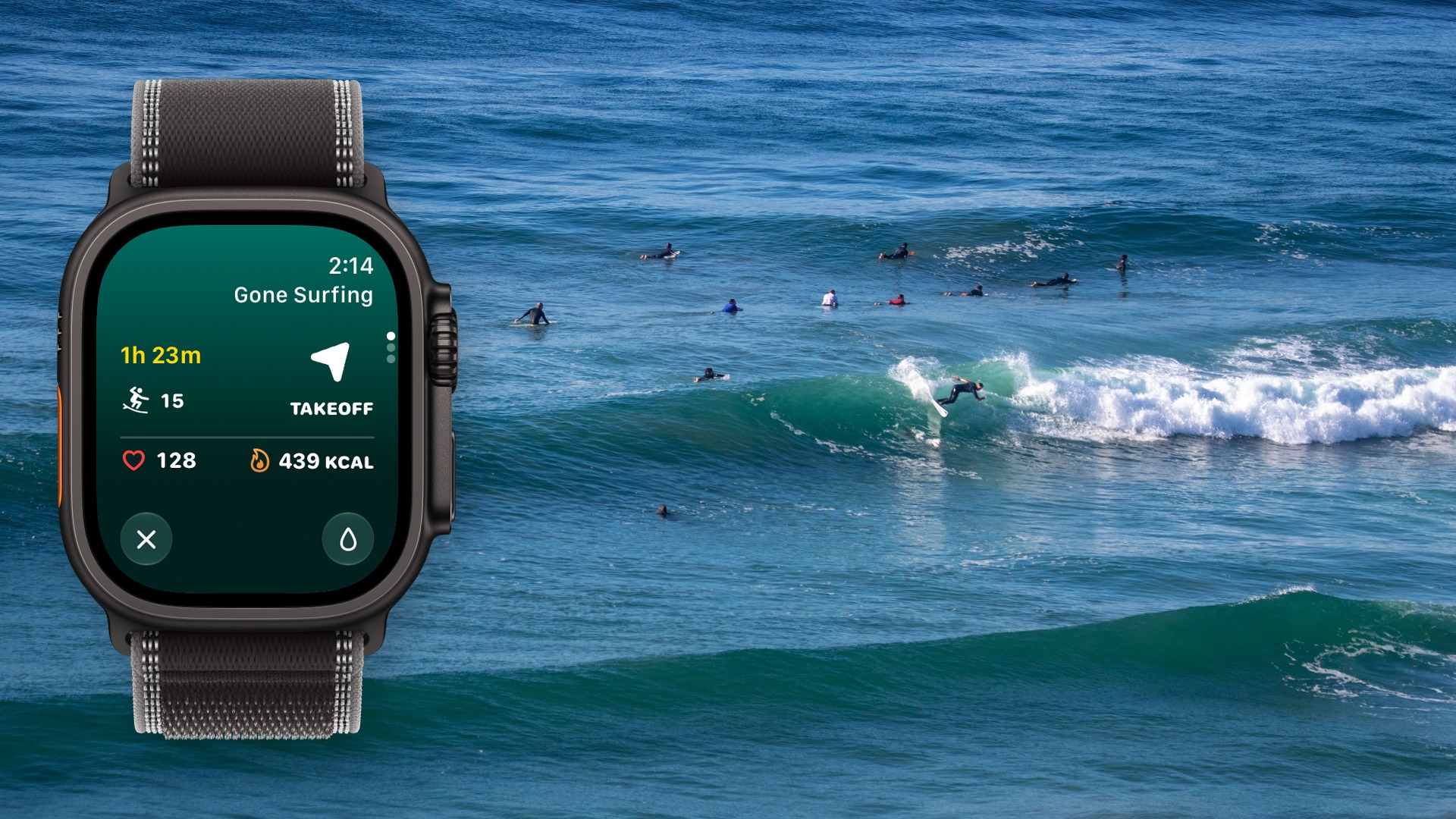
You catch a good wave, ride it to the inside and paddle back out. The lineup looks the same as before, but the current has carried you 30 metres (about 100 feet) away from the peak, and you didn’t notice. The next set breaks exactly where you were sitting ten minutes ago, and you watch it go past.
Why surfers drift out of position
Everything in the water moves. Currents run along the beach, the wind pushes you sideways while you sit, and the paddle back rarely follows the line you rode in on. You line up on a house, a tree or the lifeguard tower, but those marks are hard to read from the lineup.
Anyone who surfs knows the result: a few minutes out of position, missed sets, and the slow realisation that you’ve drifted off the peak.
Gone Surfing is an iPhone and Apple Watch app built by Darian, a surfer and solo developer, for exactly this moment. Surfers have tracked more than 10 million waves with it since 2024. Plenty of apps count your waves and top speed after the session, but Gone Surfing also helps while you’re still in the water.
How the Takeoff Compass works
TL;DR: The Takeoff Compass on the Apple Watch points back to where you caught your last wave and shows how far away it is. When you’re back within 5 metres (16 feet) of that spot, the screen turns green, reads “Takeoff” and taps your wrist.
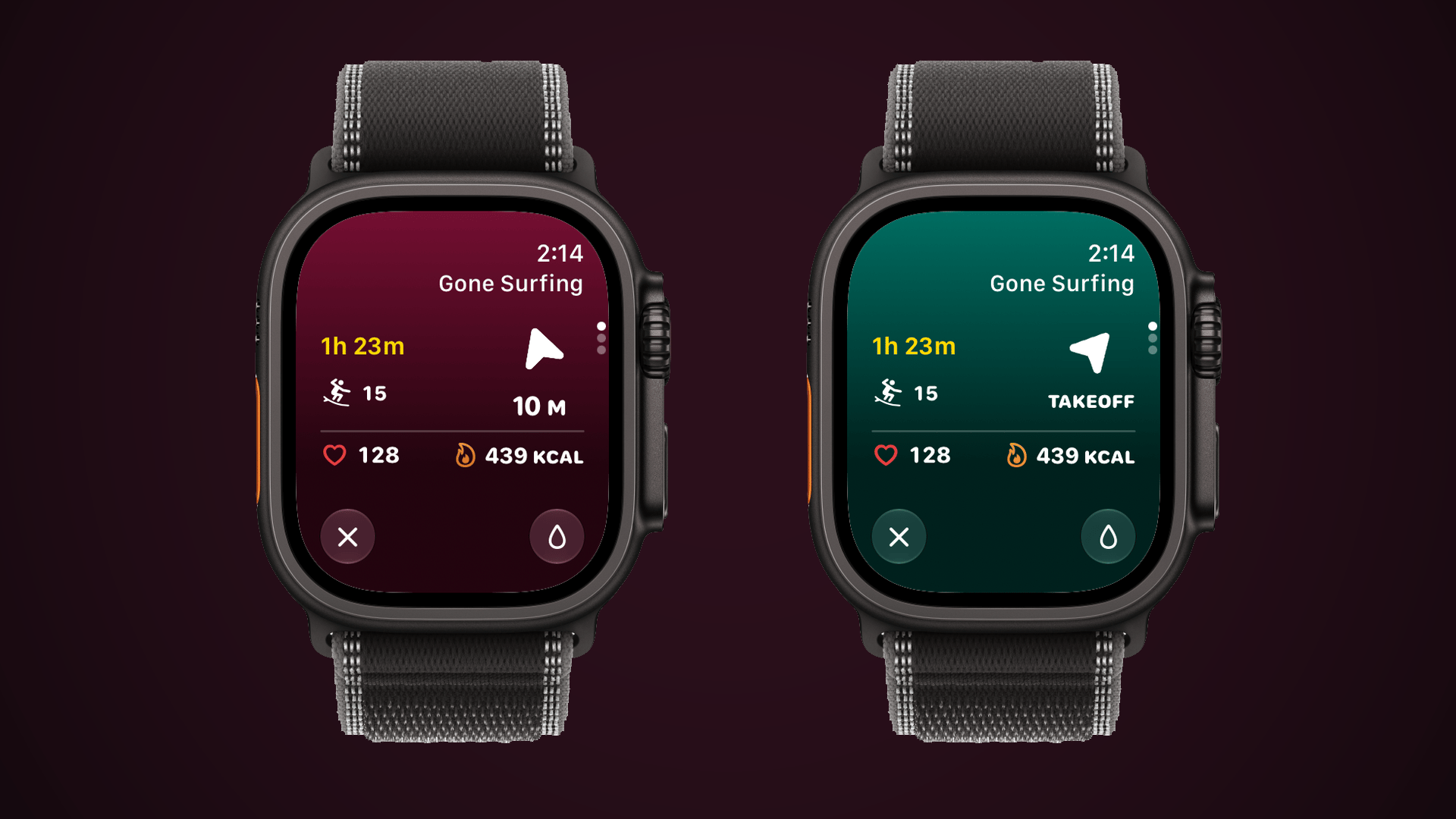
Every wave you catch moves the mark to where that wave started. The compass gives you a reference for the paddle back, but you still read the conditions and choose where to sit.
You pick your own way back, whether that’s around the impact zone, up the channel or straight out in a lull. You can check the compass against your usual landmark, or lean on it when that landmark disappears behind a set.
You don’t need to keep checking your wrist. Paddle in the direction of the arrow, and a tap tells you when you’re back on your spot. Then you can sit, watch the horizon and wait for the next one.
One session in numbers
On 5 September 2026, Darian surfed near Bells Beach in Victoria, Australia, for 72 minutes in the late-afternoon light. Gone Surfing recorded:
- 12 waves
- 763 metres ridden
- 1,600 metres paddled, in 2,592 paddle strokes
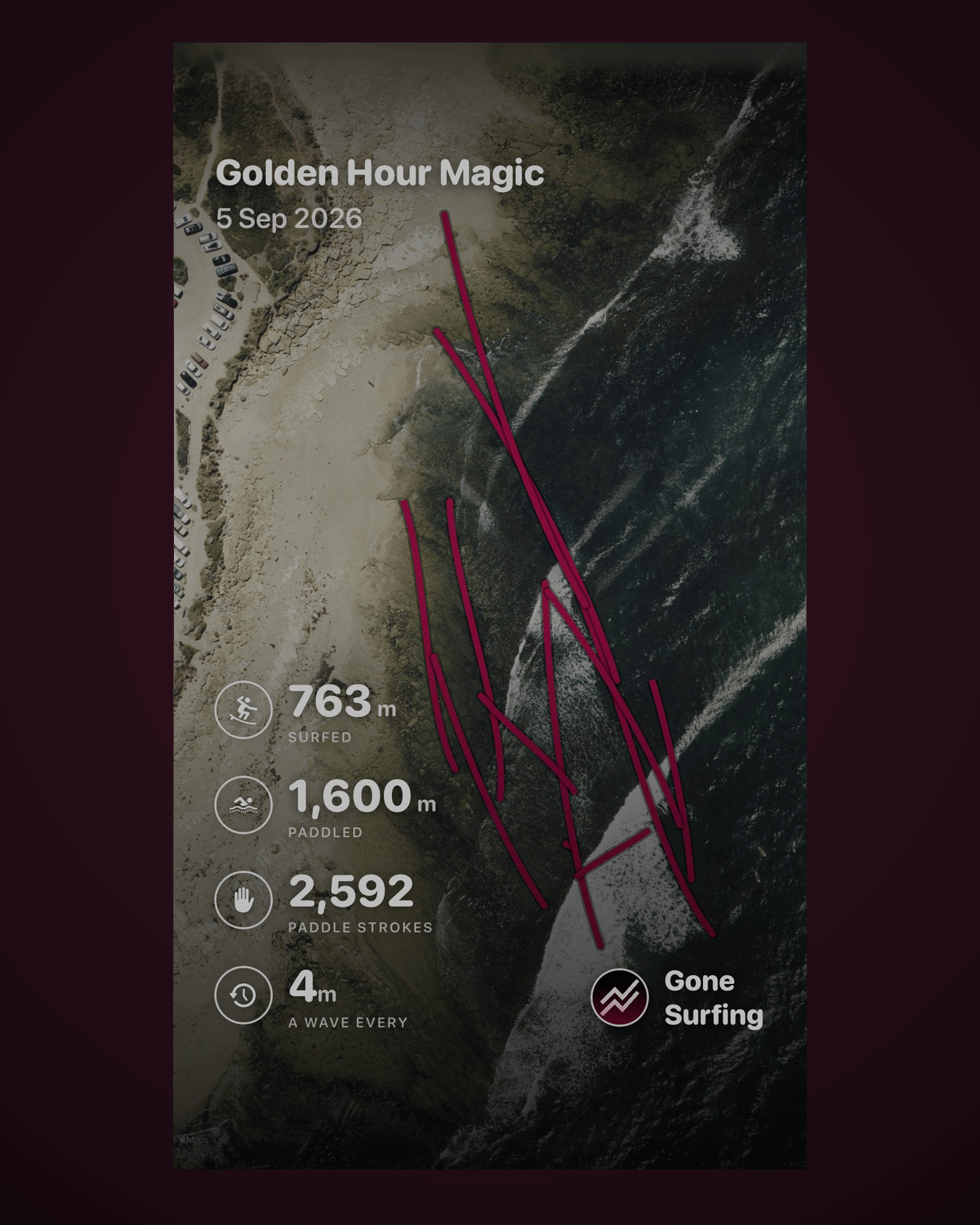
Each line on the map is a wave. Most of them start in one narrow corridor, which is where the waves were breaking that evening.
The numbers also show where the effort goes. The session had more than twice as much paddling as riding, so every metre paddled in the wrong direction is wasted.
In the water and after the surf
You start a session on the Apple Watch and leave the iPhone in the car. The watch tracks everything on its own, and the session lands on your phone afterwards.
In the water, a glance at the watch shows:
- how long you’ve been out and how many waves you’ve caught
- which way and how far it is to your take-off spot
- your heart rate and calories, plus stats for your last wave
After the surf, you can:
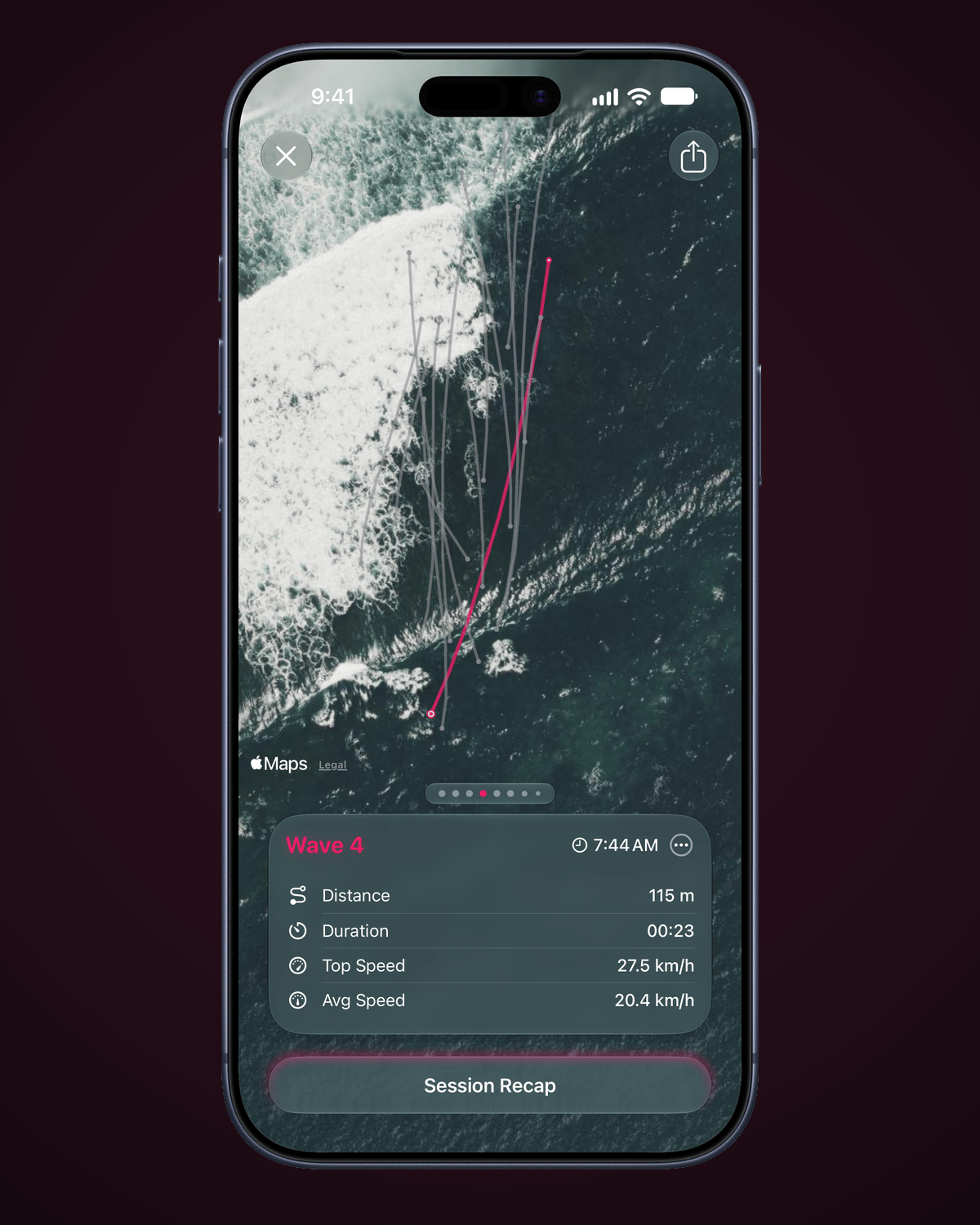
- see every wave you caught on a map of the session, with each wave’s speed and distance
- see whether you’re catching more waves and paddling better than last month
- get a Surf Coach review that tells you what to work on next session
- share a session card with your friends
- find the session in Apple Health, saved as a surfing workout
Apple Watch models, and what is free
Gone Surfing works on any Apple Watch running watchOS 10 or later, paired with an iPhone on iOS 17 or later. That covers Apple Watch Series 4 and later, every Apple Watch SE and every Apple Watch Ultra. It is Apple Watch only, with no Garmin or Wear OS version.
| Feature | Free | Pro |
|---|---|---|
| Tracking on the watch and automatic wave counting | Yes | Yes |
| Distances, paddle strokes and a map of every wave | Yes | Yes |
| Apple Health saving and the shareable session card | Yes | Yes |
| Takeoff Compass | No | Yes |
| Surf Coach review after every session | No | Yes |
| Trends across sessions, such as wave count and paddling | No | Yes |
Gone Surfing is free to download.
Who is behind Gone Surfing
Darian surfs the Victorian coast in Australia. He built Gone Surfing after too many sessions spent paddling back out and guessing where the last good wave had started.
Hero photo: Magda Ehlers on Pexels, with the Gone Surfing watch screen added.
More information: gonesurfing.app.
Author: Darian, developer of Gone Surfing, edited by the5krunner.
Quick answers
How accurate is GPS when the wrist keeps going underwater?
Accurate enough to get you back within a couple of board lengths of your spot, which is what matters when you choose where to sit. GPS signals don’t travel through water, so every GPS watch loses its fix while the wrist is under and gets it back when it surfaces. Gone Surfing filters out bad readings before it counts a wave, and the take-off zone is sized for the normal wobble of a wrist GPS.
How does Gone Surfing handle current and drift at a beach break?
Drift is the reason the compass exists. If you sit still and the distance keeps growing, the current is moving you, and you see it happening instead of noticing two sets later. At a beach break the peaks move with the sandbanks and the tide, but the mark resets with every wave you catch, so the compass follows the peaks.
Does the iPhone need to come in the water?
No. The Apple Watch records the whole session on its own, and the session appears on the iPhone after the surf. Any Apple Watch on watchOS 10 or later works, which means Series 4 and later, every SE and every Ultra.
If you enjoyed reading this, here is another in the Indie Spotlight series: Indie App Spotlight: telo lets Claude and ChatGPT read Apple Health.
Next in the series: Indie App Spotlight: Logix Pulse shows the ECG behind your Polar H10 HRV.
Last Updated on 22 November 2026 by tfk the5krunner
Small things I always use
- Garmin 90-degree charging adapter: Charges your Garmin with any USB-C cable. Essential when travelling. I use one.
- Body Glide: The blue anti-chafing stick swimmers and runners carry. I use it.
- Speedo earplugs: Fewer ear infections and no cold-water dizziness. I use them.
- Dryrobe Advance: My winter changing robe for open-water swims. I use one. A cheaper option is the AONYIYI changing robe.
- Maurten: Race fuel that stays easy on the stomach. I use them.
- Beet It Sport nitrate shots: Beetroot shots I take in the days before a race. I use them.
- Garmin charging puck: The quickest way to top up before a session. I use one.
- Injinji: Toe socks that stop rubbing, so you run more. I use them.
- Ultimate toe protectors: Stop black toenails on long runs. They work. I use them.
- Compressport R2 v2 calf sleeves: My calf sleeves of choice. I use them.
- Cellucor C4: My pre-workout before hard sessions.
- TPU tubes: Schwalbe Aerothan, Tubolito and Pirelli SmarTube. Light, tiny spares. I use all three.
- G8 insoles: Adjustable arches, perfect position. I use them.
- Cycplus Cube: A 97g electric pump that gets a road tyre rideable in two minutes. I carry one. 5% off with code THE5KRUNNER.
Health, recovery and sleep
- Kineon MOVE+: Red and infrared light for sore knees, Achilles and other joints after hard training. I use it.
- FreeStyle Libre 3 Plus: Shows how my blood sugar responds to diet. Occasional use.
- hDrop: Measures my sweat loss in summer and indoors. I use it.
- Fourth Frontier Zone: Checks my heart under load in hard sessions.
- Oura Ring 5: My partner’s recovery tracker of choice.
- Eight Sleep: A cooling mattress cover my partner and I use nightly.
Watches and sensors
- Polar H10: My daily driver for waking HRV.
- Polar Verity Sense: My backup arm-worn HR sensor.
- Nomad bedside charger: Charges my iPhone and Apple Watch overnight. I use it, and many of their bands.
- Train.Red: The best muscle oxygen sensor I’ve used. Occasional use.
- Tymewear: Accurate heart rate and reliable ventilatory zones. I use it to pace endurance rides over an hour.
- Garmin Forerunner 970: A pro-grade triathlon watch. I use this.
- Apple Watch Ultra 4: My daily smartwatch. No phone needed on rides.
On the bike
- Continental GP5000 for everyday riding, and Aero 111 on the front for special occasions. I use both.
- Helmets: Specialized S-Works Evade 3 for road riding, and Rudy Project Wing for TT-style races. I use both.
- Ravemen FR300: A front light that mounts under your Garmin or Wahoo. I use one.
- Ravemen FR1000: The light and the computer mount in one unit, so nothing else goes on the bars. Better than mine.
- Ravemen FR1500SE: 1,500 lumens hanging under your Garmin, for proper night rides.
- Ravemen FR1100SE: 1,100 lumens under your Garmin, and up to 46 hours on slow flash.
- Ravemen FR500: A brighter FR300 with the same mount.
- Wahoo TRACKR Radar: I use it on one bike and Varia on the other. They perform the same.
- Garmin Varia RTL515: Radar that warns you of cars from behind. I use this model.
- Wahoo ELEMNT Roam 3: The bike computer that’s easy to use. I use mine on most rides.
- Favero Assioma Pro RS2: Accurate power pedals that swap easily between bikes. I use this model.
Home and indoor training
- NPE Runn: Makes my basic treadmill smart, sending more accurate speed and distance to my watch and Zwift. I use it.
- Google Wifi: Keeps Zwift connected in my pain cave. I use it.
- Apple TV 4K: Zwift on the big screen. I use two.
- Google Nest Doorbell (wired, 2nd gen): My video doorbell, running in both Google Home and Apple Home via Starling. I use it.
Reader-Powered Content

This content is not sponsored. It’s mostly me behind the labour of love, which is this site, and I appreciate everyone who supports it.
Support the site: Follow (free, fewer ads) · Subscribe (paid, ad-free) · Buy Me A Coffee
Written by real people, with AI assistance. Fact-checked and verified for originality. See the Editorial Policy. FTC: Affiliate Disclosure — some links pay commission. As an Amazon Associate, I earn from qualifying purchases.
tfk is the founder and author of the5krunner, an independent endurance sports technology publication. With 20 years of hands-on testing of GPS watches and wearables, and competing in triathlons at an international age-group level, tfk provides in-depth expert analysis of fitness technology for serious athletes and endurance sport competitors. See the gear tfk uses. ID
