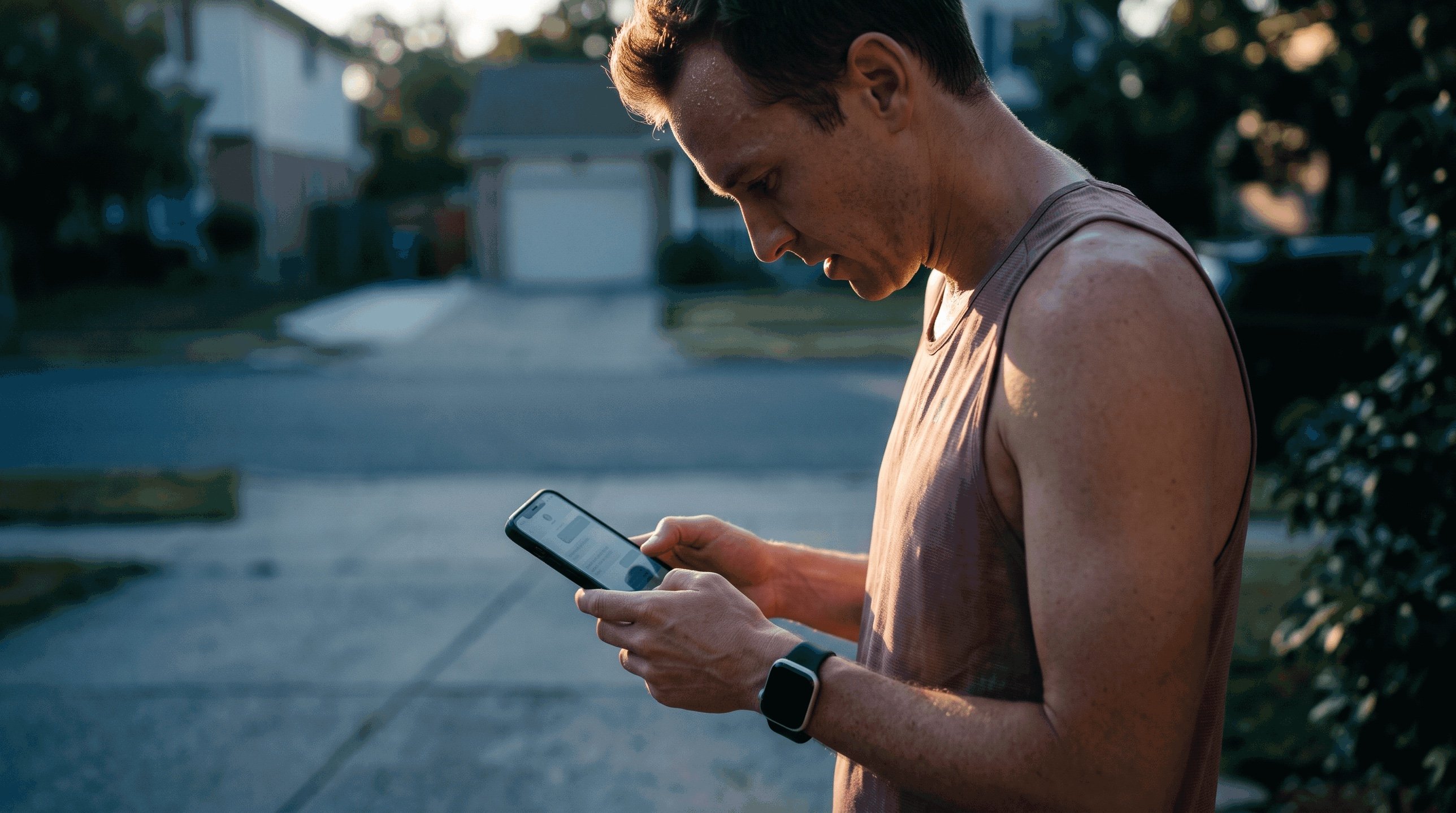
A runner with an Apple Watch already has a detailed record of every session in Apple Health: duration, distance, heart rate, splits, and the sleep from the night before. What the runner usually wants is an answer, not a chart. Was today’s run actually easy? Did a short night show up in the effort? How does this week compare with last month?
AI assistants handle that kind of question well, but they cannot see the records. The usual workaround is exporting a large XML file or pasting screenshots into a chat, and neither survives past one conversation.
telo is an iPhone app that connects Apple Health to Claude, ChatGPT and other assistants, so the runner can ask in plain language and the assistant reads the records it needs to answer.
How telo works
TL;DR: The telo app sends the Apple Health categories the runner approves to a private telo account. The runner connects that account to an assistant once, and from then on the assistant can look up runs, sleep and daily metrics while answering.
Setup takes three steps:
- On the iPhone: the runner installs telo, signs in with an email code or Sign in with Apple, chooses which Apple Health categories to share and approves sending them. History syncs from the newest records back.
- In the assistant: the runner adds telo from the Claude or ChatGPT directory, or as a custom connector elsewhere, and approves access with the same account.
- Ask: for example, “Use telo to show my last run and the night before.”
After that, the iPhone keeps syncing in the background. The assistant does not get a dump of everything. It calls specific lookups, such as a date range of daily values, a list of nights or one workout’s detail, and the server does the arithmetic, such as heart-rate zones and comparisons with the runner’s usual range. The telo app keeps a read log showing which assistant read what, and when.
Worked example: an interval run and the night before
This is one of Leo’s own sessions, recorded on an Apple Watch on 18 November 2026. The question was:
“Use telo to find my latest run. Show the date, duration, distance, the minutes in each heart-rate zone, any time with no heart-rate data, and the maximum heart rate used for the zones. Then show my sleep the night before and compare it with my nights over the previous 30 days. Mark missing values.”
The run. The run covered 8.13 km in 50:05, with an average heart rate of 144 bpm and a peak of 159 bpm. The session was a 15-minute warm-up, three 8-minute efforts with 3-minute recoveries, and a 2-minute finish. Kilometre splits ran from 5:42 to 6:36.
telo splits heart rate into six bands by percentage of maximum heart rate. With no tested maximum supplied, it used the highest value recorded in the runner’s workouts up to that day, 181 bpm.
| telo zone | % of max (bpm) | Time |
|---|---|---|
| Zone 0 | Below 50% (below 91) | 0:00 |
| Zone 1 | 50 to 60% (91 to 108) | 0:00 |
| Zone 2 | 60 to 70% (109 to 126) | 4:30 |
| Zone 3 | 70 to 80% (127 to 144) | 15:20 |
| Zone 4 | 80 to 90% (145 to 162) | 23:35 |
| Zone 5 | 90% and above (163 and above) | 0:00 |
| No heart-rate data | Not applicable | 6:40 |
The gap. Most of the 6:40 without data, about 5:40, falls in the first seven minutes of the warm-up. The watch read 149 to 157 bpm in the first minute, logged almost nothing until about 6:50, and then picked up at 123 bpm. Those opening readings sit oddly high for the start of a warm-up, and only the runner can judge whether they were real. The missing minutes are probably the easiest part of the session, so the 4:30 in Zone 2 likely understates how much of the run was easy. telo reports the gap as its own line rather than spreading it across the zones, because filling it in would make the run look easier or harder than the measurements support.
Against the watch. The Fitness app on the iPhone shows the same run with Apple’s five zones, which come from the watch’s own heart-rate settings rather than a percentage of 181 bpm. The kilometre splits match telo’s to the second, but the zones need lining up.
| Fitness app zone | Range (bpm) | Time |
|---|---|---|
| Zone 1 | Below 130 | 11:09 |
| Zone 2 | 131 to 143 | 12:18 |
| Zone 3 | 144 to 157 | 24:12 |
| Zone 4 | 158 to 170 | 2:01 |
| Zone 5 | 171 and above | 0:00 |
The hard part of the session agrees. Apple’s Zone 3, at 144 to 157 bpm for 24:12, covers almost the same range as telo’s Zone 4, at 145 to 162 bpm for 23:35. The names differ, but the effort does not. The difference is at the easy end. Apple’s zones add up to 49:40 of the 50:05 run, while telo counts 43:25 with data and 6:40 without. Apple’s own heart-rate chart shows the same blank stretch at the start, but the zone list does not say how those minutes were counted, and that is where most of Apple’s extra Zone 1 time is likely to come from.
The maximum. 181 bpm is an observed peak, not a tested maximum. If the runner’s true maximum were 190 bpm, the Zone 4 floor would move from 145 to 152 bpm, and a good part of the 23:35 would drop into Zone 3. Giving a known maximum in the question fixes the bands, and a runner who trains by Apple’s zones can give the assistant those boundaries instead.
The night before. The runner was in bed from 10:06 p.m. to 5:18 a.m., with 7 h 08 min asleep: 54 min deep, 93 min REM and 5 min awake. The Health app lists the same night from the same watch as 4 h 40 min core, 1 h 33 min REM and 53 min deep, which agrees stage by stage. Health rounds each line down to the minute, so its stages add up to 7 h 06 min.
| Measure | Night before the run | Previous 30 days |
|---|---|---|
| Nights with a record | Not applicable | 20 of 30 |
| Time asleep | 7 h 08 min | Average 7 h 38 min (range 5 h 53 min to 8 h 54 min) |
| Deep sleep | 54 min | Average 57 min |
So the night was about half an hour shorter than usual, with normal deep sleep. Ten of the 30 earlier nights have no sleep record at all, and telo leaves them out of the average instead of counting them as zero. An assistant that treated those as short nights would report a much lower average.
The run and that night fall inside the free plan’s seven days, but the 181 bpm maximum and the 30-day comparison both come from older history, which needs Pro. On the free plan, the maximum would come from the last week’s workouts only.
What telo reads, and where it works
telo reads what the runner’s devices and apps write to Apple Health, and only what the runner allows. For running, these categories matter most:
- Workouts: sport, start and end, duration, distance, energy, average and peak heart rate, time in zones, laps, kilometre and mile splits, pauses and elevation gain. For the last 30 days it also reads 10-second series of heart rate, speed, running power, stride length, vertical oscillation and ground contact time. Older workouts keep their summaries and zones permanently.
- Sleep: time in bed, time asleep, awake, core, deep and REM, plus overnight heart rate, HRV, blood oxygen, breathing rate and wrist temperature where they are recorded.
- Heart and fitness: resting and walking heart rate, HRV, VO2 max, cardio recovery and blood pressure.
- Daily activity and body: steps, active and resting energy, exercise and stand minutes, distances by sport, weight, body fat and the other body measurements.
telo also reads the respiratory, mobility, hearing, nutrition and mindfulness categories in Apple Health, so a question about caffeine or time in daylight works the same way. GPS routes are never sent.
| Assistant | How it connects |
|---|---|
| Claude | Listed in the Claude directory |
| ChatGPT | Listed in the ChatGPT apps directory |
| Gemini, Grok, Mistral Le Chat and Perplexity | Custom connector, where the account allows one |
| Claude Code, Codex, Cursor and other developer tools | MCP server address |
Every assistant reads from one synced account, so a runner can ask Claude on the laptop and ChatGPT on the phone and get answers from the same records. freddy, an earlier Indie Spotlight app, does a similar job for Garmin, Oura and WHOOP data, and Runbo turns the same Apple Health records into a suggested run for the day.
What it costs
- Free: the assistant can read the last seven days of synced records, with no time limit and no card needed.
- Pro: the full synced history, including long baselines like the 30-night comparison above. It costs $49 a year in the US and £49 a year in the UK, billed through the App Store.
On either plan, the runner can download everything telo holds as CSV files from the Account page at telo.health. Deleting the account in the app removes the synced records from telo’s servers.
Limits worth knowing
- iPhone only: there is no Android app, and Apple Health is the only source. Garmin, COROS, Polar or WHOOP data reaches telo only where those apps write it into Apple Health.
- Data is as fresh as the last sync: iOS controls background time, and Apple Health cannot be read while the iPhone is locked, so a run can take a while to appear. Opening the app or pulling to refresh sends it straight away.
- Zones are estimates: they come from the watch’s samples and a percentage of maximum heart rate. Gaps are reported, not filled.
- The assistant still writes the answer: telo gives it the synced records, but a model can still misread a question, which is what the read log is for.
- Not a medical device: telo does not diagnose anything.
Who is behind telo
telo is built by Leo, an independent developer and runner. He started it because he wanted to ask Claude and ChatGPT about his own Apple Health data without exporting files or pasting screenshots into a chat. The app launched on the App Store in 2026, and many of its recent features came from questions users asked their assistants that telo could not yet answer.
More information: telo.health and the App Store.
Author: Leo, developer of telo, edited by the5krunner.
Quick answers
What leaves the phone?
Only the Apple Health categories the runner approves: daily values, sleep sessions and workout records, plus detailed series for the last 30 days of workouts. They are stored in the runner’s telo account so assistants can query them, and the assistant receives only what it looks up for a given question.
Why do GPS routes stay off?
Distance, duration, splits and heart rate are enough for pace and zone questions. A route shows where someone lives and trains, and none of the questions telo is built for need it, so telo never reads workout routes.
ChatGPT can already read Apple Health. Why use telo?
At the time of writing, in November 2026, the built-in ChatGPT and Claude health features are limited to the US, and Claude’s to its paid plans. telo works in any country where the app is available, with any of the assistants above. It also hands the assistant computed answers, such as zone time with coverage, sleep from a single source per night and averages that skip missing nights, instead of raw samples for the model to add up.
If you enjoyed reading this, here is another in the Indie Spotlight series: Indie App Spotlight: Murmo Notes records mid-run thoughts on Apple Watch.
Last Updated on 21 November 2026 by tfk the5krunner
Small things I always use
- Garmin 90-degree charging adapter: Charges your Garmin with any USB-C cable. Essential when travelling. I use one.
- Body Glide: The blue anti-chafing stick swimmers and runners carry. I use it.
- Speedo earplugs: Fewer ear infections and no cold-water dizziness. I use them.
- Dryrobe Advance: My winter changing robe for open-water swims. I use one. A cheaper option is the AONYIYI changing robe.
- Maurten: Race fuel that stays easy on the stomach. I use them.
- Beet It Sport nitrate shots: Beetroot shots I take in the days before a race. I use them.
- Garmin charging puck: The quickest way to top up before a session. I use one.
- Injinji: Toe socks that stop rubbing, so you run more. I use them.
- Ultimate toe protectors: Stop black toenails on long runs. They work. I use them.
- Compressport R2 v2 calf sleeves: My calf sleeves of choice. I use them.
- Cellucor C4: My pre-workout before hard sessions.
- TPU tubes: Schwalbe Aerothan, Tubolito and Pirelli SmarTube. Light, tiny spares. I use all three.
- G8 insoles: Adjustable arches, perfect position. I use them.
- Cycplus Cube: A 97g electric pump that gets a road tyre rideable in two minutes. I carry one. 5% off with code THE5KRUNNER.
Health, recovery and sleep
- Kineon MOVE+: Red and infrared light for sore knees, Achilles and other joints after hard training. I use it.
- FreeStyle Libre 3 Plus: Shows how my blood sugar responds to diet. Occasional use.
- hDrop: Measures my sweat loss in summer and indoors. I use it.
- Fourth Frontier Zone: Checks my heart under load in hard sessions.
- Oura Ring 5: My partner’s recovery tracker of choice.
- Eight Sleep: A cooling mattress cover my partner and I use nightly.
Watches and sensors
- Polar H10: My daily driver for waking HRV.
- Polar Verity Sense: My backup arm-worn HR sensor.
- Nomad bedside charger: Charges my iPhone and Apple Watch overnight. I use it, and many of their bands.
- Train.Red: The best muscle oxygen sensor I’ve used. Occasional use.
- Tymewear: Accurate heart rate and reliable ventilatory zones. I use it to pace endurance rides over an hour.
- Garmin Forerunner 970: A pro-grade triathlon watch. I use this.
- Apple Watch Ultra 4: My daily smartwatch. No phone needed on rides.
On the bike
- Continental GP5000 for everyday riding, and Aero 111 on the front for special occasions. I use both.
- Helmets: Specialized S-Works Evade 3 for road riding, and Rudy Project Wing for TT-style races. I use both.
- Ravemen FR300: A front light that mounts under your Garmin or Wahoo. I use one.
- Ravemen FR1000: The light and the computer mount in one unit, so nothing else goes on the bars. Better than mine.
- Ravemen FR1500SE: 1,500 lumens hanging under your Garmin, for proper night rides.
- Ravemen FR1100SE: 1,100 lumens under your Garmin, and up to 46 hours on slow flash.
- Ravemen FR500: A brighter FR300 with the same mount.
- Wahoo TRACKR Radar: I use it on one bike and Varia on the other. They perform the same.
- Garmin Varia RTL515: Radar that warns you of cars from behind. I use this model.
- Wahoo ELEMNT Roam 3: The bike computer that’s easy to use. I use mine on most rides.
- Favero Assioma Pro RS2: Accurate power pedals that swap easily between bikes. I use this model.
Home and indoor training
- NPE Runn: Makes my basic treadmill smart, sending more accurate speed and distance to my watch and Zwift. I use it.
- Google Wifi: Keeps Zwift connected in my pain cave. I use it.
- Apple TV 4K: Zwift on the big screen. I use two.
- Google Nest Doorbell (wired, 2nd gen): My video doorbell, running in both Google Home and Apple Home via Starling. I use it.
Reader-Powered Content
This content is not sponsored. It’s mostly me behind the labour of love, which is this site, and I appreciate everyone who supports it.
Support the site: Follow (free, fewer ads) · Subscribe (paid, ad-free) · Buy Me A Coffee
Written by real people, with AI assistance. Fact-checked and verified for originality. See the Editorial Policy. FTC: Affiliate Disclosure — some links pay commission. As an Amazon Associate, I earn from qualifying purchases.
tfk is the founder and author of the5krunner, an independent endurance sports technology publication. With 20 years of hands-on testing of GPS watches and wearables, and competing in triathlons at an international age-group level, tfk provides in-depth expert analysis of fitness technology for serious athletes and endurance sport competitors. See the gear tfk uses. ID
