Daily Suggested Workouts
Garmin Daily Suggested Workouts (DSW) is a training feature that recommends a specific running or cycling session each day — type, target intensity, and approximate duration — matched to an athlete’s current fitness, recent training load, and recovery state.
Daily Suggested Workouts operates as an automated coaching layer within Garmin’s training intelligence suite. Rather than following a fixed schedule, the system evaluates recent physiological data from recorded activities and recovery metrics and generates an appropriate session that adjusts after each activity.
The feature is only as accurate as the data it gets. An athlete whose VO2 max estimate is significantly wrong, whose heart rate data is unreliable, or who trains across multiple sports without consistent watch use will receive suggestions misaligned with their true readiness.
What the Suggestion Actually Means
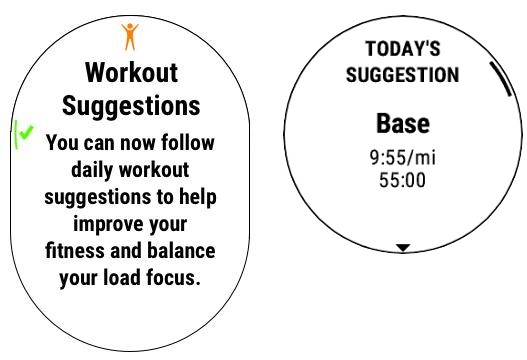
DSW produces a workout prescription — session type, target heart rate zone or pace range, and estimated duration — rather than a single number. The underlying logic rests on a continuous numerical assessment of training state.
A suggestion to perform a high-intensity session indicates that the watch judges the athlete to have adequately recovered and is capable of absorbing hard work. A suggestion to run easy or rest indicates that load has accumulated beyond what recovery has offset, or that fitness remains at a foundational level insufficiently established for harder sessions.
Workout types span a spectrum from recovery runs and base runs to tempo efforts and interval sessions. The specific session recommended on a given day reflects where the athlete sits in the relationship between recent training load (acute load) and longer-term training history (chronic load).
How Garmin Calculates It
DSW draws on the athlete’s current VO2 max estimate, Training Status, Training Load (acute and chronic components), and Recovery Time. On devices with Training Readiness support, that composite score serves as the most direct signal of same-day capacity. The physiological modelling behind Training Load, Training Effect, and related metrics originates from algorithms developed by Firstbeat Technologies, which Garmin acquired in June 2020.
The algorithm compares the current training state against the athlete’s history. An athlete whose acute load is low relative to chronic load and whose recovery is complete receives a more demanding suggestion. An athlete whose acute load has spiked, or whose Recovery Time counter is still running, receives an easier prescription.
Where the athlete has set a race goal in Garmin Connect, the system weights session types toward the demands of that event. Garmin maintains a rolling short-term suggested workout schedule (typically about a week long). The watch shows the current day’s session and adjusts the upcoming suggestions after each recorded activity.
Full list of possible inputs (will vary by device generation):
- VO2 max estimate.
- Training Status.
- Training Load (acute and chronic components).
- Recovery Time.
- Training Readiness.
- Load Focus (distribution of aerobic and anaerobic load).
- Sleep data.
- HRV Status.
- Stress history.
- The profile of recently performed workouts.
Typical Suggested Workouts
Garmin’s workout library includes:
- Recovery runs
- Base runs
- Tempo runs
- Threshold sessions
- VO₂max intervals
- Long runs
Cycling suggestions typically focus on endurance rides and tempo efforts.
What Affects the suggestion
Heart-rate accuracy is one of the largest sources of error. DSW depends on heart rate data to estimate Training Effect, calibrate the VO2 max model, and assess Recovery Time. When wrist-based optical heart rate produces unreliable data — during intervals, in cold conditions, or where watch fit is poor — every downstream calculation is affected. A chest strap eliminates most of this error for the activity itself.
DSW accounts only for sessions that the watch records. Gym work, cross-training, and recreational activity that goes unrecorded is invisible to the load model. An athlete who records five runs but omits three cycling sessions will appear less loaded than they are, and the system will suggest harder sessions than actual fatigue warrants.
Short-term illness and non-training stress — poor sleep, travel, occupational load — remain invisible to the algorithm unless they produce measurable changes in resting heart rate, HRV Status, or overnight Body Battery depletion. The system reads physiological signals only.
How Accurate Is It
No independent peer-reviewed study has evaluated the accuracy of DSW output specifically — whether the prescribed workout type and intensity are appropriate for a given athlete on a given day.
The accuracy of DSW depends on the accuracy of its component metrics. Research on Garmin’s VO2 max estimation has found mean errors of roughly 3–5 ml/kg/min relative to laboratory measures under controlled conditions, with larger errors in field conditions. Recovery Time and Training Load have received less independent validation. Because the feature relies on several physiological metrics, the accuracy of the suggested workout depends on the combined reliability of those inputs rather than on any single metric.
Experienced runners report that DSW performs most reliably for session type: the signal on whether to run hard, moderate, or easy is broadly consistent with perceived recovery state in athletes who train consistently and record all sessions. Specific intensity targets should be treated as approximate. Trend reliability over weeks is stronger than day-to-day precision.
Competitor Equivalents
- Polar: FitSpark provides daily workout suggestions based on cardio load and Nightly Recharge recovery data. The session library is broader across activity types than Garmin’s running-centric approach.
- Apple: Apple Watch lacks a daily workout prescription feature as of early 2026. Automated session-type recommendation based on recovery state is absent from the native platform.
- Coros: Training Suggestions on the Apex 2 Pro and Vertix 2S use Coros’s own load and recovery calculations. Coros publishes less methodology documentation than Garmin, making direct algorithmic comparison difficult.
- Suunto: Suunto Race and Race S include adaptive training guidance through the Suunto app. Third-party review data suggest it is less granular in session-type variety than DSW.
- Wahoo: ELEMNT head units carry no automated daily workout suggestion feature. Training integration is delivered through third-party platforms such as TrainerRoad and Wahoo X.
Which Garmin Devices Support It
Garmin introduced Daily Suggested Workouts in September 2020, launching first on the Forerunner 745, with broader rollout following firmware updates across the ecosystem.
Recent Garmin performance watches and outdoor models support Daily Suggested Workouts, including the latest generations of the Forerunner, Fenix, Epix, and Instinct. Compatibility varies by model and firmware version.
Prior-generation devices carrying DSW on existing firmware include the Instinct 2, Forerunner 965, Forerunner 265 and 265S, Epix Pro Gen 2, and Fenix 7 Pro. New DSW capabilities introduced for the Fenix 8/Forerunner 970 platform are reserved for that platform. Prior-generation devices receive maintenance firmware only.
Edge x40 cycling computers (e.g. 540, 840, 1040) also support daily suggested cycling workouts.
The Venu 4 (September 2025) supports DSW. Entry-tier devices — the Vívoactive 6, Venu 3, Lily 2, and all Vivosmart variants — do not.
Where to Find It
On supported watches, DSW typically appears as a dedicated widget or training prompt within the widget loop, displaying the session type, target intensity, and approximate duration. The athlete can initiate the workout directly from the widget. A widget glance shows the session type in abbreviated form as the athlete scrolls the stack.
When a session is started from the DSW widget, guided workout steps appear on the watch face, matching the prescribed effort periods. DSW functions as a workout initiator; it is unavailable as a passive data field during free activity recording.
The Morning Report on supported devices summarises the day’s suggested workout, along with Training Readiness and Recovery Time. Morning Report availability follows device tier; some devices that carry DSW do not include the Morning Report.
In Garmin Connect mobile, the Training section shows the day’s suggestion for review before the session. On Garmin Connect, the DSW presentation is less prominent than in the mobile app. Daily Suggested Workouts is available to all athletes with a supported device and a standard Garmin Connect account. A Garmin Connect Plus subscription is not required to access the feature.
Common Problems and Misreadings
The most frequently raised concern is that DSW recommends easy sessions when the athlete feels ready for hard work. This typically reflects the algorithm’s conservative response to accumulated load or incomplete Recovery Time. The suggestion is a recommendation that can be overridden, not an instruction.
DSW may prescribe a hard session when the athlete feels fatigued. This occurs most often when non-training stress leaves no measurable signal in the sensor data — poor sleep or life stress that produces no change in overnight heart rate or HRV. The system interprets physiological signals recorded by the watch rather than subjective fatigue.
Athletes who record sessions inconsistently report that DSW underestimates fatigue from non-running work and tends to skew toward running-type suggestions. This reflects a structural limitation of the current system. Recording all training sessions gives the algorithm its best opportunity to account for actual load.
DSW may show the same suggestion for several consecutive days during periods of very low activity, when Training Status enters a detraining state, and the system defaults to foundational session types. Resuming consistent recorded activity typically restores dynamic suggestion behaviour within one to two weeks.
How to Improve It
Establish a reliable VO2 max estimate by recording runs at varied intensities — including sessions that reach lactate threshold effort — with a chest strap heart rate monitor. The VO2 max model updates most accurately when both heart rate and pace data are clear, and the effort reaches a meaningful aerobic challenge.
Record every training session. The algorithm accounts only for the fatigue it can measure. All strength, swim, and cycling sessions should be logged. When sessions are completed without a watch, enter them manually in Garmin Connect to provide the system with a partial-load signal.
Set a race goal or target event in Garmin Connect. This shifts the distribution of suggested session types toward the specific demands of the target distance and adjusts the implied training phase. Without a goal, DSW operates in a general fitness-maintenance mode rather than a periodised build.
Other Points
A 2020 study by Flatt and colleagues in the International Journal of Sports Physiology and Performance found that HRV-guided training — adjusting daily session intensity based on morning HRV — produced superior gains in aerobic fitness compared to a fixed programme in recreational runners over seven weeks. DSW incorporates HRV via HRV Status and Training Readiness as one component of its daily assessment, suggesting the approach has physiological precedent. However, the study did not evaluate Garmin’s specific implementation.
Frequently Asked Questions
- Can I ignore the suggested workout and do something else? Yes. Start any activity from the activity list regardless of what the widget shows. The system recalculates its next suggestion using the actual session data after recording is complete.
- Why does my suggested workout keep saying easy run or recovery? Check whether Training Status shows Maintaining or Overreaching, and review the remaining Recovery Time. If both indicate high load, the conservative suggestions are functioning as intended. Extended inactivity can also push DSW toward foundational sessions until a training baseline is re-established.
- Do Daily Suggested Workouts work for cycling as well as running? Yes. DSW can generate cycling suggestions on supported devices. The recommendations are most accurate when cycling power data are available from a power meter or smart trainer, allowing the system to estimate cycling VO₂max and training load more reliably. Cycling load feeds Training Status, but suggestions are far less frequent/varied (mostly basic base rides) vs. mature running library (intervals/tempos).
- Do Daily Suggested Workouts replace a coaching plan? DSW supplements rather than replace a structured training plan with periodised phases. Athletes preparing for a specific event benefit from adding a goal entry in Garmin Connect or using DSW alongside a formal coaching plan that supplies mesocycle structure.
Scientific Basis
Flatt, A.A., Hettinga, F.J., Layne, G., and Esco, M.R. (2020). “HRV-guided training for enhancing cardiac-vagal modulation, aerobic fitness, and endurance performance.” International Journal of Sports Physiology and Performance. Demonstrated that HRV-guided daily intensity prescription produced superior aerobic adaptations over a fixed programme in recreational runners — the conceptual basis for recovery-guided training prescription systems similar to those used by DSW.
Impellizzeri, F.M., Marcora, S.M., and Coutts, A.J. (2019). “Internal and external training load: 15 years on.” International Journal of Sports Physiology and Performance, 14(2), 270–273. Established the dual-load framework — internal load (heart rate) and external load (pace, distance) — that DSW’s use of Training Effect alongside GPS data reflects.
How It Connects to Other Features
A calibrated VO2 max estimate is a prerequisite for meaningful DSW output, anchoring the intensity zones used in workout targets and underpinning Training Status classification. Training Status is the primary input to session type selection: Productive status produces progressively challenging suggestions; Maintaining or Overreaching shifts the prescription toward consolidation; Detraining produces foundational volume sessions.
Training Load determines whether the system judges the athlete ready for additional stress: high-intensity sessions are withheld when the acute-to-chronic ratio indicates excessive loading. Recovery Time establishes the floor below which only easy or recovery-intensity sessions are prescribed. On devices that support it, Training Readiness synthesises sleep quality, HRV Status, Recovery Time, and acute load into the single most direct readiness signal feeding DSW.
Once a suggested workout is completed, Training Effect records the physiological stimulus, updates Training Load, which in turn updates Training Status, which informs the next DSW output. For athletes with a race goal set, the [LINK: race-predictor] projection and goal proximity also shift the DSW suggestion distribution toward race-specific intensities as the target date approaches.
