Fitness Age
Garmin Fitness Age is a metric that expresses an athlete’s cardiovascular fitness as an equivalent biological age, based on their VO2 max relative to established population norms. A runner with a VO2 max typical of a 35-year-old will receive a Fitness Age of 35, regardless of their chronological age.
Garmin uses the metric to contextualise VO2 max in terms that require no prior understanding of maximal oxygen uptake. The limitation is that Fitness Age depends entirely on the accuracy of the underlying VO2 max estimate: any error in that estimate propagates directly into the displayed age.
What the Number Actually Means
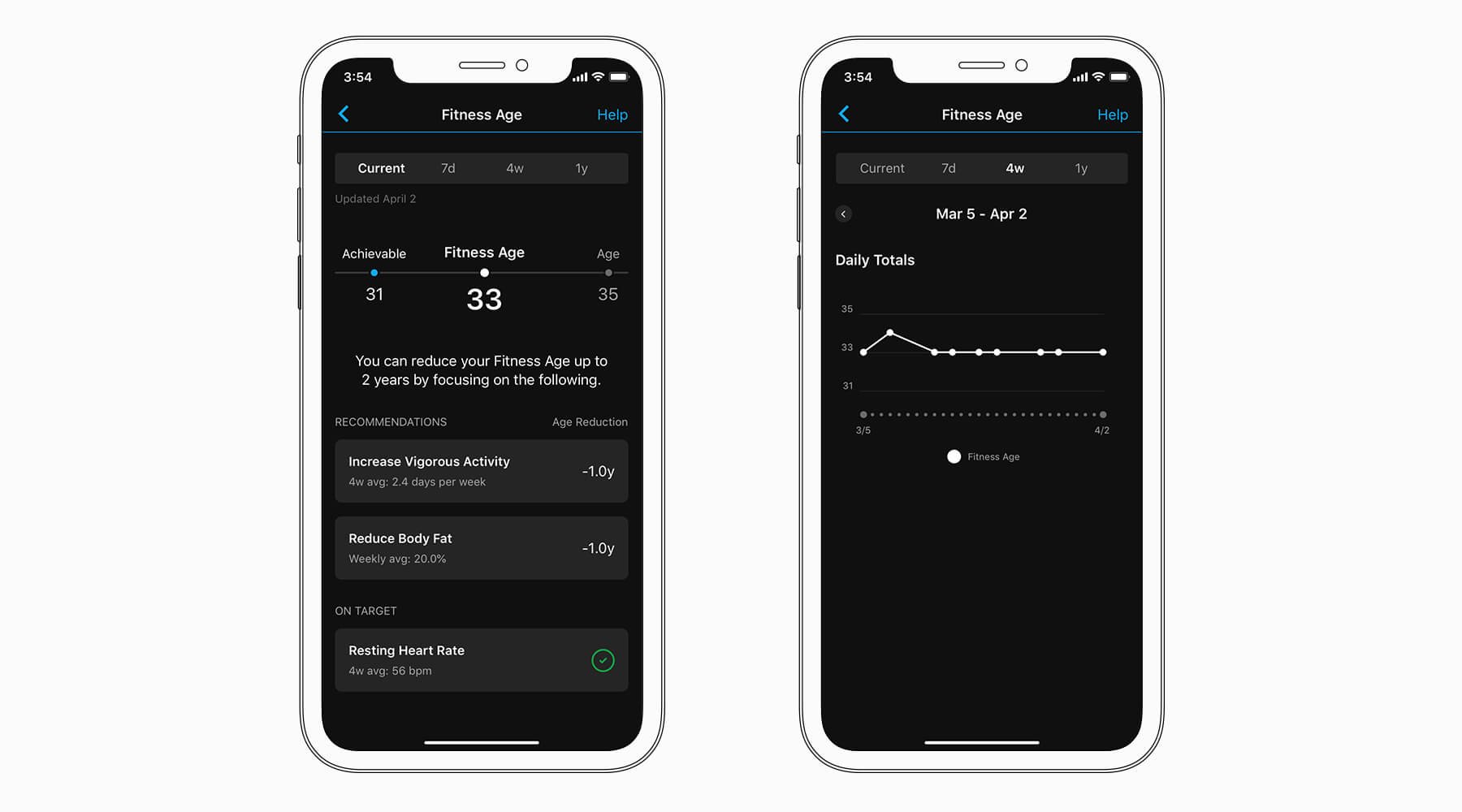
A Fitness Age below the athlete’s chronological age indicates cardiovascular fitness above the average for their age and sex group. An age equal to or above chronological age indicates fitness at or below the population average for that demographic.
The metric is anchored to population reference data segmented by age and sex. A 50-year-old woman with a VO2 max that places her in the top percentile for her cohort may have a Fitness Age in the low 30s. Sex is material to interpretation because the distributions of male and female VO2 max differ substantially across age bands.
How Garmin Calculates It
Garmin derives Fitness Age from the VO2 max estimate produced by the Firstbeat Analytics engine. That engine calculates VO2 max from heart rate and pace data collected during outdoor running or cycling activities, using a proprietary algorithm developed by Firstbeat Technologies and licensed by Garmin.
Once a current VO2 max estimate is available, Garmin maps the value against sex- and age-adjusted reference tables drawn from published population data. The resulting output is the youngest chronological age at which the athlete’s VO2 max would fall at or near the population median for that age and sex group.
Fitness Age updates whenever the underlying VO2 max estimate updates. VO2 max requires an outdoor run or cycle of sufficient intensity and duration — typically a minimum of ten minutes above a moderate effort — with GPS active. On a treadmill or during an indoor activity, VO2 max and, therefore, Fitness Age remain at the previously recorded value.
What Affects the Reading
Heat elevates heart rate relative to pace, which causes the Firstbeat algorithm to underestimate VO2 max. This results in a Fitness Age that is older than the athlete’s true fitness level. The effect is most pronounced when ambient temperature exceeds approximately 22°C, and the athlete has had limited time to acclimatise.
Altitude raises heart rate at any given pace for the same reason as heat — reduced oxygen availability — and produces the same direction of error. Athletes training at elevation will see a Fitness Age appear older until the algorithm has collected enough data to account for the altitude effect, which can take several days and multiple activities.
Wrist-based heart rate introduces measurement noise not present with a chest strap. During high-intensity intervals or activities with significant wrist movement, optical heart rate may deviate from true values. These artefacts distort the heart rate-to-pace relationship and can push the VO2 max estimate — and therefore the Fitness Age — in either direction.
Illness typically suppresses VO2 max estimates because heart rate remains elevated relative to pace during and immediately after infection. An athlete who trains through a minor illness may see their Fitness Age increase by several years for days to weeks after recovery.
How Accurate Is It
Fitness Age inherits the accuracy characteristics of the VO2 max estimate on which it is based. Firstbeat’s validation studies report a mean absolute error of approximately 3.5 ml/kg/min for the VO2 max algorithm under controlled outdoor running conditions with chest-strap heart rate. At typical VO2 max values — say, 45 ml/kg/min — an error of this magnitude corresponds to a shift of roughly three to five years in the Fitness Age output, depending on where the athlete falls in the reference distribution.
Trend reliability is stronger than absolute accuracy. If an athlete’s VO2 max estimate rises consistently over a training block, the Fitness Age will fall in a directionally accurate way even if the absolute figure is offset from laboratory measurement. Athletes are best served by tracking the direction and rate of change rather than treating the displayed age as a precise biological assessment.
Competitor Equivalents
- Polar: Polar devices display a Fitness Test Age derived from the Polar OwnIndex test, which estimates VO2 max from a five-minute rest-state measurement using resting heart rate, heart rate variability and self-reported activity level rather than pace-matched exercise data. The rest-state method avoids environmental confounders but provides less sensitivity to acute training changes than pace-matched estimation.
- Apple: Apple Fitness+ and the Apple Watch Health app display Cardio Fitness Level as a VO2 max range rather than a fitness age. Apple’s implementation uses heart rate and motion data from walks, hikes, and runs, and contextualises the figure against age and sex norms, but presents a category label (Low, Below Average, Above Average, High) rather than an equivalent age range.
- Coros: Coros watches display VO2 max, but do not convert it to a fitness-age equivalent. Coros contextualises VO2 max using the same type of population reference bands as Garmin, but presents the raw number with a percentile descriptor rather than an age mapping.
- Suunto: Suunto’s Fitness Level metric performs a similar function to Garmin Fitness Age, mapping an estimated VO2 max to a fitness category scale segmented by age and sex. Suunto presents a fitness-level category rather than a specific-year equivalent.
- Wahoo: Wahoo’s ELEMNT cycling computers display VO2 max estimates derived via the Firstbeat algorithm — the same engine Garmin uses — but present the raw VO2 max figure without a fitness age conversion.
Which Garmin Devices Support It
The Garmin Vivosmart 3, launched in April 2017, was the first device to feature Fitness Age. It is primarily a Garmin Connect presentation layer rather than a watch-side widget, and its availability on a given device is therefore determined by whether that device’s VO2 max data syncs to the Connect platform, which applies to all current GPS-equipped Garmin watches.
Fitness Age is available on any Garmin watch that calculates a running or cycling VO2 max estimate. The Fenix 8 series (including the Fenix E and Enduro 3) and the Forerunner 970 represent the current flagship and running-flagship anchors, respectively; both support Fitness Age as a standard feature of the Garmin Connect platform rather than as a watch-side display element. The Forerunner 265, Forerunner 570, Venu 4 and Vívoactive 6 include VO2 max estimation and therefore surface Fitness Age in the Garmin Connect app.
Entry-tier devices present a partial picture. The Forerunner 165 calculates VO2 max and therefore generates a Fitness Age, but the Forerunner 55 and Instinct 3 also estimate VO2 max and surface the metric in Connect. Devices without GPS — such as fitness bands like the Vivosmart 5 — produce no VO2 max estimate and therefore display no Fitness Age.
Where to Find It
Fitness Age is primarily accessible through Garmin Connect Mobile. In the app, it appears within the Health Stats section, alongside the VO2 max trend graph. A historical trend is available showing how the metric has moved over weeks and months. On the watch, Fitness Age is displayed through the VO2 max widget on supported devices; the watch face shows the current VO2 max value, and the associated Fitness Age appears as a secondary readout on the widget detail screen on most current-generation models. Garmin Connect shows the VO2 max estimate, but the Fitness Age presentation on the web interface is more limited than in the mobile app — the web view shows the figure but lacks the trend visualisation available in the app. Fitness Age is available to all Garmin Connect accounts at no subscription cost.
Common Problems and Misreadings
The Fitness Age reading appears older than expected after hot-weather training. This is the heat effect on heart rate described above: elevated heart rate relative to pace depresses the VO2 max estimate, which shifts the age upward. The reading typically corrects over one to two weeks as the algorithm accumulates post-acclimatisation data.
Athletes see a sudden increase in Fitness Age without any change in training. The most common cause is a new or changed heart rate source — switching from a chest strap to a wrist-based heart rate monitor, or pairing a new strap with a different baseline. A single activity with atypical heart rate data can nudge the VO2 max estimate by several ml/kg/min and produce a visible age shift.
The metric fails to update for several weeks. Fitness Age updates only when VO2 max updates, and VO2 max requires outdoor runs or rides of sufficient effort. Indoor treadmill or trainer sessions produce no update. Athletes training exclusively indoors through a winter block should expect the displayed age to remain static.
The Fitness Age is older than the runner’s chronological age, indicating that the runner considers themselves fit. This situation arises when the runner’s chronological age places them in an older age cohort whose median VO2 max remains high relative to the general population. A 45-year-old male runner with a VO2 max of 48 ml/kg/min may receive a fitness age of 47 — not because the figure is unflattering in absolute terms, but because the male 45-49 cohort has a relatively high population median. The metric reflects population distribution, not absolute fitness.
How to Improve It
Fitness Age falls as VO2 max rises. The most direct training stimulus for VO2 max improvement is high-intensity interval training at or near maximal aerobic pace — efforts of three to eight minutes at an intensity that produces a near-maximal heart rate response. Two sessions per week of this type, sustained over eight to twelve weeks, consistently produce measurable VO2 max gains in recreational and competitive athletes alike.
Easy aerobic volume also contributes, particularly for athletes with limited base fitness. Increasing weekly running distance at a conversational pace builds the aerobic base that supports high-intensity work. This mechanism is slower to produce VO2 max improvements than interval training, but compounds over months and reduces injury risk relative to a high-intensity-only approach.
Consistency over time matters more than any single session. VO2 max responds to chronic training load rather than acute effort. Maintaining structured aerobic training for 12 weeks or more yields greater and more sustained improvements than short, intense training blocks separated by periods of detraining.
Other Points
VO2 max, the direct input to Fitness Age, is one of the strongest known predictors of all-cause and cardiovascular mortality in the general population. A large prospective study by Wisloff et al., published in the European Journal of Cardiovascular Prevention and Rehabilitation in 2006, using data from the HUNT cohort of over 4,600 adults, found that a low estimated VO2 max was associated with a substantially elevated mortality risk, independent of other cardiovascular risk factors. A Fitness Age meaningfully above chronological age, therefore, carries implications beyond athletic performance.
VO2 max declines during detraining at a rate that directly raises Fitness Age. The decline is not linear: the largest losses occur in the first three weeks of inactivity, with research including work by Mujika and Padilla published in Medicine and Science in Sports and Exercise in 2000 indicating that trained athletes can lose approximately 4–14% of their VO2 max within this initial period. Fitness Age will typically rise by several years during a sustained break from aerobic training before stabilising at a lower baseline level.
Frequently Asked Questions
- Why is my fitness age older than my actual age? A Fitness Age above chronological age means the current VO2 max estimate places the athlete below the median for their age and sex group. This outcome is common for new runners, those returning from a break, or those whose recent activities have been affected by heat or illness. Consistent training will lower the figure over weeks to months.
- How often does the fitness age update? Fitness Age updates whenever the VO2 max estimate is recalculated. That recalculation requires an outdoor GPS-enabled run or cycle of sufficient duration and effort — typically ten or more minutes at moderate to hard intensity. In practice, an active runner training four to five days per week will see an update after most qualifying sessions, though the displayed value changes only when the underlying VO2 max shifts by a meaningful amount.
- Can the fitness age go below 20? Garmin’s reference tables have a lower bound. On most implementations, the displayed age floors are approximately 20, reflecting the youngest adult cohort in the population norm dataset. An elite athlete with a VO2 max above the 20-year-old median for their sex will see 20 as the minimum displayed figure.
- Does fitness age differ between running and cycling VO2 max? Garmin calculates separate VO2 max estimates for running and cycling. The running estimate is used for the primary Fitness Age display on run-focused devices. On devices that also compute cycling VO2 max, Garmin typically surfaces the running figure as the headline Fitness Age. Check the Garmin Connect settings if a different sport’s estimate is appearing.
- Why did my fitness age jump by ten years overnight? A single activity with corrupted heart rate data — optical sensor loss of contact, interference from a poorly fitting strap, or an activity recorded in extreme heat — can shift the VO2 max estimate by several ml/kg/min in one direction. The Firstbeat algorithm applies smoothing over time, but a sufficiently anomalous session will still move the output. Subsequent normal activities will pull the estimate back toward the historical trend.
Scientific Basis
Bouchard, C., et al. “Familial aggregation of VO2max response to exercise training: results from the HERITAGE Family Study.” Journal of Applied Physiology, 1999. This study established the reference framework for interpreting variation in VO2 max across the adult population and underpins the age-adjusted norms used in fitness age calculations.
Kaminsky, L.A., et al. “Reference standards for cardiorespiratory fitness measured with cardiopulmonary exercise testing: data from the Fitness Registry and the Importance of Exercise National Database.” Mayo Clinic Proceedings, 2015. This paper presents the population reference database from which age- and sex-adjusted VO2 max percentiles are derived, forming the foundation for fitness age mapping on consumer wearable platforms.
Wisloff, U. et al. “A single weekly bout of exercise may reduce cardiovascular mortality: how little pain for cardiac gain?” European Journal of Cardiovascular Prevention and Rehabilitation, 2006. This study from the HUNT cohort demonstrated that estimated VO2 max is a strong predictor of cardiovascular mortality across age groups, establishing the epidemiological relevance of fitness age as a population health metric.
Firstbeat Technologies. “Automated Fitness Level (VO2max) Estimation with Heart Rate and Speed Data.” Firstbeat White Paper, 2014. This technical document describes the Firstbeat algorithm used by Garmin to estimate VO2 max from GPS pace and heart rate data during outdoor running, including the validation methodology and reported error ranges.
How It Connects to Other Features
Fitness Age is a presentation layer on top of VO2 max. The two metrics share the same underlying calculation; Fitness Age adds no new data but reframes the VO2 max figure in a demographic context. Any factor that affects VO2 max accuracy — including the heart rate source quality addressed in Max Heart Rate — affects Fitness Age by the same degree.
Training Status uses the VO2 max trend to identify whether fitness is improving, maintaining, or declining. Fitness Age will fall over the same period that Training Status reads as Improving, making the two metrics complementary readouts of the same underlying fitness trajectory.
[LINK: health-status] is a broader daily wellbeing metric introduced on the Venu 4 and later devices that incorporates VO2 max as one input among several, alongside HRV, resting heart rate and sleep. An improving Fitness Age over weeks tends to correlate with a positive Health Status trend, though the two metrics operate on different timescales and use different data inputs.
