Garmin Recovery Time
Recovery Time tells an athlete how many hours must elapse before the body is ready to handle another hard training session.
Garmin Recovery Time is a post-activity estimate, expressed in hours, of the minimum period required for full physiological recovery from a completed workout. The metric is calculated by Garmin using a methodology developed by Firstbeat Analytics and draws on heart rate data collected throughout the activity. It appears on the watch immediately after a session ends and declines as the recovery window progresses.
The estimate is based on the cardiovascular stress of the just-completed session. It accounts for residual fatigue from up to 4 days and updates throughout the day based on sleep, stress, relaxation, and physical activity (but not nutrition or illness).
What the Number Actually Means
Recovery Time is expressed as a single integer — typically between 0 and 96 hours — representing the estimated time needed for full physiological recovery from the completed activity. A figure of 24 hours or below indicates a session the body can absorb quickly; figures above 48 hours indicate a high-stress effort such as a long run, tempo session, or race.
The figure reflects training load intensity rather than duration alone. A short, very high-intensity interval session can produce a recovery estimate comparable to a long steady run, because both generate significant cardiovascular stress. Age affects recovery capacity, so two athletes completing identical sessions may receive different estimates if their physiological profiles differ.
How Garmin Calculates It
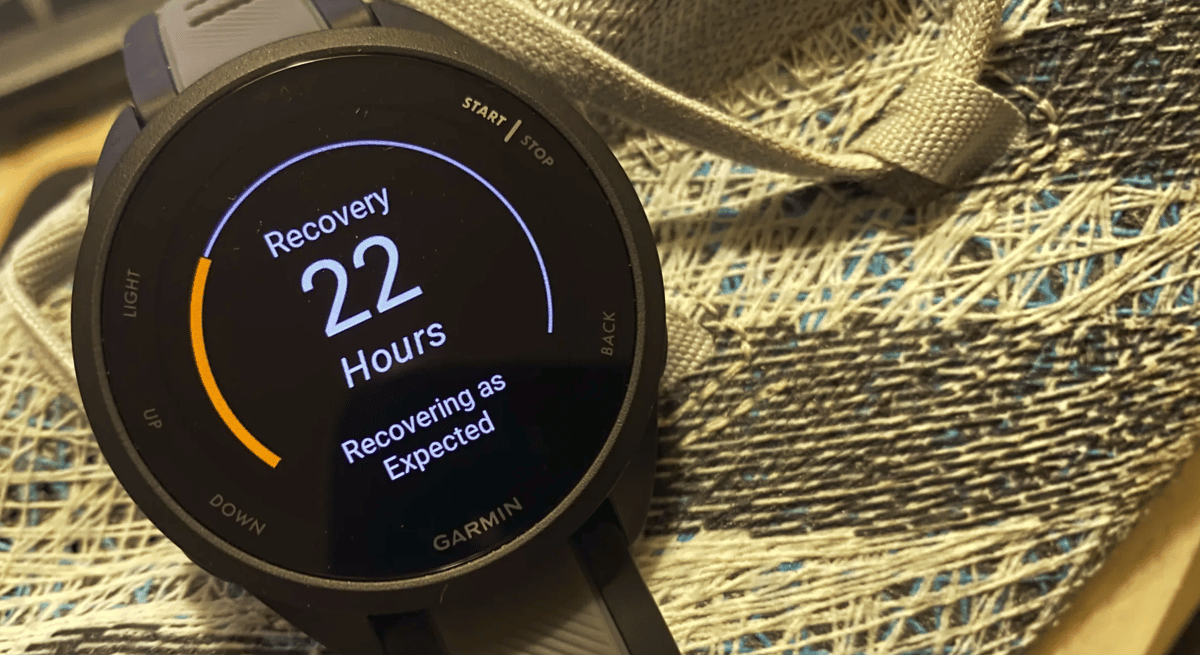
Garmin calculates Recovery Time using Firstbeat Analytics methodology, which was developed before Garmin acquired Firstbeat in 2020. The calculation is based on excess post-exercise oxygen consumption (EPOC), a physiological measure of the metabolic disturbance caused by exercise.
EPOC is estimated from heart rate data collected during the activity. The algorithm models the relationship between heart rate, oxygen consumption, and the biochemical debt accumulated by working muscle tissue. A higher EPOC value produces a longer Recovery Time estimate.
The watch requires a recorded activity with continuous heart rate data to generate Recovery Time. Sessions recorded without heart rate — or where heart rate data is significantly interrupted — will produce no estimate or an unreliable one. The metric updates on the watch face as the recovery window counts down, reaching zero when the estimated recovery period has elapsed.
What Affects the Reading
Heat and humidity elevate heart rate beyond what the underlying effort alone would produce. Because the algorithm uses heart rate as its primary input, sessions completed in hot conditions generate a higher EPOC estimate and therefore a longer Recovery Time than equivalent efforts in cool conditions.
Wrist-based optical heart rate introduces measurement error that the EPOC calculation inherits. Optical sensors are susceptible to motion artefacts during high-cadence running, particularly during interval work where heart rate changes rapidly. A chest strap or arm-band heart rate monitor produces a more reliable Recovery Time estimate.
Caffeine, dehydration, and elevated stress all raise resting and exercise heart rate, biasing the estimate upward. An athlete who runs a moderate session while dehydrated may receive an overstated Recovery Time.
Activity type matters. Cycling and swimming typically generate lower Recovery Time estimates than running at equivalent perceived effort, because those sports place less eccentric load on the body.
Recovery Time reflects cardiovascular stress as measured by heart rate; it captures no information about muscle damage from downhill running or prolonged racing.
How Accurate Is It
Independent validation of Garmin’s specific Recovery Time implementation is limited. The underlying EPOC methodology has a stronger evidence base. Firstbeat published a white paper documenting the relationship between heart rate, EPOC, and recovery requirements, which Garmin’s algorithm draws upon.
Research on EPOC-based recovery models suggests that heart rate alone captures cardiovascular recovery well but underestimates neuromuscular recovery time, particularly after eccentric-dominant exercise such as downhill running or marathon racing. Athletes recovering from events with substantial eccentric load typically require more time than the estimate reflects.
Trend reliability — the degree to which the metric accurately distinguishes harder sessions from easier ones within an individual’s training log — is generally considered stronger than absolute accuracy. The estimate is more useful as a relative indicator of session demand than as a precise countdown to readiness.
Competitor Equivalents
- Polar: Polar provides a Recovery Status metric in its Training Load Pro system, which estimates recovery time using orthostatic test data (HRV) and training load history.
- Apple: Apple Watch provides no direct equivalent. Apple’s Fitness app displays Training Load as a weekly metric but offers no estimate of recovery time.
- Coros: Coros provides a Recovery Time estimate within its Training Hub platform, calculated from training load and acute-to-chronic load ratios. The methodology differs from Garmin’s EPOC-based approach in that it places greater weight on session history than on the single-session heart rate trace.
- Suunto: Suunto provides a Resources metric, expressed as a percentage of available energy, that serves as a recovery-readiness indicator rather than a time-based countdown. The calculation draws on heart rate, sleep, and stress data from Suunto’s partner platform.
- Wahoo: Wahoo’s SYSTM platform provides recovery guidance based on training load history and the TRIMP (Training Impulse) model. Wahoo targets cycling and does not offer a post-activity recovery-hour countdown equivalent to Garmin’s implementation.
Which Garmin Devices Support It
Recovery Time was introduced alongside Firstbeat’s EPOC-based training load features, making it available on mid-range and high-end Garmin running watches from approximately 2014 onwards.
The Forerunner 265 and later models in the same tier carry Recovery Time as part of the full training intelligence suite. The Forerunner 970 and Fenix 8 series, as current-generation flagship and high-tier devices, support the feature in full. The Forerunner 165 carries a partial training intelligence suite.
The Forerunner 55 and entry-tier devices below the Forerunner 165 level support only VO2 max estimation and do not include Recovery Time. The Instinct 3 series carries a partial training intelligence suite.
Garmin Edge cycling computers, including the Edge 540, Edge 840, and Edge 1050, support Recovery Time for recorded cycling activities. The estimate for Edge devices draws on the same EPOC methodology used for cycling heart rate data.
Where to Find It
On supported watches, Recovery Time appears as a summary screen immediately after an activity is saved. The figure is presented alongside Training Effect and other post-activity metrics.
A Recovery Time widget is available in the widget loop on supported devices. The widget displays the remaining recovery hours as they count down in real time, reaching zero when the estimated window has elapsed.
During a subsequent activity, some devices display a data field showing remaining Recovery Time.
In Garmin Connect Mobile, Recovery Time is visible in the activity details view under the Training section. The app presents the figure as recorded at the end of the session. Historical Recovery Time figures are available within individual activity records, but there is no trend chart.
On Garmin Connect, Recovery Time appears in the activity summary. The web interface matches the mobile app in this respect and presents no additional detail. A Garmin Connect Plus subscription is not required to access Recovery Time.
Common Problems and Misreadings
Athletes often see Recovery Time lower than expected after a seemingly hard session. This happens when the heart rate stays lower than usual (heat adaptation, conservative pacing, or fatigue blunting cardiac response). Garmin’s algorithm only measures cardiovascular stress via heart rate and Training Effect — it cannot detect muscular or local fatigue.
Recovery Time can exceed 72 hours (up to 96+ hours) after races or very long efforts. This reflects only the acute stress of that single session. It does not account for your training history or adaptation from high-volume training. Experienced high-mileage runners typically recover faster than the number suggests.
How to Improve It
Recovery Time is guidance, not a strict training target. The goal is balanced intensity distribution: hard sessions followed by enough recovery, easy sessions that produce low EPOC and clear the clock quickly.
For better accuracy, use a chest strap during intervals — it significantly reduces motion artefact and gives a cleaner heart-rate trace. In hot conditions, heart rate rises, so expect longer Recovery Time figures; adjust interpretation accordingly rather than overriding the number.
Other Points
Research on EPOC and training load links chronic underrecovery (training through elevated Recovery Time) to higher injury risk and early overreaching. Meeusen et al.’s (2013) consensus statement identifies excessive training load, along with inadequate recovery, as the primary cause of non-functional overreaching and overtraining syndrome.
Recovery Time is not a clinical diagnostic tool, but persistent elevation beyond planned recovery windows matches the load patterns that precede overreaching.
Frequently Asked Questions
- Why is my Recovery Time so high after an easy run? Any recorded activity generates some EPOC and therefore produces a non-zero Recovery Time figure. An easy run at genuinely low intensity will typically produce a recovery time of under 24 hours. A figure that seems high for an easy effort usually reflects a heart rate higher than expected — check whether the session was affected by heat, dehydration, or fatigue, which can elevate cardiac output.
- Does Recovery Time account for sleep? The initial post-activity estimate is based on the session’s Training Effect. The countdown then updates throughout the day using sleep, stress, relaxation, and daily activity. Training Readiness combines Recovery Time, sleep, HRV status, and training load for overall readiness.
- Can I train while my Recovery Time is still counting down? Yes — easy aerobic activity is fine and aligns with active recovery guidelines. The metric specifically flags when you are ready for another hard effort.
- Why did my Recovery Time not appear after my activity? A missing or poor HR signal means no estimate is generated.
- My Recovery Time is 96 hours after a marathon — is that right? Yes. The maximum is 96 hours (4 days). This reflects the acute cardiovascular stress of the race effort only; full physiological recovery (especially neuromuscular) often takes 2–4 weeks.
Scientific Basis
Firstbeat Technologies. Science behind Firstbeat Fitness Features. White paper, 2014 (updated 2017). Establishes the EPOC-based methodology for estimating training load and recovery requirements from heart rate data; this document is the precursor methodology underlying Garmin’s implementation of Recovery Time.
Borsheim, E. and Bahr, R. (2003). Effect of Exercise Intensity, Duration and Mode on Post-Exercise Oxygen Consumption. Sports Medicine, 33(14), pp. 1037–1060. Quantified the relationship between exercise intensity, duration, and EPOC magnitude, providing the physiological basis for using EPOC as a proxy for recovery requirement.
Meeusen, R. et al. (2013). Prevention, Diagnosis and Treatment of the Overtraining Syndrome. European Journal of Sport Science, 13(1), pp. 1–24. Established consensus definitions for overreaching and overtraining and identified chronic underrecovery as the primary precipitating factor, providing context for the clinical relevance of recovery monitoring.
Halson, S.L. (2014). Monitoring Training Load to Understand Athletes’ Fatigue. Sports Medicine, 44(Suppl 2), pp. 139–147. Reviewed the relationship between training load metrics and fatigue markers, noting the limitations of single-variable models — including heart rate — for capturing neuromuscular recovery.
How It Connects to Other Features
Recovery Time feeds directly into Training Readiness, which incorporates the outstanding recovery window alongside HRV status, sleep, and acute training load to produce a composite readiness score each morning. An elevated Recovery Time suppresses the Training Readiness figure and may influence the character of the daily suggested workout.
The metric uses the same EPOC calculation as Training Effect and Training Load. Training Load aggregates EPOC across sessions over a rolling period; Recovery Time expresses the acute recovery requirement of the most recent session alone.
Recovery Time interacts with Training Status. A sustained pattern of completing sessions before the recovery clock has cleared is one of the signals the Training Status algorithm uses to identify an overreaching trend, potentially shifting status toward Overreaching or Unproductive.
[LINK: hrv-status] provides complementary information. Where Recovery Time reflects cardiovascular stress from exercise, HRV Status reflects autonomic nervous system state across multiple days. The two metrics together give a more complete picture of the recovery state than either provides alone.
