| Manufacturer | Google (Fitbit) |
|---|---|
| Type | Fitness tracker |
| Series | Charge |
| Released | October 2023 |
| Price at launch | £139.99 |
| Predecessor | Fitbit Charge 5 |
| Successor | None confirmed. Google’s Pixel 11 launch ads in August 2026 showed an unannounced wearable that may be a Fitbit Charge 7 or a separate Pixel-branded device. |
| Band size | Small (130mm to 170mm) and large (170mm to 210mm), both included in the box |
| Colours | Coral/Champagne Gold Aluminium, Porcelain/Silver Aluminium, Obsidian/Black Aluminium |
Specifications and features as at launch.
Expert opinion | What’s new versus Charge 5 | Specifications | Battery life | Features | Sensors and health features | Further reading
Expert opinion
The Fitbit Charge 6 is a top-tier everyday health and fitness tracker. It offers excellent sleep tracking, comprehensive health metrics including ECG, HRV and skin temperature, and improved optical heart rate accuracy derived from Google Pixel Watch algorithms, alongside useful smart features like Google Wallet and Google Maps.
Its built-in GPS remains unreliable, and it lacks an altimeter for floor tracking. The simplified three-zone heart rate model and minimal post-workout metrics fall short of what serious runners or endurance athletes need for deep training analysis. It is an outstanding daily wellness device for general fitness enthusiasts, but dedicated sports watches from Garmin or Coros remain better suited to performance tracking.
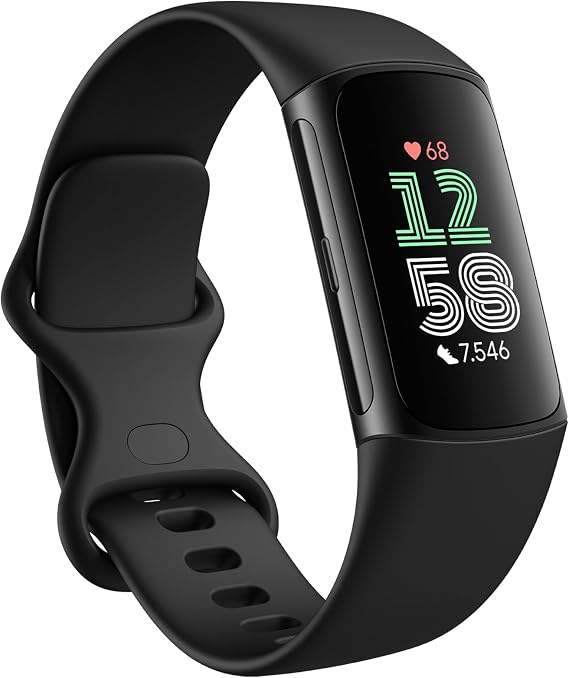
Fitbit Charge 6
Fitness tracker with SpO2 and skin temperature sensing, Cardio Fitness Level, Sleep Score and up to 7 days of battery life. Heart rate tracking is rated up to 60% more accurate than other Fitbit trackers during vigorous activity.

What’s new versus Charge 5
Hardware
- A haptic side button returns for the first time since the Charge 3. The Charge 5 relied on touchscreen gestures only, which struggled with sweat, water or gloved hands. The button wakes the display, returns to the clock face and moves through the interface without a screen tap.
- The case is 1.8mm taller, 4.3mm narrower and 0.5mm thicker than the Charge 5. The design and display are otherwise unchanged.
Software
- A machine learning heart rate algorithm, adapted from the Google Pixel Watch, replaces the Charge 5’s model. Google states it is up to 60% more accurate during vigorous activity such as HIIT, spinning and rowing.
- Workout modes expand from the Charge 5’s 20 to more than 40 on the Charge 6, including HIIT, CrossFit and skiing profiles.
- The Charge 6 can broadcast heart rate over Bluetooth to gym equipment, including Peloton bikes and NordicTrack machines. The Charge 5 has no equivalent feature.
- Google Wallet replaces Fitbit Pay for contactless payments.
- Google Maps and YouTube Music controls are new additions, both absent from the Charge 5.
- Pace alerts for walking, cycling and running, plus distance and time goal setting, are new to the Charge 6.
Specifications
| Display | |
|---|---|
| Type | AMOLED |
| Cover glass | Corning Gorilla Glass 3 |
| Physical | |
| Dimensions | 36.73mm (L) x 23.09mm (W) x 11.20mm (H) |
| Weight | 30.00g |
| Materials | Silicone band with loop and peg closure |
| Water resistance | 50 metres (5 ATM, ISO 22810:2010) |
| Sensors and positioning | |
| Positioning | Built-in GPS and GLONASS |
| Heart rate | Optical heart rate monitor |
| Motion | 3-axis accelerometer |
| Blood oxygen | Red and infrared SpO2 sensors |
| Skin temperature | Device temperature sensor, variation shown in the Google Health app |
| Electrical | ECG app and EDA Scan app compatible |
| Other | Ambient light sensor, vibration motor |
| Connectivity and storage | |
| Radio | Bluetooth, NFC |
| Sync range | Up to 30ft (9m) |
| On-device storage | 7 days of minute-by-minute motion data, 30 days of daily totals, heart rate at 1-second intervals during exercise and 5-second intervals otherwise |
| Operating temperature | -10°C to 45°C |
| Maximum altitude | 8km |
Battery life
| Mode | Battery life |
|---|---|
| Typical use | Up to 7 days |
| Charge time, 0 to 100% | 2 hours |
Battery type is lithium-polymer. Google states the 7-day figure is based on testing with default settings and a median usage profile; the always-on display and SpO2 tracking both require more frequent charging.
Features
The Charge 6 pairs with the Google Health app, which replaced the Fitbit app, and requires a Google account.
- Cardio Fitness Level estimates VO2 max from heart rate and activity data.
- Sleep Score rates the previous night’s sleep.
- SmartTrack automatically detects and logs workouts without a manual start.
- Stress Management Score gives a daily score based on the body’s physical response to stress, drawing on the EDA sensor.
- Smart notifications cover calls, texts, calendar alerts and app notifications, including Gmail and Google Calendar.
- Three months of Google Health Premium are included at launch, unlocking AI-based coaching built with Gemini. It renews at £7.99 a month after the trial.
Sensors and health features
The SpO2 and skin temperature sensors are not available in all countries and are not intended for medical diagnosis; Google positions them as wellbeing tools rather than clinical measurements. The ECG app and irregular heart rhythm notifications are restricted to select countries and are not intended for users under 22 or those with known arrhythmias, with heart rhythm data recorded only when the wearer is still or sleeping.
The EDA Scan app measures skin conductance changes linked to stress. Advanced analytics for these metrics require a Google Health Premium subscription.
