Will Zwift Ever Hit Its Old Peak? Indoor Cycling Competition Intensifies. Has Growth Really Returned?
Zwift has been synonymous with indoor cycling for over a decade, offering a platform that combines structured training with a gamified social experience. However, recent usage data and trends in related searches suggest that Zwift’s growth may have returned after the initial fall from its all-time high in 2021.
Tracking Peak Zwift
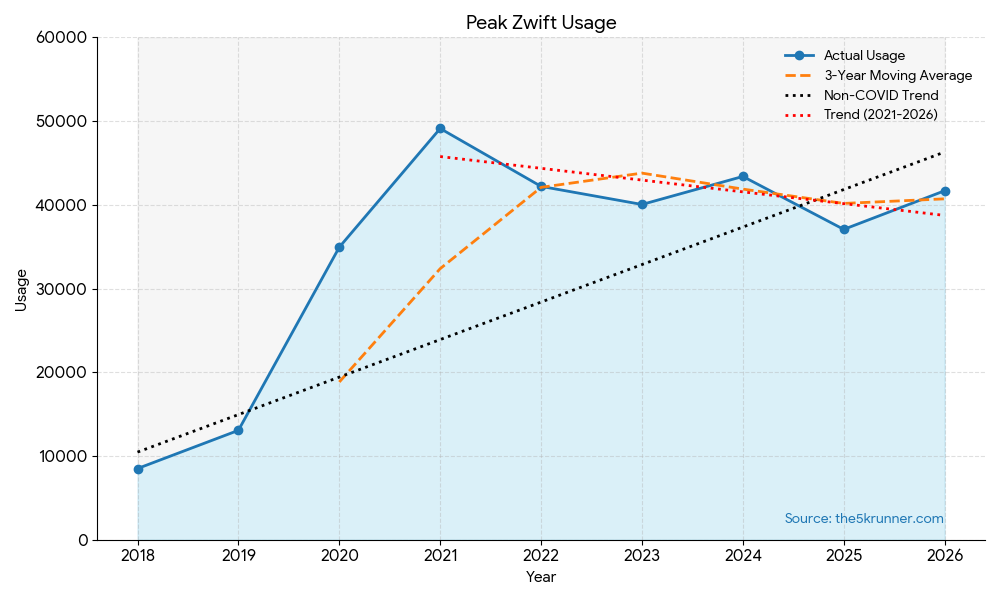
Interesting data from Zwift Insider , dcrainmaker, and GPLAMA: the downturn suggested by last year’s declining Peak Zwift numbers appears to be a floor, as 2026 figures show a notable upward trend.
- 2018: 8,500 (Approx)
- 2019: 13,064
- 2020: 34,940
- 2021: 49,114 (best)
- 2022: 42,199 (-14.1%)
- 2023: 40,039 (-5.1%)
- 2024: 43,387 (+8.4%)
- 2025: 37,065 (-14.6%)
- 2026: 41,680 (+12.5%)
It’s hard to make out the true trends in those raw numbers. When graphing the same information, however, it raises more questions than answers. e.g. A 3-year moving average is roughly flat; a 6-year straight line trend is downwards, whereas a trend that excludes the COVID years is significantly positive.
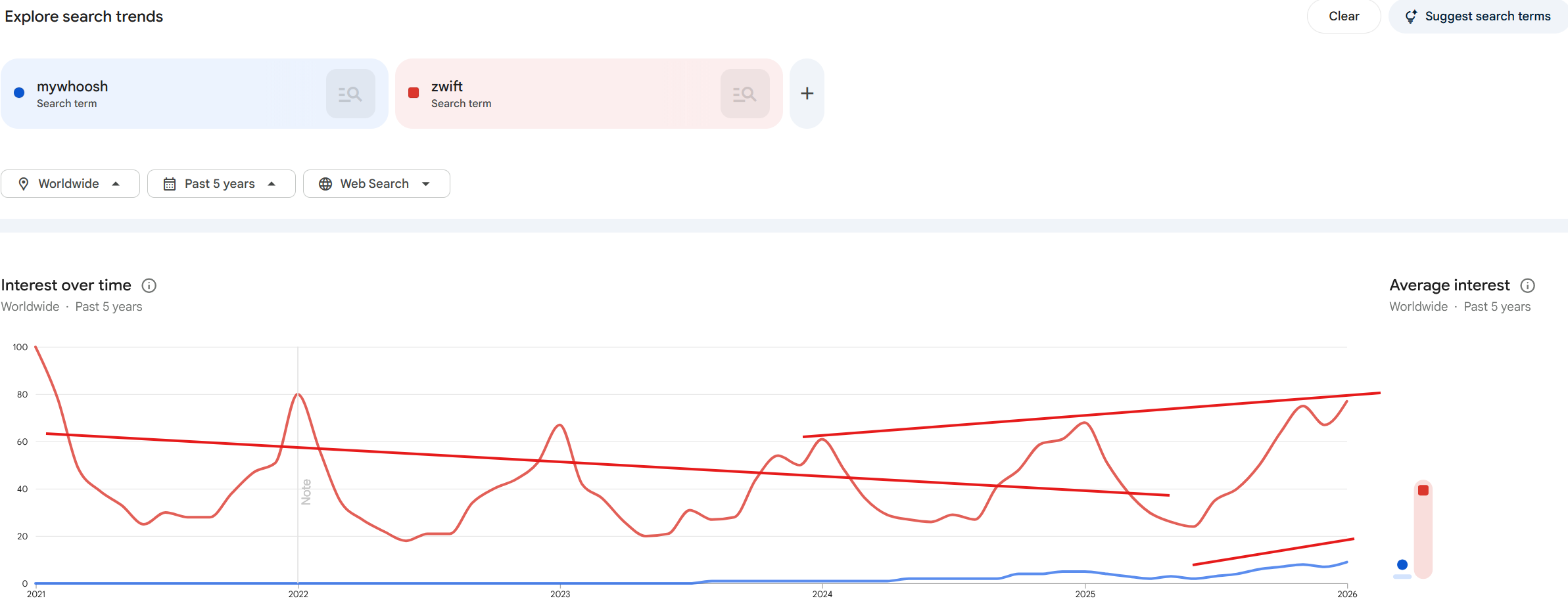
Indeed, if we look at Google Trends information, we see precisely that. Despite more significant competition for Search by MyWhoosh over the last 6 months, Zwift demonstrates a solid 3-year upward trend in the peaks of the average interest data.
Factors Behind the Changes
Several factors contribute to this shifting trend:
- Post-Pandemic Normalisation — Zwift saw unprecedented growth during the COVID-19 lockdowns as gym closures funnelled existing cyclists indoors and simultaneously created new cyclists. With restrictions lifted, many former indoor cyclists have returned to outdoor riding.
- Subscription Price Increases — Zwift’s May 2024 price hike from $14.99 to $19.99/month (a 33% increase in the US, 38% in the UK) hasn’t helped retention. The annual plan now costs $199.99—making Zwift one of the pricier options in an increasingly competitive market.
- Increased Competition — While Zwift remains dominant, competitors are gaining ground. MyWhoosh (completely free) now hosts the UCI Cycling Esports World Championships through 2026. TrainingPeaks Virtual (formerly IndieVelo) launched in late 2024, bundled with TrainingPeaks Premium at $124.99/year.
- Free 25km Trial Removed — In 2025, Zwift discontinued its free monthly 25km allowance, removing a key on-ramp for casual or seasonal riders who might have converted to full subscribers.
- Weather and Seasonal Trends — Mild European winters in recent years have kept more cyclists outdoors during the traditional peak indoor season.
- Demographic shifts – Running in the youth age groups is certainly experiencing an upswing. Perhaps the same age groups have also recently turned to cycling in general and to indoor cycling more specifically.
More: Mywhoosh Review
The MyWhoosh Effect
While Google search interest in most non-Zwift indoor cycling platforms lags far behind the market leader, MyWhoosh has emerged as a genuine long-term competitive threat—particularly in high-profile esports racing. The UAE-based platform secured exclusive rights to the UCI Cycling Esports World Championships for 2024-2026, a significant loss for Zwift, which previously hosted this prestigious event.
MyWhoosh’s key advantage is its price: completely free. While the platform has fewer concurrent users and relies partly on bot riders to fill out the experience, its active user base has grown significantly – my own anecdotal evidence from using the new Bhutan world in late 2025 showed precisely that. For riders who primarily want structured training without the social gamification, it’s increasingly hard to justify Zwift’s premium pricing.
2025’s Major Zwift Developments
According to Zwift Insider’s 2025 Year in Review, the platform delivered significant updates throughout the year:
- December 2025: Draft Indicator finally arrived, showing real-time aerodynamic benefit. The New Progress Report screen replaced the old Streaks view with comprehensive fitness metrics.
- October 2025: The New York map more than doubled in size with new roads through Brooklyn and expanded Manhattan.
- September 2025: Zwift Click v2 controllers replaced both original Click and Play controllers, supporting virtual shifting with Cog. (co-branding with Wahoo Kickr Core 2, reviewed)
- April 2025: New cobbled roads in France. Outdoor ride integration with Garmin/Wahoo for fitness tracking.
- March 2025: Bike Upgrades system launched, letting riders unlock performance improvements through milestones.
The platform also added 60 new routes in 2025—more than any previous year—along with 8 new Climb Portal climbs and major events including Tour de Zwift, Zwift Games, and Zwift Community Live in Mallorca.
Competitive Landscape in 2026
The indoor cycling market now features several viable alternatives to Zwift:
- Zwift — $19.99/month ($199.99/year) — Market leader with the largest user base, reported 1M+ active subscribers in 2024. Best social features and racing ecosystem.
- MyWhoosh — Free — UCI Esports partner through 2026. Cash prizes are available in races. Growing user base but bot-heavy in quieter hours.
- TrainingPeaks Virtual — $124.99/year (part of TrainingPeaks Premium) — Formerly IndieVelo. Realistic physics engine, race-focused with strong anti-cheat. Available free through March 2025, now requires a Premium subscription. Sounds bad..unless youalready had the Premium subscription, in which case it is a freebie!
- Rouvy — $14.99/month — Real-world video footage of iconic routes. Strong marketing push throughout 2025.
Is Zwift in Decline?
Internal Zwift sources to this site confirmed the company celebrated reaching one million active subscribers in 2024. According to Zwift Insider, subscriber numbers and corporate financials remain “strong” heading into 2026, with streamlined onboarding and purpose-built hardware (the Zwift Ride smart bike) helping attract new riders.
It’s worth noting that while “Peak Zwift” concurrent numbers have turned a corner and might be trending upwards, overall participation remains significantly (roughly three times) higher than pre-2020 levels. Changes to peak users neither signal a business in trouble nor one on the rebound.
My Take
I expect indoor cycling participation to grow modestly over the coming years, driven by demographic and behavioural changes, as well as hardware improvements and better onboarding. The Zwift-specific element of that appears to have upsides, but only if a compelling justification for the subscription exists.
The real shake-up will come from free platforms. Right now, MyWhoosh is the only realistic mass-market contender with an upward trajectory. I’ve used it on and off over the past two years, and while the presence of bots is undeniable, its real active user base has grown. It offers a free, good-enough experience that works for many riders but not all. The problem for Zwift is that awareness of MyWhoosh is growing—especially with UCI backing. Once that awareness reaches critical mass, a tipping point could trigger an exodus. There is no barrier to exiting Zwift, and no technical barrier to entering MyWhoosh; you can even transfer some of your digital achievements.
Looking further ahead, TrainingPeaks Virtual presents another real but focused threat. Its analytics and training tools have locked in many users to its platform. With IndieVelo’s realistic physics engine now bundled into TrainingPeaks Premium at $124.99/year, why would a serious trainer stay with Zwift at $199.99/year?
Just because you or I enjoy racing on a technically superior platform like Zwift doesn’t mean it’s safe from serious competition. Platforms that cater to different types of riders—free casual riders, data-obsessed trainers, cash-prize esports racers—all pose a financial threat to Zwift’s dominance.
Let’s be honest—Peak Zwift was 2021, not a Tuesday in January 2026.
Updated January 2026. Data compiled from Zwift Insider, DC Rainmaker, Zwift Forums, UCI announcements, and industry sources.
Last Updated on 29 January 2026 by the5krunner
Reader-Powered Content

This content is not sponsored. It’s mostly me behind the labour of love, which is this site, and I appreciate everyone who supports it.
Support the site: Follow (free, fewer ads) · Subscribe (paid, ad-free) · Buy Me A Coffee ❤️
All articles are written by real people, fact-checked, and verified for originality. See the Editorial Policy. FTC: Affiliate Disclosure — some links pay commission. As an Amazon Associate, I earn from qualifying purchases.
tfk is the founder and author of the5krunner, an independent endurance sports technology publication. With 20 years of hands-on testing of GPS watches and wearables, and competing in triathlons at an international age-group level, tfk provides in-depth expert analysis of fitness technology for serious athletes and endurance sport competitors.

Between Mywhoosh picking up literally all of those in need of some winter training screen filler who are on a tight budget and Rouvy apparently offering some attractive group rebates, I’m sometimes surprised that I’m not the last one left on Zwift. I really wonder how much of this is just creative statistics trying to dazzle future investors.
Sure, it’s probably not quite as bad as my Strava feed suggests because Rouvy loves to spam half a dozen activities for just about any single session, but it certainly is far from good.
(seriously, Zwift, if you want to survive, pay Strava to introduce some aggregate activity feature to group those together on the feed, the Rouvy visibility advantage will kill you!)