Your Garmin Can’t Accurately Track Daily Stress — And Neither Can Any Other Wearable
Some scientific research by Amin Sinichi has done what wearable technology companies have conspicuously avoided: testing whether a leading consumer device actually measures what it claims to measure, under real-world conditions, against a clinical standard.
The short answer is that it largely does not. The longer answer is more troubling, because the failure is not Garmin’s alone. It belongs to a broader technology category—one that has been marketed to tens of millions of consumers on the premise that it can meaningfully track physiological stress and recovery continuously.
There is also a detail worth noting before the findings are examined. The device tested was the Garmin Vivosmart 4, a model released in 2018 and equipped with Garmin’s Elevate v3 optical heart rate sensor—a previous-generation platform by any measure. Garmin has since released the Elevate Gen 5, which features updated sensors and algorithms. One might therefore expect the industry to argue that these results are historical rather than representative of what today’s devices can do. That argument does not hold. As this piece explains, the identified limitations are not attributable to sensor vintage. They depend on the sensor type.
For context on how chest straps compare to optical sensors and where heart rate data fits into training, see the heart rate guide.
What the Research Shows
The study placed a Garmin wearable alongside a full electrocardiogram reference for an entire day, capturing sleep, rest, movement, and posture changes. The device performed tolerably when participants were still: lying down, seated, or asleep. When they moved — walked, stood, or simply shifted posture — agreement with the ECG deteriorated substantially.
The errors were not small. RMSSD, the heart rate variability metric that Garmin and its competitors report to users, was off by more than 100 milliseconds in some participants. Critically, the direction of that error was not consistent. Some participants saw their HRV systematically overestimated; others had it systematically underestimated. That inconsistency is consequential: it means there is no reliable correction to apply, and no way for the user to know which side of the error distribution they fall on.
Even during sleep—the measurement context most favourable to optical sensors and the one most prominently cited in marketing—the data were not reliably accurate.
A Technology Problem, Not a Brand Problem
Garmin uses photoplethysmography, a light-based optical sensing method that is embedded beneath the wrist band of virtually every major consumer wearable on the market. Apple Watch uses it. So do Whoop, Fitbit, and the wrist-based products from Polar and Suunto. The finger-based sensors used by Oura are substantially better given the anatomy of the fingertip, but they are not immune to the underlying issues.
The physics of the method cannot be changed. PPG measures changes in blood volume at the skin surface by illuminating the tissue and detecting the reflected signal. Any movement, however small, distorts that signal in ways that are difficult to separate from the pulse. Skin tone, subcutaneous tissue depth, wrist circumference, and sensor fit introduce additional individual variability. The same device, under the same conditions, can perform adequately for one user but fail for another. This site has reiterated that point for years.
Software can partially compensate. Algorithms can flag periods of likely noise and exclude them from calculations. But they are working on a compromised signal. More sophisticated processing of unreliable data does not produce reliable data.
The Proprietary Metric Problem
Most wearables do not report raw HRV to users. They report a derived score — a “stress level,” a “body battery,” a “readiness” number — built on top of the underlying HRV estimate using proprietary models that are not independently validated and not published in any form that would allow scrutiny.
This matters for two reasons. First, any error in the HRV measurement is inherited and potentially amplified by subsequent processing. Second, these scores are not fixed: companies update their algorithms, and the numbers users see can shift as a result, without any change in the user’s actual physiology. A trend that appeared meaningful over months can be partially or entirely an artefact of a software release. As a watch owner, you have no way of knowing that.
This is not a made-up, sensationalist, hypothetical concern. It has happened. It will happen again.
What Reliable HRV Measurement Actually Requires
All said, HRV is a useful metric. It is, and a substantial body of research supports its value as an indicator of autonomic function and recovery status. The issue is the conditions under which it can be measured reliably and meaningfully.
A brief measurement taken under controlled conditions—the same time each morning, lying still before getting up—produces a signal clean enough to be interpretable. Tracked over time in this way, HRV can reflect genuine changes in physiological state. The measurement is brief, but the context gives it meaning.
24/7 tracking, by contrast, adds data volume without adding interpretive value. The majority of readings taken during daily activity are too noisy to support meaningful analysis. The result is a large number of data points that create the impression of comprehensive monitoring while obscuring rather than revealing the underlying signal.
A Question of Accountability
The Sinichi study is not the first to identify these limitations. Validation research has made similar points for over a decade. Indeed another study I covered in May 2026 showed HRV Status issues with the Garmin Forerunner 265.
The wearable industry has ensured that this literature remains firmly within the academic realm. The commercial features backed by continuous passive monitoring are communicated at scale to consumers who have no reason to question them.
The gap between what these devices are marketed to do and what the evidence shows they actually do is not a rounding error.
Garmin is the subject of this particular study. The finding applies across the industry.
- How I use HRV (the athletic option): I actively take a one-minute, waking, seated measurement with HRV4Training and a Polar H9/H10. Polar’s orthostatic tests are good.
- Other Valid Uses (the casual option): Passive, overage overnight readings as a measure of how your body is coping with non-athletic, resting physiology.
- Broadly speaking. Everything else with 24/7 HRV metrics is scientifically wrong, but you might get lucky.
Source: Sinichi et al., “Right Place, Right Time: Validation of a Consumer-Grade Wearable for Heart Rate and Heart Rate Variability Across Sleep-Wake Cycles, Physical Activity, and Postures in an Ambulatory Study” (preprint).
This article is part of the site’s sports science reference for endurance athletes. For a cross-brand view of how Garmin and its competitors sit in the running watch market, see the running watches hub.
Last Updated on 3 October 2026 by tfk the5krunner
Small things I always use
- Garmin 90-degree charging adapter: Charges your Garmin from any USB-C cable. Essential when travelling. I use one.
- Body Glide: The blue anti-chafe stick swimmers and runners carry. I use it.
- Speedo earplugs: Fewer ear infections and no cold-water dizziness. I use them.
- Dryrobe Advance: My winter changing robe for open-water swims. I use one. A cheaper option is the AONYIYI changing robe.
- Maurten: Race fuel that stays easy on the stomach. I use them.
- Garmin charging puck: The quickest way to top up before a session. I use one.
- Injinji: Toe socks that stop rubbing, so you run more. I use them.
- Ultimate toe protectors: Stop black toenails on long runs. They work. I use them.
- Compressport R2 v2 calf sleeves: My calf sleeves of choice. I use them.
- Cellucor C4: My pre-workout before hard sessions.
- TPU tubes: Schwalbe Aerothan, Tubolito and Pirelli SmarTube. Light, tiny spares. I use all three.
- G8 insoles: Adjustable insoles that are good. I use them.
- Cycplus Cube: A 97g electric pump that gets a road tyre rideable in two minutes. I carry one. 5% off with code THE5KRUNNER.
Watches and sensors
- Polar H10: My daily driver for waking HRV.
- Polar Verity Sense: My backup arm-worn HR sensor.
- Nomad bedside charger: Charges my iPhone and Apple Watch overnight. I use it, and many of their bands.
- Train.Red: The best muscle oxygen sensor I’ve used.
- Tymewear: Accurate heart rate and reliable ventilatory zones. I use it to pace endurance rides over an hour.
- Garmin Forerunner 970: A pro-grade triathlon watch. I use this.
- Apple Watch Ultra 4: My daily smartwatch. No phone needed on rides.
- Garmin Fenix 9 Pro: I’ve just bought one.
On the bike
- Continental GP5000 for everyday riding, and Aero 111 on the front for special occasions.
- Helmets: Specialized S-Works Evade 3 for road riding, and Rudy Project Wing for TT-style races. I use both.
- Ravemen FR300: A front light that mounts under your Garmin or Wahoo. I use one.
- Wahoo TRACKR Radar: I use it on one bike and Varia on the other. They perform the same.
- Garmin Varia RTL515: Radar that warns you of cars from behind. I use this model.
- Wahoo ELEMNT Roam 3: The bike computer that’s easy to use. I use mine on most rides.
- Favero Assioma Pro RS2: Accurate power pedals that swap easily between bikes. I use this model.
Home and indoor training
- NPE Runn: Makes my basic treadmill smart, sending more accurate speed and distance to my watch and Zwift. I use it.
- Google Wifi: Keeps Zwift connected in my pain cave. I use it.
- Apple TV 4K: Zwift on the big screen. I use two.
- Google Nest Doorbell (wired, 2nd gen): My video doorbell, running in both Google Home and Apple Home. I use it.
Health, recovery and sleep
- FreeStyle Libre 3 Plus: Shows how my blood sugar responds to diet.
- hDrop: Measures my sweat loss in summer and indoors.
- Fourth Frontier Zone: Checks my heart under load in hard sessions.
- Oura Ring 5: My partner’s recovery tracker of choice.
- Kineon MOVE+: Red light therapy for niggles. It works.
- Eight Sleep: A cooling mattress cover my partner and I use nightly.
Reader-Powered Content

This content is not sponsored. It’s mostly me behind the labour of love, which is this site, and I appreciate everyone who supports it.
Support the site: Follow (free, fewer ads) · Subscribe (paid, ad-free) · Buy Me A Coffee ❤️
Written by real people, with AI assistance. Fact-checked and verified for originality. See the Editorial Policy. FTC: Affiliate Disclosure — some links pay commission. As an Amazon Associate, I earn from qualifying purchases.
tfk is the founder and author of the5krunner, an independent endurance sports technology publication. With 20 years of hands-on testing of GPS watches and wearables, and competing in triathlons at an international age-group level, tfk provides in-depth expert analysis of fitness technology for serious athletes and endurance sport competitors. ID

So if I focus on metrics like resting HR, actual HR or HRV insetad of Stress score, Sleep stages or Biocharge, I am doing it not that wrong, right? I wanted to say that I am doing it right but apparently the numbers themselves can be rigged 🙂
There actually IS a consumer device with extremely accurate HRV
both at rest and activity
it’s proven at ECG level actually, it can function as medical grade 1-lead ECG
but support has never taken off
the Movesense sensors (owned by Suunto)
and people can even make their own firmware to flash, it’s open source, I bought one to play with
https://www.mdpi.com/1424-8220/24/17/5713
they compared it to Garmin HRM-Pro and the accuracy was night and day
one link is normally fine. i added it in.
that’s a chest strap tho.
ppg sensors are the issue
the movesense can be used as a free pod on the chest area without a belt
it’s a mini-strap with some kind of medical glue
they do that for 24/7 monitoring, Firstbeat used to have a pod like that too before Garmin bought them
I have even seen movesense used as a pseudo-watch using a wrist strap
it’s only the size of a US quarter and extremely light, much lighter than the old Garmin HRM pods before the PRO
the electrodes are so sensitive I can get very accurate HRV just touching them with my fingers on each hand
it really is impressive and puts Garmin to shame, it’s even better than the polar sensors
and movesense also has full motion/acceleration sensors, I wanted to try to write the code to make it work like HRM-PRO metrics but via bluetooth, however that’s beyond my skill level for now, maybe with LLM help someday
ah ok, interesting ty. I didn’t know that.
the issue behind all of this is that the wrist is teh most convenient place to record hr but the worst place to do it accurately.
the movensese pod highlights the alternative. which isn’t convenient. (I do admit to sleeping with a chest strap for my own science in years gone by, albeit not regularly!!)
Why does the title single out Garmin while the article confirms that all vendors’ wearable devices are similarly compromised? Is there an axe being ground here?
… Or is it just an unfair way to maximise clicks?
so…err…no.
if you want a super-positive Garmin article try this: https://the5krunner.com/2026/02/18/garmin-financials-q4-2025/
Who is using HRV during the day to determine anything meaningful, honest question and especially from the wrist?!
Try using a chest strap during activity with large body movements and tell me how many HRV measurements are valid for HRV analysis, after trying I can tell you it’s not higher either.
You are got to wonder why during medical diagnoses they get you to lay down with multiple lead measurements, and you think optical at the wrist passes muster!
@Matt. lots of people do
whether they should or not is a question you know the answer to!!
did you read the scientific article? the study only used garmin devices.
this post tones down the criticism of Garmin, noting the criticism applies really to all ppg/optical hr on the wrist.
Does Garmin HRV provide useful data? I have to say yes. As a 62 year old former low level amateur bicycle racer, both my Garmin and previous fitbit 6:
-Know if I’ve had a single 5 oz glass of wine.
-Went for harder 3plus hour ride vs. easy 1.5 or 2 hour zone 2.
-my hrv keeps getting lower on days 2 and 3 of riding, and pops back up on a rest day. Unless I had a glass of wine!
-knows if I have a moderate amount of back pain, which happens once a year in winter when it’s cold out. Take a naproxen, no pain,hrv pops back up.
Athletes don’t need 24 hour hrv monitoring we want to see how our body recovers during the night.
Maybe I’ll go back and read the article, and it does mention something like “tolerable” accuracy when sleeping, which again is all an athlete needs.
Article seems a bit sensationalized to get views ..
Its reporting a scientific paper.
while the numbers themselves may not be accurate, i do believe the general trends reflected are mostly correct. as you say, for some people the numbers will be higher than reality, for others lower but as long as they are reasonably consistent its ok. HRV numbers are not the point, variances from your own norm, as measured by the same device/system are what matter. is your HRV high/low or normal?
my experience over years with a FR965 is that the HRV readings are a useful and largely accurate reflection of my state. the software processing helps cut through the noise of millions of numbers and give a straightforward pattern. it probably also corrects for some of those known reading issues. i have seen times where i’ve suspected that a software update has caused a shift in the readings and required some time to pickup the new pattern.
its not perfect but it is a useful tool to give an objective 2nd opinion to your perception of stress status
are they consistent?
is science a belief system?
the 24/7 pattern is influenced by WAY too many variables to know which are causative. Hence the beauty of morning readings where the set of causative factors is at its lowest. (if that makes sense)
I wish that Amin Sinichi trialled some other brands in his research. Yes, the technology is used in other brands too but, to focus exclusively on one brand in your research and state that 62 items from that brand are failing with HRV, imo seems a little targeted.
has anyone used Morpheus ?
https://trainwithmorpheus.com/
i heard very good things about it
I’m the creator of Morpheus and I’ve been using HRV for a little over 25 years to coach people of all levels.
Morpheus uses a chest strap to measure HRV because it’s always going to give you the most accurate data possible.
We also use a standardized measurement taken first thing in the morning because that’s what the majority of 50+ years of HRV research has been validated on. Very little research has ever done using overnight averages in meaningful way and most of the research that has been done was paid for my companies selling those devices.
Overnight measurements are only valuable to look at medium to long term trends.
They are not good enough to use to make daily decisions on and I wouldn’t recommend anyone do that, whether they’re using Garmin or any other PPG sensor that’s looking at an overnight average.
There is just too much noise in that data to make an accurate reflection of where your body is at and ready for after a full wake-sleep cycle.
HRV is an extremely valuable metric, but only when measured accurately and used effectively.
Thanks Joel, sounds like you agree with the article
In general, yes, I agree with the findings of the paper and none of them are surprising.
It’s long been known that PPG isn’t as accurate as ECG data simply because it’s harder to get an accurate detection of the beat-to-beat interval by measuring changes in blood flow compared to an electrical signal.
Also, HRV has never really been considered a good metric to measure when you’re doing any sort of movement in the first place because it doesn’t really provide any additional insight compared to heart rate itself and PPG in particular is very prone to motion artifacts.
The primary value of HRV lies in getting accurate and standardized measurements in a resting state, over time, so you can see how resting vagal tone is being impacted by the stress of training and life.
It’s important to look at stability of HRV as well as directional changes in terms of weekly averages. This is how it can be used most effectively to guide training and other lifestyle decisions to optimize towards health and/or performance.
I’d suggest the bigger point is well recognised – that HRV measured continuously is pointless. Averaging it just gives a measure of what happened in the day – and there effect on HRV is super complex. But are they doing that? This is why you wear at night and don’t get a reading from the day only. I do agree from experience that Garmin is inaccurate and I stopped wearing at night. I believe it’s averaged, whereas Whoop detects a consistent sleep phase and measures that (along with RHR). It matches very closely indeed the sleep and previous day, especially as a trend – someone said the same for Garmin, which I also found to be true, but not as accurately. Incidentally sleep detection and phases reported by Whoop are generally very good, whereas Garmin borderline useless – reported naps when working at desk etc (honest I wasn’t 😂)
various hrv moving averages are used for a variety of purposes bassed on sampling at varying points of the day.
ie the body battery trace is differnt from the nightly hrv.
whoop uses very similar principles…but the same type of sensor (ppg)
Are the sensors in the latest models such as the Fenix 8 any better, or is it pretty the same?
they are better. but the article points out the problem is systemic to the nature of the tech
Why would you focus on the absolute value of a metric that doesn’t have one and base is different from person to person. Those metrics should be treated as a relative values and thus an experiment should measure how accurately a device will represent changes over time, not directly compare it with a medical grade one.
The basis of the whole article is the absolute value – why? And by the way… Garmin measure HRV(in a form of stress algorithm) only when stationary…
A HRV measure in form of HRV values algorithm is measured only during sleep in a moments of rest.
absolute value: I guess this could coome back to the power meter argument. do you want a precisely accurate value, a precise one or an actionable one.
hr rr nn rmssd sdnn etc are unambiguously measurable and comparable from person to person. not sure what you mean.
yes but there are many confounding factors in those moments of rest.
Hello,
I believe there is a significant factual error in this article regarding the Garmin Vivosmart 4.
The Vivosmart 4, which was released in 2018, is actually equipped with the older Elevate V3 sensor, not the Elevate V4. Furthermore, this specific model does not support the modern ‘HRV Status’ metric that newer Garmin devices use for tracking.
Evaluating Garmin’s current HRV tracking accuracy based on an older entry-level device with a previous-generation sensor seems quite misleading to your readers. It would be highly appreciated if you could correct the sensor specifications in the article.
Thank you.
hi @Joeun, thank you for your comment
I’ve made a slight change to avoid any ambiguity, I had used the wording “a sensor prior to gen 4” or similar but grammarly tidied it up…sorry!. The link to the paper shows it uses Vivosmart 4 as per https://www.garmin.com/en-GB/p/605739/ which does support HRV.
I agree the researchers could have used a more recent model and made that point myself at the top of the article
Just to clarify, what I mean is that the Vivosmart 4 doesn’t have the HRV status feature like the one shown in the Forerunner 165 picture you attached. It only integrates HRV and other data to calculate Stress and Body Battery, but it doesn’t display the actual HRV status or raw values. I think this is because the v3 sensor and older algorithms just weren’t accurate enough for raw HRV tracking. Garmin only started supporting HRV status on devices with the v4 sensor.
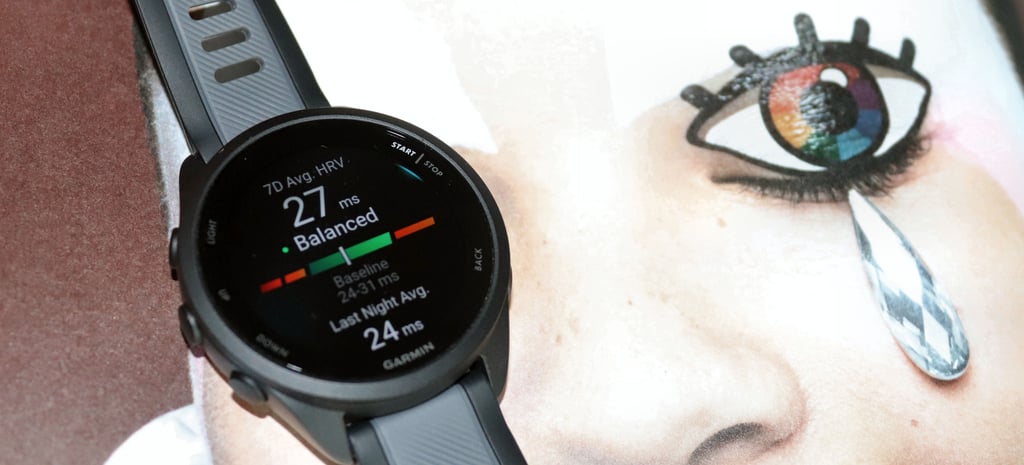
ah ok, I understand. I showed that picture because it was a nice one and the tear kinda reflected the message!! I never thought about the HRV feature shown.
I don’t know the precise methodology other than in the study it says, “HR and HRV metrics (mean HR, mean HP, SDNN, RMSSD, LF, HF) were compared across matched 5-minute epochs using MAAPE, Spearman correlation, and Bland–Altman analyses. Machine learning models were also tested to identify whether Garmin-derived parameters could distinguish between high-quality and low-quality PPG data”
I believe my Enduro uses the v3 sensor and it displays overnight HRV status/data. It didn’t when I bought it in 2022 but it was added 6-12 months later. So whatever the reason it isn’t shown on the Vivosmart, it doesn’t appear to be the underlying sensor capability (unless I’m wrong about the sensor the Enduro/Fenix 6 uses).
Part of why I purchased a Garmin was to use things like Daily suggested workouts and the Garmin Coach plan. And in times in the past they seemed great, but eventually would fail with their suggestions. I know HRV is weighted these algorithms which could explain the disconnect I’ve experienced.
Thanks for covering this! It’s a fair summary.
Hi Amin
thank you!. You are the author I presume?
Yes!
Tracking HRV (stress) values while wearing a Garmin watch 24 hours a day is worthwhile.
Even if there are discrepancies with the actual numbers, you can accurately check physical changes and trends.
When I woke up in the morning, I felt the onset of a cold but didn’t think much of it; however, after lunch, the stress level on my Forerunner 970 turned red.
I suspected this wasn’t just a simple cold, so I rushed to the hospital, confirmed an Influenza A infection via PCR testing, and received an antiviral injection (Peramiflu).
Although I suffered from a high fever and body aches all evening, I returned to perfect normal condition the next morning, and the stress level turned blue.
(Korea’s medical system is the best in the world; Koreans can receive fast and prompt treatment at any hospital, anytime, anywhere.)
What I realized after wearing the Forerunner 970 24 hours a day, 365 days a year for a year is that stress levels (HRV tracking) reflect the body’s inflammation levels very well. Spring in Korea brings a massive amount of tree pollen, leading to a surge in rhinitis patients suffering from pollen allergies (I am one of them).
My HRV levels were a mess throughout the spring, and running training was incredibly difficult. Now that summer has arrived, my body has returned to normal.